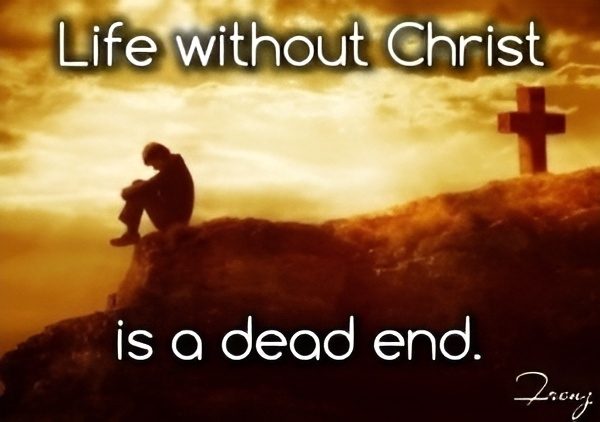
Here's a breakdown of the image's components and their symbolic meaning:
The Isolated Figure: →
* The prominent cross in the background is a universally recognized symbol of Christianity and represents the sacrifice of Jesus Christ. Its presence symbolizes hope, salvation, and the possibility of a meaningful life through faith.
The Golden Sky: →
* This powerful statement is the central thesis. It encapsulates the belief that without the principles, guidance, and promise of salvation offered through Christian faith, human existence is ultimately futile.
The Bible teaches that apart from Christ, we are spiritually dead and separated from the life that God offers.
Ephesians 2:1 says,
“And you were dead in the trespasses and sins.”
This means that, without Christ, people are not just morally misguided or in need of improvement—they are spiritually dead, unable to restore themselves to God. Spiritual death is separation from God, who is the source of all true life and meaning. As GotQuestions.org explains, “A man without Christ is spiritually dead. Paul describes it as ‘being alienated from the life of God’ in Ephesians 4:18. (To be separated from life is the same as being dead.) The natural man, like Adam hiding in the garden, is isolated from God.”
Solomon’s life is a powerful example of this truth. Though he had every earthly pleasure and achievement, he concluded,
“Meaningless! Meaningless! … Everything is meaningless” (Ecclesiastes 12:8, NIV).
He realized that life without God leads to emptiness and regret. The book of Ecclesiastes ends with a warning:
“For God will bring every deed into judgment, with every secret thing, whether good or evil” (Ecclesiastes 12:14, ESV).
Jesus Himself said,
“I am the way, and the truth, and the life. No one comes to the Father except through me” (John 14:6, ESV).
Only through faith in Christ can we be made spiritually alive, forgiven, and restored to a relationship with God.
Without Christ, our works and efforts are “dead works” (Hebrews 6:1; Isaiah 64:6), unable to save us or give us true purpose. But in Christ, we receive new life, hope, and a future that is secure in Him.
In summary:
- Life without Christ is spiritual death and a dead end (Ephesians 2:1; Ecclesiastes 12:8, 14).
- Only through Christ can we have true life, purpose, and peace with God (John 14:6).
- God offers forgiveness and new life to all who repent and trust in Jesus (Ephesians 2:4-5).

The image presents a heartwarming scene that combines everyday comfort with a message of faith. The focal point is a close-up of a steaming cup of coffee, nestled on a saucer with a decorative spoon. The color palette is soothing, featuring variations of blue and aqua that evoke a sense of calm. Two coffee beans are strategically placed, framing the spoon and further reinforcing the coffee theme. Overlaid on this scene is a message written in a friendly, approachable font. The overall aesthetic is designed to be comforting and relatable, suggesting a desire for simple pleasures and spiritual sustenance.
Article: A Morning Ritual with a Divine Twist →
The aroma of freshly brewed coffee fills the air. The rich, dark liquid steams invitingly in its ceramic embrace. It's a moment of peace, a small indulgence, a ritual that many of us embrace to start our day. But what if we could combine this everyday comfort with something even greater, something that nourishes the soul as much as coffee energizes the body?
This is the essence of the image before us. It offers a visual and textual representation of a common sentiment, a longing for both physical and spiritual fulfillment. The vibrant image depicts a beautiful blue coffee cup, a symbol of our daily caffeine fix, alongside the words:
"ALL I NEED TODAY
is a little bit of coffee
and a WHOLE LOT of
Jesus"
This simple yet profound message resonates with the heart of many believers. The "little bit of coffee" represents the small, everyday pleasures that make life enjoyable – a brief moment of relaxation, a taste of something delicious. But the message then shifts, emphasizing the importance of something far deeper, something that provides true meaning and purpose: "and a WHOLE LOT of Jesus".
The pairing of coffee and faith is a powerful one. It acknowledges the need for both the practical and the spiritual. We need to nurture our physical selves, to find enjoyment in the simple things of life. But beyond that, the image reminds us of a higher calling. It gently suggests that the true source of strength, comfort, and direction lies in a relationship with Jesus. It is a reminder that our daily routines, even those as simple as enjoying a cup of coffee, can be infused with faith.
The deliberate contrast between the everyday and the divine is a key element. The "little bit of coffee" acknowledges the need for a moment of calm and energy. The coffee beans on the side symbolize this focus. The "WHOLE LOT of Jesus" suggests a deep spiritual need and offers the viewer a deeper sense of purpose and strength. It is a gentle reminder that faith isn't just for Sunday mornings; it's meant to be woven into the fabric of our daily lives.
Ultimately, the image and its message are an invitation to embrace a life that is both grounded and hopeful. It reminds us that we can find joy in the small things, while simultaneously striving for a deeper connection with something greater than ourselves. It is a call to start our days with a cup of coffee and a prayer, recognizing that we need both to navigate the joys and challenges that life presents.
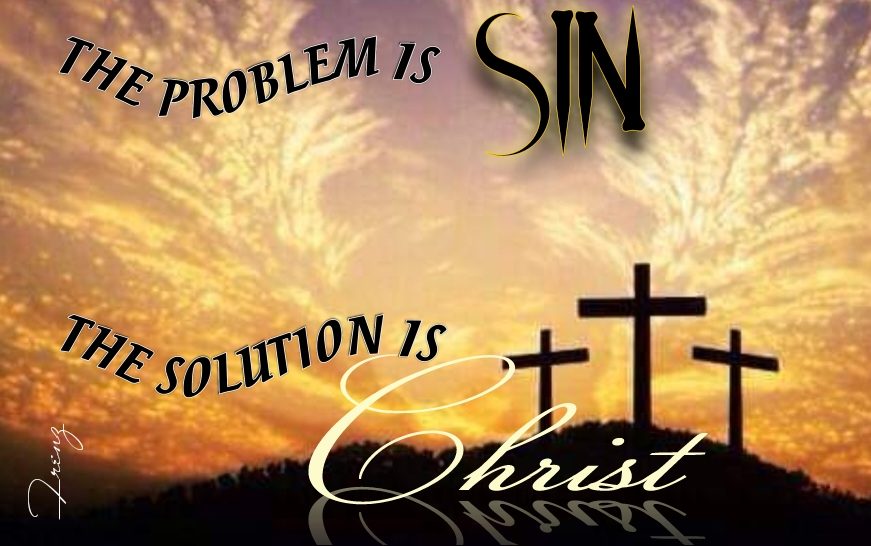
This image presents a simplified summary of the Christian belief system, which would likely function as a starting point or overview of a longer narrative, rather than representing a complete book in itself. Here's a detailed summary based on the image:
Core Message: →
The central theme revolves around the concepts of "problem," "solution," "sin," and "Christ."
The Problem: →
The image clearly identifies "sin" as the central problem. Sin, in a Christian context, represents any act, thought, or disposition that goes against God's will or moral laws. It is the source of human suffering, separation from God, and spiritual death.
The Solution: →
The solution to this problem is stated as "Christ." This refers to Jesus Christ, the central figure of Christianity. The image hints at Christ's role in offering salvation. This is where the image's content is filled in.
Visual Symbols & What They Implies: →
* The Crosses: → The three crosses on a hill symbolize the crucifixion of Jesus. This event is considered the ultimate act of sacrifice, where Jesus, believed to be the Son of God, died to atone for the sins of humanity. This sacrifice is seen as the means through which humans can be reconciled with God.
* Sunset Background: → The image features a warm, sunset or sunrise type background, indicating hope, redemption, or the dawn of a new spiritual life.
In summary: →
The image tells a narrative that addresses the problem of human sin and offers salvation through Jesus Christ, specifically referencing the meaning of the cross.
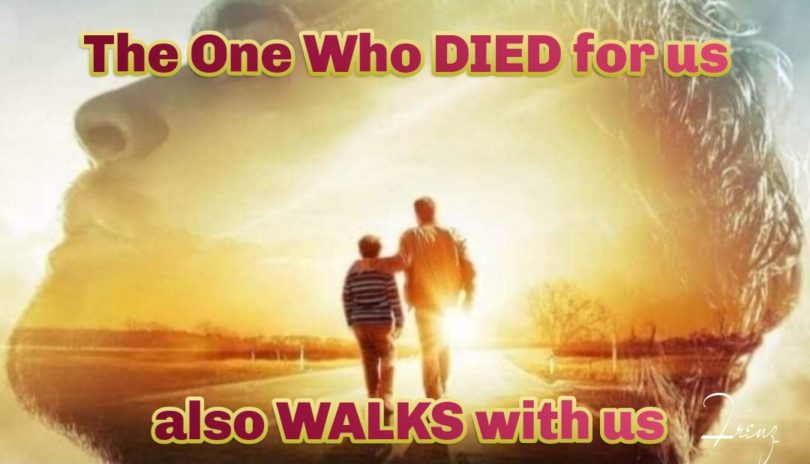
Here's a detailed analysis of the image:
Overall Impression: →
The image is a visually striking and emotionally resonant composition, intended to convey a message of faith, comfort, and guidance. It blends symbolic elements with a serene aesthetic, creating a sense of hope and reassurance. The imagery contains a religious or spiritual context.
Key Elements and Symbolism: →
* The Phrase "The One Who DIED for us also WALKS with us": → This is the central message of the image. It implies a figure, referring to Jesus Christ, who sacrificed himself for humanity ("died for us") and is now a constant presence in their lives ("walks with us"). This communicates themes of redemption, sacrifice, love, and ongoing support.
* The Composite Image (Overlaying Face): → The large, ghostly outline of a face overlaying the rest of the image is a powerful symbol. It reinforces the idea of the divine presence. The face of Jesus Christ, symbolizing his eternal presence.
* The Walking Figures: → The image of a father and son walking together down a sunlit path is a potent visual metaphor for guidance, companionship, and support. The father, bathed in light, evokes the idea of a divine figure offering protection and leading the way.
* The Setting: → A serene, open landscape with a warm, inviting color palette. The road follows a journey or life's path. The sun or bright light at the end of the path indicates the hope and spiritual power available.
* Color Palette: → The use of warm colors (yellow, orange, and gold) in the background enhances the message of hope, optimism, and the divine presence.
Interpretation and Message: →
* Faith and Comfort: → The image aims to comfort the viewer by reassuring them that even though a great sacrifice was made ("died for us"), the divine figure is still with them, guiding and walking alongside them through life's journey.
* Hope and Guidance: → The sunny landscape and the father-son image suggest a path, a journey, and a sense of direction, supported by a guiding figure.
* Unconditional Love: → The phrase "died for us" highlights the ultimate sacrifice, representing unconditional love and care, which extends into the present day.
* Eternal Presence: → The composite image conveys that the divine figure is always with them.
Overall, the image is a beautifully composed and emotionally charged message of faith, hope, and guidance. It’s intended to resonate with viewers who hold religious or spiritual beliefs. It’s a visual reminder of the divine presence and the promise of ongoing companionship and support. →
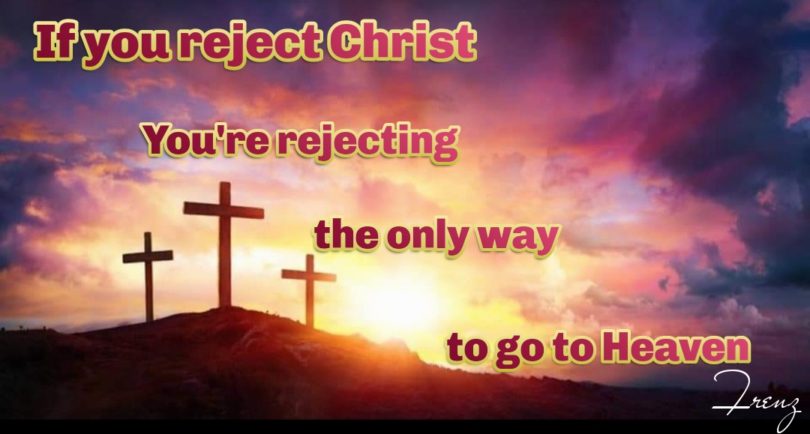
Here's a detailed analysis of the image:
Overall Impression: →
The image is a Christian-themed visual designed to convey a message of faith and salvation. It uses a combination of text and imagery to make its point, aiming to persuade viewers of the importance of accepting Jesus Christ. The overall tone is serious and emphasizes the exclusivity of the Christian path to Heaven.
Visual Elements: →
* Background: → The backdrop is a dramatic sky, at sunset or sunrise. The colors are vibrant and include shades of orange, purple, pink, and yellow, creating a visually appealing and potentially awe-inspiring scene. These colors can symbolize hope, beauty, and the promise of something greater.
* Crosses: → Three crosses are prominently displayed on a small hill or mound, silhouetted against the bright sky. These crosses are a direct reference to the crucifixion of Jesus Christ, a central event in Christianity. The placement of the crosses on an elevated surface emphasizes their significance and the sacrifice they represent.
* Text: → The image features text that is centrally placed and highly visible. The words are written in a bold font with a contrasting gold color outlined in a maroonish-red. The text conveys a direct and assertive message.
Textual Elements and Message: →
* "If you reject Christ": → This is the starting point of the message, establishing a condition that the viewer is being asked to consider. It clearly indicates that this message is being directed to an audience who has not yet accepted Jesus Christ.
* "You're rejecting": → This phrase strengthens the argument, telling the viewer the outcome of what happens if Christ is not accepted.
* "the only way": → This is a crucial statement that reinforces the belief in the exclusivity of the Christian path. It tells that there is no other means to achieve salvation or access Heaven.
* "to go to Heaven": → This phrase provides the ultimate end goal: Heaven. It defines the ultimate reward if Christ is accepted.
Overall Interpretation and Potential Impact: →
The image's primary intent is to persuade viewers to accept Jesus Christ as their savior. It does this by:
* Creating a sense of urgency: → The phrase "If you reject Christ" implies a potentially negative consequence.
* Offering a clear path: → The image indicates the belief that Christ is the exclusive means of reaching Heaven, providing a single, clear path.
* Evoking emotional responses: → The beautiful background imagery and the association with religious symbols like the crosses attempt to evoke feelings of hope, reverence, and potential awe.
Target Audience: →
The intended audience is people who are not actively practicing Christians, or who have doubts or questions about the Christian faith. The tone is direct, and the message is unambiguous.
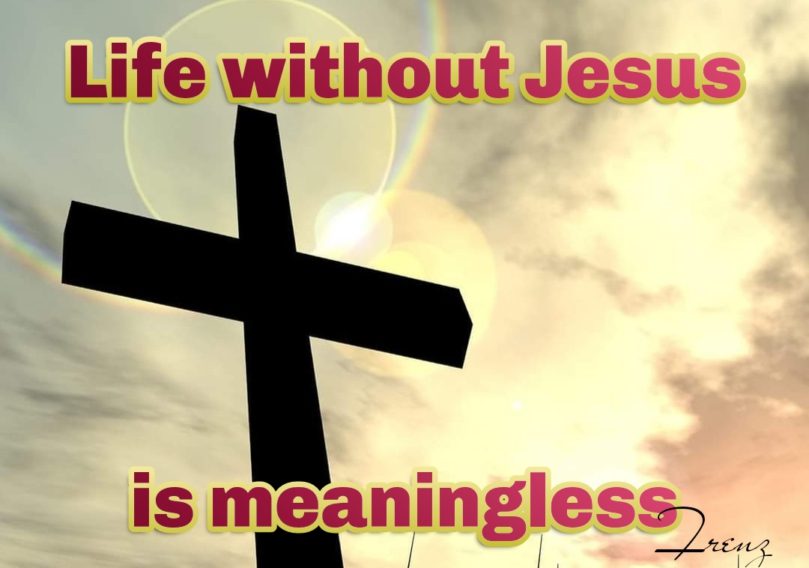
The image is a religious meme or graphic with a clear message. Here's a detailed breakdown:
* Text: → The central message is conveyed through text: "Life without Jesus is meaningless". The words are in a bold, serif font with a red color and a yellow outline for emphasis.
* Image of the Cross: → A large, black silhouette of a Christian cross dominates the image. The cross is a significant symbol of Christianity, representing the crucifixion of Jesus Christ. Its prominence visually reinforces the connection between the text and the faith.
* Background: → The background is a gradient that blends warm colors like yellow and pink with some clouds, suggesting a sunrise or sunset. There are also some bright, circular light effects that create a sense of light and glory. This provides an uplifting, peaceful atmosphere.
* Overall Message: → The image expresses a strong statement of faith, declaring that life lacks purpose or value without belief in Jesus Christ. It presents a core tenet of Christianity.
In summary, the image is a visual proclamation of Christian faith, conveying a belief about the importance of Jesus Christ for a meaningful life. It uses simple, yet impactful imagery and text to communicate this message.
The image contains key elements:
* Theme of Faith: → The image centers around Christian faith, belief in Jesus, and possibly the challenges or struggles related to practicing that faith.
* Visual Imagery: → The silhouette of a person sitting on a tree branch, gazing at a sunset/sunrise, and the presence of a bicycle may indicate introspection, reflection, finding peace, or seeking solace in nature/quiet moments, and or a journey.
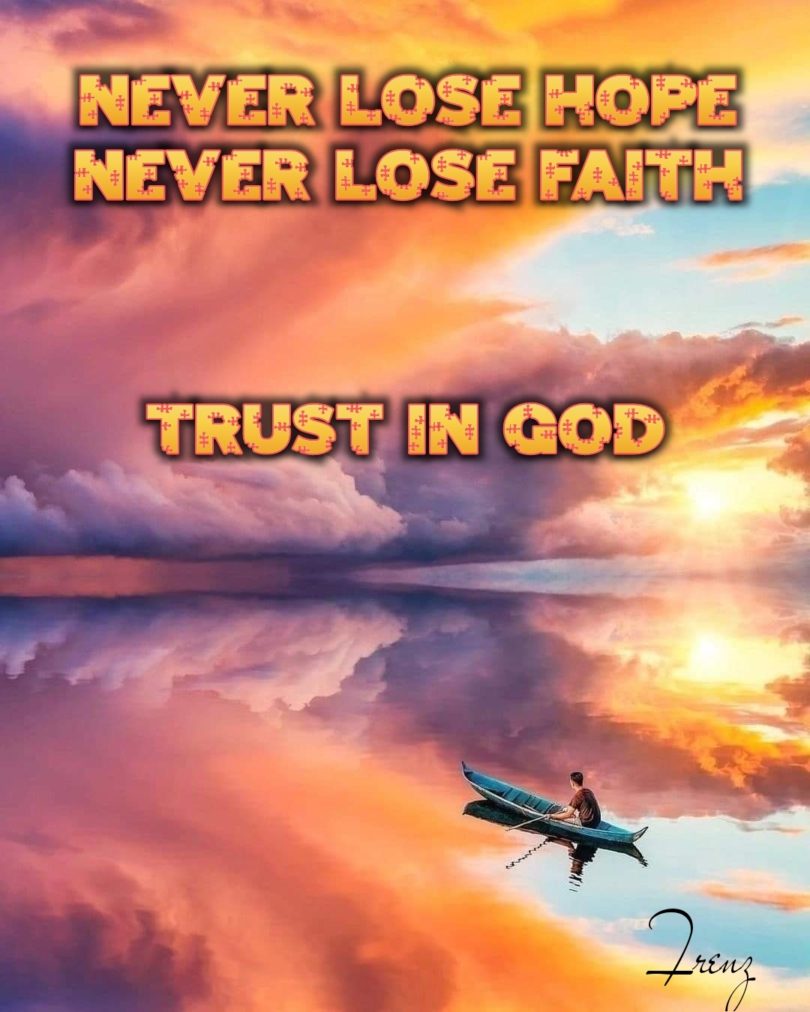
Here's a detailed explanation of the image:
Overall Impression: →
The image is a motivational and spiritual composition. It's designed to inspire hope and faith, with a clear message of trusting in God. The visual elements are chosen to create a serene and uplifting atmosphere.
Visual Elements: →
* Sky and Water: → The dominant element is a stunning depiction of a colorful sky mirrored in a calm body of water, possibly a lake or the ocean. The sky is a blend of warm colors like orange and pink, transitioning to a cooler blue hue. This transition suggests a sunrise or sunset, adding a sense of both hope and peace. The mirroring effect in the water enhances the beauty and creates a feeling of tranquility.
* Boat and Person: → A small boat is visible in the water, with a person rowing. The boat adds a sense of journey or resilience. The person rowing may represent the individual navigating life's challenges. The presence of the person emphasizes human effort and the necessity of action.
* Text: → The image is overlaid with text that carries the main message:
* "NEVER LOSE HOPE"
* "NEVER LOSE FAITH"
* "TRUST IN GOD"
The words are in a bold, eye-catching font. The use of a bold and vibrant color further enhances the message of hope, faith, and belief in God.
Message and Interpretation: →
* Themes: → The image powerfully conveys the themes of hope, faith, and trust in a higher power (God). It's meant to remind viewers to maintain these crucial aspects of life, especially during difficult times. The message can encourage the viewer to always maintain hope and trust in God.
* Symbolism: → The sky and water reflect a journey through life that can be calm or turbulent. The boat and rower can represent an individual, who faces an endeavor and navigates difficulties in life, all while trusting in God and never giving up hope and faith.
* Overall Impact: → The image is designed to have a positive impact. It's meant to offer encouragement, strength, and a sense of serenity. The combination of uplifting visuals and inspirational words makes it a visually impactful message of faith and hope.
In Conclusion: →
This image is a well-crafted piece of inspirational art. Its use of color, imagery, and text work together to deliver a powerful message. It effectively combines visual appeal with a clear and uplifting message of hope, faith, and trust in a higher power.
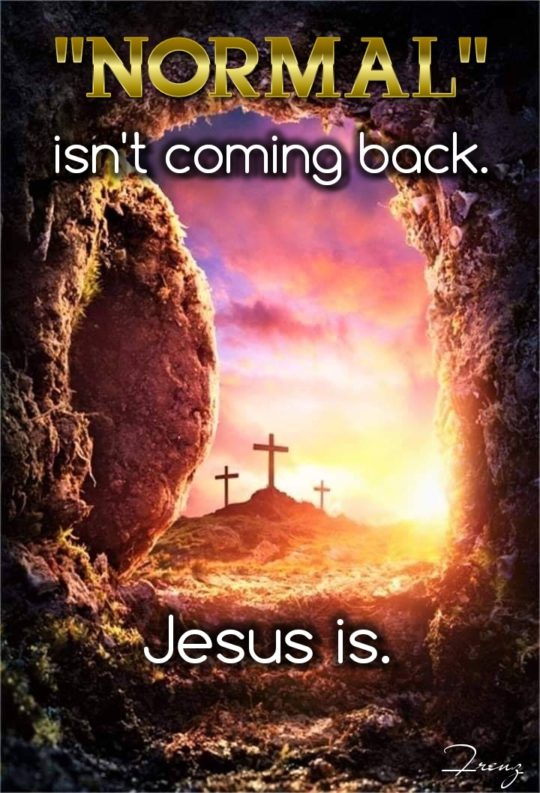
The image is a visual message with a religious and hopeful tone. It conveys the idea that the "normal" life people were used to isn't returning. The image uses the imagery of the empty tomb of Jesus. The phrase "Jesus is" is placed in the image as a message of hope and comfort. It implies that even though the familiar is gone, there is a new reality, faith, and future represented by Jesus.
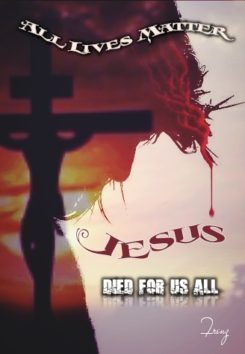
Image Analysis: A Christian Perspective on "All Lives Matter" →
The image is a visually striking piece that blends Christian symbolism with the contemporary social and political discourse surrounding the phrase "All Lives Matter." It's designed to convey a message of universal love, sacrifice, and the belief that all human lives are equally valued in the eyes of God. Let's break down the key elements:
* Central Christian Imagery: → The dominant visual cues are undeniably Christian. The prominent cross (symbol of Jesus' crucifixion) and the depiction of blood, often associated with the suffering and sacrifice of Jesus Christ, clearly point to a Christian worldview. The silhouette of a person on the cross is also visible. The inclusion of a crown of thorns, a symbol of Jesus' suffering before his crucifixion, further reinforces this theme.
* Textual Message: → The text overlays are carefully chosen to communicate a specific message.
* "All Lives Matter": → This phrase, which has become a point of contention in discussions about racial justice and equality, is placed at the top of the image. In this context, it's intended to convey the belief that all people, regardless of their background or circumstances, are equally deserving of love and respect from a Christian perspective.
* "Jesus": → The name "Jesus" is emblazoned across the image. This firmly grounds the message in Christian faith.
* "Died for Us All": → This phrase is a core tenet of Christian belief, emphasizing that Jesus' sacrifice on the cross was for the redemption of all humanity. This sentence reinforces the idea that Jesus's sacrifice was universal, and his love extends to everyone.
* Color and Aesthetic: → The color scheme is dominated by reds, browns, and whites, conveying solemnity and emotion. The blood is portrayed, often symbolizing the suffering and sacrifice of Jesus. The overall aesthetic is intended to be both powerful and thought-provoking.
Christian Interpretation and Intended Message: →
From a Christian viewpoint, the image is meant to convey the following:
* Universal Love and Redemption: → The core message is that God's love, exemplified by Jesus' sacrifice, extends to all people. The image emphasizes that every human life is valuable in God's eyes.
* Unity and Equality: → By including "All Lives Matter," the image seeks to advocate for unity and equality.
* Focus on the Christian Foundation: → The image reinforces the belief that the foundation of these values and principles is rooted in the Christian faith.
* An Invitation to Reflect: → It may be meant to encourage viewers to consider the implications of their faith in their interactions with others.
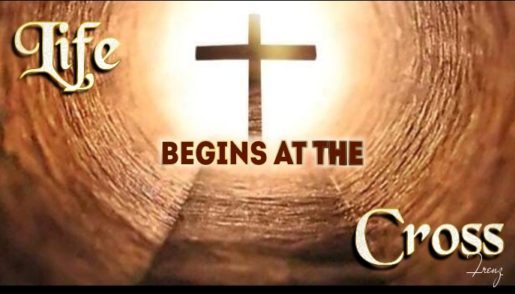
Here's a detailed analysis of the image, along with an explanation of its potential meaning:
Image Analysis →
The image is a digitally created composition with a strong religious theme. Here's a breakdown:
* Central Focus: The Cross. → Dominating the image is a dark, solid cross. It is positioned at the center, against a bright, emanating light source, suggesting a symbol of hope and salvation.
* Pathway/Tunnel Effect: → The background forms a pathway or tunnel. This element creates a sense of depth and leads the viewer's eye toward the cross. The texture on the walls of the tunnel has a rough texture with a warm brown tone, suggestive of a cavern or a passage.
* Textual Elements: → The image incorporates the following text:
* "Life" (in a stylized, decorative font) positioned at the upper left.
* "BEGINS AT THE" (in a bold, straightforward font) positioned horizontally in the middle of the image.
* "Cross" (in a stylized, decorative font) positioned at the lower right.
* Color Palette: → The primary colors used are brown (suggesting earth, wood, or a cavern), white (symbolizing purity and divine light), and black (for the cross). The overall tone of the image is warm and somewhat dramatic.
* Overall Composition: → The composition directs the viewer's eye from the edges toward the cross at the center. The use of light and shadow, combined with the pathway effect, adds to the symbolic representation of the cross.
Interpretation and Meaning →
The image is designed to evoke a specific spiritual message, primarily associated with Christianity. Here's how the elements work together to create that meaning:
* "Life Begins at the Cross": → This is the central message. It's a statement of faith often used within Christian belief. It refers to the belief that true or spiritual life begins when a person accepts Jesus Christ and his sacrifice on the cross for the forgiveness of sins.
* The Cross as a Symbol: → The cross is a universally recognized symbol of Christianity. It represents the crucifixion of Jesus Christ, his death, and ultimately, his resurrection. It is the point of salvation and a pathway to eternal life.
* Pathway Metaphor: → The tunnel or pathway visually emphasizes the journey of faith. It suggests the idea of a path that leads toward the cross and towards spiritual enlightenment.
* Light and Hope: → The bright light surrounding the cross represents divinity, hope, and the presence of God. This conveys a sense of promise and eternal life.
* Visual Emphasis on Belief: → The composition is crafted to make the statement "Life Begins at the Cross" visually prominent. The layout encourages the viewer to reflect on the significance of the cross as the starting point of a transformed life.
* Style and Feel: → The warm, somewhat dramatic color scheme and font choices add to the image's sense of solemnity and reverence.
In essence, the image serves as a visual sermon, conveying the core Christian belief that spiritual life, renewal, and salvation are found through the sacrifice of Jesus Christ on the cross. → It encourages viewers to embrace their faith, take their first steps on their faith journey
The image is a digital artwork with a strong message rooted in faith and personal growth. It combines visual elements with a textual quote to convey a core belief about prayer, resilience, and the purpose of challenges in life.
Visual Elements →
* Color Palette: → The image is dominated by a warm, earthy color palette, primarily consisting of deep reds, oranges, and browns. This choice creates a sense of intensity, passion, and perhaps even a feeling of reverence or solemnity. The colors blend together, creating a slightly blurred, artistic effect.
* Subject: → The focal point of the image is a blurred, artistic depiction of a person in prayer. They have their hands clasped together, presumably in a gesture of supplication, humility, and contemplation. The face is partially visible, with the eyes closed or cast downwards, further emphasizing the act of prayer.
* Artistic Style: → The style is a mix of digital painting and photo manipulation. It has a painterly quality, with brushstrokes and soft edges. The blurry quality suggests that the artwork aims to evoke an emotional feeling rather than a high level of visual detail.
* Text Overlay: → The image includes text that is integrated into the artwork:
* The text is gold-colored, which adds to the overall feeling of the artwork and also makes the text stand out from the background.
* The text is strategically placed to complement the visual elements, with the top quote over the upper portion of the image, and the bottom quote along the lower section, and is therefore very impactful.
Message and Interpretation →
* Central Idea: → The core message revolves around the concept that prayer should be about seeking inner strength and personal growth rather than simply asking for an easier life. The phrase "Don't ask God to make life easier; ask him to make you a stronger person" suggests that challenges are opportunities for development and that faith is about cultivating inner resilience.
* Spiritual and Religious Themes: → The image is strongly connected to religious or spiritual themes, with an obvious appeal to people who believe in God or a higher power. The depiction of prayer and the use of religious language are clear indicators of this.
* Emphasis on Personal Growth: → The emphasis is on personal transformation and the development of inner strength. This resonates with the broader themes of self-improvement, resilience, and the value of adversity in shaping character.
* Emotional Impact: → The image is designed to evoke a sense of hope, encouragement, and reflection. The combination of the visual elements and the quote aims to inspire viewers to adopt a positive attitude toward life's difficulties.
Overall Effect →
The image is a motivational and spiritual piece that encourages the viewers to reflect on their relationship with their faith and challenges. It encourages viewers to consider that life's difficulties can actually be opportunities for growth and development, and that the key to success is developing inner strength and resilience.
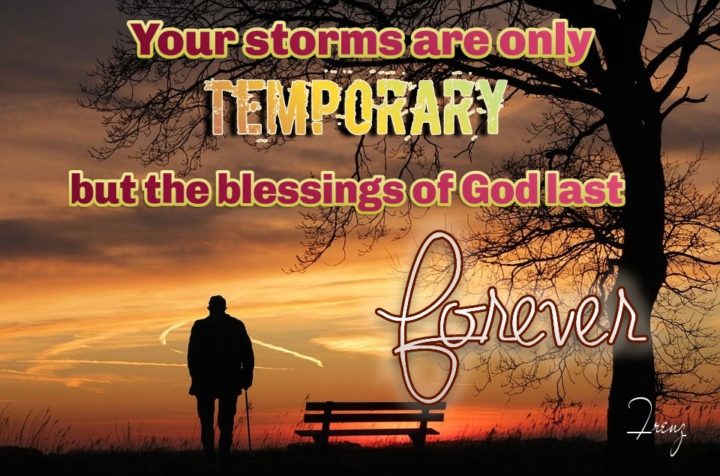
Here's a detailed analysis of the image, combining visual description with its message:
Visual Description →
The image is a visually rich scene designed to convey a message of hope and faith. Here's a breakdown of its elements:
* Setting: → The background is a beautiful sunset, characterized by warm oranges, yellows, and reds painting the sky. These colors suggest a sense of peace and transition, hinting at the end of a difficult period or the dawn of a new day. Subtle streaks of light across the sky add dynamism.
* Foreground Elements: →
* Silhouette of a Person: → A solitary figure, silhouetted against the sunset, stands on a grassy knoll. The person appears to be elderly, holding a walking stick, suggesting either old age or, perhaps, overcoming physical challenges. The silhouette emphasizes anonymity, allowing the viewer to project their own experiences onto the scene.
* Bench: → A park bench sits to the right of the figure. It adds a touch of tranquility and invites reflection, suggesting a place to sit and contemplate.
* Tree: → A large, bare tree dominates the right side of the image. Its branches reach upwards, adding a sense of height and strength. This tree serves as a visual anchor and a symbol of endurance.
* Text and Design Elements: →
* Message: → The image includes the text: "Your storms are only TEMPORARY but the blessings of God last FOREVER." The font is a combination of bold and script. "TEMPORARY" is emphasized in bold yellow, while "FOREVER" appears in an elegant script form, almost like an organic drawing. This emphasizes the contrast between the temporary difficulties and the everlasting rewards.
Interpretation and Message →
The image conveys a powerful message of resilience, hope, and faith:
* Addressing Challenges: → The phrase "Your storms are only temporary" directly addresses the difficulties and hardships that people face in life. It provides reassurance that trials are not permanent but will eventually pass.
* Emphasizing Faith and Belief: → By contrasting the temporary storms with "the blessings of God last forever," the image encourages a strong belief in a higher power and the enduring nature of blessings. The focus is on the eternal and unwavering support of faith.
* Hope and Comfort: → The overall imagery contributes to the message of hope. The sunset represents a period of renewal and calm. The silhouette of the individual suggests someone is in a place where the blessings can be acknowledged.
* Visual and Emotional Impact: → The choice of colors, the solitary figure, and the overall composition work together to evoke feelings of serenity, peace, and contemplation. It's a visual reminder that, despite challenges, there is always enduring hope and faith.
In essence, the image is a motivational piece, aimed at providing comfort and inspiration, and promoting the idea that adversity is temporary while faith and blessings are eternal. → It's intended to be uplifting and a source of strength for anyone facing difficult times.
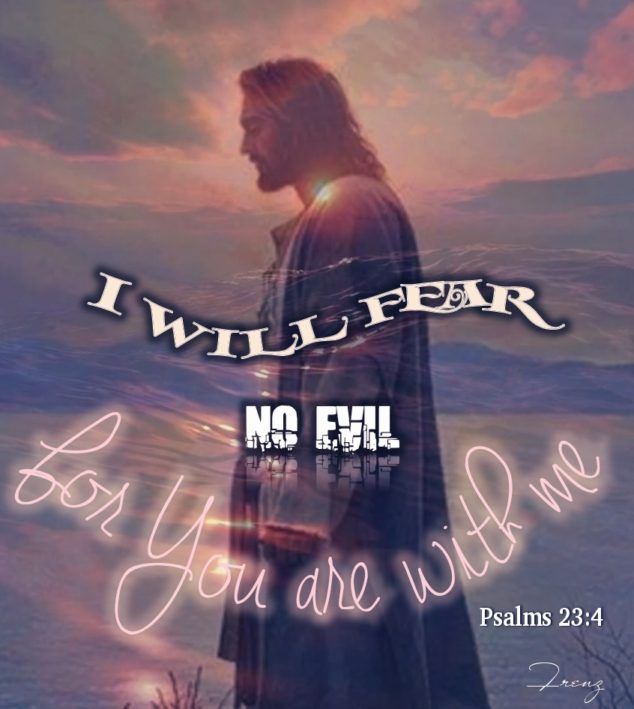
Overall Impression: →
The image is a Christian inspirational graphic designed to evoke a sense of faith, comfort, and reassurance. It uses visual elements to reinforce a message of courage and trust in God.
Visual Elements: →
* Jesus Silhouette: → A prominent figure of Jesus Christ is depicted in the background. He's presented in a semi-transparent silhouette against the backdrop, facing away from the viewer, creating a sense of contemplation, reverence, and an intimate connection with nature.
* Background: → The background is a soft, pastel-colored depiction of a sunset or sunrise, suggesting a calm, peaceful, and hopeful environment. The blending colors enhance the serenity of the image.
* Text: → The primary focus of the image is text.
* "I Will Fear No Evil": → This quote is a direct reference to Psalm 23:4, a well-known verse in the Bible. The font is bold and dramatic, it's curved along Jesus's head, emphasizing the strength and conviction of the statement.
* "For You are with me": → Written in a softer, cursive script, this phrase reinforces the context of the promise of protection and comfort derived from the presence of God.
* "Psalms 23:4": → The Bible verse is referenced to provide context and source.
* "Frenz": → A signature of the designer of the image.
* Color Scheme: → The image predominantly uses soft, calming colors, particularly blues, purples, and pinks. The text is highlighted in a white and light pink.
Message and Interpretation: →
The image delivers a message of faith and trust in God, particularly through the following elements:
* Overcoming Fear: → The phrase "I will fear no evil" promises safety, protection, and freedom from fear through the belief in a divine presence.
* God's Presence: → The phrase "For You are with me" emphasizes the central tenet of faith: that God is ever-present and offers comfort.
* Psalm 23:4: → The reference to Psalm 23:4 is important because this psalm is renowned for being about the Lord, being a shepherd who provides and cares for his flock. This imagery is used to reinforce the theme of faith.
* Aesthetic: → The visual elements enhance the message. The peaceful background, the image of Jesus, and the soft colors all contribute to a feeling of tranquility and hope.
Intended Audience: →
The image is specifically targeted toward Christians or those open to Christian beliefs. It is intended to offer reassurance, hope, and to strengthen faith during times of hardship or fear.
Conclusion: →
The image is an inspirational and visually comforting piece of Christian art. It is crafted to provide a source of strength, courage, and peace of mind to those who are facing difficult circumstances or are in need of reassurance.
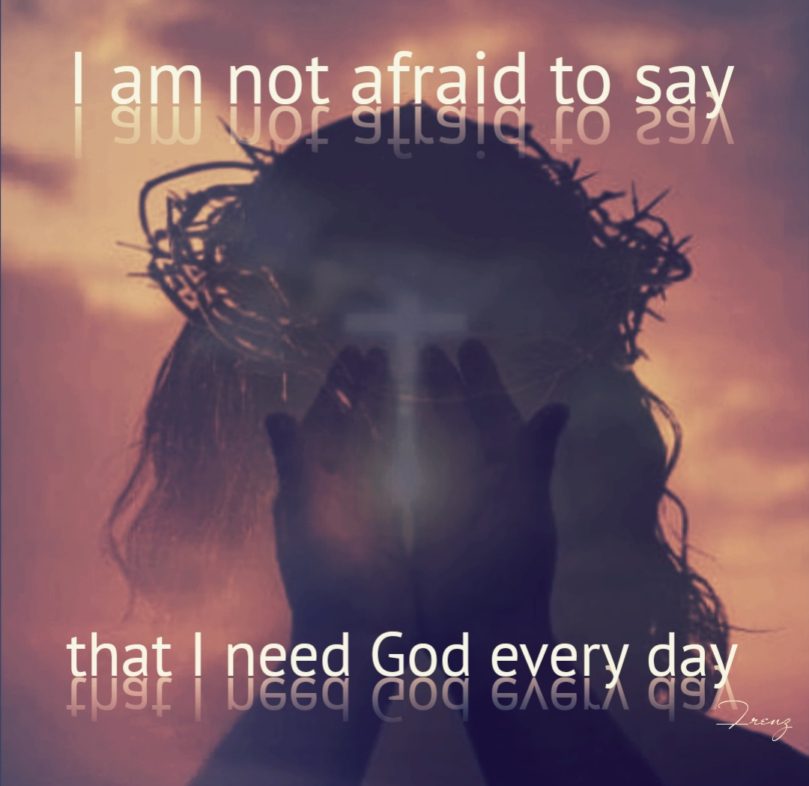
The image is a Christian-themed meme or inspirational post. It uses visual symbolism combined with a powerful statement of faith. The overall effect is meant to evoke a sense of humility, reliance on God, and the courage to openly express one's spiritual needs.
Visual Elements →
* Silhouette Figure: → The central figure is a silhouette, meant to represent Jesus Christ.
* Crown of Thorns: → The crown of thorns is a direct visual representation of Jesus's crucifixion, symbolizing his suffering, sacrifice, and ultimate triumph over sin and death.
* Hands and Cross: → The figure's hands are raised, almost in a gesture of both prayer and protection, as they seem to be shielding their face from the light radiating from a cross. The cross represents Christ's sacrifice and the center of Christian belief.
* Blurred Background: → The background is a soft, warm, sunset-like glow. This creates a serene and spiritual atmosphere.
Text and Meaning →
The text superimposed on the image reads:
"I am not afraid to say that I need God every day."
* "I am not afraid..." →: This phrase speaks of courage and boldness in faith. It conveys a willingness to be open about one's spiritual dependence.
* "...to say that I need God every day." →: The core message emphasizes the constant need for God in one's life. It acknowledges reliance on God for guidance, strength, comfort, and purpose. The phrase "every day" highlights the consistent and ongoing nature of this need.
Interpretation and Message →
The image conveys a message of:
* Humility: → Recognizing one's need for God.
* Faith and Trust: → The image symbolizes trusting in the divine.
* Courage: → Being open about one's faith, especially in a world that may not always embrace it.
* Daily Dependence: → Living in a way that reflects a continuous relationship with God.
* Sacrifice and Redemption: → The crown of thorns implies that the believer identifies with Jesus's sacrifice and the hope of redemption it offers.
Target Audience →
The image is intended for a Christian audience, or for those who are open to spiritual beliefs. It's meant to inspire, encourage, and remind viewers of the centrality of God in their lives. It's a simple, yet effective message of faith, and the image is easily shareable on social media platforms and in other contexts.
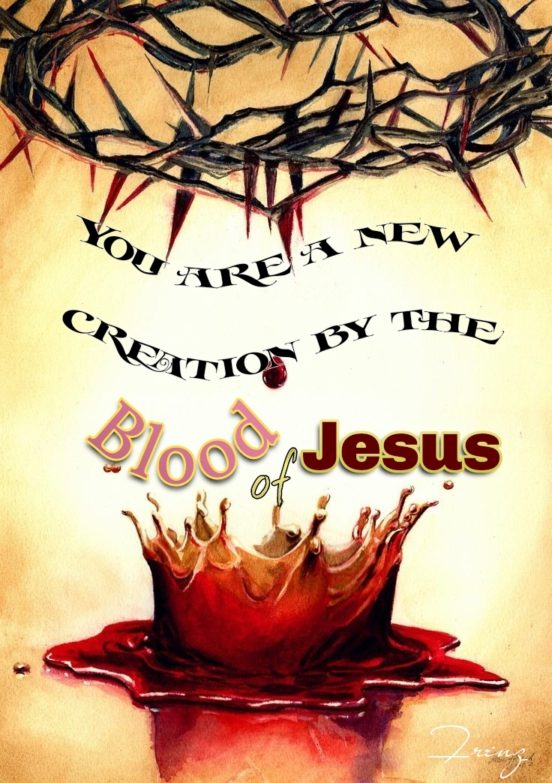
Image Analysis: "You Are a New Creation by the Blood of Jesus" →
This image is a powerful visual representation of core Christian beliefs, specifically focusing on salvation, redemption, and the transformative power of Jesus Christ. Let's break down the elements:
* The Crown of Thorns: →
* This is the most direct symbol of Jesus' suffering and crucifixion. The crown was placed on his head by Roman soldiers as a mockery of his claim to be the King of the Jews.
* It represents the physical and emotional pain Jesus endured, his humiliation, and his willingness to bear the sins of humanity.
* The thorns, sharp and piercing, are depicted with a reddish hue, suggesting blood and agony.
* The Text: "You Are a New Creation by the Blood of Jesus": →
* This phrase is the heart of the message, directly stating the central belief.
* "New Creation" references the concept of spiritual rebirth. Christians believe that through faith in Jesus, they are no longer defined by their past sins and weaknesses but are given a new identity in Christ. This is a fundamental aspect of salvation.
* "By the Blood of Jesus" refers to the sacrifice Jesus made on the cross. His blood is seen as the price paid for human sin, cleansing believers and reconciling them with God. The shedding of Jesus' blood is the ultimate act of love and sacrifice.
* The Splashing Blood: →
* This is a dramatic visual depiction of the blood of Jesus. The splash and droplets convey the idea of an abundant outpouring and the completeness of the sacrifice.
* The color red is symbolic of blood, life, sacrifice, and atonement.
* The image conveys a sense of power, cleansing, and the transformative nature of this event.
* Overall Design and Tone: →
* The image is artistic, aiming to evoke emotion and awe. The color palette is warm and rich, which is designed to evoke the feeling of solemnity, importance, and reverence associated with the subject.
* The layout is organized, with the text and the image of the blood, along with the crown of thorns, drawing the viewer's attention to the central message of redemption and spiritual rebirth.
Theological Interpretation: →
The image encapsulates several core Christian doctrines:
* The Atonement: → The belief that Jesus' death on the cross atoned for the sins of humanity, making it possible for people to be forgiven and reconciled with God.
* Salvation: → The process of being saved from sin and its consequences through faith in Jesus Christ.
* Regeneration: → The spiritual rebirth or renewal that occurs when a person becomes a Christian, marked by a transformation of character and a new relationship with God.
* Justification: → The act of being declared righteous in God's eyes through faith in Jesus.
Conclusion: →
This image is a powerful and visually compelling statement of Christian belief. It uses strong imagery and direct language to communicate the heart of the Christian Gospel: that through the sacrifice of Jesus, humans are given the opportunity for a new life, a transformed identity, and a restored relationship with God. It is an invitation to reflect on the significance of Jesus' sacrifice and to consider the life-changing implications of faith in Him.
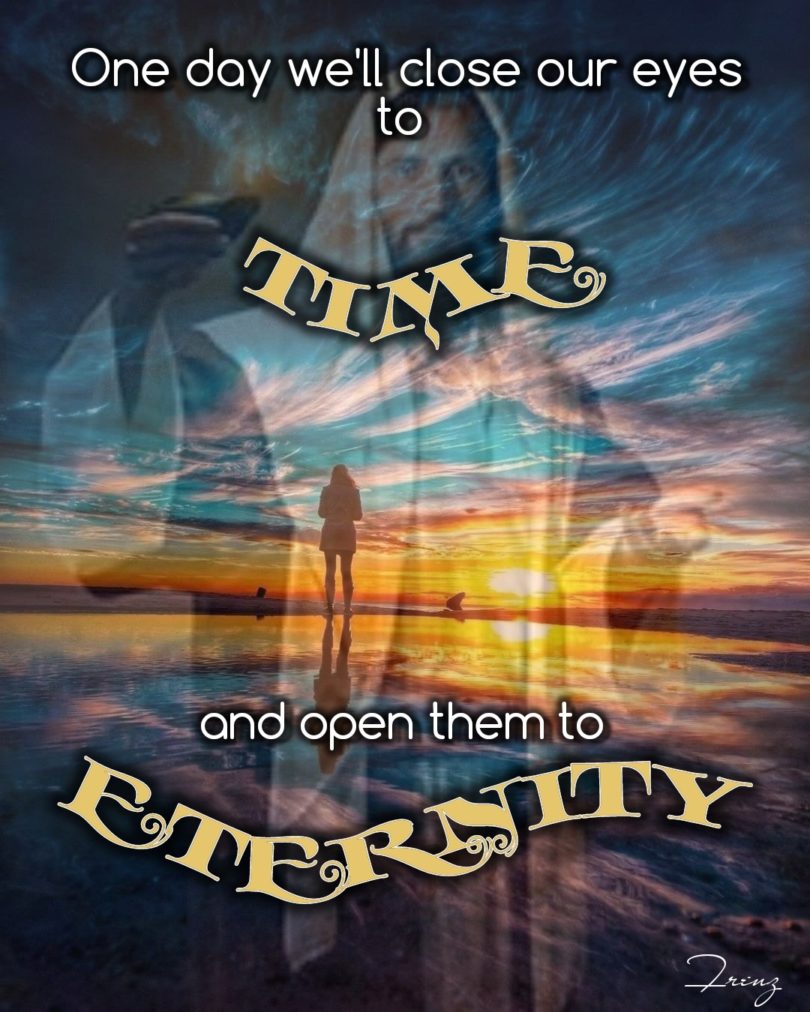
The image is a digital composition that blends religious and philosophical themes, aimed at conveying a message of faith, hope, and the afterlife. It has a somewhat sentimental and inspirational tone, typical of religious or devotional imagery.
Visual Elements and Composition: →
* Overlaying Images: → The image uses a layering technique. The most prominent and visible are the following:
* Figure of Christ: → A partially transparent image of Jesus Christ is overlaid as the backdrop. This suggests a connection to Christian beliefs. The figure is rendered in a way that it could be interpreted as a spiritual presence watching over.
* Sunset Landscape: → A scenic landscape, featuring a calm body of water the ocean or a lake), a sunset with a warm color palette (orange, yellow, and red), and a silhouette of a person standing and looking out at the view. This landscape symbolizes the beauty, serenity, and transient nature of life on Earth, as well as a reflection of the soul.
* Text: →
* The image features large text that is separated with a clear font, enhancing readability. The text is the core message of the image: "One day we'll close our eyes to TIME and open them to ETERNITY" The word "TIME" is strategically placed in the upper middle, "ETERNITY" is in the lower middle.
* The words are in a golden, fancy font that adds a decorative element and draws the viewer's attention to the message. The overall text composition suggests a transition from earthly existence ("TIME") to a realm of everlasting existence ("ETERNITY").
* Color Palette: → The predominant colors are warm tones of orange, yellow, and red for the sunset, with a cool blend of blues and purples in the background. The golden hue of the words adds a bright touch. The colors evoke emotions of peace, hope, and the promise of a new beginning.
Interpretation and Meaning: →
* The Passage of Time and the Afterlife: → The central message speaks to the human experience of time and the idea of the afterlife, it is a common theme within religious teachings. "Closing our eyes" can be interpreted as the end of life or death. "Opening our eyes" to eternity suggests a transition to an existence beyond our earthly one.
* Hope and Faith: → The image uses visual elements associated with a serene setting to portray a hopeful and optimistic view on death. The message offers comfort and reassurance, catering to believers who find solace in faith.
* Christian Symbolism: → The image makes explicit references to Christian symbolism. The implied presence of Christ and the emphasis on eternity are consistent with Christian beliefs about salvation, the afterlife, and the promise of eternal life.
* Reflection and contemplation →: The lone figure looking out at the landscape on the shoreline invites the viewer to contemplate their own place in the world and to reflect on the meaning of life and death.
Overall, the image is a spiritually charged composition designed to inspire a sense of peace, hope, and faith. It combines visual elements with a clear and concise message. It evokes feelings of hope and promise of a new beginning.
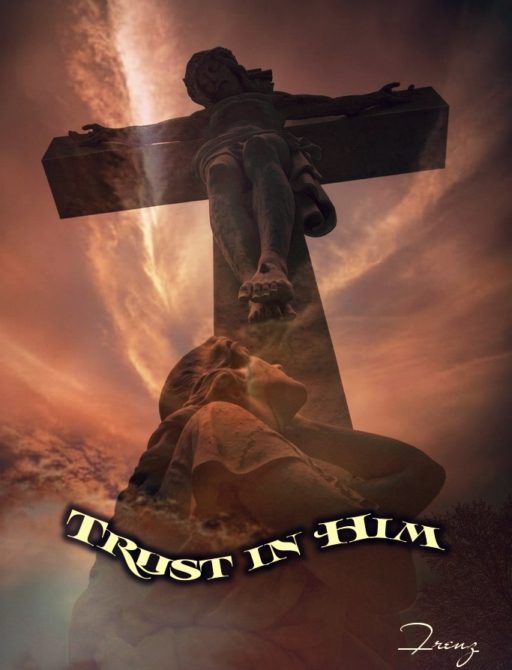
The image is a powerful and evocative depiction of Christian faith, centered around the crucifixion of Jesus Christ. It's a devotional image designed to inspire reflection, faith, and a sense of peace or comfort. The central theme is "Trust in Him," as indicated by the prominent text superimposed on the image.
Visual Elements and Their Significance: →
* The Crucifix: → The dominant element is the cross bearing the sculpted figure of Jesus. The figure is rendered in a detailed, classical style, conveying a sense of reverence and solemnity.
* Jesus's Posture: → The figure of Jesus is depicted on the cross, reflecting the moment of his death.
* Figure at the Foot of the Cross: → A figure, which represents Mary, the mother of Jesus, is depicted below the cross, looking up at Jesus.
* Lighting and Atmosphere: → The lighting and the background are carefully chosen to create a specific mood. The sky is a mixture of warm oranges and reds, with a dramatic, cloudy texture. The lighting is soft, casting the figures into shadow and emphasizing the contours of the cross and the figures. This dramatic light and color palette can evoke feelings of awe, grief, and even hope.
* Text: → The words "TRUST IN HIM" are prominent, reinforcing the image's message of faith and reliance on Jesus Christ. The font is a classic font with a metallic effect, giving it a sense of importance.
Interpretation and Symbolic Meaning: →
* Sacrifice and Redemption: → The image powerfully communicates the central tenets of Christianity: Jesus's sacrifice on the cross for the redemption of humanity. The visual evokes the pain, suffering, and ultimate triumph of Jesus.
* Faith and Hope: → The words "Trust in Him" combined with the visual of the crucified Christ directly convey the message of faith as a core tenet.
* Reverence and Prayer: → The figure looking upwards at Jesus can represent prayer, supplication, and devotion. It invites the viewer to consider their own faith and relationship with Jesus.
* Atmosphere of Prayer: → The dramatic lighting and colors create an atmosphere of prayer and reflection, enhancing the contemplative experience for the viewer.
Overall Impression: →
The image is a visually striking and emotionally resonant work of religious art. It speaks directly to Christian values of faith, sacrifice, hope, and redemption. The combination of the solemn imagery of the crucifixion with the supportive text "TRUST IN HIM" creates a message that is easily understood and accepted by Christians. The image serves as a visual reminder of the core beliefs of Christianity and can be used to foster faith.
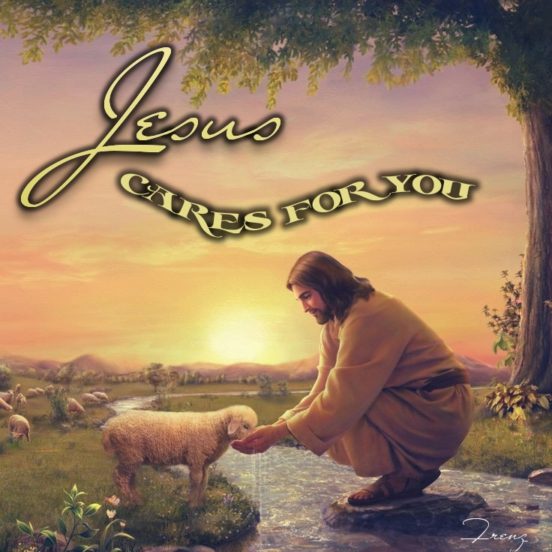
The image is a digital artwork with a clear Christian theme. It's designed to convey a message of love, comfort, and care. The style is sentimental and aims to evoke a sense of peace and serenity.
Detailed Breakdown: →
1. Central Figures & Elements: →
* Jesus: → The central figure is a depiction of Jesus Christ. He's portrayed in a familiar, idealized manner: long hair, beard, and a gentle expression. He's wearing a robe of a warm color and is kneeling beside a stream.
* Lamb: → Jesus is interacting with a lamb. The lamb represents vulnerability and innocence, a symbolic reference to Jesus as the "Good Shepherd" who cares for his "flock" (followers). The lamb is drinking from his cupped hands, conveying care and provision.
* Landscape: → The background is a pastoral scene, enhancing the overall message of tranquility.
* Stream: → A clear stream flows in front of Jesus and the lamb, adding to the pastoral scene and symbolizing cleansing, renewal, and life-giving provision.
2. Text Overlay: →
* "Jesus Cares For You": → The phrase is the most striking part of the image, and clearly conveys the message. The text reinforces the overall message of comfort, reassurance, and love.
3. Color Palette and Lighting: →
* The image is predominantly filled with warm colors, with tones of gold, orange, and amber, particularly in the background and sky, at sunset. This creates a warm, welcoming, and comforting atmosphere.
* The lighting emphasizes a sense of peace and spirituality. The light source is the sun setting or rising on the horizon.
4. Composition: →
* The composition is balanced, with Jesus and the lamb positioned at the center of the image, and the text positioned across the top in a decorative font to capture the attention.
* The perspective creates depth, with the stream, sheep, and landscape receding into the background, adding dimension to the scene.
Interpretation and Message: →
* Symbolism: → The image heavily employs Christian symbolism. Jesus is seen as a loving shepherd providing for and protecting his flock. The lamb is a classic symbol of purity and innocence. The stream may be seen as a metaphor for faith, spiritual cleansing, and life.
* Themes: → The main themes include:
* Care and Love: The central message is Jesus's unwavering care for individuals, offering reassurance and support.
* Faith and Hope: The image aims to evoke feelings of faith, comfort, and spiritual strength.
* Protection and Guidance: Jesus is portrayed as a protector and guide for those who believe in him.
* Audience: → The image is aimed at Christians and those interested in Christian beliefs. It's meant to provide encouragement, reinforce faith, and offer a feeling of connection with Jesus.
In Conclusion: →
The image "Jesus Cares for You" is a visually appealing and meaningful artwork. By merging elements of traditional Christian iconography with warm colors, and a pastoral landscape, it seeks to convey the message of Jesus's loving care and provision for all. It is a message of comfort, peace, and unwavering support that aims to resonate with people of faith.
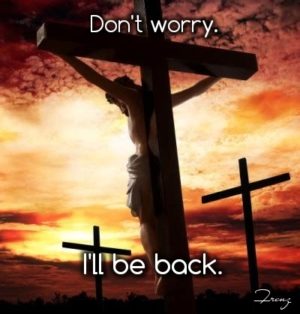
The image presents a powerful and iconic Christian symbol combined with a message of reassurance. Let's break down the elements:
* Central Figure: Jesus on the Cross: → The most striking element is the depiction of Jesus Christ on the cross. This is a universally recognized symbol within Christianity, representing the crucifixion, a pivotal event in Christian belief. It signifies Jesus's ultimate sacrifice for humanity's sins, a core tenet of the faith. His posture, often depicted as one of suffering yet serene acceptance, reinforces the theme of sacrifice.
* Background: Sunset/Sunrise: → The background features a dramatic sky with hues of orange, red, and yellow, resembling a sunset or sunrise. These colors can symbolize the end of one era (Jesus's death) and the beginning of a new one (his resurrection and the promise of eternal life). The vibrancy of the colors adds to the overall feeling of hope and beauty, even amidst the somber scene.
* Additional Crosses: → In the background, there are two other crosses. These represent the two thieves who were crucified alongside Jesus, further emphasizing the historical and biblical context.
* Text: "Don't worry. I'll be back." → This is the key message. It's a direct quote from Jesus, offering comfort and encouragement to believers. The phrase "I'll be back" is a clear reference to the resurrection, the central event in Christianity. It promises that Jesus will rise from the dead, triumph over death, and offer the hope of eternal life.
Article: The Enduring Promise: Faith, Hope, and the Return →
The image we see is a visual embodiment of the Christian faith's core tenets: sacrifice, redemption, and the promise of eternal life. It encapsulates the central narrative of Christianity, offering both a reflection on suffering and a powerful message of hope.
The Crucifixion: A Symbol of Sacrifice →
The central figure in the image, Jesus Christ crucified, is a visual representation of the ultimate sacrifice. According to Christian beliefs, Jesus, the Son of God, willingly died on the cross to atone for the sins of humanity. This act, often referred to as the crucifixion, is seen as a pivotal event, paving the way for forgiveness and the possibility of eternal salvation for those who believe in Jesus. The image powerfully conveys the depth of this sacrifice, reminding viewers of the cost of love and redemption.
The Message of Hope: "Don't Worry. I'll Be Back." →
Accompanying the image is the promise "Don't worry. I'll be back." This phrase is a declaration of hope and a direct reference to the resurrection of Jesus. The resurrection, the belief that Jesus rose from the dead three days after his crucifixion, is the cornerstone of the Christian faith. It confirms Jesus's divinity, defeats death, and offers the promise of eternal life to believers. The message, therefore, is a source of immense comfort, urging Christians to not despair in the face of suffering or hardship, but to trust in the ultimate victory of good over evil.
The Symbolism of Light and Renewal →
The background of the image, with its dramatic sunset or sunrise, adds another layer of meaning. The vibrant colors of the sky symbolize the transition from darkness to light, from death to life, and from despair to hope. These colors can represent the end of one era (Jesus's death) and the dawn of a new one (his resurrection and the promise of eternal life). The beauty of the scene, combined with the powerful message, reinforces the idea that even in moments of great suffering, there is always hope and the potential for renewal.
Conclusion: A Call to Faith and Endurance →
This image serves as a potent reminder of the core beliefs that shape the Christian faith. It encourages believers to reflect on the sacrifice of Jesus, to find hope in his resurrection, and to live their lives with faith, knowing that they are not alone. The message "Don't worry. I'll be back," is not just a promise; it is an invitation to trust, believe, and persevere through life's challenges, secure in the knowledge of a future filled with eternal life and God's unending love.
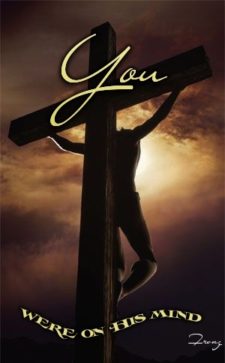
The image is a powerful and emotive visual representation of the crucifixion of Jesus Christ, a central event in Christian theology. Here's a breakdown of its elements:
* The Cross: → The dominant feature is the large, dark cross. It's a symbol of suffering, sacrifice, and ultimately, salvation in Christianity. The wooden texture gives it a sense of reality and historical context.
* The Silhouette of Jesus: → A silhouetted figure is nailed to the cross. The pose suggests agony and the struggle of death but also echoes the triumph in the resurrection. The shadowy depiction allows viewers to connect with the core of the story without necessarily seeing the face, allowing for a more personal interpretation.
* The Sky: → The background is a dramatic sky with a blend of colors in the background, suggesting the end of a day, the dramatic and possibly even the supernatural nature of the event.
* The Text: → The words "You were on His Mind" are overlaid in elegant, script-like typography. This text personalizes the image. It suggests that Jesus' sacrifice was made for the benefit of each individual, emphasizing the unconditional love and ultimate sacrifice in Christianity.
* Overall Tone: → The image evokes a sense of solemnity, reverence, and perhaps even awe. The use of light and shadow creates a dramatic mood, highlighting the importance of the message.
Detailed Article: "You Were on His Mind: Finding Yourself at the Foot of the Cross" →
The image you see before you is more than just a visual; it's an invitation to contemplate the deepest questions of faith, love, and purpose. It encapsulates the core message of Christianity – the incredible sacrifice of Jesus Christ on the cross and its profound implications for humanity.
The dark silhouette of the man upon the cross, while indistinct in features, immediately evokes the suffering endured by Jesus. The crucifixion was a brutal form of execution, designed to inflict maximum pain and humiliation. The imagery immediately confronts the reality of human suffering and the high cost of redemption.
But the image is more than just a stark depiction of death; it's about life. The message "You were on His Mind" is the emotional heart of the message. These few words transform the narrative. They aren't just an observation. They're an invitation to personal contemplation.
* Unconditional Love: → The words remind us that Jesus willingly endured this torment, out of love for humanity. This love extends to each of us, regardless of our past actions, our flaws, or our worthiness. In the story of Christianity, God's love is unconditional, an encompassing force that transcends all human failings.
* Sacrifice and Forgiveness: → The crucifixion is the ultimate sacrifice. Jesus' death is understood as a payment for the sins of all humanity. For Christians, this act offers the possibility of forgiveness, reconciliation with God, and eternal life. To look at the cross and consider this message is an intimate moment of reflection.
* Personal Relevance: → The words "You were on His Mind" turn the image into a profoundly personal message. It suggests that Jesus' sacrifice wasn't a historical event, but a sacrifice made for *you*. It encourages reflection on your place in the grand narrative of faith. How do you respond to such an act of love and sacrifice?
* Hope and Redemption: → The darkness in the background, though somber, also serves as a backdrop for hope. The crucifixion wasn't the end of the story. The resurrection of Jesus three days later provides the foundation for Christian hope – the promise of eternal life and the triumph of good over evil. The hope in the resurrection is rooted in the sacrifice on the cross.
The Cross as a Gateway →
The cross, in this image, serves as a doorway. It is a doorway into a deeper understanding of God's love, a gateway to personal reflection, and a passage to redemption. The image provides an opportunity to pause and consider your beliefs, your relationships, and your place in the world.
The Call to Action →
If you are open to it, this image is an opportunity to explore the tenets of Christianity. It's a visual reminder of the foundational events and truths of the Christian faith. Whether you find yourself drawn to the image with faith, curiosity, or even skepticism, it's an open invitation to engage with the profound questions of existence.
By allowing the image to wash over you, and by embracing its message, you will find that *you* were on His Mind.
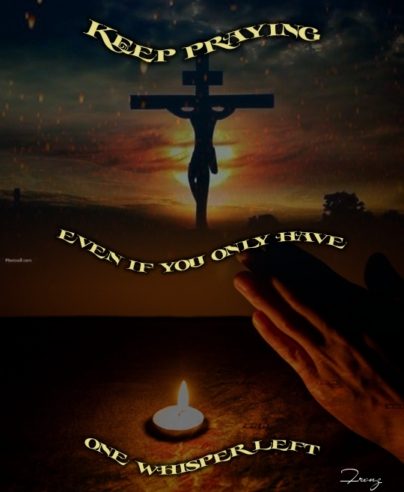
The image is a Christian-themed motivational piece, designed to encourage faith and perseverance in prayer, even in difficult circumstances. It combines several powerful visual elements to convey a sense of hope, faith, and the enduring power of prayer. The overall tone is somber yet uplifting.
Visual Elements and Symbolism →
* The Crucifix: → The dominant feature is the silhouette of Jesus on the cross. This is a central symbol of Christianity, representing sacrifice, suffering, and ultimately, redemption and salvation. The silhouette against the dramatic sunset sky emphasizes its significance and the sacrifice made.
* The Sunset/Sky: → The background features a vibrant sunset with dramatic colors. This sunset could symbolize both the end of a challenging period and the dawn of new hope and new beginnings.
* Praying Hands: → The inclusion of a pair of hands clasped in prayer provides a powerful visual representation of prayer and devotion. It anchors the message in a personal, active way.
* Candle: → A single lit candle placed in the foreground is a potent symbol in Christian imagery. It can represent:
* Hope: → Even in darkness, a small light persists.
* Faith: → A belief that endures despite challenges.
* Presence of God: → A lit candle can signify the presence of the Holy Spirit.
* The Text: → The text is arranged around the image:
* "Keep Praying" : A direct call to action and a key message.
* "Even if you only have one whisper left" : This phrase speaks directly to times of hardship and exhaustion, suggesting that even the faintest expression of faith is valuable and can be effective. This is the core encouragement.
* Color and Light: → The image is dominated by warm colors of the sunset and candle, and the dark silhouettes of the cross and hands create a contrast.
Message and Interpretation →
The image's central message is a call to persevere in prayer, even when faced with adversity. It acknowledges that life can bring times of difficulty, when one might feel depleted or weak. The image suggests that prayer remains vital, even if it's a whisper or a silent plea. The presence of the cross and the candle act as symbols of hope, faith, and divine support, promising that even a single act of prayer can be meaningful and significant. The imagery implies that faith in God can bring solace and give strength, and that the connection to God is enduring.
Overall Impact →
The image seeks to offer comfort, hope, and encouragement to viewers. It is meant to resonate with those who are struggling, reminding them of the power of prayer and faith in the face of adversity. The composition is well-suited for devotional or inspirational content, serving as a visual reminder of the importance of faith and prayer. The artist's signature indicates a personal touch, making it more than just a generic image.
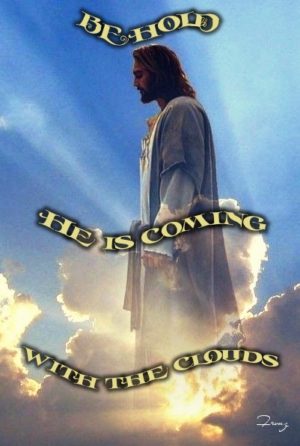
The image is a religious illustration, intended to convey a message of faith and the Second Coming of Christ. It combines photographic elements and text to create a visually striking and spiritually evocative piece. The style suggests a somewhat romanticized or idealized representation of the biblical figure.
Visual Breakdown →
* Central Figure: → The primary focus is a depiction of Jesus Christ. He's presented with the traditional features: long hair, a beard, and draped in flowing robes. The pose is somewhat contemplative, with his head bowed. This is a symbolic representation, as opposed to a realistic portrait, aiming to project an image of serenity, compassion, and divine authority.
* Setting: → The background is a celestial scene. It's dominated by a sky filled with clouds, and shafts of light. The light breaking through the clouds creates a dramatic atmosphere and reinforces the notion of a divine presence. The clouds might symbolize the heavens or the presence of the divine.
* Text: → Three phrases overlay the image, using a stylized font. These phrases convey a clear message:
* "BEHOLD" - This is a call to attention, often used to emphasize something of importance.
* "HE IS COMING" - This directly references the Second Coming of Christ, a central tenet of Christian belief, stating that Jesus will return.
* "WITH THE CLOUDS" - This adds further imagery to the statement from the biblical passage, the image directly alludes to the book of revelation "Behold, He is coming with the clouds, and every eye will see Him, even those who pierced Him; and all the tribes of the earth will mourn over Him. Even so, Amen."
* Color Palette: → The dominant colors are blues, whites, and golds, creating a sense of peace, purity, and divinity.
Interpretation and Meaning →
The image is rich in symbolism and reinforces core Christian beliefs:
* The Second Coming: → The central message is the anticipation of Jesus' return. This is a crucial element of Christian faith, promising the fulfillment of prophecy and the ultimate triumph of good over evil.
* Divine Presence: → The heavenly setting, the shafts of light, and the image of Christ himself evoke a sense of the divine. It suggests the presence of God and the hope of salvation.
* Hope and Faith: → The artwork encourages a sense of faith and optimism. The overall message implies that believers should "behold" or be vigilant, in preparation for the anticipated return of Christ.
Artistic Style and Purpose →
* Style: → The image has a romantic, illustrative style. The focus is on capturing an emotional and spiritual experience rather than achieving perfect realism.
* Purpose: → The purpose is to inspire and reassure believers. It serves as a visual reminder of their faith and the promises of the scriptures. It is often used in religious contexts, such as churches, or personal expressions of faith (social media, etc.).
Additional Notes →
* The image uses familiar Christian iconography to resonate with a wide audience.
* The aesthetic is designed to evoke a feeling of awe and reverence, which is appropriate given the subject matter.
* Overall, the image is a positive and encouraging expression of faith, aimed at strengthening the viewer's connection to Christian beliefs.
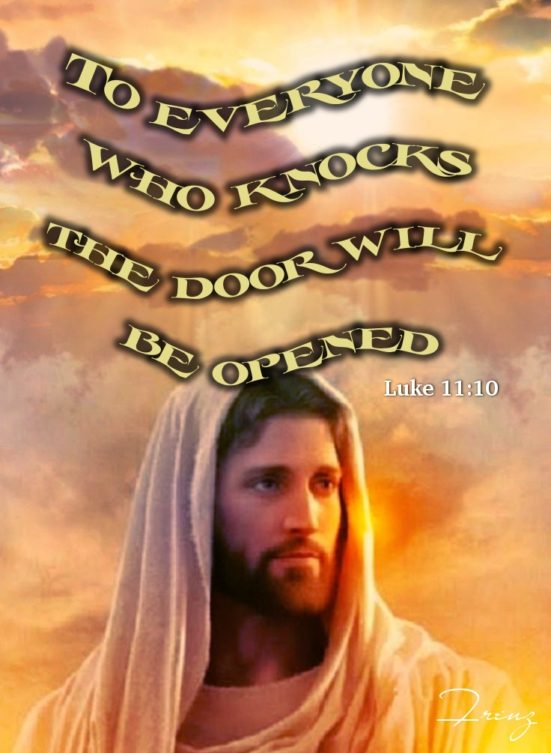
A Testament to Faith: Analyzing the Image of Jesus with the Encouraging Words from Luke 11:10 →
This image is a powerful visual representation of Christian faith, blending a portrait of Jesus Christ with a well-known and comforting verse from the Gospel of Luke. The overall composition is designed to inspire hope, provide assurance, and remind viewers of the core tenets of Christian belief.
Visual Elements and Composition: →
* The Central Figure: Jesus Christ: → The dominant element is a depiction of Jesus. He is portrayed with classical features – a well-groomed beard, serene expression, and a soft gaze directed slightly to the right. He is draped in a white or cream-colored robe, with the hood slightly pulled up, which creates a sense of solemnity and reverence. His face is illuminated, with light and shadow emphasizing the gentle contours of his face, creating a peaceful yet strong impression. The artistic style is a realistic, almost photographic rendering, making him approachable, while still retaining a sense of divine presence.
* The Background: A Celestial Canvas: → The background is a vibrant and visually appealing depiction of the sky, suggesting a dawn or dusk scene. The gradients of orange and yellow, blended with touches of light, create a sense of warmth and divine light, amplifying the feeling of hope and heavenly support. Clouds and light form an implied space for Jesus, emphasizing his transcendent existence.
* The Text: Luke 11:10: → The image includes the words "To everyone who knocks, the door will be opened" in a prominent position across the top part of the image. This verse, from Luke 11:10, is written in an elegant serif font. The font and its color enhance readability while adding a slight degree of formality. Its positioning draws the viewer’s eyes upward, encouraging the contemplation of the divine promise. The citation "Luke 11:10" is positioned in the upper right corner of the image, providing context.
Interpretation and Significance: →
The image's message revolves around the themes of prayer, persistence, and divine accessibility.
* Knocking as Prayer: → The central verse from Luke 11:10 encourages persistent prayer and seeking. "Knocking" suggests actively seeking a connection with God through prayer, faith, and spiritual practice. It is a promise that those who diligently seek will eventually find answers, guidance, or spiritual fulfillment.
* The Opened Door: Divine Presence and Grace: → The phrase "the door will be opened" implies that God will answer, listen, and welcome those who approach him with sincerity. It is a message of encouragement, offering comfort and a promise of access to the divine.
* The Portrait of Jesus: Christ as the Mediator: → The inclusion of Jesus’s image serves as a reminder of the role of Christ as a mediator between humanity and God. It reinforces the idea that through faith in Christ, one can draw closer to God. The gentle appearance of Jesus encourages the viewer to be unafraid of prayer and connection with the divine.
* Overarching Message: Hope, Comfort, and Faith: → The combination of the visual and textual elements conveys an encouraging and optimistic message. It serves as a reminder of the possibility of divine intervention and the rewards of a committed faith. It is meant to offer solace, reminding believers that they are not alone in their struggles.
Purpose and Intended Audience: →
This image is intended to be both inspirational and faith-affirming. It would likely be displayed or shared in religious settings, on social media, or in homes of believers. The intended audience is Christians, or those exploring Christianity, who seek comfort, encouragement, and reminders of the promises of their faith.
In Conclusion: →
This image is a carefully constructed piece of Christian art, harmonizing a biblical verse with a visually appealing portrait of Jesus. Its composition and message aim to uplift, inspire, and reassure viewers of the accessibility of God's grace and the importance of steadfast faith. It's a visual testament to the belief in a responsive, loving God, available to those who seek him.
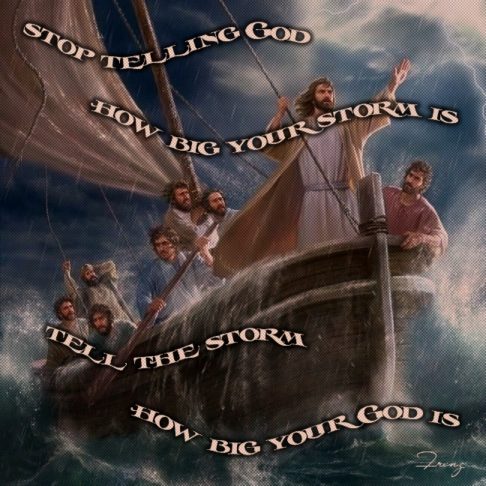
The image is a digitally manipulated graphic based on a well-known depiction from Christian art. It features a scene of Jesus Christ and his disciples on a boat caught in a raging storm. The boat is being tossed about by powerful waves, and the sky is dark with storm clouds. Jesus is prominently positioned, standing in the boat with his arms raised, in the act of calming the storm or preaching. The disciples are shown visibly distressed, some rowing to try to control the boat. The scene clearly illustrates a moment of crisis, danger, and reliance on faith.
Textual Overlay and Meaning: →
Superimposed over this scene are words in a stylized, slightly distressed font. These words are the primary message:
* "STOP TELLING GOD HOW BIG YOUR STORM IS"
* "TELL THE STORM HOW BIG YOUR GOD IS"
This overlay transforms the image from a simple biblical scene into a meme-like statement with a powerful message of faith and resilience. It's a call to shift the focus from fear and doubt (complaining about the problem) to trust and proclamation of God's power.
Interpretation and Implications: →
* Thematic Emphasis: → The core message is a call to shift one's perspective. Instead of constantly focusing on the magnitude of their challenges and difficulties (the "storm"), individuals are encouraged to center their attention on the magnitude of their faith in God. The implied suggestion is that faith has the ability to lessen, control or overcome difficulties.
* Metaphorical Meaning: → The storm represents life's challenges, trials, hardships, and setbacks. The boat represents the individual's life or spiritual journey. The disciples represent individuals who are trying to navigate life. Jesus embodies faith, hope, and a belief in God's power.
* Application and Audience: → This message is especially directed to a Christian audience, as it plays on familiar biblical imagery and spiritual principles. It can be applied to many different situations.
* Resilience and Faith: → The image encourages individuals to turn to their faith in times of trouble, rather than being overwhelmed by fear and doubt.
* Motivational and Inspirational: → It's a reminder that strength and hope can be found through faith in the face of life's storms.
Style and Context: →
* Modern Visual Language: → The use of a meme format (overlay text on a pre-existing image) is very contemporary, making the message quickly understandable and shareable on social media platforms.
* Religious/Christian Context: → The scene, based on Jesus' act of calming the storm, provides a strong visual anchor. This reinforces the message of the faith.
In Conclusion: →
The image is a compelling visual message. It skillfully combines a familiar biblical image with a modern motivational statement. By encouraging a shift in focus from problems to faith, it offers a simple but profound message of hope, resilience, and the power of a belief in God in the face of life's troubles. It is a testament to the enduring relevance of faith and spiritual principles in a modern world
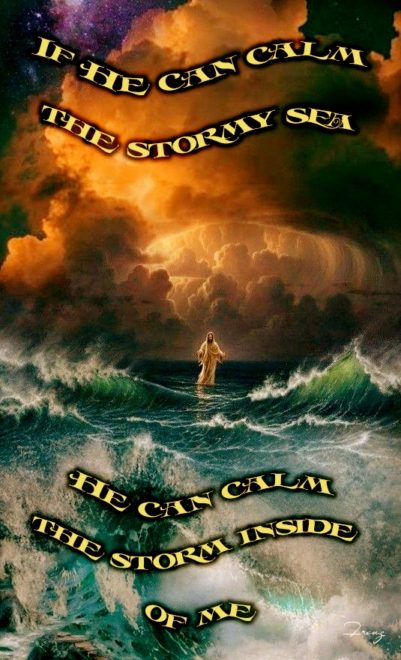
The image presents a powerful Christian message through a striking visual metaphor. It combines a dramatic depiction of a storm at sea with the figure of Jesus, and overlaid text that expresses faith in his ability to bring peace. The overall effect is one of hope, reassurance, and an invitation to find solace in faith during times of inner turmoil.
Visual Elements →
* Dramatic Backdrop: → The background is a turbulent sea under a stormy sky. The colors are vibrant, with dark blues and greens of the ocean contrasting with the fiery oranges and yellows of the storm clouds. The waves are depicted as large and crashing, emphasizing the intensity of the storm. The sky itself is a mix of dark and light patches, adding to the chaotic visual.
* Central Figure: → Jesus is positioned in the center, standing in the stormy water. His serene presence stands out against the wildness around him. The image portrays the act of Jesus walking on water, a powerful event in the Bible, showing his control over nature. His attire (a white robe) suggests purity and divine authority.
* Textual Overlay: → Two lines of text with a yellow, outlined font are placed at the top and two lines at the bottom: "IF HE CAN CALM THE STORMY SEA" (top) and "HE CAN CALM THE STORM INSIDE OF ME" (bottom). The font style is bold and eye-catching, making sure the message is very visible.
Thematic Interpretation →
* Metaphorical Representation: → The "stormy sea" can be interpreted as representing the external challenges, hardships, and difficulties one faces in life. The "storm inside" symbolizes the inner turmoil, anxiety, fear, or emotional struggles that can make life overwhelming.
* Faith and Trust: → The image's central message is about faith. By highlighting Jesus's power to calm the sea, it suggests that he can also calm the "storm" within us. It is an affirmation of faith, inviting viewers to trust in the power of faith to overcome personal trials.
* Reassurance and Hope: → The image provides comfort and encouragement. It suggests that no matter how challenging life's circumstances, there is a source of peace and stability available through faith in Jesus. It is a source of hope for those experiencing inner turmoil.
* Biblical Reference: → The image is directly linked to the biblical story of Jesus walking on water. It serves as a reminder of Jesus's power, but also as a visual aid in internal meditation on the biblical story.
In Summary →
This image is a strong piece of Christian art that uses powerful visual and textual elements to convey a message of faith, hope, and comfort. It serves as a visual reminder of the power of belief and the assurance that peace is attainable even in the midst of life's most turbulent storms. It is intended to be shared as a message of faith and encouragement, offering solace to those facing personal hardships.
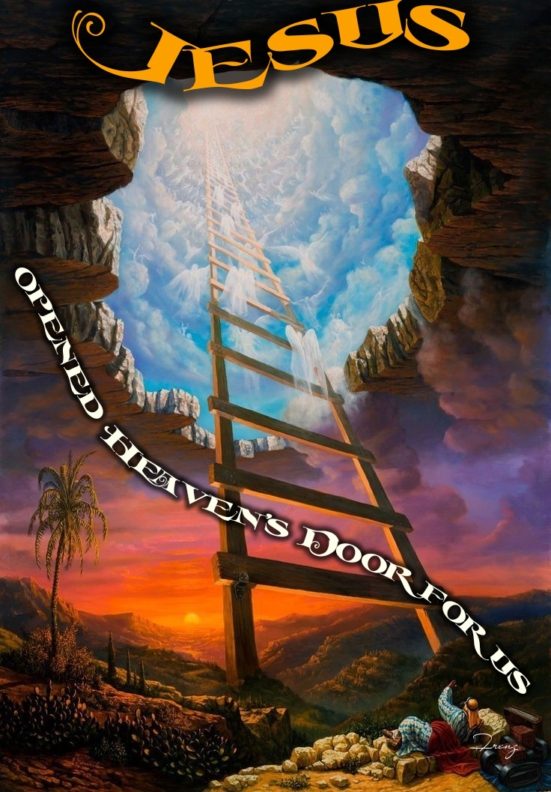
Image Analysis: →
The image is a vibrant and symbolic Christian artwork. It primarily depicts the following elements:
* Central Motif: The Ladder: → A prominent wooden ladder is the central focus, extending from the earthly realm upwards through an opening into the heavens. This represents a connection between earth and the divine.
* The Heavens: → The upper portion of the image showcases a bright, sunlit, cloud-filled sky. The light and the angels suggest the presence of God.
* The Opening: → The ladder appears to emerge from a rock formation, resembling a cave entrance. This could symbolize the transition from the earthly to the heavenly realms.
* Earthly Landscape: → The bottom of the image features an earthly landscape with a dramatic sunset/sunrise with mountains, and a palm tree. These elements represent the world and its beauty.
* The inscription: → The text "JESUS" is at the top in bold, ornate lettering. In addition, there's an inscription on the side "OPENED HEAVEN'S DOOR FOR US".
* Human Figure: → At the base of the ladder, there appears to be a human figure, lying down in what looks like a humble position, possibly injured.
Article: →
"Opened Heaven's Door for Us": A Visual Testimony of Faith →
This powerful piece of Christian artwork offers a visual prayer, inviting the viewer to contemplate the core tenets of faith, hope, and salvation. The image, a tapestry of color and symbolism, speaks volumes about the transformative power of Jesus Christ.
The image’s core message is immediately evident: Jesus, the central figure, has "OPENED HEAVEN'S DOOR FOR US." This phrase, rendered in an elegant script, serves as the linchpin of the visual narrative. It directly references Jesus' role as the mediator between God and humanity. Christians believe that through Jesus’ sacrifice, the barriers that separate humans from God have been overcome.
The wooden ladder, rising from the darkness of the Earth toward the brilliant light of the heavens, acts as the pictorial pathway. It is a direct visual allusion to the biblical concept of ascending to the divine. The ladder serves as a visual of Jacob's ladder, a biblical imagery.
The composition is divided into two distinct but interconnected realms: the earthly and the heavenly. The lower section showcases the human realm – the world, with the sunset, the palm tree - while the upper part is dominated by the light-filled sky. The contrast underscores the dichotomy of life on Earth and the promise of eternal life. The human form lying at the base of the ladder, perhaps injured, suggests the burdens and sufferings faced by humanity. Yet, the ladder presents a path out of darkness, offering salvation and the promise of a better place.
The artwork's artistry is undeniable. The skillful use of color, from the warm hues of the sunset to the bright whites in the heaven's clouds, creates a sense of hope and awe. The carefully rendered details, like the textures of the rocks, contribute to the overall impact, inviting the viewer to fully immerse themselves in the scene.
In its entirety, the image serves as a heartfelt expression of Christian faith, reminding viewers of the hope and eternal life available through Jesus.
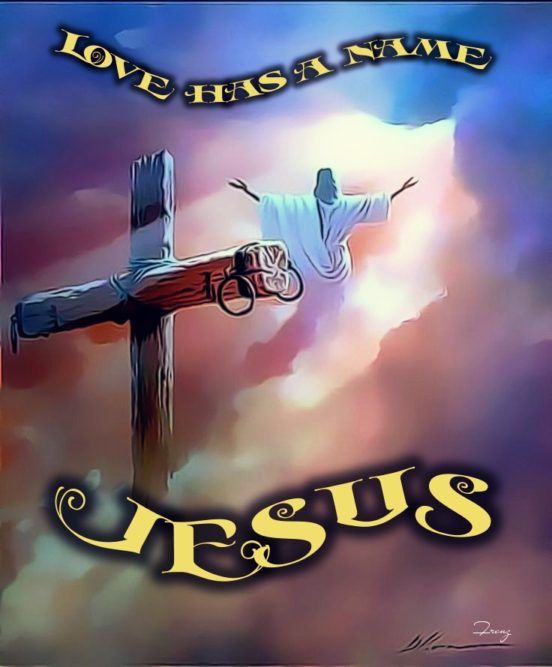
The image is a digitally created Christian artwork with a focus on the core beliefs of the religion. It conveys messages of love, sacrifice, and hope through visual symbols and text. The style is somewhat stylized and could be described as a blend of realism and artistic interpretation.
Visual Elements and their Meaning: →
* The Crucifix (Cross): → This is the central and most recognizable symbol of Christianity. It represents the crucifixion of Jesus Christ, the sacrifice he made for the salvation of humanity, and his suffering. The cross's presence suggests themes of pain, death, and ultimately, redemption.
* Jesus with Open Arms: → Positioned in the background, above the cross, is a figure of Jesus. He is often depicted as rising up to the heavens, representing his resurrection. This pose of Jesus with outstretched arms conveys themes of love, acceptance, forgiveness, and welcoming those who believe in him.
* Background: → The backdrop is a swirling, colorful sky. The colors are a mix of light blues, pinks, and golds creating a sense of the divine, a spiritual realm, and perhaps even the light of heaven.
* Text: →
* "Love Has a Name": → This text is placed above the cross and Jesus and suggests that love is not an abstract concept, but a concrete entity and can be identified. The image is clearly suggesting that the "name" of love is *Jesus*.
* "JESUS": → This word is placed prominently at the bottom of the image and is the primary identification of the message. It reinforces the idea that love is associated with Jesus Christ.
Overall Message and Interpretation: →
The image seeks to communicate several core Christian beliefs:
* The Sacrificial Love of Jesus: → The presence of the cross and the image of Jesus emphasizes the sacrifice Jesus made for humanity's salvation.
* Redemption and Hope: → The image conveys a message of hope, redemption, and forgiveness through the figure of Jesus.
* Jesus is the embodiment of love: → The text and image work together to point to Jesus as the personification of love.
* The Divine: → The background and colors emphasize the spiritual and divine nature of Jesus and his message.
Artistic Style: →
The image uses a blend of photographic elements and artistic rendering. The colors and visual style are designed to be visually appealing and to create an emotional impact.
In conclusion: →
The image functions as a visual representation of core Christian beliefs, using iconic symbols and text to express ideas about love, sacrifice, redemption, and the divine nature of Jesus Christ. It's intended to inspire faith and a sense of hope in viewers.
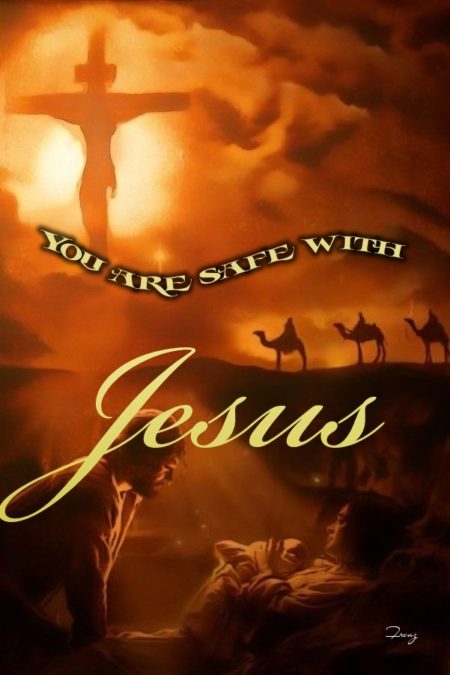
The image is a visually rich and emotionally charged Christian artwork that aims to convey a message of safety and reassurance found in faith, specifically through Jesus. It utilizes a warm, golden color palette and incorporates several key symbolic elements to create a compelling narrative.
Key Elements and Their Meanings: →
* The Crucifix (at the top): → This is the most prominent and central image, directly representing the crucifixion of Jesus Christ. The cross itself is a powerful symbol of sacrifice, suffering, and ultimately, redemption within Christian theology. The crucifixion represents the ultimate act of love, where Jesus gave his life for the salvation of humanity.
* The "YOU ARE SAFE WITH" Text: → This message is the central theme of the image, it conveys a feeling of comfort, security, and protection found in the presence of Jesus. It directly relates the crucifixion with the message of comfort and safety of Jesus.
* "Jesus" Text: → Placed prominently below the primary message, and above the nativity scene, this word establishes Jesus as the source of this safety.
* The Nativity Scene (bottom): → This depicts the birth of Jesus, which signifies the beginning of God's plan for salvation. The image focuses on the holy family. This represents the beginning of Jesus's earthly life, the fulfillment of prophecy, and the start of his mission to save humanity.
* The Three Wise Men (right middle): → Silhouetted against the sky, the three camels represent the wise men (also known as the Magi) who traveled from the East to worship the newborn Jesus. Their presence symbolizes the universality of Christ's message, as they were the first gentiles to recognize and worship Jesus.
* Color Palette: → The overall warm, golden, and earthy tones create a sense of warmth, comfort, and spirituality. The golden hues suggest divinity, light, and the presence of the divine.
Symbolism and Interpretation: →
The image blends several key moments in the Christian narrative: the crucifixion, the birth of Jesus, and the visit of the wise men. This combination allows the image to offer a profound message of comfort, salvation, and hope. It links the crucifixion with salvation and love, and that comfort can be found in Jesus Christ. The use of the three wise men show that Jesus is available to all.
Emotional Impact: →
The image is intended to evoke feelings of:
* Comfort and reassurance: → The phrase "You are safe with Jesus" provides comfort and hope.
* Reverence and awe: → The depiction of the crucifixion and the holy family inspires respect and wonder.
* Faith and Trust: → The image encourages viewers to place their faith in Jesus and seek solace in His love and sacrifice.
Overall Message: →
The core message of the image is that safety and security are found in Jesus Christ. Through his sacrifice on the cross, and his birth, Jesus offers salvation and hope to all who believe in him. The inclusion of the wise men further emphasizes that this message is for all people. The image seeks to reassure the viewer, especially in times of difficulty.
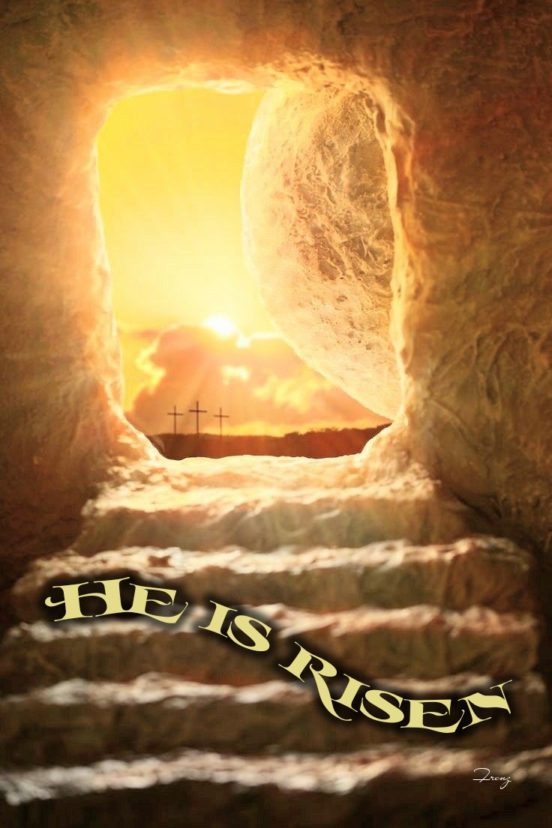
Article: The Empty Tomb - A Symbol of Resurrection and Hope →
The image is a powerful visual representation of a pivotal moment in Christian belief: the resurrection of Jesus Christ. It uses symbolism and artistic elements to convey the profound meaning of this event.
Visual Description: →
* The Empty Tomb: → The focal point is the empty tomb, depicted as a cave-like structure. The stone that once sealed the entrance has been rolled away, revealing the bright light of the sun and sky beyond.
* The Stone: → The large, rounded stone that once blocked the entrance is prominent. Its position, partially rolled away, signifies the miraculous event of Jesus's resurrection and the overcoming of death.
* Light and Radiance: → A brilliant, golden light streams forth from the tomb's opening. This light symbolizes the presence of God, hope, victory over death, and the dawn of a new era.
* The Crosses: → In the distance, silhouetted against the sunrise, are three crosses. These represent the crucifixion of Jesus and the two thieves. This element serves as a poignant reminder of the suffering and sacrifice that preceded the resurrection.
* Stairway: → A stairway seems to lead up the entrance to the tomb, suggesting a passage, a journey to another level, or a connection between the divine and the earthly.
* Text: → The words "He is Risen" are prominently displayed across the image, confirming the central message of the resurrection. The script chosen is an older style, suggesting the ancient and enduring nature of the faith.
* Overall Tone: → The image's overall tone is one of hope, triumph, and divine grace. The colors are warm, and the composition guides the viewer's eye towards the radiant light and the message of resurrection.
Symbolism and Meaning: →
* The Empty Tomb: → The empty tomb is a potent symbol. It demonstrates that Jesus conquered death and is no longer bound by the confines of the grave. It is the central proof of Christianity's central tenet - the resurrection.
* The Light: → The bright, glorious light emanating from the tomb is a visual representation of God's presence, divinity, and hope. It symbolizes the triumph of good over evil, life over death, and light over darkness.
* The Stone Rolled Away: → The stone's removal shows that God's power is greater than any earthly barrier. It emphasizes the miraculous nature of the resurrection.
* The Crosses: → The crosses are a reminder of Jesus's sacrifice, the price paid for humanity's redemption. It is a reminder of the suffering, but also that it led to ultimate victory.
* "He is Risen": → This simple phrase is the core message. It is a declaration of faith, a statement of belief in the resurrection of Jesus and the promise of eternal life for believers.
Cultural Context: →
This image is strongly associated with Easter, the most important feast in the Christian calendar. It is a powerful reminder of the central beliefs of Christianity and a source of comfort, hope, and faith for billions worldwide.
Conclusion: →
This image is a skillfully crafted visual interpretation of the resurrection of Jesus. It employs symbolic elements to create a meaningful and evocative representation of faith, hope, and the ultimate victory of life over death. It is a powerful image that communicates a message of profound spiritual significance.
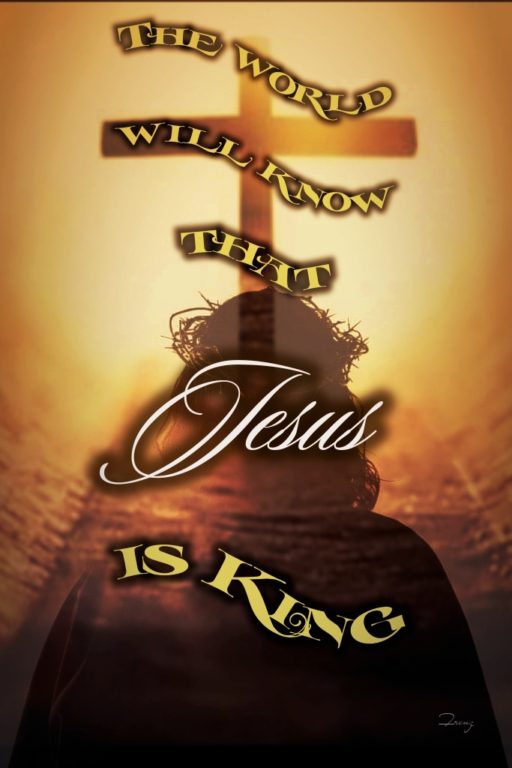
Image Overview →
The image is a visually compelling and symbolic piece of Christian art. It uses a combination of imagery and text to convey a powerful message. The overall style is reminiscent of digital art, created to be shared online or used for devotional purposes.
Visual Elements and Symbolism →
* The Figure of Jesus: → The central figure is the silhouette of Jesus. He is viewed from the back, emphasizing his humility. The shadow/silhouette creates a sense of mystery and reverence. A crown of thorns is visible, symbolizing his suffering and crucifixion.
* The Cross: → A large cross is placed in the background, visually anchoring the image. The cross is a fundamental symbol of Christianity, representing Jesus's sacrifice for humanity's sins.
* The Background: → The background is a warm, golden gradient reminiscent of a sunset or sunrise. This suggests a sense of hope, transformation, and the dawning of a new era (spiritual renewal).
* Textual Elements: → The text is placed strategically around the image to emphasize the message.
* "The World Will Know That" - is placed above the figure of Jesus and the cross to draw the eye and initiate the message of the world's transformation.
* "Jesus" - is the focal point, written in a flowing, elegant font over the outline of Jesus, drawing the focus onto the figure.
* "Is King" - is positioned beneath the "Jesus" word, which is positioned under Jesus's outline and it reiterates Jesus's authority and divinity.
Interpretation and Message →
The primary message of the image is a declaration of Jesus's kingship and the eventual recognition of this truth by the world. Several key themes emerge:
1. Jesus's Divinity: → The image strongly emphasizes Jesus's role as King. This points to his authority, power, and divine nature. It connects with biblical passages.
2. Sacrifice and Redemption: → The presence of the crown of thorns and the cross, speaks to the message of sacrifice.
3. Universality of the Gospel: → The image makes reference to "the world" knowing. This highlights the universal nature of the Christian message and its potential reach to all people, in every nation.
4. Hope and Transformation: → The warm, golden background evokes feelings of hope, renewal, and the promise of a better future.
Overall Impact →
This image is designed to inspire faith, offer comfort, and remind viewers of the core tenets of Christianity. It is a visually striking piece that conveys a powerful message about Jesus's identity, sacrifice, and his impact on the world. The use of familiar Christian imagery makes it accessible to a wide audience and serves as a reminder of the power of faith.
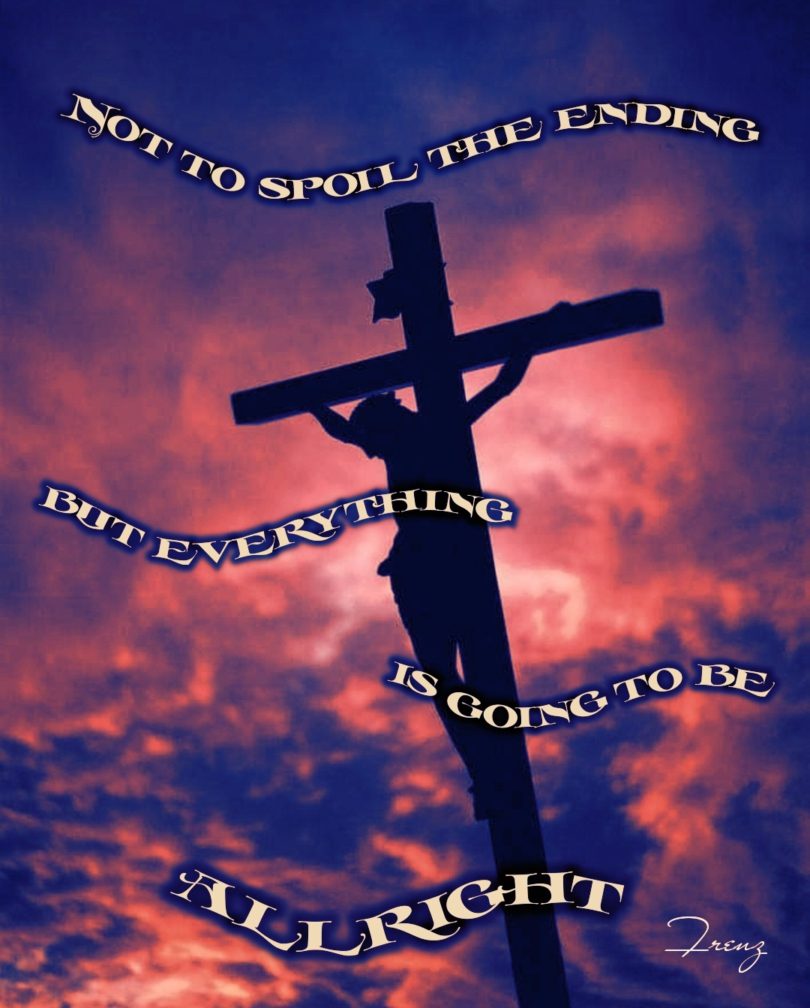
The image presents a powerful Christian message centered on faith, hope, and the assurance of a positive outcome. The central visual element is the silhouette of Jesus Christ on the cross, set against a dramatic sky, with the message emphasizing the finality of Jesus's sacrifice and the promise of redemption.
Visual Elements and Their Symbolism →
* The Crucifix: → This is the dominant and most direct Christian symbol. It represents the crucifixion of Jesus Christ, a pivotal event in Christian theology. It symbolizes:
* Sacrifice: → Jesus's willingness to die for the sins of humanity.
* Suffering and Redemption: → His suffering as a sacrifice to atone for the sins of mankind, leading to the promise of salvation.
* Hope: → The cross became a symbol of hope, faith, and the promise of eternal life for believers.
* The Silhouette: → The depiction of Jesus as a silhouette emphasizes the anonymity of the person and the power of the cross itself. The lack of detail focuses the viewer's attention on the act of crucifixion rather than the details of the figure.
* The Sky: → The sky in the background is the backdrop to the crucifixion. The combination of colors and the clouds creates a powerful visual setting:
* Color Palette: → The transition from dark blue at the top to the reds and oranges, creates a sense of drama and contrasts with the cross and the words.
* Visual impact: → The sky's drama, hints at a struggle of dark and light.
Text and Message →
The text interwoven with the image is crucial for conveying the core message:
* "Not to spoil the ending": → This phrase acknowledges the narrative of the crucifixion.
* "But Everything is Going to Be Alright": → This is the central message of reassurance and hope. It is the heart of the image's message.
Overall Message →
The image, in its totality, delivers a message of faith and hope. It encapsulates several key themes:
* The Suffering of Christ: → The crucifixion, shown through the silhouette on the cross, demonstrates Christ's willingness to suffer and die for the sins of the world.
* Reassurance and Hope: → The words "Everything is Going to Be Alright" are meant to be a source of comfort and reassurance for believers. They highlight the promise of eternal life and redemption offered by Christ.
* Triumph over Suffering: → The image is a message of hope and the overcoming of suffering. The death on the cross is followed by the resurrection and victory over death, which signifies the triumph of hope and salvation.
Conclusion →
This image is a compelling visual representation of Christian faith. By combining the powerful symbol of the cross with a comforting message, it provides a sense of hope, redemption, and the promise of a brighter future to believers. The image encourages viewers to place their faith in Christ and trust in the promise of salvation, even in the face of life's difficulties.
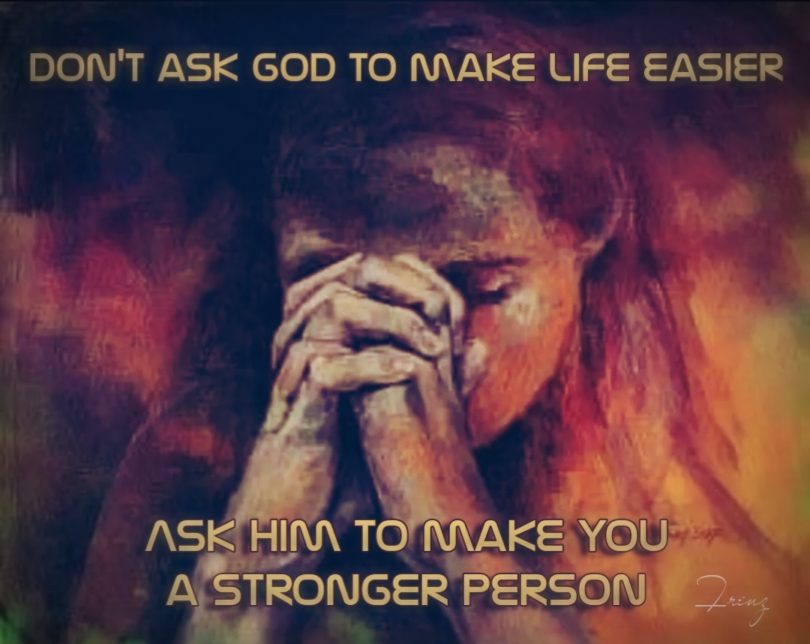
The image is a Christian-themed motivational artwork. It depicts a person in prayer, with text emphasizing a specific approach to faith and life challenges. The art style is impressionistic, utilizing blurred colors and a soft focus to evoke a feeling of spirituality and contemplation.
Visual Elements and Symbolism →
* The Praying Figure: → The central focus is a person, a woman who is depicted with her hands clasped in prayer, head bowed. This posture clearly symbolizes supplication, devotion, and a seeking of divine guidance. Her closed eyes suggest inner reflection and a connection with God.
* Color Palette: → The image uses warm, subdued colors, primarily reds, oranges, and purples. These hues create a sense of warmth, comfort, and spirituality. The use of these colors is often associated with passion, transformation, and the presence of the divine in religious art.
* Artistic Style: → The blurred, impressionistic style gives the image a dreamlike quality. This invites the viewer to focus on the core message rather than getting bogged down in the details. It softens the visuals, creating a less judgmental atmosphere.
Textual Message and Interpretation →
The primary message is conveyed through two lines of text:
1. "DON'T ASK GOD TO MAKE LIFE EASIER"
2. "ASK HIM TO MAKE YOU A STRONGER PERSON"
* Emphasis on Resilience: → The message prioritizes the internal growth and character development of the individual. It suggests that hardships and challenges are inevitable parts of life, and that the focus of faith should be on becoming resilient and able to overcome these difficulties, rather than avoiding them entirely.
* Embracing Difficulties: → The image implies that difficult experiences are not necessarily punishments or signs of God's disfavor. Instead, they're viewed as opportunities for growth and the development of strength and character.
* Shifting Focus: → The statement suggests a shift in perspective. Instead of seeking an escape from trials, the focus should be on seeking the ability to endure, learn, and become a better person as a result of these challenges.
* The Role of God: → The message positions God as a provider of strength, fortitude, and the inner resources necessary to navigate the difficulties of life. It suggests that prayer should be used to seek God's support in developing personal resilience, rather than to seek a reduction of difficulties.
Overall Meaning and Significance →
The image encapsulates a common Christian perspective on suffering and faith. It is a motivational message that encourages viewers to:
* Embrace difficulties as opportunities for spiritual and personal growth.
* Focus on developing inner strength and resilience, rather than seeking an easy life.
* View prayer as a tool for receiving divine guidance, strength, and support during challenging times.
* Shift their perspective from requesting easier circumstances to requesting inner fortitude.
Conclusion →
This image serves as a visual reminder of the importance of faith, resilience, and personal growth in the face of life's challenges. It suggests that a meaningful relationship with God is not about avoiding difficulty, but rather about finding strength and purpose within it. It is a message that encourages viewers to view challenges as opportunities for personal transformation and for growth in their faith.
The image is a Christian-themed inspirational piece. It uses visual elements that are easily recognizable within the Christian faith to convey a message of faith, perspective, and focusing on the bigger picture. The overall aesthetic is that of a classic inspirational artwork, intended for use in religious settings or as personal reminders of faith.
Visual Elements and Symbolism →
* Central Figure: → The dominant element is a depiction of Jesus Christ, rendered in a way that is recognizable to many Christians. He is depicted with long hair and a beard, wearing a simple robe and holding a staff. The staff symbolizes his role as a shepherd, guiding his followers. His posture, looking out at the landscape, suggests contemplation, authority, and guidance.
* Setting: → Jesus stands on a rocky cliffside. The background reveals a wide landscape of a river or valley under a sunset or sunrise sky. The vastness of the landscape gives an impression of the infinite nature of God's power and creation. It represents the "bigger picture" that the image is encouraging the viewer to focus on.
* Sky: → The sky is illuminated with warm colors, suggesting a new day, hope, or a divine presence. The light enhances the message of inspiration and faith. A bird, possibly a dove, flies near the figure. The dove often represents the Holy Spirit in Christian symbolism.
* Text: → The words "Focus on the Bigger Picture" are prominently placed across the image. The use of stylized font adds to the artful message.
Meaning and Message →
The image's primary message is a call to focus on the "bigger picture." → The image emphasizes the importance of:
* Perspective: → To look beyond current difficulties or concerns and see a wider, more hopeful view.
* Faith: → The presence of Jesus and the symbolism of the landscape suggests that one must trust in divine guidance and power.
* God's Presence: → It may remind viewers that God is always in the picture and always present in their lives.
* Guidance: → The staff in Jesus's hand is a common symbol of shepherding and guidance.
* Hope: → The overall message of the image is a call to look past current struggles and concentrate on hope for the future.
Overall Impression and Interpretation →
The image is designed to inspire faith, hope, and a change in perspective. It asks the viewer to rise above daily challenges and maintain a greater perspective on life by keeping their faith. The "bigger picture" could be seen as God's plan, spiritual enlightenment, the ultimate good that is promised, or something of that nature. The picture is a call to turn to God and to have faith in Jesus and look to the future.
The image is a Christian inspirational graphic featuring a stunning natural scene overlaid with text. The backdrop is a breathtaking sunset or sunrise over a body of water, possibly a lake or river. The sky is painted with vibrant hues of orange, yellow, and purple, creating a dramatic and awe-inspiring effect. The water reflects these colors, mirroring the sky and adding to the visual impact. A silhouetted tree branches out across the top right, adding depth and framing to the scene. The foreground features a sandy, textured area, possibly a beach or shoreline. The image has a calming, almost ethereal quality.
Text and Message →
The core message of the image is conveyed through the text:
* "Forgive them anyway" This is a direct call to forgiveness, regardless of the other person's actions or perceived level of remorse. It emphasizes a mindset of unconditional forgiveness, as prescribed by Christian beliefs.
* "It's not between you and them" This phrase shifts the focus away from the interpersonal conflict. It suggests that the central issue isn't the relationship between the wronged and the wrongdoer.
* "It's between you and God" This statement highlights the spiritual dimension of forgiveness in a Christian context. The idea is that forgiveness is ultimately a matter of personal faith and relationship with God, and not primarily a means of settling a score with another person.
Analysis and Interpretation →
The image's combination of the natural beauty and the text carries a strong message about forgiveness. The overall theme is rooted in Christian principles:
* Unconditional Love and Forgiveness: → Christianity emphasizes forgiveness, even when it is undeserved. The image promotes that this is a way of life, regardless of how the other person behaves.
* The Spiritual Perspective: → The core tenet is that forgiveness is a spiritual practice with the goal to be closer to God, and not a transactional exchange of "good" for "good"
* Letting Go of Resentment: → The image seems to suggest that harboring resentment is an issue within one's own heart, and not between two people. The image can be seen as advocating for a release of anger and negativity.
* Inner Peace: → Choosing to forgive can bring inner peace. The calmness of the natural scene complements the message of emotional and spiritual healing.
Overall Effect →
The image is designed to be thought-provoking and emotionally engaging. The visual and textual elements work together to create a powerful message:
* Beauty and Inspiration: → The stunning natural imagery provides a backdrop of inspiration.
* Clarity of Message: → The text is succinct, easy to understand, and direct in its call to forgiveness.
* Emotional Connection: → The image appeals to viewers' emotions by connecting them to a sense of spiritual understanding, and potential transformation.
Article Title: Embracing Divine Grace: Finding Freedom in Forgiveness →
Article Body: →
In the tapestry of human existence, woven with threads of joy and sorrow, love and loss, forgiveness stands as a beacon of hope and resilience. It is a transformative act that transcends the boundaries of earthly relationships, connecting us to the very essence of divine grace. The image of a breathtaking sunset, with its vibrant hues of orange, purple, and gold, serves as a poignant reminder of this powerful principle. Overlaid with the simple yet profound message, "Forgive them anyway. It's not between you and them, it's between you and God," this artwork speaks volumes about the essence of Christian faith and the journey toward inner peace.
The call to "Forgive them anyway" is an echo of Jesus' teachings, who himself exemplified forgiveness in the face of injustice. It is a challenge to release the chains of resentment and bitterness, to free oneself from the burden of anger. Forgiveness, in this context, is not about condoning the actions of the other person. It is about healing and setting oneself free from the emotional turmoil that binds one to past wrongs.
The second part of the message, "It's not between you and them," shifts the focus from the interpersonal dynamics of the situation. This subtle change in perspective is critical. It redirects the emphasis away from seeking vindication or acknowledgment from the offender, and instead focuses on the individual's relationship with God.
The ultimate truth is revealed in the final phrase: "It's between you and God." This is where the true essence of forgiveness resides. In the eyes of faith, forgiveness is an act of devotion, a personal commitment to following the path of righteousness. The act of forgiving is more than just a moment; it is a testament to one's relationship with God and their unwavering faith.
The beauty of the image is that it is not about overlooking wrongdoings. It is about creating a place for oneself where grace can flourish. It acknowledges the pain, the hurt, the sense of betrayal, but it also provides a doorway to a different reality. Through the act of forgiveness, one connects themselves to a love that is more profound than understanding.
The image serves as a gentle reminder of the divine presence that is always available to assist us. When we are at our lowest, or facing our most difficult emotions, we can look at this image, and remember that love is an active process. The act of forgiving is a means to achieve a deeper spiritual fulfillment.
In a world so often marred by division and strife, the message of this image is more pertinent than ever. By embracing the grace of God and the spirit of forgiveness, we have the ability to achieve personal growth, heal relationships, and build a world filled with love, compassion, and unwavering faith. This image gives an inspirational boost for our journey forward.
The image is a Christian-themed inspirational visual. It combines a photograph with overlaid text to convey a message of faith, reassurance, and the presence of God in all aspects of life. The overall tone is peaceful and comforting.
Visual Elements →
* Photograph: → The central visual element is a photograph of someone's feet, a person embodying faith, standing on a beach or at the edge of the water. The person is wearing a simple robe or garment, adding to the image's sense of humility and connection to nature. The water, a common symbol of cleansing and spirituality, further reinforces the religious theme. The soft lighting and muted colors create a calming and serene atmosphere.
* Text: → The text is the most prominent element of the image. It's written in an elegant, cursive font that suggests grace, beauty, and importance. The words, "For the Lord thy God is with you wherever you go," are placed over the image in a way that highlights the text. The text provides the message, conveying God's comforting presence in life's journey.
Symbolism and Interpretation →
* Feet/Person in Robe: → The anonymous figure of the person in robes walking on the water can be interpreted to represent Jesus, symbolizing faith and the walking on water from the Bible, or a follower of Christ. The focus on the feet emphasizes the journey and the constant presence of God as they embark on it.
* Water: → The water could be a beach which holds a sense of spirituality in this image.
* Text: → The Bible quote is from Deuteronomy 1:21 and expresses the core belief that God is always present and supports the believer wherever they go. It's a message of hope, courage, and assurance. The phrase serves as a promise of divine companionship and guidance, urging the viewer to live with faith and trust.
Artistic Style and Techniques →
* Composition: → The composition is simple and direct. The figure on the water and the text are arranged so as to easily catch the viewer's eye. The use of the text as the centerpiece ensures that the quote is the core message of the image.
* Font: → The ornate, flowing font contributes to the overall aesthetic.
* Color Palette: → The muted colors of the photograph are combined with the cursive white font.
Inspirational Message →
The image's combined elements suggest an encouragement to trust in faith. The message invites the viewer to remember that God is with them no matter where they go.
In Conclusion →
The image is a well-designed visual representation of Christian faith and a message of divine presence. It combines visual elements with biblical verses to create a message of hope, comfort, and encouragement for the viewer. The goal is to inspire and remind the viewer of the comforting presence of God throughout their life's journey.
The image is a motivational and inspirational Christian-themed artwork, intended to offer comfort and encouragement to those facing difficult circumstances. It combines a visually striking scene with a powerful message of faith and perseverance.
Visual Elements and Their Meaning: →
* The Background: → The background is dominated by a dramatic, cloud-filled sky with shafts of light breaking through. This imagery evokes a sense of hope, divine intervention, and the presence of God. The light piercing the darkness symbolizes hope, guidance, and illumination in times of hardship.
* The Silhouette: → A lone figure stands silhouetted on a rocky outcrop, gazing upwards towards the light. This represents an individual who is seemingly facing a challenge, struggle, or moment of reflection. The positioning of the figure suggests a sense of isolation but also determination and a possible connection to something beyond the self.
* Text Overlay: → The text is the central message of the image, conveying the core theme:
* "GOD HAS A PURPOSE": This sets the foundation, asserting a belief in divine will and a larger plan. It suggests that everything, even the negative experiences, has a meaning.
* "FOR YOUR PAIN": The idea is that even the suffering has purpose. This offers solace and encourages finding a silver lining or lesson in the painful experiences.
* "A REASON FOR / YOUR STRUGGLE": This clarifies that difficulty is not random but meaningful. It encourages the audience to understand the reasons behind the obstacles.
* "AND A GIFT FOR / YOUR FAITHFULNESS": This portion promises a reward for enduring faith and maintaining belief during hard times.
* "DON'T GIVE UP": The final message is a direct command, reinforcing the idea of resilience and perseverance. It urges the viewer to continue, implying that rewards will be reaped if the viewers persevere.
* Color Palette: → The color palette is predominantly warm: golds, browns, and shades of orange. These colors contribute to the image's hopeful and comforting tone. They evoke feelings of warmth, stability, and the radiance of the divine.
* Font: → The font style, which is a slightly stylized serif font, with gold and brown text on a dark background creates the style that represents the old testament and the bible style.
Symbolism and Interpretations: →
* Faith and Hope: → The overarching theme is one of faith and hope in the face of adversity. It reminds the viewer that they are not alone and that even through pain and struggle, there is a higher purpose and a reason for their experience.
* Resilience and Perseverance: → The "Don't Give Up" message emphasizes the importance of resilience and persevering through difficult times. It encourages the viewer to keep moving forward, trusting in the divine plan.
* The Divine Presence: → The beams of light breaking through the clouds represent the presence and guidance of God. They serve as a visual representation of hope and promise.
* Personal Journey: → The lone figure on the rock can represent the individual's personal journey through life's trials.
Target Audience and Possible Usage: →
* Purpose: → The image is created to encourage and inspire others.
* Context: → The image is designed to be shared on social media, printed as a poster, used as a screensaver, or included in cards or gifts.
In Summary: →
This image is a powerful visual message of faith, hope, and perseverance. It uses symbolic imagery and encouraging text to remind individuals of the importance of trusting in a higher power, persevering through hardship, and finding meaning in their experiences. The message can offer comfort, support, and motivation to anyone who is facing challenges in their life.
The image is a powerful visual statement with a clear message against racism, rooted in Christian values. Let's break down its elements:
* Hands in a Circle: → The central feature is a circle formed by hands of various skin tones. This represents unity, equality, and the interconnectedness of humanity. The diversity in skin tones emphasizes the message that all people, regardless of their race or ethnicity, are part of the same circle and are equally valued.
* Crucifix in the Background: → Behind the circle of hands is a silhouette of a cross, with the figure of Jesus on it. The cross is a universal symbol of Christianity, representing Jesus' sacrifice and the core tenets of the faith: love, forgiveness, and redemption. The placement of the cross in the center and behind the hands suggests that the Christian faith is the foundation for the unity and equality depicted.
* Color Scheme: → The image uses bright, inviting colors. The blue sky, green grass, and the diverse hands' skin tones, combine to create a peaceful, harmonious environment.
* Text: → The image is punctuated by two key phrases:
* "CHRIST AND RACISM DO NOT MIX" - This statement unequivocally declares that racism is incompatible with the teachings of Christ and Christian principles. It's a direct and assertive condemnation of racial prejudice.
* "YOU CANNOT LOVE GOD AND HATE HIS CREATION" - This phrase underscores the image's central message. It points out that God created all people, and therefore, to hate or discriminate against anyone is to reject God's creation and, in turn, His love.
Christian Viewpoint →
The image speaks directly to a Christian worldview. Here's how:
* Theological Basis: → The message is deeply rooted in the Christian belief in the inherent value and dignity of every human being. Christianity teaches that all people are created in God's image (Genesis 1:27) and that Jesus Christ died for the sins of all people, not just those of a particular race or group (John 3:16). This foundational belief in the equal worth of all people makes racism, discrimination, and prejudice fundamentally contradictory to Christian principles.
* Love as a Core Value: → Christianity places love at the center of its teachings. Jesus' most significant commandments are to "love God with all your heart, soul, and mind, and love your neighbor as yourself" (Matthew 22:37-39). The image's message directly aligns with this, arguing that one cannot genuinely love God while harboring hatred or prejudice against others, who are one's neighbors.
* Emphasis on Unity: → The Bible speaks of the church as a body, with many members but one spirit (1 Corinthians 12:12-27). It envisions a community of believers from every nation, tribe, people, and language (Revelation 7:9). The image reflects this vision of unity, where differences are celebrated, and all people are welcomed in God's love.
* Call to Action: → The image serves as a call to action for Christians to confront racism in their lives, communities, and the world. It encourages Christians to actively combat prejudice, advocate for equality, and treat all people with respect and dignity.
Overall Message →
The image is a powerful and straightforward message. It condemns racism while upholding Christian principles of love, unity, and the inherent value of all people. It calls on Christians to reject racism and to live out their faith by treating all people with the love and respect they deserve. It's a reminder that the teachings of Christ and the practice of racism are fundamentally incompatible.
The image is a visually striking and deeply symbolic representation of Christian faith, specifically focusing on the resurrection of Jesus Christ. It uses imagery associated with Easter to convey themes of love, hope, salvation, and new beginnings.
Visual Elements and Symbolism: →
* The Empty Tomb: → This is the central and most potent symbol. The open tomb signifies that Jesus has risen from the dead, defeating death and opening the way to eternal life for believers. The absence of the body is the ultimate testament to the resurrection.
* The Stone Door: → The large, partially rolled-away stone at the entrance of the tomb further emphasizes the resurrection. This depicts the act of God, who had removed the stone to allow for Jesus's emergence from the tomb.
* The Three Crosses: → In the background, silhouetted against the sky, are three crosses. These represent the crucifixion of Jesus and the two criminals who were crucified with him. This element serves as a reminder of the sacrifice Jesus made for humanity's sins, leading to the promise of eternal life.
* The Sunrise/Sky: → The vibrant sunrise or sunset visible through the opening of the tomb symbolizes hope, new beginnings, and the dawning of a new era through the resurrection. The bright light can also be interpreted as representing the presence of God, His glory, and the promise of a brighter future.
* "LOVE IS AN OPEN DOOR": → The text prominently displayed on the image's right side is a direct message and theme. The word "LOVE" and its placement highlights the love that drives the Christian story.
* Colors: → The predominant warm colors (yellow, orange, red) create a sense of warmth, hope, and divinity. They contribute to the overall message of joy and victory.
* The Texture: → The use of natural textures on the tomb and the surrounding scenery gives the image an earthen feel that ties the message to the earth.
Meaning and Interpretation: →
The image's overall message is a proclamation of hope and redemption central to the Christian faith. The image is a visual embodiment of:
* The Resurrection of Jesus: → The empty tomb is the focal point, driving home the pivotal Christian belief that Jesus Christ rose from the dead. This is the foundation of Christian faith.
* Victory Over Death: → The open tomb signals triumph over death, the promise of eternal life for believers, and the defeat of sin.
* Love and Salvation: → The phrase "LOVE IS AN OPEN DOOR" emphasizes how God's love, manifested through Jesus's sacrifice and resurrection, opens the way to salvation and a relationship with God.
* Hope and New Beginnings: → The sunrise/sunset indicates the end of the world's darkness.
Target Audience: →
The image is targeted at Christians and people who are familiar with Christian symbolism. It would likely be used in religious contexts such as churches, Christian websites, social media posts, or cards and merchandise related to Easter or religious holidays.
Overall, the image is an inspiring and uplifting depiction of the core tenets of Christian faith. It offers a visual reminder of hope, redemption, and the promise of eternal life through the resurrection of Jesus Christ.
The image depicts a representation of Jesus Christ. He is shown emerging from water, likely symbolizing baptism or being in a turbulent situation. He is dressed in flowing white robes, a common depiction of Jesus in religious art. His right arm is outstretched, offering a hand, which suggests an invitation or a gesture of help. The image is overlaid with the following text, prominently placed in a curvilinear fashion around Jesus:
* "People Can't Change The Truth"
* "But The Truth"
* "Can Change People"
Christian Interpretation & Meaning: →
This image conveys a core message of the Christian faith, emphasizing the unchanging nature of God's truth and its transformative power. Here's a breakdown of the image's message, connecting it to key Christian beliefs:
1. Jesus as the Truth: → In Christian theology, Jesus Christ is often described as "the way, the truth, and the life" (John 14:6). He is the embodiment of God's truth, which is the foundation of the Christian faith. The image uses Jesus, who is reaching out from the stormy waters. The image depicts Jesus as the source of truth, the savior, and the one offering salvation.
2. The Unchanging Truth (God's Word): → The text "People can't change the truth" affirms that objective truth exists and that it is not subject to human manipulation, preferences, or societal trends. Christians believe that God's truth is revealed in the Bible, in the teachings of Jesus, and in the Holy Spirit. These truths about God's character, purpose, and how to live a life of faith are immutable.
3. The Power of Truth to Change People: → The text "But the Truth Can Change People" is a central tenet of Christianity. It's about the transformative power of encountering God and understanding His truth. This means that embracing the teachings of Jesus and living according to God's Word will lead to a renewed life, a life that is more aligned with God's will.
4. The Invitation of Jesus: → Jesus extending his hand can be interpreted as the same in the Bible. It's a clear signal for anyone who is interested to take his hand. He's offering help, salvation, and a new way of life. It is the invitation to faith. The invitation is extended to anyone who is struggling, searching, or seeking a better life.
5. Water Symbolism: → The fact that Jesus is in the water could refer to baptism, which symbolizes cleansing, new beginnings, and entry into the Christian faith.
6. Overall Message: → The image promotes that God's truth, which is expressed through Jesus, is the only thing that can truly transform people. This transformation leads to a life that is aligned with God's will.
In conclusion, → this image encapsulates a central Christian message of hope and transformation. It reminds Christians and non-Christians alike that God's truth is unchanging. When we trust it, it will lead us towards a life of faith and salvation through Jesus Christ.
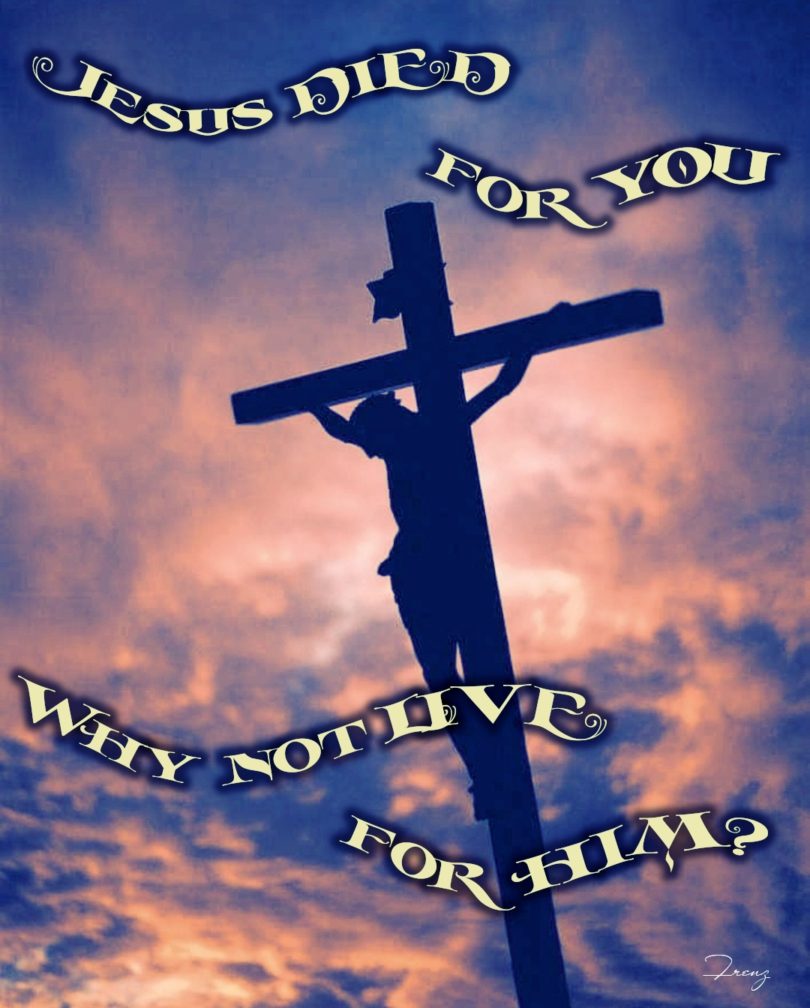
Image Analysis →
The image is a Christian-themed graphic, visually striking and emotionally charged. Here's a breakdown of its components:
* Central Figure: The Crucifixion: → At the heart of the image is the silhouette of Jesus Christ on the cross. The cross itself is a symbol of Christianity, immediately conveying the central tenet of the faith: the sacrifice of Jesus for the sins of humanity. The silhouette emphasizes the suffering and the ultimate act of love. The positioning of Jesus on the cross is a universal Christian symbol, meant to evoke a sense of reverence, sorrow, and hope.
* Color Palette and Background: → The background is a dramatic sky filled with colors that suggest a sunset or sunrise. The dominant colors are shades of blue and orange, which contrasts with the darkness of the cross and figure, which provides a dynamic atmosphere that adds to the emotional intensity of the scene.
* Textual Elements: → The image includes two key phrases, displayed prominently in a stylized font:
* "Jesus Died for You" These words are placed above the cross, directly linking Jesus's crucifixion to the viewer. The message is one of personal sacrifice and atonement for sins.
* "Why Not Live for Him?" This question is positioned below the cross, prompting the viewer to consider how they live their lives in response to Jesus's sacrifice. The question is a direct call to action, encouraging the viewer to live a life of faith and devotion.
* Overall Composition: → The image utilizes a simple composition, focusing on the silhouette of the cross and the surrounding sky. The arrangement is designed to be visually appealing, yet it directs the viewer's attention to the main message. The image evokes a sense of peace and solemnity while highlighting the central themes of sacrifice and redemption.
Message and Interpretation →
The image delivers a clear, concise message rooted in Christian faith:
* The Sacrifice of Jesus: → The image directly references the core belief of Christianity, that Jesus died for humanity's sins. The crucifixion on the cross is the visual representation of this sacrifice.
* Personal Connection: → The inclusion of "for you" in the message creates a personal connection. It emphasizes that Jesus's sacrifice was not just a general act but was meant for each individual who sees the image.
* Call to Action: → The final question, "Why Not Live for Him?", functions as a call to action. It prompts the viewer to consider a response to the sacrifice of Jesus. In a Christian context, "living for Him" typically means living a life of faith, following Jesus's teachings, and seeking a relationship with God.
Potential Impact and Usage →
The image aims to:
* Evoke Emotion: → It attempts to touch the viewer's heart, creating a sense of reverence, gratitude, and conviction.
* Share the Gospel: → The image serves as a simple but effective way to share the Christian message and introduce the core tenets of the faith.
* Encourage Reflection: → The image asks the viewer to pause and consider their relationship with God and how they are living their lives.
* Inspire Faith: → The image inspires or strengthens faith.
In Conclusion →
The image is a concise, visually impactful depiction of a Christian message. Through its use of iconic imagery (the cross) and direct textual messages, it conveys the core beliefs of Christianity and challenges the viewer to consider their faith and purpose. The overall effect is a call to faith.
The image is a digital composition with a Christian theme, intended to be inspirational or a message of faith and hope. Here's a detailed breakdown:
1. Visual Elements: →
* Background: → The background appears to be a blended, textured design. It gives the impression of water, representing the spiritual waters or a stormy time, or the clouds. The overall tone of the background is somewhat hazy, potentially suggesting mystery, the unknown, or the divine.
* Jesus Figure: → A depiction of Jesus Christ appears within the background with a close-up of his hand pointing towards the viewer. This visual element is central to the image's message, as it conveys a sense of reaching out, providing guidance, or offering a divine blessing.
* Text: → The image features overlaid text in various fonts and colors:
* "Stay Strong" →: This is the most prominent text, serving as a direct message of encouragement. It's written in a stylized blue font, possibly to contrast it with the darker tones of the background.
* "Jesus" →: The word "Jesus" is in pink/mauve font below the "Stay Strong", again adding to the message.
* "is coming soon" →: This text is in a similar font and color to the "Jesus" text. It is a direct reference to the Second Coming.
2. Overall Message and Theme: →
* Christian Faith & Hope →: The image is a Christian-themed piece. It seeks to offer comfort, encouragement, and hope to the viewer.
* Encouragement →: The "Stay Strong" message and the image of Jesus convey a sense of encouragement to keep the faith.
* The Second Coming →: The phrase "is coming soon" is a clear reference to the belief in the Second Coming of Jesus Christ, which is a central belief in Christianity. This suggests that the viewer should stay strong in faith, because the return of Jesus is imminent.
Interpretation and Possible Intended Audience →
This image is created for a Christian audience. The creator's purpose is to give assurance and reinforce belief in Jesus Christ and the promise of his return. The image could be used:
* As a social media post.
* As a wallpaper.
* As part of a religious presentation or sermon.
Overall Style →
The image is digitally created, with a blend of different elements. It is not highly realistic but uses artistic touches and a vibrant color palette to convey its message effectively.
The image is a Christian-themed graphic designed to encourage spiritual growth and resilience against temptation. It prominently features a Bible, a wooden cross, and text conveying a specific message.
Visual Elements →
* Bible: → The open Bible is the central visual element. The pages are spread open, suggesting active reading and engagement with scripture. The well-worn appearance of the pages implies frequent use and a deep relationship with the text. The gold gilding along the pages gives the Bible an old appearance.
* Cross: → A wooden cross rests on top of the open Bible. This is a strong symbol of Christianity, representing the sacrifice of Jesus Christ and the core beliefs of the faith.
* Background: → The background is a wooden surface. This neutral setting provides a clean backdrop that helps to draw focus to the central elements, namely the Bible and cross.
Text and Message →
The text is the most direct communicator of the image's message:
* "Fill your mind with God's Word" →: This phrase emphasizes the importance of studying the Bible and absorbing its teachings. It implies that the Bible should be a central focus in a Christian's life.
* "and you have no room for Satan's lies" →: This is the core message. It connects the act of studying the Bible to spiritual protection. It states that by filling one's mind with biblical truth, there is no space left for deceptive ideas (Satan's lies) that can lead to sin and spiritual harm.
Overall Interpretation and Purpose →
The image conveys a core Christian principle: spiritual warfare →. It suggests that Christians are engaged in a battle against spiritual forces of evil. The key to victory in this battle is to arm oneself with God's Word. It's a call to action, urging viewers to actively engage with the Bible as a means of spiritual protection and guidance. The image's simple design, the direct message, and the recognizable Christian symbols (Bible and cross) all combine to make it a powerful piece of inspirational content.
In Summary →
The image is a concise, visually appealing statement about the importance of scripture in the Christian faith. It encourages believers to engage with the Bible to strengthen their faith and protect themselves from negative influences.
The image is a Christian-themed motivational message that equates the application of God's Word with the acquisition of wisdom. It uses a strong visual metaphor to communicate the idea of finding freedom and enlightenment through religious devotion.
Visual Elements and Symbolism: →
* Subject: → The central figure is a person holding a Bible, with their hands secured by handcuffs. This is the core of the image's message.
* Bible: → The prominent presence of a Bible ("HOLY BIBLE" is visible) clearly indicates the source of the wisdom being promoted. It represents religious teachings, guidance, and spiritual truths.
* Handcuffs: → The handcuffs are the most striking visual element. They symbolize imprisonment, confinement, and constraint. The implication here is that by embracing God's Word, you're "handcuffed" to a life of faith and truth.
* Text: → The text is simple and direct:
* "The best way to gain wisdom." - This establishes the theme.
* "is by applying God's Word to your life." - This explicitly states the message: wisdom is found through implementing biblical principles.
* Color Palette and Lighting: → The image has a somewhat dark and serious tone, enhancing the gravity of the message. The soft lighting focuses on the person's hands and the Bible, drawing the viewer's attention to the key symbolic elements.
Interpretation and Meaning: →
The image is designed to inspire religious faith and devotion. The symbolism of the handcuffs may suggest that applying God's word to your life is the "best way to gain wisdom", a freedom from the prison of ignorance, sin, or worldly concerns. The image aims to communicate the following:
* The Power of Faith: → The image subtly suggests that true freedom and wisdom are found in adhering to God's word.
* Transformative Potential: → The message is about a transformative process of becoming wiser by living a life according to religious beliefs.
* Commitment: → The handcuffs are an indicator of commitment.
Target Audience: →
The image is clearly targeted at Christians or individuals open to Christian beliefs. It would likely be effective on social media, in religious publications, or in motivational Christian materials.
Overall Effectiveness: →
The image is visually compelling and uses clear symbolism to convey its message. It has the potential to be a powerful reminder of the importance of faith. The image is a concise and effective piece of Christian imagery.

Image Analysis: A Call for Truth and Moral Courage →
The image is a visually compelling piece with a clear message, primarily aimed at a Christian audience. It blends artistic elements with a powerful statement about the importance of truth-telling, even when it might cause discomfort.
Visual Elements: →
* The Sword: → The centerpiece of the image is a shining, ornate sword being held firmly in a hand. The sword represents truth, righteousness, and the power of the word. Swords are often used in Christian iconography to symbolize the "Sword of the Spirit," which is the word of God.
* The Hand: → The hand gripping the sword symbolizes faith, the strength to stand against opposition, and courage to hold onto truth.
* The Background: → The background features a gradient of colors, representing the clash between light (truth) and darkness (deception). The swirling colors imply chaos, conflict, and the challenges faced when speaking the truth.
* Overall Tone: → The image has a dramatic and determined tone. The visuals create a sense of importance and the weight of the message.
Textual Message: →
* Key Message: → The primary message conveyed is the importance of speaking the truth, even if it offends others. The image asserts that while it's natural to be concerned about hurting people's feelings, a greater concern should be the consequences of *not* speaking truth, namely leading others astray and the potential for "destruction" that can come from being deceived.
* Structure: → The text is divided into two key parts, creating a contrast. The first part tells the reader *what not to worry about*: "who will be offended if you speak the truth." The second part tells the reader *what to worry about*: "who will be misled, deceived, and destroyed if you don't." This structure is quite effective in emphasizing the critical nature of speaking the truth.
* Underlying Christian Themes: → The message resonates with core Christian values, such as:
* The importance of truth and honesty.
* The consequences of sin and deception.
* The need to protect others from being led astray.
* The calling to boldly proclaim the gospel.
Overall Interpretation →
The image is a call to action for those who believe in the Christian faith. It encourages them to overcome their fears and speak truth, recognizing that while honesty may be painful for some, the alternative (remaining silent) carries potentially devastating consequences for those who are misled. The image suggests that the potential for spiritual harm or being "destroyed" is far more critical than the risk of causing offense. The image provides a visual reminder that their faith involves taking a stand for truth and against deception.
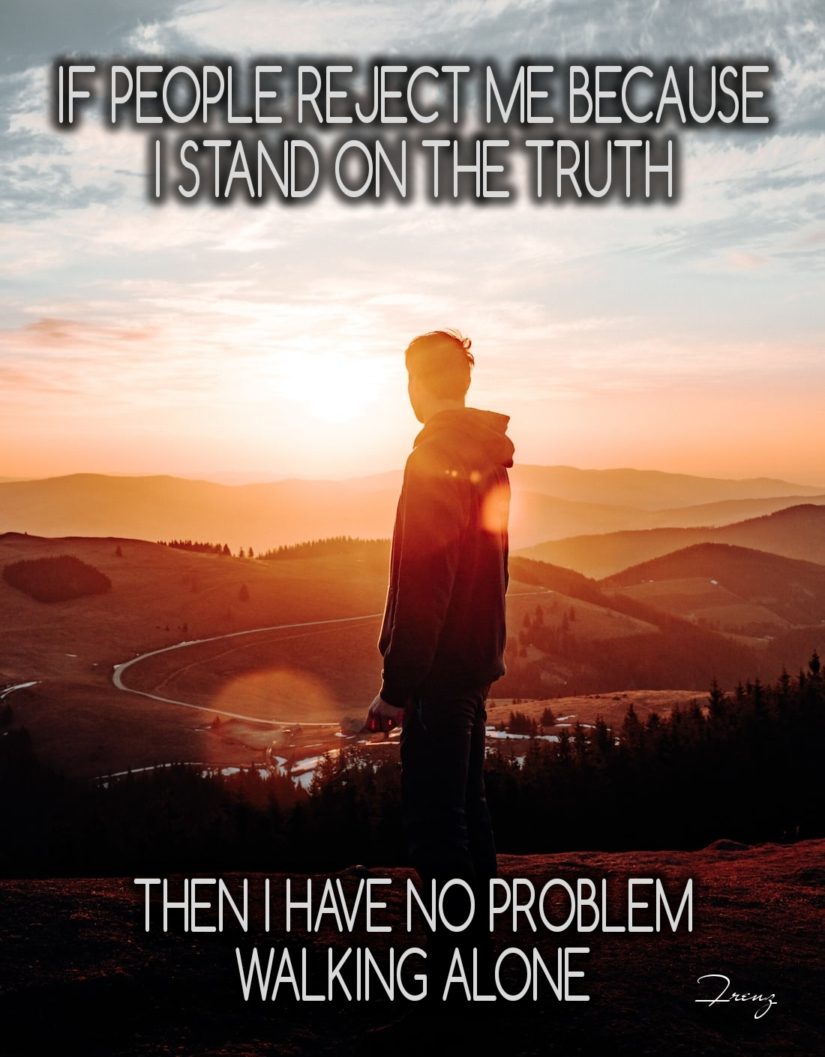
The image conveys a message of self-assuredness, integrity, and a willingness to be independent. It suggests that the speaker prioritizes truth and personal conviction over social acceptance. The visual elements (scenic background) amplify this theme, creating a sense of solitude, contemplation, and strength.
Visual Elements and Their Interpretation →
* The Scene: → A person is seen standing on a hill, overlooking a beautiful landscape during sunrise or sunset. This background is important for the image to work; it is scenic, it provides an ambiance of solitude. It's also a powerful image because a hill means an elevated perspective.
* The Silhouette: → The person in the image is rendered as a silhouette. They are facing away from the viewer, adding a layer of mystery and anonymity. This emphasizes their isolation and decision to go their own way. It symbolizes a figure who has made a choice, and is unconcerned with the views of others.
* Lighting and Color: → The warm, golden light of the sunrise/sunset creates a sense of hope and optimism. It might also symbolize the illumination of truth.
Text Analysis →
* The Core Message: → The central message, "IF PEOPLE REJECT ME BECAUSE I STAND ON THE TRUTH, THEN I HAVE NO PROBLEM WALKING ALONE," is a strong declaration of independence. It suggests that the speaker values truth and authenticity above being liked or accepted by others. It's a defiant stance, but one rooted in a clear moral compass.
* Rejection as a Consequence: → The "rejection" of people is framed as a possible consequence of upholding the truth. This implies that speaking the truth might be unpopular or even unwelcome in certain circumstances. This is a challenging truth that can often be hard to grasp, but the image offers some support.
* Embrace of Solitude: → The willingness to "walk alone" is not presented as a burden but as an acceptance and affirmation of the speaker's convictions. There's a subtle strength here: the ability to stand by one's principles, even if it means isolation.
Overall Message →
The image encourages viewers to:
* Value truth above popularity: → It suggests standing up for one's beliefs, even if it means going against the crowd.
* Embrace self-reliance: → It promotes the idea of finding strength within oneself rather than seeking external validation.
* Find comfort in solitude: → It implies that being alone, if it is a result of staying true to oneself, is not something to be feared.
Potential Interpretations and Audience →
* Religious/Spiritual: → The image resonates with religious values (especially Christian), emphasizing the importance of faith, upholding morals, and not being afraid to go against the grain of popular opinion. The "truth" is a core concept in many religions.
* General: → The message speaks to anyone who feels alienated or misunderstood for their beliefs, values, or choices. It could be applied to various ethical and social contexts.
Conclusion →
The image is a simple yet effective statement about integrity, authenticity, and the courage to stand alone for what one believes in. The visual elements work in harmony with the text to create a powerful message of self-assurance and a willingness to walk one's own path.
The image depicts a tender and intimate embrace, rendered in a soft, almost ethereal style. Here's a breakdown of the key elements and their potential Christian interpretations:
1. The Embrace: →
* The Central Action: → The central focus is the act of embracing. This gesture universally symbolizes love, comfort, security, connection, and compassion. In a Christian context, the embrace holds profound meaning. It can be interpreted as:
* God's Love for Humanity: → The image evokes the concept of God's unwavering love, acceptance, and welcoming embrace for all people. It embodies the Gospel message of forgiveness and salvation.
* Jesus's Embrace: → The embrace can be viewed as the embrace of Jesus. The New Testament speaks of Jesus as the shepherd who gathers his flock.
* Community and Unity: → The embrace can represent the bond between Christians, the fellowship and mutual support that's meant to characterize believers.
* Comfort in Times of Need: → The embrace offers solace and strength, suggesting a place of refuge and safety during times of personal hardship, doubt, or sorrow.
2. The Figures: →
* Ambiguity: → The figures are depicted in a way that is not highly detailed, potentially with the intent of allowing the viewer to project their own meaning onto the image.
* Symbolism: →
* Jesus and the Believer: → The image is often interpreted in a way to be Jesus embracing a believer.
3. The Background and Style: →
* Soft Lighting and Colors: → The use of soft lighting, muted colors (typically blues, purples, and whites), and a slightly blurred effect creates a sense of peace, tranquility, and otherworldliness. This style is often used to evoke a spiritual or heavenly atmosphere.
* A Sense of Mystery: → The ambiguity of the figures and the background adds a sense of mystery and draws the viewer inward.
4. The Text Overlay: →
* "The best is yet to come": → This phrase is a powerful affirmation of faith and hope, that also serves as the core message of the image. It holds several layers of meaning:
* Eternal Life: → It speaks to the Christian belief in eternal life after death. The "best" is often interpreted as the promise of heaven and a relationship with God.
* Hope in the Present: → It reminds Christians that even in the face of suffering or challenges, there is hope for a brighter future.
* Trust in God's Plan: → It encourages believers to trust in God's plan, knowing that He is working all things for their good.
Overall Interpretation in a Christian Context: →
The image, combined with the text, provides a message of hope, comfort, and faith. The core message is of God's love, His presence, and the promise of a fulfilling future. The image can be used as a visual representation of many of the most important aspects of the Christian faith: a deep sense of belonging, that God is always by our side and in the end, the best is yet to come. It's a reminder that God's love, which comes by way of Jesus is everlasting.
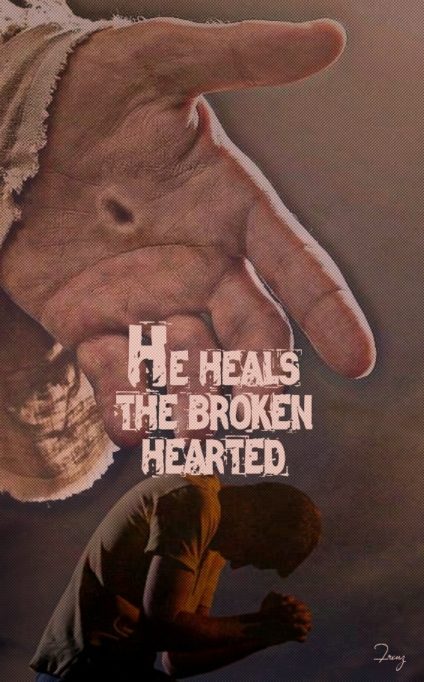
Image Analysis: Comfort and Healing in the Christian Faith →
The image presents a powerful visual message rooted in Christian faith, conveying themes of hope, healing, and divine intervention. The composition and symbolism work together to create a compelling statement about the nature of God's love and care for humanity.
Visual Breakdown: →
* Dominant Element: The Hand: → The most prominent feature is an enormous, up-close depiction of a hand, with a visible wound in the palm, a clear reference to the crucifixion of Jesus Christ. The hand's size and position convey a sense of protection and power. The torn fabric attached to the hand reinforces the imagery of Jesus Christ.
* Subordinate Element: The Praying Figure: → Below the hand, a silhouette of a person is shown in a posture of prayer. The person is bowed down kneeling, with hands clasped in a gesture of supplication. This posture expresses humility, vulnerability, and dependence.
* Text Overlay: → The words "He Heals the Broken Hearted" are prominently displayed between the hand and the praying figure. This phrase, taken from the Bible (Psalm 147:3), is the core message of the image, directly connecting the visual elements.
* Color Palette and Atmosphere: → The image is predominantly monochromatic, with muted colors and a blurred background, which helps to draw attention to the main figures and the text.
Symbolism and Interpretation: →
* The Hand and the Wound: → The hand with the wound is a powerful symbol of Jesus Christ's sacrifice. The wound represents the suffering and death that Jesus endured on the cross for the sins of humanity. The size of the hand conveys God's protection, grace, and strength.
* The Praying Figure: → The bowed-down figure symbolizes the human condition – one of dependence on God. The posture represents a person seeking solace, healing, and guidance from God. It suggests that the healing begins with an acknowledgement of one's need and a turning towards God.
* "He Heals the Broken Hearted": → This phrase is the central message of the image. It offers comfort to those who are experiencing grief, sadness, loss, or any form of emotional pain. The image visually reinforces the message that God is not only aware of human suffering, but actively involved in healing.
Overall Message: →
The image conveys a clear message of hope, faith, and healing within the Christian faith. It communicates that:
* God is Compassionate: → The image expresses God's compassion and care for those who are hurting. The sacrifice of Jesus, represented by the hand, shows God's willingness to suffer for humanity.
* God Offers Healing: → The message states that God is able to heal the brokenhearted.
* Turning to God in Prayer: → The bowed figure, coupled with the "He Heals the Broken Hearted" text, suggests that seeking God in prayer is a path to healing and comfort.
* God is Protective: → The large hand and the pose of the individual convey the feeling of being sheltered.
Conclusion: →
The image is a powerful visual representation of core Christian beliefs. Through its use of symbolism, text, and composition, it offers a message of hope, healing, and divine love, providing comfort and reminding viewers of the central role of faith and prayer in times of difficulty.

Visual Composition: → The image presents an open, aged book, illuminated by a warm, soft light, suggesting a light source such as a candle, lamp, or the sun through a window. A pen rests on the book's open pages, adding a sense of antiquity and contemplation. The background is blurred and dark, emphasizing the book as the focal point. The composition creates a feeling of intimacy, reverence, and mystery.
* Textual Elements: → The image is overlaid with text, giving the image its significance. The text is written in a bold, somewhat distressed font, creating a sense of age and importance. The text begins with "AN ANCIENT BOOK WRITTEN MORE THAN TWO THOUSAND YEARS AGO." This text sets the context for the image, implying that the book in the picture is very old and historically significant. Beneath this, the text reads, "BUT TRUTH HAS NO EXPIRATION DATE." This is the primary message, connecting the age of the book to the idea that the truth is timeless and enduring.
* Symbolism and Interpretation: →
* The Book: → The open book symbolizes knowledge, wisdom, and tradition. Its age, which is written in the image, indicates something valuable and time-tested.
* The Pen: → The pen suggests writing, authorship, and the act of putting thoughts and ideas onto paper. This adds to the sense of the content that is being presented.
* Light and Darkness: → The play of light and shadow creates a sense of drama and points to the importance of seeking truth.
* The Message: → The core message of the image is the idea that even though something is ancient, its value may not diminish over time.
Article: →
The Enduring Power of Truth: A Timeless Message from an Ancient Text →
In a world constantly bombarded with new information, evolving perspectives, and fleeting trends, the image of an open book bathed in the warm glow of light offers a powerful and thought-provoking message. The image, coupled with its accompanying text, invites us to reflect on the nature of truth, knowledge, and their enduring relevance.
The image's words, "AN ANCIENT BOOK WRITTEN MORE THAN TWO THOUSAND YEARS AGO," immediately establish a sense of historical gravitas. This sets the stage for a discourse on the power of time and the enduring legacy of wisdom. The book, its pages open, invites us to explore its contents, suggesting that within its ancient text lie truths that have resonated for centuries.
The image's final statement, "BUT TRUTH HAS NO EXPIRATION DATE," is the heart of the message. This simple yet profound statement reminds us that genuine truth transcends time. Unlike perishable goods or outdated ideas, truths that are truly fundamental have the power to enlighten, inspire, and guide us through the ages. The image implies that the book contains a message of timeless validity.
This message offers a timely reminder in an era of rapid change. It encourages us to consider the source of the information we consume. It suggests that, even in the face of modernity, there is value in the wisdom of the past, in those ideas and principles that have proven their ability to endure.
The image also speaks to the importance of the book itself, whatever its text. It suggests that there are messages from the book that were meant to remain for future generations. It is up to us, with our open minds, to seek the meaning of the truth.
In conclusion, the image of the open book, and the accompanying text, presents a powerful meditation on the nature of truth. It is a message that encourages us to embrace the enduring value of knowledge, and the essential worth of timeless wisdom. In a world that is always changing, this message is a beacon of hope.
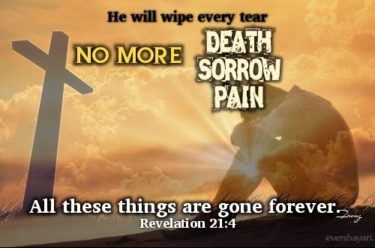
The image is a Christian visual representation of hope, solace, and the promise of eternal life. It presents a message of comfort, assuring viewers that suffering and pain will be eliminated in the afterlife. The overall tone is one of optimism and reassurance, drawn from the Christian faith's belief in a loving God and the ultimate triumph over sorrow and death.
Key Elements and Their Symbolism: →
* The Cross: → The prominent cross in the background is the central symbol of Christianity. It represents the crucifixion of Jesus Christ and the Christian belief in his sacrifice for the sins of humanity. It's a powerful symbol of faith, redemption, and the ultimate victory over death. The positioning of the cross, silhouetted against the sky, suggests transcendence and the hope of eternal life beyond earthly suffering.
* Figure in Prayer/Sorrow: → The person, slumped in a position which could be described as sorrow or in prayer, represents a universal human experience of grief, sorrow, and despair. It embodies the suffering that is endemic to life. The figure is presented as a human silhouette, possibly meant to identify with every person. This figure's inclusion makes the text even more comforting.
* Words: → The words express the ultimate truth and core message of the image. They are meant to comfort and show the ultimate promise.
* "He will wipe every tear" →: This phrase is taken directly from the Bible (Revelation 21:4), and conveys a sense of loving care and comfort. It describes God as being compassionate and involved in comforting the believers.
* "NO MORE DEATH, SORROW, PAIN" →: These are the key promises for eternity. They are the ultimate words of reassurance, describing the eternal freedom from suffering, the elimination of death, pain and despair. They express the ultimate good.
* "All these things are gone forever" →: This is also from Revelation 21:4, and it echoes the promise of ultimate peace, that these things are in the past and can not hurt any longer.
* Revelation 21:4: → The citation of Revelation 21:4 grounds the image's message in biblical authority, linking it to a specific promise within Christian scripture. Revelation 21 describes the new heaven and the new earth, and this verse is a vital part of its message of renewal.
* Color Palette and Atmosphere: → The warm color palette, with the hues of orange, yellow, and hints of red, contributes to the overall feeling of hope and warmth. The sunrise or sunset imagery in the background often symbolizes new beginnings, the end of darkness, and the dawning of a brighter future. The soft, diffused light also adds to the sense of peace and tranquility.
Interpreting the Message: →
The image's message can be interpreted as a message of hope and comfort:
* Addressing Suffering: → The image acknowledges the reality of pain, sorrow, and death in the world. It validates the experience of those who are suffering or grieving.
* Offering Hope: → It presents the Christian belief in the afterlife, the end of suffering, and the promise of a new heaven and earth.
* Providing Comfort: → By focusing on the verses from Revelation, the image provides comfort and reassurance, telling the viewer that God is a comforting presence and that pain and sorrow will not last forever.
* Emphasizing Faith: → It encourages faith in God and trust in his promises of comfort, healing, and everlasting life.
Target Audience: →
The target audience for this image are Christians, especially those who may be going through difficult times, experiencing grief, or seeking comfort in their faith. It could also appeal to those interested in spirituality and looking for reassurance.
Overall, the image is a visual representation of faith, comfort, and the promise of a future free from pain. It encapsulates the Christian belief in the ultimate triumph over suffering and offers hope to those who are struggling.
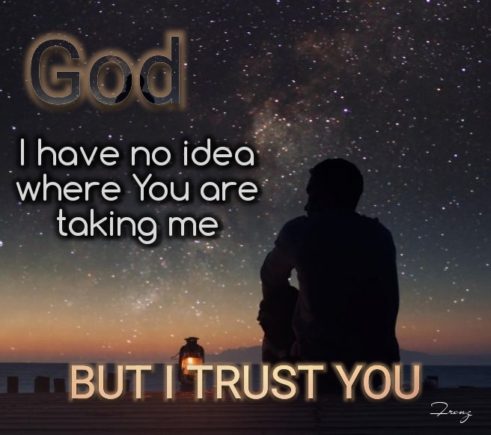
The image is a visually compelling Christian-themed meme or inspirational graphic. It uses a combination of imagery and text to convey a message of faith and trust in God. Here's a breakdown of the elements:
* Visuals: →
* Night Sky: → The backdrop is a breathtaking night sky filled with stars. This represents vastness, mystery, and the unknown. It is typically associated with a sense of awe and wonder.
* Silhouette of a Person: → A person is silhouetted, sitting and looking out towards the horizon/night sky. This figure symbolizes humanity, possibly a follower, gazing into the unknown, showing vulnerability and introspection.
* Lantern: → A lantern is placed in the foreground, suggesting a source of light and hope amidst the darkness.
* Color Palette: → A blend of dark, muted blues, oranges, and yellows evokes a sense of serenity and calm.
* Text: →
* "God" →: Placed at the top, the word "God" is emphasized. This is immediately establishes the context of the message as religious or spiritual.
* "I have no idea where You are taking me" →: This phrase expresses the speaker's uncertainty about the future. It acknowledges the challenges and unknowns of life, and the follower's surrender to God.
* "BUT I TRUST YOU" →: The contrast in this statement is crucial. Even in the face of uncertainty, the speaker expresses unwavering faith and trust in God's plan.
* Overall Message: → The image's core message revolves around trust in God, even when the path ahead is unclear. It encourages viewers to surrender to God's guidance and to maintain faith despite the unknowns of life.
Article: →
Navigating the Unknown: A Lesson in Faith and Trust →
In moments of uncertainty, when the path ahead is shrouded in mist and the destination is hidden from view, the human spirit often grapples with doubt and fear. But within the realm of faith, there exists a profound understanding that even in the darkest of nights, we are not alone. This is the message at the heart of a deeply moving and evocative image, one that speaks to the core of our relationship with a higher power.
The image captures the essence of this faith beautifully. It is a stark reminder of the Christian value, built on visuals and textual elements.
The backdrop is a starlit sky, vast and infinite, representing the enormity of the unknown and the boundless capacity of God's grace. A silhouette of a human figure, perhaps a follower, sits gazing into the night, embodying the sense of vulnerability and introspection. The presence of a lantern provides a source of light and hope in the darkness, illuminating the path, even if the destination is unclear.
The words are powerful. The opening phrase, "God," sets the stage for a conversation of faith. The words "I have no idea where You are taking me" acknowledge the common human experience of navigating life's uncertain passages. It is in these moments, when the future is uncertain, that the true test of faith arises. The closing words, "BUT I TRUST YOU," stand as a testament to the unwavering faith that underpins a believer's relationship with God. It is a bold statement that demonstrates the ability to place our complete faith in God's will, surrendering to his guidance even when the path is unclear.
This image offers a timeless message, that speaks to those seeking guidance, or those seeking to deepen their relationship with God. It is a reminder that while we may not always understand the path, we can find comfort and strength in the unwavering belief that there is a divine force at work. The image inspires viewers to embrace faith, even in the face of uncertainty, and to trust in God's plan for their lives. It is a simple yet profound lesson, resonating deeply with anyone who has ever felt lost or uncertain about the journey ahead.
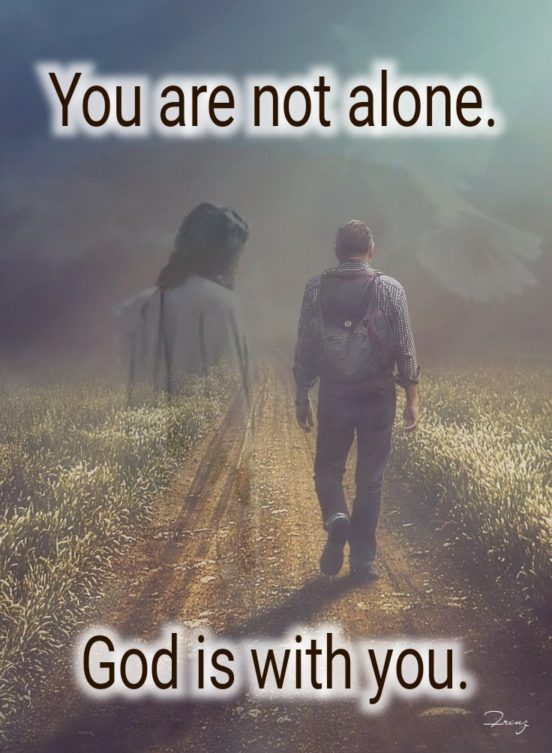
The image is a Christian-themed inspirational artwork. It features:
* A Man Walking: → The central figure is a man, seen from the back, walking down a dirt path. He wears a backpack, suggesting a journey or a life path. His posture and clothing are casual, indicating he is an ordinary person.
* A Ghostly Figure: → Beside the man, walking in the same direction, is a translucent, ethereal figure. Based on the appearance, this figure represents Jesus. This figure is faintly visible, suggesting a spiritual presence.
* The Path and Landscape: → The man and Jesus are walking on a path in a field of tall grass, symbolizing the journey of life. The landscape is softly lit, creating a serene and somewhat mysterious atmosphere.
* Text Overlay: → The image is overlaid with the text "You are not alone. God is with you." This message is placed prominently at the top and bottom, reinforcing the central theme.
* Overall Tone: → The image has a gentle, hopeful, and comforting tone, designed to reassure and inspire.
Detailed Article: Finding Comfort in Faith - You Are Not Alone →
In a world often filled with uncertainty, challenges, and moments of profound solitude, the message of "You are not alone. God is with you" provides a beacon of hope and comfort for many. This simple yet powerful statement resonates deeply within the Christian faith, offering solace and reassurance to those navigating life's complex journey.
The image itself is a poignant visual representation of this message. It depicts a solitary figure walking along a path, a common metaphor for the course of life. The presence of a translucent, ghostly figure alongside him serves as a powerful visual symbol of God's presence. This subtle but significant detail reminds us that we are never truly alone, even in our most isolated moments.
This imagery suggests a profound truth: that in moments of doubt, fear, or struggle, we are not abandoned. Instead, we are accompanied by a divine presence, a source of strength, guidance, and unwavering support.
The Message's Significance →
* Comfort in Times of Trouble: → The message provides comfort in the face of adversity. When dealing with loss, illness, hardship, or loneliness, knowing that a higher power is with us can provide a sense of peace and the strength to persevere.
* Guidance and Support: → The belief in God's presence can offer guidance in decision-making and in navigating the complexities of life. It suggests a source of wisdom, comfort, and encouragement.
* Hope and Resilience: → This message fosters a sense of hope, reminding individuals that they are not adrift in the world. It can inspire a spirit of resilience, empowering people to overcome obstacles and persevere in their faith.
* The Universal Human Experience: → The feeling of being alone is a shared human experience. The message acknowledges and validates that feeling, offering the promise of connection and belonging.
Living the Faith →
The promise that God is with us is not merely a passive statement but an active call to live a life in accordance with those beliefs:
* Prayer and Reflection: → Connecting with God through prayer, meditation, and reflection is central to experiencing God's presence. This helps to increase awareness, find clarity, and express gratitude.
* Community and Fellowship: → Connecting with others who share the same faith, whether in religious services or support groups, helps foster a sense of belonging.
* Acts of Service: → Demonstrating faith through actions, like helping others, shows love, and serves as an outlet for generosity and compassion.
* Embracing the Journey: → The image of walking along a path signifies the journey of life. Through times of both joy and difficulty, faith asks individuals to trust God, and live with a firm belief that this walk will always involve God.
Conclusion →
The image with the message "You are not alone. God is with you" encapsulates a core tenet of Christian faith. It conveys the idea of hope, reassurance, and the unending presence of divine support. It serves as a reminder that, even in our loneliest moments, we are part of something bigger, and never truly alone on our journey through life. It is a message of enduring strength, offering comfort, encouragement, and unwavering hope to all who embrace it
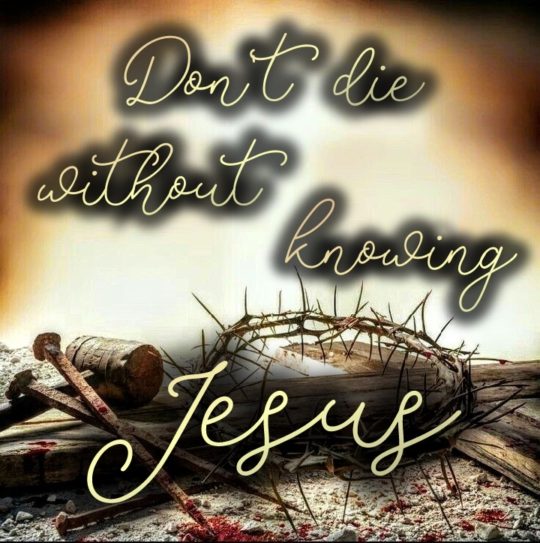
The image is a powerful and emotionally charged expression of Christian faith. It visually communicates the importance of having a relationship with Jesus Christ before death. It uses symbolic imagery associated with the crucifixion to evoke empathy and reflect the Christian belief in the sacrifice Jesus made for humanity's salvation.
Visual Elements & Their Significance →
* Text: → The central message is conveyed in elegant script: "Don't die without knowing Jesus." This is a direct and urgent plea to the viewer. It underscores a belief that the most important goal of life is to come to know Jesus Christ.
* Background: → A blurred, light-filled background provides a soft, hopeful backdrop. It could suggest a sense of divine presence or the afterlife and is more neutral in its religious context.
* Foreground Imagery: → The foreground is rich in Christian symbolism, evoking the final hours of Jesus:
* The Crown of Thorns: → This is a direct reference to the crown that Roman soldiers placed on Jesus's head as a mockery during the events leading up to his crucifixion. The thorny crown symbolizes pain, suffering, and humiliation, representing the immense suffering Jesus endured.
* The Cross/Wood: → The planks of wood likely represent part of the cross that Jesus was crucified on. The visible blood on them amplifies the pain and sacrifice.
* The Nails and Hammer: → The presence of nails, and the hammer that would have been used to drive them, reinforces the reality of the crucifixion and the physical suffering endured by Jesus. These elements create a visceral reminder of the act of sacrifice.
* Red/Blood: → The presence of blood is meant to call to mind the blood of Christ shed on the cross, seen as a symbolic means to redeem and cleanse humanity.
Interpretation and Message →
The image's core message is a call to faith, a gentle reminder to consider one's spiritual state.
* Urgency of Faith: → The phrase "Don't die without knowing Jesus" highlights the importance of accepting the Christian message before the end of life. It's a call for people to examine their beliefs and, if they haven't already, to embrace Jesus Christ as their Savior.
* Jesus' Sacrifice: → The image's symbolism underlines the significance of Jesus's death on the cross. It is a visual testament to the pain he suffered and the price he paid for humankind's sins.
* Promise of Salvation: → It suggests that by believing in Jesus, a person can receive salvation and eternal life. The background is a hopeful image of the afterlife, indicating that there is a greater existence after death.
* Invitation to Relationship: → The use of the word "knowing" can be interpreted as more than just intellectual understanding. It emphasizes the development of a personal relationship with Jesus Christ, built on faith, love, and trust.
Overall Tone →
The image is somber yet hopeful. The focus is on the pain and the sacrifice of Jesus, but it has a hopeful tone, suggesting the potential for redemption and eternal life. The script is elegant and inviting, not harsh or demanding.
Conclusion →
This image is designed to resonate with Christians and those open to the Christian faith. It is a poignant reminder of the sacrifice of Jesus, a call to consider one's relationship with him, and a hopeful message of redemption and eternal life. It aims to inspire contemplation, reflection, and potentially the beginning of a spiritual journey.

The image is a Christian motivational piece, aiming to inspire hope and faith. It combines a scenic landscape with a powerful message drawn from scripture. The aesthetic is soft and uplifting, using warm colors and a contemplative figure to convey a sense of peace and reassurance.
Visual Elements →
* Background: → The backdrop is the focal point of the image. A dramatic sky dominates the top half, transitioning from deep blues and purples to vibrant oranges and yellows, suggesting a sunset or sunrise. This color palette creates a sense of awe and a feeling of the divine. The landscape below the sky is blurred, hinting at rolling hills or a body of water bathed in the golden light, offering an expansive and hopeful vista.
* Figure: → A silhouetted figure stands on a rocky outcrop, facing the horizon. The person's back is to the viewer, emphasizing their focus on the view. The figure's posture suggests contemplation and reflection, possibly prayer or meditation, reinforcing the connection to faith.
* Text: → The image's main message is delivered in elegant, cursive script. The key phrases "You're going to make it" and "Trust Me" are large and prominent, drawing the viewer's attention. The words are layered over the background, and their placement, particularly the way they flow around the figure, creates a sense of visual depth. The text is the cornerstone of the message, and the overall feel is of a personal message from God.
* "You're going to make it" →: This statement offers a sense of affirmation, encouragement, and hope.
* "Trust Me" →: This underscores the importance of faith and reliance on a higher power for guidance and support.
* Scriptural Reference: → The phrase "Psalm 23" is written on the bottom of the image. This provides context, tying the message to a well-known and beloved psalm, which speaks of God as a shepherd who provides and protects.
Message and Interpretation →
The image's core message is one of reassurance and encouragement, specifically rooted in Christian faith.
* Focus on Faith: → The image urges the viewer to trust in God, which is a central theme in Christianity. The message of "making it" implies overcoming challenges and finding success in life.
* Hope and Perseverance: → The combined elements suggest that, with faith and trust, one can successfully navigate life's journey and ultimately achieve a sense of fulfillment.
* Comfort and Support: → The image aims to provide comfort, support, and a reminder of God's constant presence and care. It's a message of hope meant to resonate with individuals in times of difficulty, promoting inner strength.
Overall Impression →
The image is a well-crafted piece of Christian art that merges visuals and text to create a message of faith, hope, and encouragement. It is meant to uplift and support viewers, providing a sense of peace and the reassurance of a benevolent presence in their lives.
Image Analysis: A Visual Representation of Christian Faith →
The image is a digitally rendered artwork that prominently displays Christian symbolism and a well-known scriptural message. Let's break down its components:
* Central Figure: → The most striking element is the figure of Jesus Christ. He is depicted in traditional Christian iconography:
* Appearance: → He has long hair, a beard, and is wearing flowing robes, typical of artistic representations of Jesus.
* Gaze: → He is looking towards the horizon, symbolizing the future, hope, or the ultimate goal of faith.
* Staff: → He is holding a staff, which can be interpreted as a symbol of guidance, shepherding his flock, or authority.
* The Cross: → A prominent Christian symbol, the cross, stands in the background. It's a direct reference to the crucifixion of Jesus, a central event in Christian theology, representing sacrifice, redemption, and salvation.
* Background and Lighting: → The background is a vibrant, ethereal sky with a sunrise or sunset effect.
* Colors: → The warm, glowing colors suggest hope, peace, and the presence of God.
* Light: → The bright light emanating from around Jesus represent divine illumination, the presence of the Holy Spirit, or the glory of God.
* Text: → The words "IF GOD IS FOR US, WHO CAN BE AGAINST US?" are superimposed on the image. This is a direct quote from Romans 8:31 in the Bible. This verse encapsulates a core tenet of Christian faith: believers are protected and supported by God, and thus, they need not fear opposition.
Christian Interpretation and Significance →
The image's elements work together to convey a powerful message of Christian faith:
* Faith and Assurance: → The verse, along with the image of Jesus, promotes faith in God's unwavering support. It assures Christians that their ultimate victory is secured, regardless of the challenges they face in the world.
* Hope and Encouragement: → The vibrant colors and the figure of Jesus provide encouragement to believers. It serves as a visual reminder of the promises of salvation, peace, and eternal life.
* Identity and Belonging: → The image is a powerful way for Christians to connect to their identity, showing them they belong to a community united by faith in Christ. The image acts as a symbolic depiction of salvation, peace and eternal life.
Overall Impact →
This image is intended as a source of inspiration, comfort, and encouragement for Christians. It's a visual representation of their beliefs, providing a tangible and aesthetically pleasing reminder of God's love, protection, and the hope of salvation. The use of the direct Bible quote, combined with iconic Christian imagery, makes the message clear and easily understood by those familiar with the Christian faith. The art is meant to reassure believers that they are never truly alone, and that their faith and good deeds are rewarded.
Image Analysis: "God Will Direct Your Steps" →
The image is a powerful visual representation of faith, guidance, and the Christian concept of finding direction in life through God. Here's a breakdown of its elements:
1. Central Message: →
* The dominant text, "God will direct your steps," is the core message. It directly expresses the belief that God guides and provides direction in the lives of believers. This concept is frequently echoed in Christian teachings and scriptures, especially in the Book of Proverbs.
2. Visual Elements and Symbolism: →
* The Person: → A lone figure stands in a field, facing a cross. This represents an individual, a believer, in a moment of reflection or seeking guidance. The person's posture—turned towards the cross—suggests a connection to their faith and a willingness to follow God's path.
* The Cross: → A large, clear silhouette of the cross with the figure of Jesus crucified on it is prominently displayed. The cross symbolizes Christ's sacrifice for humanity, the core of Christian faith. It signifies redemption, salvation, and the ultimate example of love and selflessness.
* The Field: → The field, often depicted as a landscape of tall grass or wheat, can represent life's journey. The vastness of the field could indicate the complexity and choices one faces, while the openness suggests possibilities and the pursuit of a meaningful existence.
* The Sky and Colors: → The sky's color gradient of a bright sunset or sunrise plays a crucial role. The sunset or sunrise often symbolizes hope, promise, new beginnings, and God's presence and warmth. The vibrant hues can also indicate the glory of God and the power of faith.
* The Lighting: → The lighting creates a sense of spiritual awakening, guiding the viewer's focus.
3. Overall Interpretation: →
The image conveys a message of faith, trust, and reliance on God's guidance. It suggests that the individual is searching for purpose or needs direction in life. By focusing on the cross, the person is reminded of Jesus' sacrifice and the foundation of the Christian faith. The message implies that if one places their trust in God, He will guide them, providing direction for their steps.
4. Effectiveness of the Image: →
* Visual Appeal: → The artwork is visually appealing. The combination of the vibrant sky, the lone figure, and the text creates a compelling composition.
* Clarity of Message: → The message is direct and easy to understand. The visual symbols, combined with the text, reinforce the central theme of divine guidance.
* Emotional Impact: → The image evokes feelings of peace, hope, and faith. It invites the viewer to contemplate their own spiritual journey and consider the role of God in their life.
In Conclusion: →
The image is a beautiful and effective expression of Christian faith, offering a message of guidance, comfort, and hope. It is a call to trust in God's plan and find direction in life by following the teachings of Christ. The visual elements work together to create a powerful and memorable image for believers.
Image Explanation: "Temporal World, Eternal Life" →
The image is a visually striking representation of a Christian message, centered around the contrast between the fleeting nature of earthly existence and the promise of eternal life through faith in Jesus Christ. Let's break down the key elements:
* Cross: → A large, wooden cross dominates the background. It's a powerful symbol of Christianity, representing the sacrifice of Jesus Christ for the sins of humanity. The position in the background indicates it is the root cause of the faith.
* Light: → Behind the cross, and radiating around it, there's a brilliant, golden light. This light symbolizes divinity, the presence of God, and hope. It also signifies the illumination that comes from faith.
* Bread and Wine: → In the foreground are elements commonly associated with the Christian sacrament of communion (Eucharist). The bread represents Jesus's body, and the wine represents his blood. These elements symbolize the spiritual sustenance that believers receive through faith and participation in the sacrament.
* Wheat and Grapes: → These elements are connected to the communion but are a more common reminder of the "harvest", which is used to represent the fruits of faith and devotion to God, the harvest of souls or a bountiful life given by God.
* Text: → The image is overlaid with two key phrases:
* "This world is Temporal": This phrase reminds viewers that earthly life is temporary, subject to change and eventual end.
* "Life in Jesus is Eternal": This is the central message. It proclaims that through faith in Jesus, believers are offered eternal life, a permanent existence with God.
Article: The Temporal and the Eternal: A Christian Reflection →
In a world marked by change, uncertainty, and the inevitable passage of time, the image provides a powerful message for those who seek purpose and meaning. The image acts as a visual sermon on the contrast between the temporal and the eternal:
The Transient Nature of Earthly Existence →
The phrase "This world is Temporal" underscores a fundamental truth of human experience. Our time on Earth is limited. Everything we see, feel, and experience in this physical realm is subject to change and eventual decay. The image reminds us that material possessions, worldly achievements, and even the beauty around us are ultimately fleeting.
This doesn't imply that life on Earth is without value. Rather, it encourages us to see beyond the material and to seek something more enduring.
The Promise of Eternal Life Through Jesus →
The image's core message lies in the promise of "Life in Jesus is Eternal". This concept is at the heart of Christian faith. It states that through believing in Jesus Christ, accepting his sacrifice, and living according to his teachings, one can receive eternal life.
The elements representing communion—the bread and wine—are key in the image. They visually represent the spiritual sustenance that believers gain through faith.
Living with an Eternal Perspective →
The image urges us to live our lives with an eternal perspective. This means:
* Focusing on Values: → Prioritizing things that have lasting value, such as love, compassion, forgiveness, and faith.
* Seeking Spiritual Growth: → Nurturing a relationship with God through prayer, scripture reading, and worship.
* Living a Life of Purpose: → Recognizing that our actions and choices have significance, both in the present and the future.
The message is not simply about the afterlife. It's also about how we live our lives *now*. It's an invitation to find meaning, purpose, and hope in the midst of a world that can sometimes feel transient and fleeting.
Conclusion →
The image is a compelling reminder of the Christian faith. It offers a perspective that transcends the limitations of the temporal world, providing believers with a foundation of hope, a call to a life of purpose, and the promise of an eternal inheritance. It serves as a beautiful reminder that while this world is temporary, the life offered through Jesus is eternal.
Image Analysis: "God is Greater" →
The image is a visually powerful representation of a core Christian belief: that God's power, love, and presence transcend the challenges and difficulties of life. It uses symbolic imagery to communicate this message in a deeply resonant way.
Visual Elements & Symbolism: →
* Silhouette of a Person Kneeling: → This central figure is a silhouette, making them universal. The kneeling posture is a posture of prayer, humility, and submission. It suggests someone in a moment of vulnerability and seeking solace. This is a powerful visual cue for viewers to connect with the message, regardless of their personal background.
* Large Cross: → The prominent cross is the defining symbol of Christianity. It represents the sacrifice of Jesus Christ, his death, and ultimately, his resurrection. The cross signifies redemption, forgiveness, and hope. Its size and central placement emphasize its importance as a beacon of faith and divine presence. The cross appears to glow, perhaps illuminated by the setting sun or heavenly light.
* Sunset/Sunrise Background: → The background presents a gradient of colors that suggests either a sunset or a sunrise. This adds multiple layers to the message:
* Sunset: → The sunset symbolizes the ending of a day, the end of a period of suffering, or the closing of a chapter in one's life. It could be a time of reflection and letting go of past burdens. It can also evoke themes of peace, tranquility, and acceptance of the end of suffering.
* Sunrise: → The sunrise symbolizes new beginnings, hope, and the promise of renewal. It points to the resurrection and the idea that after darkness (difficult circumstances), there is always a new dawn.
* Text: "God is greater than your circumstances": → This is the core message, clearly articulating the theme. The words are placed in a way that frames the visual elements of the cross and kneeling figure, further reinforcing the message that despite any difficulty or personal pain, God is superior to all.
Interpretation & Meaning (from a Christian Perspective): →
The image speaks to several important Christian themes:
* God's Sovereignty: → It emphasizes that God is in control, even when life feels chaotic or overwhelming. His power surpasses the limitations of human experience.
* Hope in Suffering: → It offers solace and reassurance. The kneeling figure and the cross indicate that God is present even during times of hardship. It suggests that faith can be a refuge and source of strength when facing life's challenges.
* Prayer and Dependence: → The kneeling figure highlights the importance of prayer and dependence on God. It encourages believers to turn to Him in times of need, to seek comfort, guidance, and strength.
* Redemption and Renewal: → The cross, set against the backdrop of a new day or an ending, points to the promise of redemption and renewal found in Christ. It tells that difficult circumstances can be overcome with faith and that a brighter future is possible through belief in God.
* Faith and Trust: → This image is an invitation to trust in God's goodness, even when circumstances seem dark or difficult. It encourages the viewers to believe that God's love and power are always with them, no matter the situation.
Overall Impact: →
The image is designed to inspire faith, encourage hope, and remind the viewer of God's enduring presence and love. The combination of visual and textual elements makes it a powerful tool for meditation, reflection, and sharing the core values of the Christian faith. It is a reminder that faith is the most significant power to get through any difficulty, and God will be there every step of the way.
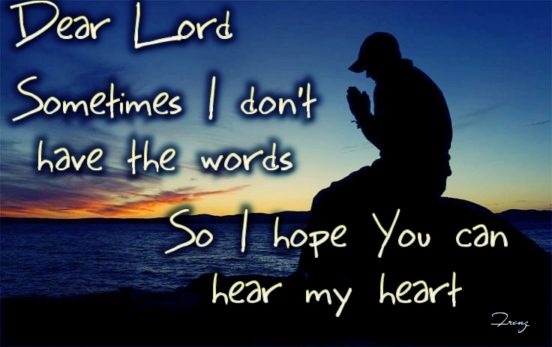
The image is a visual expression of a heartfelt Christian prayer. It combines a striking silhouette with a simple yet powerful message, aiming to evoke a feeling of intimacy and connection with God. The scene and the text work together to communicate the core idea: the limitations of words in expressing one's faith and the reliance on the sincerity of one's heart.
Visual Elements →
* Silhouette: → The central visual element is the silhouette of a man, kneeling or sitting with hands clasped in prayer. The silhouette is dark, which emphasizes the act of prayer as a private and intimate experience. The position suggests humility, reverence, and seeking connection with God. The person's form is not specific in details, which allows the viewer to project their own identity and feelings onto the image.
* Background: → The background creates a serene and reflective atmosphere. It depicts a sunset or sunrise over the water, with a gradient of colors blending blue, orange, and other tones. This is a very peaceful setting.
* Text: → The text overlays the image and acts as the primary message of the image. The font is simple and handwritten. It appears to be white which is good in contrast to the dark silhouette and colored background.
Textual Message and Interpretation →
The text consists of a short prayer expressing the feeling of not being able to articulate one's feelings to God in words. Each line of the text contributes to this central message:
* "Dear Lord": → This is a traditional and reverent address to God, setting the tone for prayer.
* "Sometimes I don't have the words": → Acknowledges the limitations of language and the struggle to express deep emotions and thoughts to the Divine. It expresses the feeling of being overwhelmed or simply not knowing what to say in those times of need, joy, fear, or gratitude.
* "So I hope You can hear my heart": → This line is the crux of the prayer. It expresses the faith that God understands beyond spoken words. The heart is seen as the true source of communication, where sincerity and genuine feelings reside. It shows a reliance on God's understanding and the belief that He listens even when words fail.
Themes and Symbolism →
* Prayer: → The core theme is, of course, prayer. The image celebrates the act of communication with God.
* Faith: → The image highlights the importance of faith, trust, and hope in the relationship with God. Even when one's words are inadequate, faith enables people to believe that God is listening and understanding.
* Humility: → The posture of the silhouette and the confession of inadequacy suggests humility. It recognizes the vastness of God and the limitations of humanity.
* Intimacy: → The dark silhouette, private prayer, and gentle wording all suggest a personal and intimate relationship with God.
Overall Impact →
The image is meant to be emotionally resonant. It offers comfort to those who may struggle to put their faith into words. It's a gentle reminder that the heart's sincerity is what matters most in prayer. The combination of the peaceful visual and the simple words creates a mood of peace, reflection, and faith, that can be meaningful to any Christian. It is also a gentle reminder of how God and faith are present in the world.

Article: Finding Strength in God When Life Brings Us Down →
The image before us is a powerful and comforting message of faith, offering solace to those facing hardship. It speaks directly to a common human experience: the feeling of being devalued, discouraged, or "put down" by others. Its simplicity and visual language make it universally accessible, yet its core message is deeply rooted in Christian beliefs.
Visual Breakdown: →
* Hands Intertwined: → The focal point of the image is two hands clasped together. One hand, appearing larger and emanating a soft, radiant light, is meant to represent God's hand. The other, smaller hand, represents a human in need. This visual metaphor of holding hands is a classic depiction of connection, support, and protection. It symbolizes that in times of struggle, God is there, reaching out to help and offer assistance.
* Radiant Light: → The light surrounding the hand symbolizing God is significant. Light often represents divine presence, goodness, and hope in religious art. It suggests that God's power is always present, ready to help and provide direction, especially when facing struggles and discouragement.
* Background and Color: → The background is a soft blue and transitions to brighter light. The peaceful background color reflects calmness, peace, and serenity and highlights the hopeful nature of the image. This provides an atmosphere of peace and serenity.
Textual Message: →
The text accompanying the image further clarifies the message. The words, "When people put you down, God will pick you up," are direct and straightforward.
* "When people put you down": → This acknowledges the reality of human experience. It validates that criticism, judgment, and the feeling of being devalued are common struggles for people.
* "God will pick you up": → This is the core promise of the image. It offers reassurance and hope. It communicates the Christian belief that God is a source of strength and comfort in times of difficulty. It is a direct assertion that God's love and support are always available to those who seek it. The idea of being "picked up" suggests being lifted from a difficult situation, given strength to move forward, and restored to a place of value and dignity.
Christian Themes and Interpretation: →
The image and its message resonate with several core Christian themes:
* God's Love and Compassion: → The image embodies the Christian belief in God's unconditional love and compassion. It suggests that God sees and cares for each individual, regardless of their circumstances or the judgment of others.
* Suffering and Hope: → The image acknowledges that suffering and hardship are part of life. It speaks to the experience of feeling diminished or devalued. However, it also offers hope, suggesting that even in the midst of difficulty, there is a source of strength and renewal.
* Trust and Faith: → The message encourages individuals to trust in God's power and faithfulness. It is a reminder that faith can provide comfort and support when people feel overwhelmed. It encourages those who believe in God to turn to God for guidance and direction.
* Redemption and Restoration: → The image hints at the potential for redemption and restoration. It implies that God can help individuals heal from the wounds of being "put down" and find new strength to rebuild their lives.
Overall Impact and Purpose: →
This image is designed to provide comfort, encouragement, and inspiration to those who are struggling. It offers a simple, yet profound message of hope that is rooted in Christian beliefs. It affirms the idea that God's love and support are always available, particularly during difficult times. It could be shared to help others to feel that they can get through their difficulties with God's support.
In conclusion, the image is a visual representation of the Christian concept of faith and support. It's a reminder that, regardless of what the world throws our way, there is always a loving God available to help us and make us stronger.
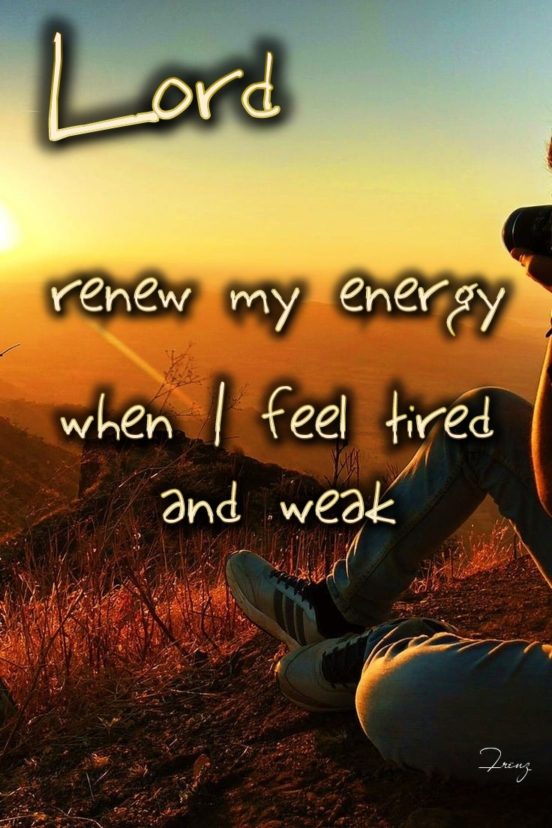
* Overall Composition: → The image is a vertical graphic, intended for use as a mobile phone wallpaper or a shareable image on social media. It combines a scenic photograph with overlaid text.
* Background: → The background presents a stunning landscape, possibly a sunrise or sunset over a mountainous area. The dominant colors are warm hues of orange, gold, and a touch of blue, creating a feeling of serenity and hope. The sun is visible, adding to the bright and uplifting feel.
* The foreground is composed of a person in a relaxed position, enjoying the view. The person is partially visible, seated with their legs extended towards the viewer. The person's position suggests a moment of contemplation or rest.
* Text: → The image features text, clearly formatted and designed to be easily read:
* The word "Lord" appears at the top of the image. It is the largest text.
* The text is formatted in a simple, clear font and is of white color.
* The text reads: "renew my energy when I feel tired and weak".
Interpretation and Meaning: →
* Christian Theme: → The inclusion of "Lord" clearly identifies this image as having a Christian religious context. It is a prayer or plea directed toward God.
* Prayer of Exhaustion and Seeking Renewal: → The text expresses a common human experience – feeling tired, weak, and needing replenishment. This sentiment is directed toward God, acknowledging a dependence on divine support.
* Seeking Inner Strength: → The image connects physical exhaustion with a spiritual need for renewal. It suggests that seeking God's help can provide the needed boost in both strength and the ability to carry on.
* Hope and Peace: → The beautiful background landscape is highly symbolic. It suggests a place of peace and the potential for beauty and renewal. It complements the prayer with the hope that, with God's help, peace can be found even in the midst of fatigue and weakness.
Overall Impact: →
* Emotional Resonance: → The combination of the evocative landscape, the prayer for renewal, and the sense of being at rest creates a strong emotional connection. It is designed to be comforting, inspiring, and hopeful.
* Accessibility: → The image's simplicity and straightforward message are easy to understand and appreciate.
* Visual Appeal: → The color, the clear text, and the composition make it aesthetically pleasing. The use of a natural setting will likely evoke feelings of peace and calm.
* Intended Use: → The design makes it suitable for digital sharing (e.g., a mobile wallpaper, social media post). It is designed to be a visual reminder of faith and to provide encouragement.
In conclusion, → the image is a heartfelt, simple, and effective Christian image. It merges beauty with a prayer of seeking comfort and renewal, which makes it an appealing image for those seeking faith-based encouragement.
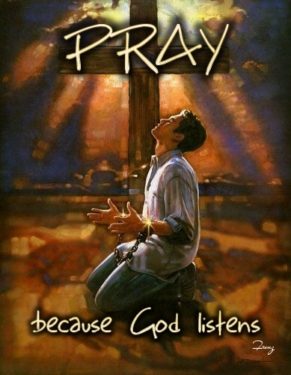
Image Analysis: A Visual Prayer →
The image is a powerful visual representation of prayer within a Christian context. It's designed to evoke a sense of reverence, faith, and the personal connection between an individual and God. Here's a breakdown of its key elements and their symbolic meaning:
Core Elements: →
* The Cross: → The most prominent symbol is the cross, the central emblem of Christianity. It signifies the crucifixion of Jesus Christ, his sacrifice for humanity's sins, and the foundation of Christian faith. The cross's placement directly above the praying figure emphasizes that prayer is directed towards, and connected to, the faith in Jesus and the salvation offered through Him.
* The Praying Figure: → A man is depicted on his knees, head tilted upwards, with his hands clasped in a position of supplication. The posture of kneeling, with head elevated, is a common act of reverence and humility in prayer. This posture shows the worshipper's submission and reverence to God.
* The Text: → The word "PRAY" is emblazoned above the cross, serving as a direct call to action. "because God listens" at the bottom provides the motivation and reassurance that prayer is not a futile exercise. It speaks to the Christian belief that God is attentive to the prayers of His followers.
* Lighting and Background: → The light is streaming from behind the cross, representing divine light or guidance. The background is filled with warm colors, creating a sense of awe and reverence.
Symbolic Meanings and Interpretations: →
* Humility and Submission: → The kneeling posture is a physical manifestation of humility, surrender, and recognizing one's reliance on God. It symbolizes the Christian belief that one must approach God with a humble heart.
* Openness to God: → The upward gaze signifies a reaching out to God, opening the heart and mind to His presence. It suggests a willingness to receive guidance, comfort, or answers.
* Faith and Belief: → The image implicitly communicates a strong faith in God's responsiveness. The text's promise that "God listens" reinforces this belief. This is a fundamental element in Christian faith - the confidence that God hears and answers prayers.
* Personal Relationship with God: → The individual nature of the prayer suggests a personal relationship with God. It is an intimate moment. The artist emphasizes that prayer is a personal conversation with God.
* Hope and Guidance: → The placement of the cross and the light shining through the sky could represent hope and God's divine guidance.
Overall Impression: →
The image is a powerful visual prayer that is designed to inspire faith and action. It reminds the viewer of the core values of Christianity, which are faith, hope, and love. It urges the viewer to pray, assuring them that they will be heard. The composition encourages an attitude of reverence and surrender.
Target Audience: →
This image is intended to connect with individuals who share Christian beliefs. The image is meant to encourage Christian to turn to prayer.
In conclusion: → The image functions as a succinct visual prayer, encouraging viewers to engage in prayer as a direct line of communication with God. The symbols employed – the cross, posture of prayer, and reassuring text – work together to evoke a sense of faith, humility, hope, and a personal relationship with God.
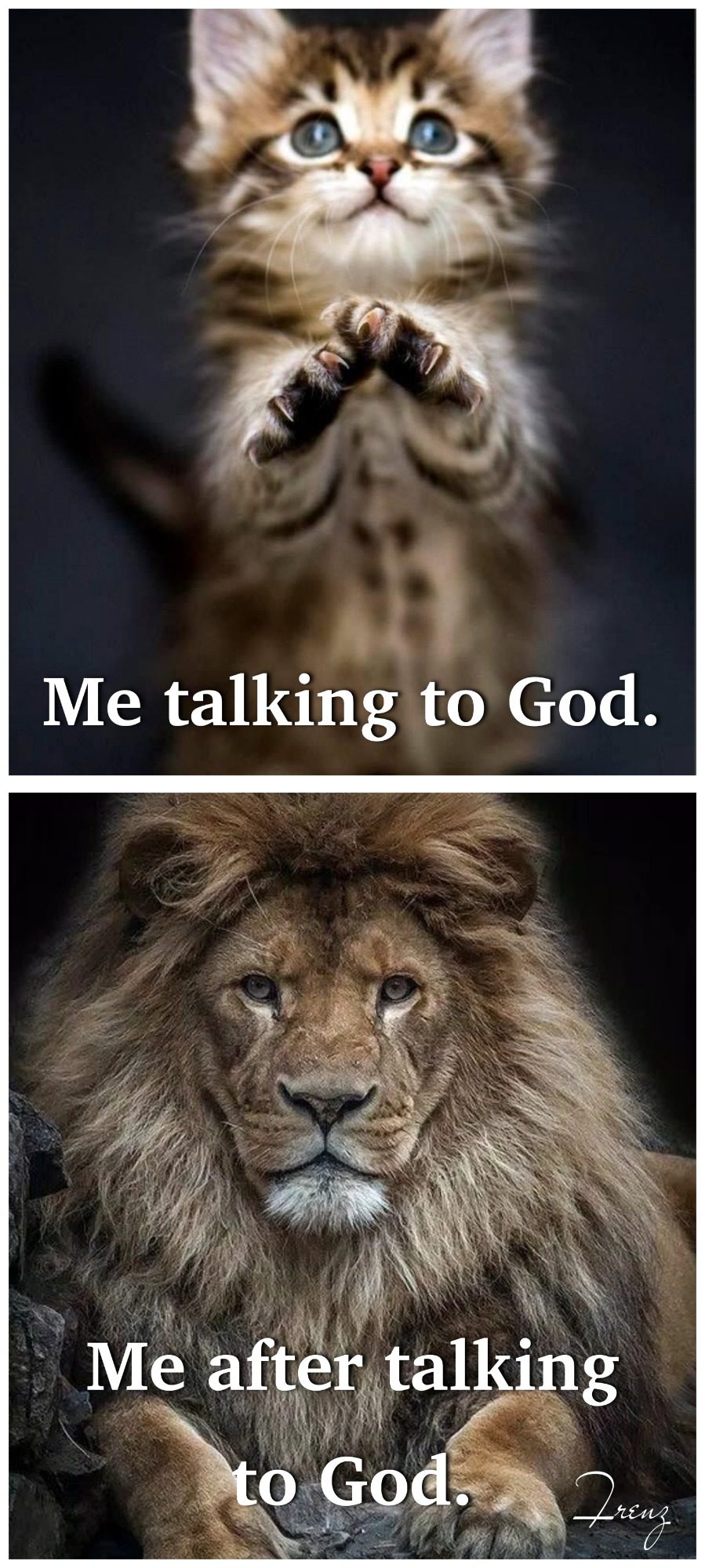
The image is a humorous meme that uses a contrasting visual metaphor to represent the perceived change in oneself before and after prayer or communication with God. It juxtaposes two photos: one featuring a cute, vulnerable kitten in a prayerful pose, and the other depicting a powerful, majestic lion.
Image Breakdown: →
* Top Image: →
* Subject: → A young kitten with striking blue eyes, looking upward with its paws clasped together as if in prayer or supplication. The kitten’s expression is one of innocent sincerity and vulnerability.
* Text: → "Me talking to God." This text reinforces the kitten's portrayal as the "self" during the act of communicating with God. The kitten's appearance suggests a state of humility, need, and dependence.
* Bottom Image: →
* Subject: → A mature lion, regal and imposing, staring directly at the viewer. The lion's expression is confident, self-assured, and even slightly intimidating. The fur of the lion has a rich color and the overall image portrays the lion as powerful and in control.
* Text: → "Me after talking to God." This text identifies the lion with the same "self" but after a spiritual experience, presumably prayer. The lion's power and composure contrast sharply with the kitten's vulnerability.
Interpretation and Meaning: →
The meme relies on humor and a relatable message for Christians. It suggests that:
* Before Prayer: → The act of talking to God may involve a sense of humility, vulnerability, and dependence. Like the kitten, the person might feel small, in need of help, or seeking guidance. This reflects the Christian tradition of acknowledging one's shortcomings and seeking divine assistance.
* After Prayer: → The act of prayer or communication with God transforms a person, instilling a sense of confidence, strength, and inner peace. The lion symbolizes this transformation. The implication is that prayer, faith, and a relationship with God empower individuals, making them feel capable and resilient. The humor comes from the dramatic change in presentation.
Possible Themes and Ideas: →
* Empowerment: → The meme conveys the idea that faith in God can empower individuals.
* Transformation: → It suggests that prayer and belief can lead to a personal transformation, a change in self-perception, and an increased ability to face challenges.
* Humor in Faith: → It uses humor to connect with believers, acknowledging the challenges or feelings of vulnerability that some may have before seeking God's guidance.
* Self-Perception: → It is a humorous take on the way Christians may feel about their abilities and confidence after talking to God.
Overall, this image is a simple and humorous way to express the idea that faith can provide strength, confidence, and a sense of empowerment.
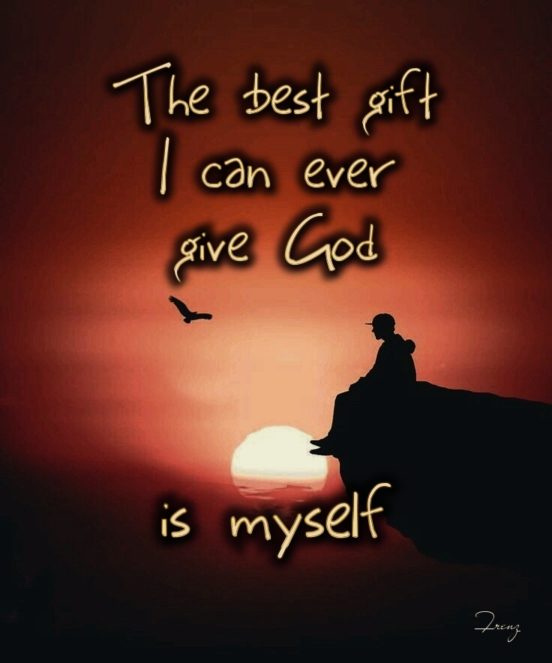
The image is a visually evocative and spiritually uplifting statement, intended for a Christian audience. It centers around the idea of self-surrender to God as the ultimate act of devotion. The combination of the text, the imagery of nature, and the implied solitude creates a sense of reverence and introspection.
Visual Elements and Their Significance: →
* Color Palette: → The dominant colors are warm and rich—deep reds, oranges, and hints of yellow. These colors suggest sunset or sunrise, creating a sense of peace, transition, and new beginnings. The warmth can also be interpreted as representing divine love and presence.
* Silhouette of a Person: → A solitary figure is silhouetted, sitting on the edge of a cliff or rock. This person is looking at the sunset (or sunrise). The fact that they are silhouetted, without identifiable features, emphasizes that this can represent any individual. The posture suggests contemplation, possibly prayer, and a sense of vulnerability.
* The Sun: → The sun itself, rendered in a softened glow, is a central visual element. It can symbolize God, creation, and the source of all light and life. Its position low on the horizon further reinforces the sense of transition and the end of a day, encouraging reflection.
* The Bird: → The bird flying through the sky adds another layer of symbolism. It could represent freedom, spiritual ascension, or the soul's journey towards God. It adds a sense of movement and aspiration to the stillness.
* Typography: → The text is handwritten style. It reinforces the personal and intimate nature of the message.
Message and Interpretation: →
The core message of the image is simple and profound: *"The best gift I can ever give God is myself."* This statement is a concise expression of faith and devotion. It means:
* Surrender: → The most significant offering a person can make to God is complete surrender of their life, will, and desires.
* Availability: → It means being available for God's purpose. It is a willingness to be used for good in the world and allowing God to work in and through you.
* Love and Gratitude: → The message is about love and gratitude. The best way to express love for God is to offer your whole self—your thoughts, actions, and everything you are.
Religious Context (Christianity): →
This image is highly resonant within a Christian context. It draws on fundamental tenets of the faith:
* Relationship with God: → The emphasis on a personal relationship with God, built on self-giving and love.
* Faith as Action: → The belief that faith is not passive, but actively expressed through the offerings of ourselves.
* Worship: → That offering oneself to God is an ultimate form of worship and devotion.
Overall, the image is intended to be a reminder and an encouragement. It is a visual invitation to reflect on one's own relationship with God and consider whether the most valuable gift one can offer has been made.
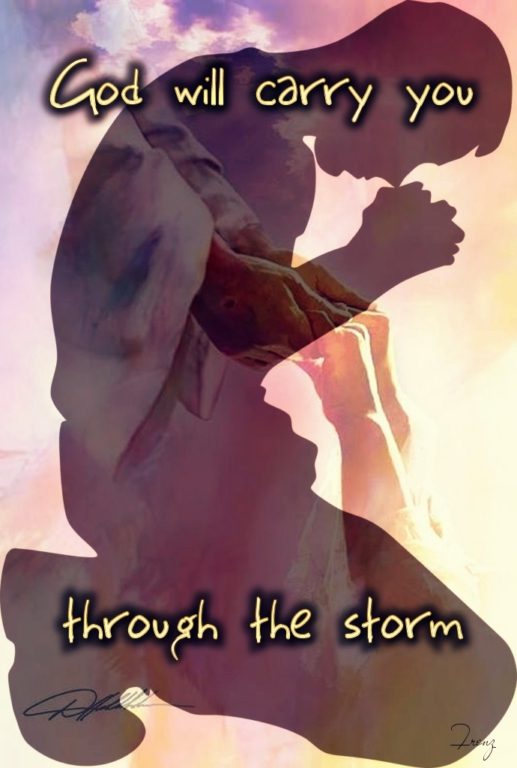
Image Analysis: "God Will Carry You Through the Storm" →
The image is a deeply spiritual and comforting visual message. Here's a detailed breakdown of its components and the overall message it conveys:
Visual Elements: →
1. Figure in Prayer: →
* The central element is a figure kneeling in prayer. The posture, with bowed head and clasped hands, is a universal symbol of reverence, supplication, and seeking divine guidance or comfort.
* The figure is rendered in a translucent, almost silhouette-like style. This gives it a dreamlike, ethereal quality, enhancing the sense of the spiritual. The use of what seems to be a dark purple-ish outline, giving it the appearance of a shadow, further emphasizes the idea of the divine presence supporting the figure.
2. Overlay of Imagery: →
* The silhouette is partially overlaid with other, more detailed imagery of hands and clothing. This layering creates a sense of depth and texture. The use of layering suggests that while the person's struggles may be seen as their own, there's an underlying force at work offering strength and support.
3. Color Palette: →
* The color palette is warm and uplifting, featuring a mix of light and dark colors. There are shades of yellows and orange blended with purple and pink, particularly in the background. This color scheme evokes feelings of serenity, peace, and hope, complementing the message.
4. Text Overlay: →
* The words "God will carry you through the storm" are prominently displayed. The text is written in a script-like font with a yellow glow around it, making it stand out and easily readable.
* The text is centered, which draws the viewer's eye directly to the message.
Interpretation and Message: →
1. Faith and Support: →
* The core message is one of faith, reassurance, and divine support. It conveys the idea that even in the face of adversity ("the storm"), believers can find strength and comfort in their belief in God.
2. Overcoming Adversity: →
* "The storm" is a metaphor for life's challenges, hardships, and difficulties. The image offers encouragement that one is not alone in these struggles.
3. Surrender and Trust: →
* The act of prayer symbolized by the figure suggests the need to surrender to a higher power and to place one's trust in God.
* The use of the words "will carry" is significant, as it suggests that it's not necessary to face the struggles alone. God will provide support, assistance, or comfort to get through the difficult times.
Overall Effect: →
The image is a powerful visual statement that is easily understood. It's designed to be comforting and uplifting, resonating with people of faith and those who may be facing difficult circumstances. It provides a sense of hope and offers a reminder of the presence of God.
Analysis of the Image →
The image is a visually impactful Christian artwork, designed to convey a message of faith, comfort, and divine presence. Here's a breakdown of its elements:
* Background: → A scenic beach at sunset/sunrise sets the stage. The sky is filled with warm hues of orange, gold, and pink, suggesting a time of peace, reflection, and hope. The ocean gently laps the shore, adding to the tranquil atmosphere.
* Overlaid Figure: → The ethereal, translucent figure of Jesus is overlaid on the scene. The figure's posture suggests a sense of guidance, support, and protection. The soft, almost ghostly, appearance reinforces the idea of a spiritual presence.
* Text: → The words "God is watching over you" are prominently displayed. "God" is emphasized with a stylized, golden font, immediately drawing the viewer's attention. This is the central message of the image.
* Silhouette: → In the foreground on the beach, there is a small silhouette of a person sitting on the beach looking towards the water. This figure is small and in the background emphasizing the size of God and his presence.
* Overall Impression: → The combination of these elements creates an image meant to be inspirational. It offers a message of reassurance, reminding the viewer that they are under divine care, even in moments of solitude or difficulty.
Article: Finding Comfort in the Divine Gaze →
In a world often marked by uncertainty and challenges, Christians find solace in the unwavering presence of God. This beautiful image encapsulates the essence of that faith: the ever-present gaze of a loving God, watching over us.
The image is a reminder of God's constant presence in our lives. We are reminded that even when we feel alone, there is a divine entity that watches over us. The soft figure of Christ provides comfort and assurance.
The message is meant to be read as a source of comfort. The image invites us to reflect on the promise of divine care. We are never truly alone, as we are always surrounded by his love.
The beach setting, bathed in the warm glow of sunset, sets a tranquil backdrop. The ocean can symbolize the vastness of God's love and the immensity of his presence. The sunset/sunrise represents hope, renewal, and the promise of a new day, even after periods of darkness.
The figure of Jesus is positioned as a guardian, an unseen force guiding us through our journey. He is ever present.
The image serves as a visual prayer, a whispered affirmation of faith, and a beacon of hope. It's a reminder that God is always present.
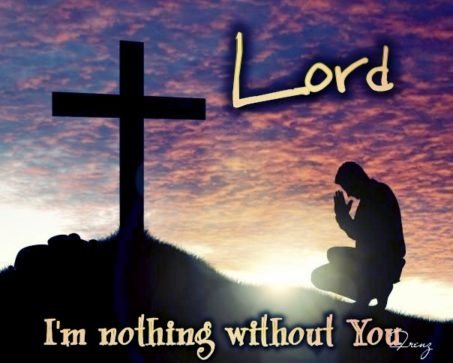
The image is a powerful visual representation that carries deep meaning within a Christian context. Let's break down the elements:
* Silhouette of a Person: → The central figure is a silhouette, obscuring the person's identity. This allows viewers to project themselves into the scene, embodying the universality of the message. The slumped posture and position against the natural background, suggest the person is introspective and humbled. They are sitting and pondering.
* Background: → The background is a sunset, with warm hues of orange, gold, and hints of blue. Sunsets often symbolize transition, the end of one phase and the beginning of another. In a Christian context, it can represent the close of the day of life or the end of a period of struggle. The presence of some barren or dying plants may represent areas in the persons life that need attention or change. The sky is big.
* Text: → The overlaid text is the heart of the message:
* "I KNOW LORD": This is a declaration of faith and acknowledgment of God's presence. It acknowledges a relationship with the Lord.
* "I MUST CHANGE": This conveys recognition of a need for personal transformation. It suggests awareness of shortcomings, sins, or areas of life that are not aligned with Christian values.
* "PLEASE HELP ME": A plea for divine assistance. This is an act of humility and a dependence on God's grace and guidance.
Overall Message: →
The image conveys a message of repentance, self-reflection, and reliance on God. It depicts a person at a moment of internal struggle, acknowledging their imperfections and reaching out for help. The combination of the visual and textual elements creates a potent reminder of the Christian journey of faith, which includes recognizing sins, repenting for them, and asking for Gods grace.
---
Detailed Article: A Moment of Reckoning →
(Image displayed at the top) →
The soft glow of the setting sun paints the sky in hues of hope and reflection. Silhouetted against this breathtaking backdrop is a lone figure, hunched in a posture of quiet contemplation. Above them, the words "I KNOW LORD" rise like a whispered prayer. Beneath, a plea – "I MUST CHANGE, PLEASE HELP ME." This image is more than just a picture; it's a mirror, reflecting the internal struggles and ultimate faith that define the Christian experience.
This artwork speaks to the heart of what it means to be a follower of Christ. It captures a moment of reckoning, a time when we, as individuals, are forced to confront our shortcomings, our weaknesses, and our distance from the ideal we strive for in our faith.
The "I KNOW LORD" at the beginning of the message. This isn't just a statement of knowledge; it's a declaration of faith, trust, and relationship. It's a recognition that there is a higher power, a loving God, present and involved in our lives. It is a prayer.
The heart of the message lies in "I MUST CHANGE." This statement is a testament to the ongoing journey of a Christian life. It acknowledges that perfection is impossible in this world, that we are all works in progress, and that repentance is an essential component of our growth. It is a recognition that our actions, thoughts, and attitudes don't always align with God's will, and that a conscious effort toward transformation is necessary. This can be the acknowledgement of a sin, a flaw in character, or a negative habit that needs to be broken. This is a powerful and honest statement.
The most profound element of this message is the final phrase, "PLEASE HELP ME." This is a testament to our dependence on God's grace. It is a humble plea for assistance, acknowledging that we cannot undergo this transformative journey alone. We ask for the wisdom to see our shortcomings, the courage to confront them, and the strength to overcome them.
The setting sun reinforces this theme of transition and new beginnings. As the day draws to a close, it is a time for reflection, for turning inward and making the decision to pursue a better way of life. It offers a chance for reflection, introspection and the beginning of a new day with the Lord.
Ultimately, this image offers a powerful reminder of the continuous dance between faith and action that shapes a Christian life. It's a testament to the process of growth, the grace of repentance, and the unwavering hope found in the embrace of the Lord. It is a message of encouragement, reminding us that vulnerability is a sign of strength and that God is always present, ready to offer a helping hand to those who seek to follow His way.
The image presents a poignant visual statement with clear Christian undertones. Here's a breakdown:
* Visual Elements: →
* A silhouetted figure is the focal point. The person is seated in a contemplative pose, with their back turned toward the viewer, which suggests humility and introspection.
* The background is a sunset or sunrise, with warm, golden hues. This provides a sense of peace, hope, and a connection to the natural world.
* The text overlays the image, adding significant meaning.
* Textual Elements: →
* "I Know Lord" - A clear declaration of faith and acknowledgement of a higher power. It reflects a recognition of God's presence and authority.
* "I Must Change" - This phrase indicates self-reflection and a commitment to personal growth. It's a recognition of areas in one's life that need improvement.
* "Please Help Me" - A plea for divine assistance, illustrating reliance on God's grace and a desire for transformation.
Article: A Heart's Cry: Seeking Transformation Through Faith →
The image speaks to the core of the Christian experience: the journey of faith, self-reflection, and the continual pursuit of a closer relationship with God. The image paints a scene of introspection, hope, and the fundamental human need for guidance and grace.
A Moment of Contemplation →
The solitary figure, silhouetted against the warm glow of a sunset or sunrise, invites us to a place of quiet contemplation. It's a visual metaphor for a soul seeking connection with the divine. The posture of the figure implies vulnerability and humility, suggesting a moment of honest self-assessment. This person is not looking out at the world, but inwardly, engaging in a dialogue with the higher power.
Acknowledging the Lord →
"I Know Lord" is the starting point. It's an affirmation of faith, a recognition of God's presence and sovereignty in one's life. It signifies a level of trust and acceptance of God's plan. This opening statement sets the stage for the subsequent expressions of need and desire for change.
The Need for Transformation →
"I Must Change" acknowledges the imperfection inherent in human nature. It's the honest recognition of personal flaws, habits, or attitudes that fall short of the ideals taught within the Christian faith. This sentiment highlights the Christian understanding of sin and the continuous need for repentance and spiritual growth. This recognition is vital, as the journey of faith involves the ongoing process of aligning oneself with God's will.
The Plea for Divine Assistance →
The ultimate expression of the image is "Please Help Me." It's a heartfelt plea for divine aid, a declaration of reliance on God's grace. This phrase showcases the understanding that one cannot achieve true transformation solely through their own efforts. It acknowledges that true change requires the guidance, strength, and love offered by God. In Christian doctrine, this is often interpreted as the necessity of prayer and the leading of the Holy Spirit to walk in the path of righteousness.
A Pathway of Faith and Grace →
The image encapsulates a powerful and relatable message about the Christian journey. It reminds us that faith is not a static destination, but a dynamic process of growing closer to God. It urges us to practice self-reflection, embrace change, and find strength in prayer, opening our hearts to the divine grace that is always available to those who seek it. It's a testament to the power of faith, humility, and the transformative impact of a relationship with the Lord.

The Quiet Assurance of Faith: A Visual Reflection of Christian Hope →
The image presents a powerful and comforting message rooted in Christian faith, using both visual elements and text to convey its meaning. It's a serene scene designed to inspire reflection and offer a source of hope for those facing challenges or seeking guidance in their lives. Let's break down the components and the message they deliver.
Visual Elements and Their Symbolism →
* The Silhouette: → A lone figure, silhouetted against a vibrant sunset, sits on a simple chair on the edge of a fence. This figure represents the individual believer, facing the vastness of the world and pondering life's journey. The silhouette gives the figure a sense of anonymity, making it relatable to anyone facing life's hardships. His posture exudes a sense of contemplation and quiet strength, suggesting a state of waiting or reflection.
* The Landscape: → The backdrop is dominated by a stunning sunset, with hues of pink, orange, and purple blending into the sky. Sunsets are often symbolic of endings, transitions, or the promise of a new dawn. In a Christian context, the beauty of nature serves as a reminder of God's creation and His presence in the world.
* The Fence: → The fence upon which the man sits gives the image a sense of security and place, but also gives it a sense of separation from the world.
Text and Its Significance →
* "PRAY WAIT TRUST": → These three words, stacked vertically and in a stylized, elegant font, form the heart of the message. They are presented as the core actions a believer should take, especially in times of uncertainty or difficulty.
* PRAY: → Prayer is the central act of communication with God. It's an expression of faith, a means of seeking guidance, and a way to share our hopes and fears.
* WAIT: → Waiting patiently is a key aspect of Christian faith, often accompanied by trust. The believer accepts that God has a timeline and that His timing is perfect.
* TRUST: → At the core, trusting God is the foundation of the Christian faith. It involves surrendering control, believing in God's wisdom, and relying on His promises.
* "GOD HAS A PLAN": → The concluding phrase, positioned at the bottom, brings closure to the message. It reinforces the promise that there is a divine purpose for all of life. The font and position of the sentence suggest importance.
The Christian Context and Message →
This image is deeply rooted in Christian theology and belief. It underscores the importance of:
* Faith: → The image emphasizes the power of faith in the face of life's trials. The man has a steadfast view of the world, and waits patiently.
* Hope: → The image provides a message of hope. The sunset, the beauty of the scene, and the phrase "God has a plan" all suggest the possibility of a better future.
* Submission to God's Will: → The act of waiting and trusting is a form of surrendering to God's plan. It recognizes that God's ways are higher than our own, and that His will is ultimately what matters.
* The Importance of Prayer: → The instruction to pray is central. Prayer is the means of communication between the believer and God, a time to be humble and seek advice.
* The Value of Patience: → Waiting is an essential virtue in the Christian faith. It is sometimes a test of our faith, and it is also part of our connection to the divine.
Overall Interpretation →
The image is a gentle, yet powerful reminder that faith, prayer, patience, and trust are vital tools for navigating life's challenges. It encourages viewers to turn to God, believe in His plan, and find strength and hope in their spiritual journey. It's a visual prayer, offering comfort, guidance, and a sense of peace to those seeking divine support
Analysis of the Image: "Satan Can't Destroy What God Protects" →
The image is a powerful visual statement conveying a core tenet of Christian faith: the ultimate protection offered by God. It combines imagery with a specific message:
* Visual Elements: →
* Central Figure: → A silhouette of Jesus Christ on the cross dominates the image. This immediate conveys a message of faith, sacrifice, and salvation.
* Background: → A dramatic sky with a blend of colors, like yellow, and other colors. This adds a sense of the divine or spiritual.
* Text: → The words "Satan," "can't destroy," "what," "God," and "protects" are strategically placed around the figure of Christ. The text's color is also symbolic, with the word "God" standing out.
* Message: →
* Theme of Divine Protection: → The phrase is a direct declaration of faith in God's power and ability to protect believers. It suggests that anything God chooses to safeguard is impervious to the destructive forces of evil, represented by Satan.
* Triumph Over Evil: → The image implicitly affirms the Christian belief in the eventual triumph of good (God) over evil (Satan). It reassures believers that ultimately, evil will not prevail.
Detailed Article: "Divine Shield: A Christian Perspective on Protection and Faith" →
In the realm of faith, especially within Christianity, the concepts of protection and the battle between good and evil are central. The image "Satan can't destroy what God protects" encapsulates this fundamental tension and offers a message of enduring hope and assurance.
The Core Belief: →
At its heart, the image reflects the unwavering belief in God's omnipresence, omnipotence, and benevolence. It communicates that God, in His infinite power, offers refuge and protection to those who believe. This protection isn't necessarily a guarantee against hardship or suffering in this life; rather, it signifies the eternal safeguard of one's soul and spirit.
The Role of Satan: →
The image explicitly acknowledges the existence of Satan, the personification of evil, temptation, and the forces that oppose God. The image highlights that Satan is not all-powerful. It implies that while Satan may inflict suffering, tempt believers, or create chaos, he cannot ultimately destroy what God safeguards.
Interpreting the Imagery: →
* The Crucifix: → The silhouette of Christ on the cross serves as the cornerstone of the image. The cross is a symbol of sacrifice, atonement, and redemption. It signifies God's ultimate act of love and sacrifice for humanity. The inclusion of the cross in the image is a visual representation of the protection offered by God. The silhouette of Christ represents a relationship, and faith of God.
* Dramatic Background: → The backdrop is carefully chosen. The sky indicates the spiritual realm.
The Power of Belief: →
This image is a call to faith, offering solace and strengthening the resolve of believers in times of hardship or doubt.
Living in the Light of Protection: →
The image encourages believers to:
* Live a life rooted in faith: → To seek guidance from God.
* Embrace prayer and the scriptures: → These are seen as pathways to draw closer to God and receive His protection.
* Resist temptation: → Strengthened by the belief in God's ultimate protection, believers are encouraged to actively reject evil.
* Find hope in times of adversity: → Because the image offers comfort in moments of distress, it gives them strength to persevere through challenges.
In Conclusion: →
The image, "Satan can't destroy what God protects," is a powerful message for Christians. It emphasizes the ultimate triumph of good, the importance of faith and the unwavering protection offered by God. It is a visual reminder of the ongoing battle between good and evil and a call to find strength, hope, and refuge in the divine.
An Examination of Faith: Decoding the Imagery of Prayer →
This image is a powerful visual representation of Christian faith, designed to evoke feelings of peace, connection, and reverence. The central theme is prayer, and the image employs several key symbols to convey its message. Let's break down the elements:
1. The Silhouetted Figure in Prayer: →
* The Gesture: → The primary focus is a silhouetted figure with hands clasped in prayer and head tilted upward. This posture is universally recognized as a sign of supplication, humility, and seeking divine guidance. It immediately establishes the context of the image as one about faith and devotion.
* The Color Palette: → The use of silhouette allows the backdrop to speak through the prayer. The color palettes are in sunset tones with darker shades, which can signify a feeling of warmth, hope, and reflection, setting a reverent tone.
2. The Crucifix: →
* The Symbol of Sacrifice: → The image of Jesus Christ on the cross serves as a central, unmistakable symbol of Christianity. It represents the ultimate act of love and sacrifice for humanity's sins. Its placement behind the praying figure suggests that prayer is a means of connection to Christ, an acknowledgment of his sacrifice, and a pathway to salvation.
3. The Light and Celestial Elements: →
* Divine Presence: → The blue starry effect emanating from the head suggests a connection to the divine. This could represent God's presence, the Holy Spirit, or a vision of heaven.
* Transcendence: → The celestial elements visually lift the image from the earthly plane and toward a sense of the spiritual, symbolizing reaching beyond the self and connecting with something greater.
4. The Word "PRAYER" and "The world's greatest wireless connection": →
* Direct Message: → The word "PRAYER" is prominently displayed, reinforcing the core theme. The style of the font adds to the meaning.
* Modern Metaphor: → The phrase "The world's greatest wireless connection" is a contemporary metaphor for prayer, suggesting that through prayer one can connect with God at any time and in any place. It's a creative way to emphasize prayer's constant availability and accessibility.
5. Overall Interpretation: →
The image, as a whole, aims to convey a sense of:
* Intimacy: → Prayer as a personal and intimate connection with the divine.
* Hope: → The sunset tones and celestial imagery suggest a sense of hope, salvation, and promise.
* Devotion: → A visual reminder of the power of prayer, calling the viewer to seek divine guidance and grace.
* Connection: → The image stresses the Christian belief that prayer is a fundamental tool to connect with God.
Conclusion: →
This image is a carefully constructed piece of Christian art. Through its use of recognizable symbols, the image effectively communicates the central importance of prayer within the Christian faith. It is an image designed to inspire reflection, evoke reverence, and encourage a deeper connection with the divine. It is a potent visual testament to the power of faith and the practice of prayer.
Image Analysis: A Moment of Contemplation and Faith →
The image is a heartwarming and spiritually resonant photograph that subtly communicates a message of faith and self-worth. Let's break down the elements and their possible interpretations:
Visual Elements: →
* Subject: → The central figure is a young child, positioned on a sandy beach. The child is seen from the back, knees drawn up, gazing out towards the ocean. This posture conveys a sense of introspection and quiet observation.
* Setting: → The background is a beach scene. The sky is overcast, hinting at a slightly melancholic or thoughtful atmosphere. The gentle waves and expansive ocean create a sense of peace and vastness.
* Text Overlay: → The words "You are God's MASTERPIECE" are superimposed across the top of the image in a handwritten, decorative font. The font choice adds a personal, almost intimate feel.
Symbolism and Interpretation: →
* The Child: → The child represents innocence, vulnerability, and the potential for growth. The fact that the child is looking out towards the horizon suggests looking towards the future, or looking beyond to the unseen.
* The Beach: → The beach, a place where the earth meets the water and the sky, often signifies transition, renewal, and a sense of peace. The sandy environment where the child sits on the sand also signifies purity and simplicity.
* The Ocean: → The vast ocean can symbolize the immensity of God's love, the mysteries of life, and the unknown.
* The Phrase "You are God's MASTERPIECE": → This is the core message of the image. The phrase speaks to the idea that each individual is uniquely created and valued by God. It is a reminder of one's worth, and a declaration of God's creative love. The phrase itself is a reflection of how all creations are special and can come in any shape or form.
* Overcast Sky: → The gray sky might reflect times of emotional difficulty, challenges, or reflection. The quiet, soft nature of the image, despite the gray sky, creates an overall feeling of peacefulness.
Overall Message and Purpose: →
The image's power lies in its simplicity and gentle message. The photograph seems designed to:
* Affirm Self-Worth: → The primary message is one of value and belonging. It serves as a reminder to the viewer that they are loved, cherished, and an intentional creation.
* Promote Faith and Hope: → The imagery, combined with the text, is intended to inspire faith in a higher power. It suggests that even in times of doubt or difficulty, the viewer is loved, and their future is safe.
* Encourage Contemplation: → The pose of the child and the tranquil beach setting encourages viewers to pause, reflect on their own lives, and find meaning.
Target Audience: →
The image is intended to resonate with individuals who:
* Identify with Christian or faith-based values.
* Seek comfort, reassurance, and a sense of belonging.
* Are going through a time of introspection or reflection.
* Appreciate the visual beauty of photography.
In Conclusion: →
The image is a well-crafted and touching combination of visual elements and a powerful message. It conveys a feeling of peaceful introspection, affirmation of faith, and the fundamental value of each individual. The use of the child figure and the beach setting creates a sense of comfort and invites the viewer to meditate on their own worth and connection to something greater.
The image presents a visually compelling message. Here's a breakdown:
* Text: → The core of the image is the quote: "YOU WILL NEVER INFLUENCE THE WORLD BY TRYING TO BE LIKE IT." This statement is presented in bold, slightly stylized white text with a subtle drop shadow, making it stand out against the background.
* Background: → The background features a serene scene of a person standing with outstretched arms, silhouetted against a cloudy sky reflecting on water. The overall tone is one of peace and contemplation. The color palette uses shades of blue, gold, and white, contributing to the image's inspirational feel.
* Overall Impression: → The image conveys a strong message about authenticity, the futility of conformity, and the power of genuine character in making a positive impact.
Article: "The Paradox of Influence: Finding Your Voice in a World of Conformity" →
In a world that often celebrates conformity, it can feel like the only path to success is to blend in, to adopt the latest trends, and to silence the unique voice within us. Yet, the image of the silhouetted figure against the vast, open sky offers a profound truth: "YOU WILL NEVER INFLUENCE THE WORLD BY TRYING TO BE LIKE IT."
A Christian Perspective on Influence: →
This quote resonates deeply with core Christian values. The Bible calls believers to be "salt and light" in the world (Matthew 5:13-16). Salt seasons and preserves, and light illuminates. Both roles require us to be different, to stand apart from the darkness and decay of the world, not to become indistinguishable from it.
* Called to Be Different: → As Christians, we are called to a higher standard – to live a life that reflects the character of Jesus Christ. This means embracing virtues like love, compassion, humility, and integrity, even when they are unpopular or counter-cultural. The world around us often prioritizes self-interest, power, and material wealth, but the Christian message challenges us to love our neighbors, forgive our enemies, and seek justice. It is the differences that offer a true lasting influence.
* The Power of Authenticity: → Trying to be like the world is exhausting. It requires us to constantly monitor our image, to twist our values, and to suppress the truth within us. Jesus warned us against this kind of hypocrisy (Matthew 6:5-6). True influence, on the other hand, comes from being genuine. People are drawn to authenticity, to those who live with integrity and conviction. When we are true to ourselves, when we live out our faith authentically, we become a beacon of hope and a catalyst for change.
* Embracing Vulnerability: → The world often tells us to be strong, to hide our weaknesses, and to avoid vulnerability. However, the Christian faith teaches us that strength is found in weakness, and vulnerability is a pathway to connection. When we are willing to be honest about our struggles, our fears, and our imperfections, we create space for others to be honest as well. It's in these moments of shared humanity that genuine connection and meaningful impact are born.
* Seeking God's Guidance: → The image's backdrop of the sky can be seen as a metaphor for spiritual guidance. Instead of seeking approval or direction from the world, Christians are called to seek God's wisdom through prayer, scripture, and fellowship. This means discerning God's will for our lives and allowing the Holy Spirit to shape our thoughts, words, and actions.
The Path to True Influence: →
So, how do we influence the world without becoming like it?
1. Know Your Identity: → Understand who you are in Christ. Understand what he wants from you.
2. Cultivate Your Character: → Focus on developing virtues such as kindness, empathy, courage, and integrity.
3. Speak Your Truth: → Be willing to share your beliefs and values, even when it's difficult. Do it with love and compassion.
4. Love Others Unconditionally: → Demonstrate God's love through your actions and words.
5. Serve and Serve: → Seek opportunities to serve others and to make a difference in your community.
Conclusion: →
The image is a powerful reminder that true influence doesn't come from blending in but from standing out. From a Christian perspective, this means living a life transformed by the gospel of Jesus Christ. It means embracing authenticity, cultivating our character, and shining our light in a world that desperately needs it. By striving to be more like Christ, we will find that our influence grows far beyond our expectations. The world is changed not by imitation but by authenticity and love, the hallmarks of a life lived in true faithfulness.
The image is a motivational and faith-based design, clearly intended to offer hope and encouragement to the viewer. It uses visual elements to convey the idea of divine assistance, specifically within a Christian context. The style is somewhat simplified but visually striking, employing text and imagery to communicate a core message of support in times of struggle.
Visual Elements and Symbolism →
* Central Text: → The image prominently features the words "HE WILL HELP YOU OVER COME". This phrase is the direct message, forming the heart of the image.
* The text is arranged vertically, creating a sense of progression or a journey.
* The text's varying colors and styles add visual interest and allow for emphasis on specific words.
* Hands: → The most prominent visual element is the representation of hands:
* One set of hands reaches out towards another set of hands, and the other set of hands are larger which indicates it is the hand of Jesus. This arrangement powerfully symbolizes help and support.
* The gesture speaks of divine grace, assistance, and connection.
* The use of hands evokes a sense of personal connection and care.
* Background: → The background is simple, blurred, and golden.
* The background is soft and warm. This creates a serene and comforting ambiance, enhancing the overall feeling of support.
Interpretation and Christian Significance →
The image conveys a clear Christian message:
* Divine Help: → The core message is that *He* (referring to Jesus Christ) will provide help. This ties directly to Christian teachings about God's love, grace, and provision for believers.
* Overcoming Challenges: → The phrase "over come" suggests that the viewer might be facing hardships, difficulties, or trials in life. The image promises the assurance that with Christ's help, they can triumph over such obstacles.
* Faith and Belief: → The overall message encourages faith and belief in Jesus Christ as a source of strength, guidance, and support. It is meant to offer hope and encouragement to believers, and it provides solace to those who may be struggling with challenges.
Artistic Choices and Effect →
* Typography: → The text, which overlays the hands, is bold and clear, making the message easily readable. The choice of fonts and their color variations further emphasizes the core message.
* Color Palette: → The use of warm colors creates a sense of comfort, hope, and peace.
* Imagery: → The imagery of hands reaching out towards other hands creates a sense of hope, salvation, and a strong feeling of a relationship with God.
In summary, → the image is a visually straightforward but emotionally resonant message of faith and encouragement. It offers a reminder of divine help and support in overcoming life's challenges and speaks to the core beliefs and values of the Christian faith.

The image is a digital composition, combining text and a photograph to create a visual message. Here's a breakdown of its elements:
* Text: → The prominent feature is the text "CALL THE HOTLINE TO HEAVEN". The words are displayed in a large, bold, and somewhat stylized font. Each word has a 3-D outline effect, suggesting depth and importance.
* Visual Metaphor: → A red telephone receiver is positioned in the image, seemingly suspended in the air or against a cloudy sky background. It hangs in the air, acting as a visual representation of the "hotline".
* Background: → The background is a blurred image of a blue sky with clouds. It gives the impression that the telephone receiver is connected to the clouds of the heavens.
Interpretations and Potential Meanings →
The image is designed to be thought-provoking and open to interpretation. Here are some potential meanings, particularly from a Christian perspective, but also some more general ideas:
1. Christian Religious Context: →
* Prayer as Communication: → The most direct interpretation is that the "hotline to heaven" symbolizes prayer. The image suggests that prayer is a direct line of communication with God, similar to making a phone call. The use of the word "hotline" implies immediate access and availability.
* Seeking Guidance and Comfort: → In this context, calling the "hotline to heaven" implies seeking guidance, help, comfort, or forgiveness from God. This could be in moments of distress, uncertainty, or when seeking answers to life's big questions.
* Faith and Belief: → The image subtly promotes the importance of faith and belief. It encourages the viewer to believe in the possibility of direct communication with a higher power.
2. The Visual Appeal and Message →
* Simplicity: → The image's visual simplicity enhances its impact. The bold text and the single visual element of the receiver make it instantly understandable.
* Symbolism: → The receiver is a modern item, used with a religious interpretation. This is a common theme.
* Encouragement: → The image has an encouraging tone. It's an invitation to reach out, to believe, and to connect with something greater than oneself.
Article: Dialing into Faith: The "Hotline to Heaven" →
The image, with its stark simplicity, invites us to ponder the nature of faith, prayer, and our connection to the divine. It presents a bold message: "CALL THE HOTLINE TO HEAVEN." But what does this modern, almost playful image truly suggest about the act of faith?
At its core, the image brilliantly connects the abstract concept of prayer with a tangible, familiar object: the telephone. The "hotline" is a clear metaphor for prayer, a direct line of communication, and a source of guidance. It immediately suggests immediate access to a higher power, similar to how one can dial and immediately connect with someone on the phone.
The Power of Prayer →
The image suggests that prayer is not just a series of rituals or rote recitations. It highlights the potential of prayer as a powerful tool for communication, providing a connection to a source of comfort, wisdom, and strength.
The visual cues also contribute to the message:
* The Background: → The background is a blue sky with clouds, representing heaven.
* The Bold Text: → The typography of the image is significant. The bold typeface and 3D outline conveys a sense of importance, drawing the eye to the message.
* The Receiver: → The red phone receiver is in contrast with the blues of the sky.
The Message of the Image →
Ultimately, "CALL THE HOTLINE TO HEAVEN" speaks to the fundamental desire for connection, guidance, and hope. It encourages us to embrace our faith, to lean on our beliefs. It reminds us that whatever form our spirituality takes, the potential for communication, comfort, and understanding is always there.
The image is a stark and visually striking Christian-themed graphic. It utilizes a combination of imagery, text, and color to convey a powerful message about Jesus's sacrifice and the call to a life of faith. The overall aesthetic is dramatic and aims to provoke reflection on the central tenets of Christianity.
Visual Elements and Symbolism →
* The Cross and Body: → The most prominent element is the depiction of a person crucified on a cross. This is a direct representation of Jesus Christ's crucifixion, a central event in Christianity. The focus on the hands and feet, specifically, where nails are driven through, is a classic visual depiction of this event. The blurred nature of the image suggests it is of human origin, and is meant to evoke empathy for the subject and the subject matter.
* Text and Typography: → The image's message is primarily communicated through its textual elements. The text is arranged in a way that emphasizes key phrases. The font itself is bold, outlined, and a little stylized, which may suggest importance.
* "I DIED FOR YOUR SINS. LIVE FOR ME." →: This is the core message of the image. It presents Jesus as having died to atone for humanity's sins (the wrongs people commit). It then issues a command (implied), for a shift in lifestyle by committing to a life of faith.
* "JESUS" →: The name of the central figure is displayed vertically in a color that makes it stand out. This serves to highlight who is speaking.
* Color Palette and Lighting: → The image employs a dark color palette with a focus on black and shades of red. This enhances the drama and solemnity of the message. The red color on the JESUS is particularly vibrant, drawing the viewer's eye and symbolizing the blood shed by Jesus.
Message and Interpretation →
The image is designed to evoke a spiritual and emotional response. Here’s a breakdown of its intended meaning:
* Atonement and Sacrifice: → The central theme is the concept of Jesus's sacrifice for the sins of humanity. This is a core tenet of Christian belief, where Jesus's death on the cross is seen as payment for the sins of all who believe.
* Call to Faith and Transformation: → The second part of the message – "Live for Me" – is a call to a life transformed by faith in Jesus. It encourages believers to live in accordance with Jesus's teachings and values, often interpreted to include the love of God and neighbor.
* Emphasis on Relationship: → By using the word "me", the text invites believers to focus on the relationship and the sacrifice that makes salvation possible.
Overall Impact →
The image aims to be a powerful reminder of the Christian faith's key elements. It seeks to do this in order to motivate viewers to commit more to the teachings.
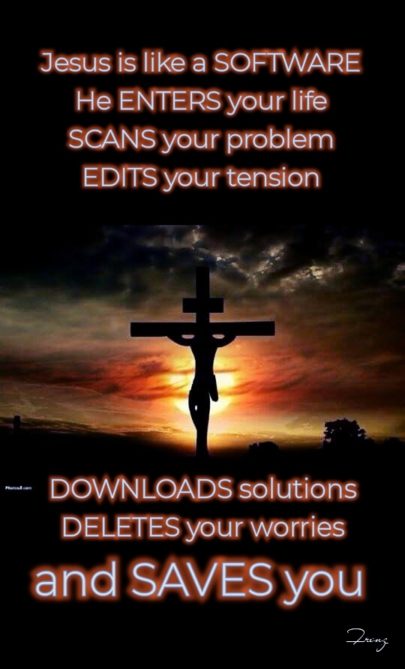
The image is a Christian meme or inspirational graphic designed to express the role of Jesus Christ in the lives of believers. It uses a modern, relatable analogy of software to communicate complex spiritual concepts. The aesthetic combines a striking visual with a straightforward message.
Visual Elements: →
* Background: → The backdrop is a dramatic sunset or sunrise scene. The sky is filled with dark clouds and fiery orange and yellow hues, which represent a sense of hope or the divine. The contrast between the dark clouds and the bright light creates a visually compelling image.
* Crucifix: → Silhouetted in the foreground is a cross, with the figure of Jesus on it. This symbolizes the central tenet of Christianity: the sacrifice of Jesus for the salvation of humanity. The silhouette makes the cross the focal point against the bright, vibrant background.
* Text: → The text is presented in a red, slightly glowing font, which contrasts with the dark background and draws the eye. The text is arranged in a logical order, with each line building upon the previous one. The words are formatted in a way that makes it easy to read and understand the message, and they add to the visual impact and message.
Textual Message and Its Interpretation: →
The core message of the image is a comparison of Jesus Christ to software, describing his functions:
* "Jesus is like a SOFTWARE" →: This establishes the central analogy. The comparison uses something familiar and modern (software) to explain something abstract (Jesus's role).
* "He ENTERS your life" →: This is the first step in the software process, the entry of Jesus into a person's life.
* "SCANS your problem" →: Like software that scans for issues, Jesus is presented as recognizing and understanding the problems and imperfections in an individual's life.
* "EDITS your tension" →: This represents the process of healing and reducing stress and emotional burdens, similar to software editing and fixing.
* "DOWNLOADS solutions" →: Jesus offers answers and guidance to overcome challenges, likened to software downloads providing solutions.
* "DELETES your worries" →: This symbolizes removing anxieties, guilt, and doubts through faith and trust in Jesus.
* "and SAVES you" →: The ultimate goal is achieved. This refers to the Christian concept of salvation, offering eternal life and forgiveness of sins through Jesus Christ.
Key Themes and Religious Significance: →
* Salvation: → The image's ultimate message is about salvation, which is a central tenet of Christianity.
* Transformation: → The comparison to software highlights the idea of a transformative process. The individual's life is "edited" and "saved" by Jesus.
* Modern Relevance: → By using the software analogy, the image seeks to connect with a modern audience.
Effectiveness and Intended Audience: →
* Impactful Visuals: → The dramatic background and the prominent cross create a strong visual impact, immediately conveying the religious theme.
* Relatable Language: → The use of everyday language and a modern analogy make the message easily understandable.
* Inspirational Tone: → The message is positive, offering hope, and promising a better life through faith.
* Target Audience: → The image is clearly directed at Christians or those exploring Christianity. It aims to encourage faith, offer hope, and share a message about Jesus's role in one's life.
Overall, the image is a clear, concise, and visually striking expression of Christian faith, using a modern analogy to communicate a timeless message of hope, transformation, and salvation.
* Visual Elements: →
* A layered, slightly blurred image of a person in profile, appearing contemplative or in prayer. The figure is semi-transparent, allowing underlying elements to show through.
* A subtle image of a cross is overlaid in the background, suggesting the core of Christian faith.
* Text, in a cursive, stylized font, dominates the composition:
* "Hell has no exit"
* "Heaven has one door"
* "Jesus" (this word is highlighted in a pink color)
* Overall Tone: → The image has a solemn and serious tone. The imagery and text work together to convey a message of faith, salvation, and the importance of choosing the correct path.
Article: The Path to Eternal Life: A Christian Perspective →
The image, with its poignant message, reflects a core tenet of Christian faith: the reality of choices that affect our eternal destiny. The words etched across the backdrop – "Hell has no exit. Heaven has one door. Jesus" – encapsulate this critical message. Let's delve into the meaning behind these words from a Christian viewpoint.
Hell: A Reality for Those Who Reject God →
The first statement, "Hell has no exit," speaks to the doctrine of Hell. In Christianity, Hell is not merely a physical location but a state of separation from God. This separation is a consequence of rejecting God's love, His forgiveness, and His path of righteousness. The Bible depicts Hell as a place of torment, a place of eternal regret, and a place devoid of God's presence. The phrase, "no exit," emphasizes the finality of this choice. Once in Hell, there is no opportunity to change one's eternal fate.
Heaven: The Promised Home →
The phrase "Heaven has one door" is equally significant. Heaven, for Christians, is a place of eternal joy, peace, and fellowship with God. It is the ultimate reward for those who believe in Jesus Christ and follow His teachings. But how does one enter this heavenly realm? The answer, as the image makes clear, is through the door of Jesus →.
Jesus: The Only Way →
The final, and most vital, word is "Jesus." Christianity centers around the belief that Jesus Christ is the Son of God, who came to earth to live a perfect life, die for the sins of humanity, and rise again. He is the way, the truth, and the life (John 14:6). The Scriptures teach that through faith in Jesus Christ, and accepting his gift of salvation, individuals can be reconciled to God and inherit eternal life in Heaven. He is the one door, the only path, the only hope for salvation.
The Call to Choose →
The image and its message are not meant to instill fear but to convey a vital truth: the choice we make in this life has eternal consequences. Christians are urged to embrace the grace offered by Jesus Christ, to repent of their sins, and to live a life that reflects God's love and teachings. This is the path to Heaven, the only exit from Hell.
A personal reflection →
In a world filled with uncertainties and distractions, the message of the image provides clarity. It calls for us to reflect on our own journey. Do you believe in Jesus, and follow his ways? If not, there is still time, as Christians believe to come before Jesus.
Image Analysis: "There are no tears in heaven, and no smiles in hell" →
The image presented is a visually evocative piece that resonates with Christian theological themes. Let's break down the elements and their significance:
Visual Elements and Composition: →
* Central Figure (Left): → A large, almost ethereal, rendering of a face dominates the left side of the image. The features suggest a serene and perhaps sorrowful expression. The way it's rendered with a soft, illuminated effect implies something divine or of great importance. Given the context, this is most likely meant to represent God, Jesus Christ or a representative of the heavenly realm.
* Cross and Figure (Right): → On the right side of the image, a dark silhouette of a cross looms, with a figure carrying the cross. The cross, a universally recognized symbol of Christianity, immediately links the image to the core narrative of Jesus Christ's crucifixion. This image evokes the sacrifice and suffering of Jesus.
* Background: → The background is filled with a warm, golden light, suggesting a sunset or sunrise, which could signify the beginning of eternal life. The lighting creates a contrast between the sorrowful tone and hopeful light.
* Text Overlay: → The core message is written on the image. The text is arranged in two lines, reinforcing the theme. The simplicity of the font allows it to be easy to read.
Textual Analysis and Theological Interpretation: →
* "There are no tears in heaven..." → This phrase directly links to the Christian concept of Heaven, the afterlife promised to believers. In Christian theology, Heaven is a place of eternal joy, peace, and freedom from suffering. The absence of tears signifies that all sadness, pain, loss, and hardship are left behind. This phrase offers hope and comfort to believers who have faced challenges and losses in life.
* "...and there are no smiles in hell." → This is the antithesis of the previous phrase, relating to the Christian concept of Hell. In Christian belief, Hell is a place of eternal separation from God, a place of suffering, pain, and torment. The absence of smiles suggests the absence of any joy or hope. This phrase serves as a warning of the consequences of sin and a reminder of the importance of faith and righteousness.
* The Combination: → The pairing of these two statements is a powerful reminder of the choices one faces. It subtly highlights the significance of one's actions and beliefs during their lifetime.
Christian Context and Messaging: →
The image deeply resonates with Christian beliefs and values. It offers:
* Hope and Comfort: → The promise of Heaven, a place free from suffering, is a core tenet of Christian faith. This aspect provides comfort in the face of trials and the inevitable loss of loved ones.
* Warning and Reminder: → The depiction of Hell as a place without joy serves as a reminder of the consequences of sin and the need for salvation.
* The Sacrifice of Jesus: → The cross is the single most identifiable visual symbol of Christianity. It is the central representation of Jesus's sacrifice for humanity.
* Call to Faith and Action: → The image is meant to be a call to faith and righteous living. It encourages individuals to choose a path aligned with Christian values to secure a place in Heaven and avoid Hell.
* The Divine Presence: → The large face on the left side gives visual representation of God and conveys that people can be happy to believe in him.
Overall Impression: →
The image is a poignant and straightforward representation of core Christian concepts. It's designed to evoke emotional and spiritual responses, reflecting the doctrines of Heaven, Hell, and the sacrifice of Jesus Christ. It can be used as a source of both hope and a call to action to its believers. It communicates the importance of faith, righteousness, and choosing the right path in life.
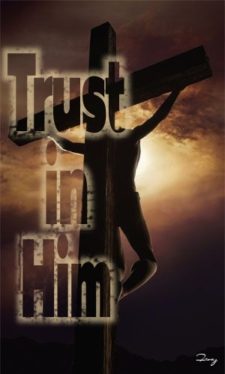
A Deep Dive into Faith: Analyzing the "Trust in Him" Image →
The image presents a powerful and evocative message, immediately recognizable to Christians worldwide. It centers on the visual symbol of the crucifixion of Jesus Christ, coupled with the imperative to "Trust in Him." Let's break down the elements of the image to understand its message more fully:
Visual Elements and Their Meaning: →
* The Crucifix: → The central and most prominent element is the cross, bearing the silhouette of a figure. This represents Jesus Christ, the central figure in Christianity. The crucifixion is a core event in Christian theology, signifying Jesus's sacrifice for the sins of humanity. The depiction, though silhouetted, shows the physical suffering of crucifixion, emphasizing the depth of Jesus's sacrifice.
* The Silhouette: → The lack of facial detail on the figure focuses attention on the crucifixion itself, the act of sacrifice. It emphasizes the suffering endured by Jesus.
* The Background: → The background is painted in a gradient, starting with a dark bottom. The colors shift upwards, featuring a dramatic display of light and color. This suggests a sunrise or sunset, further symbolizing the transition from darkness to light, from death to resurrection, and the promise of new beginnings, which is found in faith.
* The Text: "Trust in Him": → Overlaid on the crucifix is the clear message: "Trust in Him." The lettering itself is also stylized with an effect that seems to glow. This is the explicit invitation to faith. The phrase encapsulates the core of Christian belief: to place one's faith, hope, and allegiance in Jesus Christ. It's a call to reliance on God's will and promises. The image seeks to foster faith and encourage Christians to find refuge in the message that trust in Jesus will heal the heart of the faithful.
Overall Message and Interpretation: →
The image is explicitly a piece of Christian art. It leverages powerful symbolism to convey a specific message:
* The Sacrificial Love of Christ: → The image is a visual reminder of Jesus's ultimate sacrifice. It evokes feelings of reverence, empathy, and gratitude.
* The Call to Faith: → The "Trust in Him" text directly invites the viewer to embrace faith in Jesus Christ. The message is meant to inspire belief, provide comfort, and offer hope.
* Hope and Redemption: → The implied promise of salvation and eternal life, made possible through Jesus's death and resurrection, is reflected in the image's light and color. The image evokes feelings of peace and faith.
Target Audience and Context: →
The image is targeted towards Christians. It is likely intended for use in the following contexts:
* Religious Education: → It could be used in churches, Christian schools, or youth groups to teach about the Christian faith and the meaning of the crucifixion.
* Personal Reflection: → The image could be used by individuals as a source of comfort, inspiration, and a reminder to live their lives in accordance with Christian values.
* Evangelism: → It could be used in outreach efforts to share the message of Christianity with others.
In conclusion, → this image is a potent visual representation of Christian faith. It draws on the iconic symbol of the cross to communicate a message of sacrifice, love, hope, and the unwavering importance of trust in Jesus Christ. It serves as a call to action and a source of spiritual nourishment for believers.

The image is a Christian-themed graphic with a clear message: "LET THE TRUTH BE TOLD." The visual style is bold, vibrant, and designed to attract attention. It combines text with a central image of a figure, presumably Jesus, in a dramatic pose, suggesting a call for honesty and clarity.
Visual Elements and Their Interpretation →
* The Text: → The phrase "LET THE TRUTH BE TOLD" is the focal point.
* The font style is thick, blocky, and modern, conveying a sense of strength and directness.
* The letters are filled with an image of a person with their arms raised, which adds a sense of emotional engagement.
* The outline of each word in black and white, making it stand out further.
* The text is arranged in a way that makes the phrase easy to read.
* Central Image: → The image of the figure, implied to be Jesus, adds the important visual element:
* It is a dramatic shot of a person with their arms raised, likely the figure of Jesus. This suggests a sense of appeal to God.
* The image is blended into the letters, which is a clever way to visually suggest that the "Truth" is tied to Christ.
* Color Palette: → The color scheme is dominated by blue, with a gradient background and touches of white and pink:
* Blue is often associated with the sky, water, and spirituality, creating an atmosphere of peace and holiness.
* White conveys purity and enlightenment.
* Background: → The background is a blue gradient with a gold frame with little stars:
* The gradient adds depth and visual interest.
* The stars add a festive/religious atmosphere.
Symbolism and Meaning →
* Truth: → The core message is about truth. In a Christian context, "Truth" is often equated with God and the teachings of Jesus. The image urges the viewer to embrace and speak the truth.
* Jesus: → The depiction of Jesus, with his arms raised, suggests a call to faith, worship, and obedience to God's will. It creates a sense of awe and inspires the audience.
* Expression: → The image is designed to inspire and motivate, so it creates a feeling of peace and encourages those to speak out and speak the truth.
Possible Purpose and Target Audience →
* Christian Community: → The image is intended for a Christian audience.
* Social Media: → The image is well-suited for social media sharing, posters, or inspirational cards.
Overall Conclusion →
The image is a well-designed Christian graphic that conveys a message of truth, faith, and a call to action. The design, combination of images, and color scheme create a visually appealing and impactful statement. It is suitable for various uses to connect with and inspire people.
* Text: → The central and most prominent element is the text: "IT'S NOT A BLESSING IF YOU HAD TO SIN TO GET IT." The words are stacked vertically, with a bold, clear font.
* Background: → The text is overlaid on a blurred background image, suggesting a person in outdoor scenery.
* Color and Style: → The text has a dark brown outline and a white inner text. The whole text has a red outer neon like effect. The overall style suggests a modern, perhaps slightly stylized presentation.
Interpretation and Meaning (Christian Perspective): →
The image carries a strong Christian message. Here's a breakdown:
1. The Concept of a Blessing: → In Christianity, a "blessing" is something God bestows as a sign of favor, grace, and provision. It can be anything from good health and wealth to spiritual gifts and relationships. Blessings are seen as good things that ultimately bring the recipient closer to God.
2. The Definition of Sin: → "Sin" is any action, thought, or desire that goes against God's will as revealed in the Bible. This can include things like lying, stealing, greed, and so on.
3. The Message: → The core message of the image is a warning. It asserts that something is *not* a true blessing if it was obtained through sinful means. The image encourages us to examine how we obtain the things we have.
4. Why This Matters: →
* Moral Integrity: → The message reinforces the importance of moral integrity and doing things in a way that aligns with Christian values.
* Avoiding Deception: → The message warns us not to be deceived by what looks like a gain if that gain is achieved through compromise.
* Trust in God: → The message ultimately encourages trust in God and that he can fulfill his purpose and blessings.
* Consequences of Sin: → Sin can have negative consequences. This message reminds us that we should not pursue things at the cost of sin.
In Conclusion: →
This image is a straightforward, clear, and bold statement about prioritizing integrity over short-term gains. It communicates a Christian moral perspective.
The image is a visually appealing graphic, designed to convey a specific Christian message. The central theme revolves around the idea that genuine happiness can only be found through faith in God.
Visual Elements and Design →
* Text: → The primary element is the text, which forms the core message: "ONLY IN GOD WILL YOU FIND TRUE HAPPINESS." The text is arranged in a stacked format, with the words filling the image space.
* Font and Style: → The font is a bold, rounded sans-serif style. This gives the message a clear and accessible feel, designed to be easily read and understood.
* Overlayed Image: → Inside the text, there is a landscape scene with a depiction of Jesus. The detail is soft, with muted earthy tones that create a calming, natural atmosphere.
* Color Palette: → The overall color scheme is soft and warm, with browns, beiges, and light tints that are reminiscent of the natural world. The text is dark-edged, and the background color is a subtle, neutral pink.
* Composition: → The layout is centered, ensuring that the main message is immediately noticeable.
* Symbolism: →
* The image of Jesus implies spiritual guidance and solace, a connection to faith.
* The landscape background provides a sense of peace, connection to the natural world, and an invitation to connect with the presence of God.
Message and Interpretation →
The core message is a fundamental tenet of Christianity: that lasting happiness is found through a relationship with God. The image attempts to communicate this concept in a simple and direct way. It can be interpreted as:
* Spiritual Emphasis: → The image focuses on the spiritual aspect of life, suggesting that earthly pleasures are not the ultimate source of happiness. True happiness is found in a connection with a higher power.
* God as Source: → The image explicitly states that the source of happiness is God. The implied notion is that God can bring peace, joy, and fulfillment into one's life.
* Faith and Belief: → The message is meant to inspire faith and belief. It's an invitation to consider the role of God in one's life and to seek a spiritual connection.
Overall Impression →
The image is a positive and encouraging message that resonates with Christian beliefs. It offers a hopeful perspective on finding happiness and suggests that faith can provide comfort, purpose, and lasting joy. The design is aesthetically pleasing and intended to be shareable to others on social media.

The image is a clear expression of Christian faith, centered on the belief in the Second Coming of Jesus Christ. The aesthetic emphasizes a sense of anticipation, hope, and a connection to natural beauty.
Visual Elements and Interpretation: →
* Text: → The dominant feature is the phrase "HE IS COMING SOON." This is the core message, directly referencing the Christian belief that Jesus will return to earth. The use of capital letters reinforces the importance and urgency of this message.
* Background/Imagery: →
* Sky/Sunset/Sunrise: → The words are filled with an image of a colorful, dramatic sky, possibly a sunset or sunrise. This imagery evokes a sense of awe, beauty, and the grandeur of God's creation. The transition of colors from dark to light could also symbolize hope, the end of darkness, and the beginning of a new era.
* Cross: → The inclusion of a cross further strengthens the Christian theme. The cross stands as a central symbol of Christianity, representing Jesus' sacrifice for humanity. The placement of the cross within the landscape, possibly silhouetted against the sky, adds to the visual impact.
* Color Palette: → The dominant colors are warm tones – reds, oranges, yellows, and possibly some purples or blues in the sky. These colors often convey feelings of warmth, energy, and spiritual significance.
* Typography and Design: → The font style is bold and eye-catching. The words are outlined in a darker shade, which helps the text stand out against the background. The overall design is meant to be easily readable and impactful.
Meaning and Context: →
* Second Coming of Christ: → The central theme revolves around the Second Coming, which is a significant tenet of Christian faith. This belief is found in various parts of the New Testament. Christians believe that Jesus will return to judge the living and the dead, establish his kingdom on earth, and bring an end to evil.
* Hope and Anticipation: → The phrase "He is coming soon" often serves as a reminder of the promise of Christ's return. It offers believers comfort, hope, and the motivation to live their lives according to Christian teachings.
* Urgency and Warning: → The phrase also carries an element of urgency. It is a call to remain vigilant and prepared for Christ's return, as the timing is often portrayed as unknown. It may also serve as a call for evangelization.
Overall Message: →
The image is a visually compelling statement of Christian faith. It expresses the core belief in the Second Coming of Christ, using imagery that conveys beauty, hope, and anticipation. It is meant to remind viewers of their faith and the importance of living a life that is ready for Christ's return. The use of the phrase "He is coming soon" is intended to be both a promise and a call to action, encouraging believers to deepen their relationship with God and be prepared for the future.
The image presents the text "ANOTHER DAY ON THE ROAD TO PARADISE" arranged in a vertically stacked format. The text is the primary visual element and dominates the image's appearance. The font used appears to be bold and stylized, with a rounded, slightly bubbly appearance.
* Color and Style: → The letters are filled with an image of a sunset, transitioning from a warm, fiery orange at the bottom to deeper reds and purples at the top. This sunset gradient creates a visually appealing contrast and depth within each letter. A pink outline borders the text, adding further emphasis and making the words "pop" from the black background.
* Layout and Composition: → The text is centered within the frame, creating a sense of balance. The words are organized in a neat, easy-to-read order. The black background provides a stark contrast, drawing the viewer's attention to the colorful text.
Interpretations and Meaning: →
The phrase "Another Day on the Road to Paradise" is the central message, opening up multiple avenues for interpretation. Here's a breakdown of meanings:
* Hope and Optimism: → The phrase inherently suggests a hopeful outlook. "Paradise" is often associated with a utopian state of perfection and happiness. The phrase suggests the journey towards paradise is continuous, not necessarily a fixed destination. It acknowledges the ongoing effort required to achieve a desirable state, while holding the promise of a fulfilling outcome.
* Life's Journey: → The "road" metaphor represents life's journey, which is rarely a straight path. It suggests that there are daily challenges and experiences ("Another Day") that contribute to the overall progress toward one's ideal state.
* Personal Growth and Spirituality: → "Paradise" can also be interpreted in a spiritual context, referring to achieving enlightenment, inner peace, or a connection to a higher power. In this context, the image promotes the idea of seeking spiritual fulfillment.
* Motivational and Inspirational: → The phrase serves as a motivational mantra. It encourages perseverance and the pursuit of goals, with an emphasis on maintaining a positive attitude ("Another Day") while striving toward the desired objective ("Paradise").
* The Sunset Imagery: → The sunset within the letters can add to the interpretations. Sunsets often represent transitions, endings, and new beginnings. They also can also convey a sense of beauty and peace.
Overall Impact: →
The image aims to evoke positive feelings of hope, inspiration, and a sense of purpose. The black background is ideal, as it allows the vibrant colors and sunset image of the text to be the main focal point. The message is clear and direct.
The image is a visually striking and religiously charged composition centered around the Christian faith. It directly conveys a call to discipleship, using the phrase "FOLLOW ME" prominently displayed, integrated with imagery of Jesus Christ.
Visual Elements and Their Interpretation: →
1. The Phrase "FOLLOW ME": →
* The words "FOLLOW ME" are presented in a bold, stylized font. The letters themselves are designed as frames, and are filled with photographic imagery, seamlessly incorporating it into the message.
2. Imagery of Jesus Christ: →
* Central Figure: → The image strongly emphasizes Jesus as the focal point. He is positioned within the words and the spaces in between the letters as well.
* Facial Features & Expression: → The representation of Jesus has a thoughtful and inviting demeanor. His facial expression is gentle, and his eyes are looking towards the viewer.
* Gestures: → Jesus is shown extending his hand towards the viewer, a gesture that is commonly associated with an invitation, offering a guide to an experience, a help, or a direction to follow.
3. Color Palette and Background: →
* Dominant Colors: → The primary colors are dark and deep. This creates a clear contrast and makes the words "FOLLOW ME" stand out. The image's composition, and color, create a reverent, and serene atmosphere.
4. Symbolism and Meaning: →
* The Call to Discipleship: → The phrase "FOLLOW ME" is the most direct call to action. It is a central message in Christianity, where Jesus calls his followers to leave behind their previous lives and to embrace his teachings, in turn being guided to a different future.
* Invitation and Guidance: → The outstretched hand and the appearance of Jesus Christ as the guide. The imagery conveys an invitation to embark on a journey of faith, or spiritual transformation, and promises guidance on the way.
* Unity and Connection: → The image promotes community and togetherness, reminding viewers that they are not alone on their journey.
Overall Interpretation: →
The image functions as a simple, but powerful visual representation of Christian faith. It promotes an invitation to faith that focuses on commitment, following the teachings and examples of Jesus. The careful integration of words with imagery creates a strong emotional appeal to faith that, visually, captures the essence of Christian belief. It is a concise and accessible message that is easy to understand, and easy to remember, making it a common image that will be present in many facets of the religion.
The image is a digital graphic with a strong religious message conveyed through a combination of text and imagery. The bold, contrasting colors and the specific phrase used make it instantly recognizable as a message of faith and encouragement.
Elements and Their Interpretation: →
* Text: → The central message, "DO NOT BE AFRAID," is the most prominent element. This phrase appears frequently in the Bible (often translated as "Fear not"). It’s a direct command, designed to offer comfort, reassurance, and a call to trust in God amidst difficulties.
* Text Visual Style: → The text is rendered in large, block letters with a blue outline. This outline creates a strong visual contrast against the image background.
* Image in letters: → The image in the letters shows a cross and a sunset. The combination of natural imagery (the sunrise/sunset) with the religious message is intentional, drawing a parallel between the constancy of natural beauty and the unwavering presence of God.
* Color Scheme: → The blue outline of the text is a cool tone. The image colors inside of the letters are warm-toned. The colors might symbolize hope, serenity, peace, and the promise of a new day.
* Background: → The black background serves to make the text stand out. The black background could symbolize the darkness, the fear, and the challenges of life. The bright message of hope and comfort shines through these difficulties.
Christian Interpretation and Message: →
* Faith and Trust: → The primary message, "Do Not Be Afraid," is central to Christian faith. It’s a call to trust in God’s presence, provision, and protection, even in the face of uncertainty or fear. It implies that there is a higher power that can overcome fear.
* Promise of Comfort: → The message can offer comfort to Christians facing difficult circumstances. It reminds them to turn to faith and trust in God.
* Hope and Assurance: → The phrase acts as a reminder of God's presence and comfort.
* Overall Message: → The image, in its entirety, is a visual prayer, a meditation on faith, and a reminder of God's care. It is meant to be a source of comfort and encouragement.
Possible Target Audience and Usage: →
* Christians: → The image is explicitly targeted at Christians, as the message is deeply rooted in Christian beliefs and values.
* Social Media: → The image is highly suitable for sharing on social media platforms.
* Personal Encouragement: → The image could also be printed, framed, or used for personal reflection and prayer.
In conclusion, → the image is a well-designed and impactful piece that is designed to provide comfort and hope within a Christian context. The choice of the central message, the visual style of the text, the combination of text and images, and the overall color scheme all work together to convey a powerful and encouraging message of faith, trust, and God's unwavering presence.
The image is a digitally-rendered piece with a hopeful, comforting message. It is composed of text overlaid with sections of a painterly artwork. The message, "WE WILL MEET AGAIN," evokes a sense of reunion, in a spiritual or afterlife context. The use of artistic images within the text, coupled with the dark background, creates a visually striking and emotionally resonant piece.
Visual Analysis: →
* Text and Layout: → The words "WE WILL MEET AGAIN" are prominently displayed. The words are in a bold, sans-serif font, which gives it a clear and contemporary look. The text is outlined in a dark blue, giving the words a depth and prominence.
* Imagery within the Text: → The most striking aspect of the image is the use of snippets of a religious artwork.
* The image shows a depiction of the meeting of two individuals, one in a red garment and one in a white or light garment. The figures are positioned in a way that suggests an embrace or an intimate moment of reunion.
* There are visible brushstrokes, vibrant colors, and a focus on capturing light and emotion.
* The background is black, which serves to make the bright colors of the art inside the text stand out.
* Color Palette: → The predominant colors are warm and saturated, which creates a feeling of hope. The inclusion of rainbow-like colors gives a sense of magic and heavenly.
Interpretation and Context: →
The image has clear Christian undertones and made for Christian audiences.
* Reunion and Hope: → The central message, "WE WILL MEET AGAIN," is a core belief within Christianity. It is a promise of reunion with loved ones after death, often in the context of an afterlife (Heaven).
* The Imagery: →
* The figures in the image could represent Jesus with the believers, or a loved one with the believer.
* The hug is a sign of love and support.
Overall, the image is designed to: →
* Offer Comfort: → It aims to soothe grief or loss by offering the promise of reunion and eternal life.
* Encourage Faith: → It reinforces the Christian belief in the afterlife and the hope of seeing loved ones again.
* Create a Sense of Peace: → The combination of the heartfelt message, use of spiritual imagery and beautiful colors, is meant to leave the viewer with a sense of peace and hope.
In Conclusion: →
This image is a well-executed, spiritually-themed piece that combines a clear message with beautiful visual elements. Its intent is to communicate a message of hope, faith, and the promise of reunion, making it especially relevant to individuals experiencing loss or seeking comfort in their Christian faith.
The image is a graphic design with a clear religious message. It is visually striking, utilizing bold text and a photograph embedded within the words to convey its message. The style is modern and aims to be thought-provoking.
Text and Message →
* Phrase: → The central message is "DON'T DENY GOD." This is presented in a straightforward and direct manner, making its meaning immediately clear.
* Emphasis: → The word "DON'T" is separated from "DENY GOD," which is intentional to emphasize the action.
* Implied Subject: → The message is directed at the viewer, with the clear implication that denying God is something they should avoid.
* Font and Style: → The font is a bold, sans-serif type, giving the text a modern and assertive appearance.
Visual Elements and Design →
* Color Scheme: → The image uses a limited color palette, primarily employing shades of brown/sepia tones against a black background. This gives the image a slightly vintage or earthy feel.
* Photography Integration: → The image utilizes a photograph of a person's face, partially visible through the letter "D" and "E" in the word "DENY." This photo gives a more personal and relatable tone to the message.
* Framing and Composition: → The text is arranged in a way that creates a visual hierarchy and emphasizes the central message. The image is framed to create a clean visual.
Interpretation and Meaning →
* Religious Message: → The image is Christian, and the central message is a direct call to faith. The denial of God is a critical tenet of Christian theology.
* Call to Action: → The design is intended to be a form of religious outreach or encouragement. It's an invitation to reflect on one's relationship with God and potentially strengthen one's faith.
* Modern Approach: → The visual style makes an attempt to communicate a traditional message in a way that might resonate with a contemporary audience.
* Underlying Tone: → The tone of the message is one of conviction and warning. The instruction "DON'T" has a sense of urgency.
Overall, the image is a powerful statement designed to encourage Christian belief and discourage disbelief.
The image is a Christian-themed graphic design. It's a motivational and faith-based visual meant to inspire courage and trust in God. The design effectively combines text, imagery, and color to convey its message.
Key Elements and Their Meaning →
1. Text: →
* "FAITH OVER FEAR" →: This is the central message of the image. The bold, capitalized text emphasizes the core idea: that faith is meant to overcome fear. It's a common phrase used in Christian circles and serves as an encouragement to trust in God's presence and power rather than being controlled by anxiety or worry.
* "Psalms 118:6" →: This indicates a biblical reference. Psalms 118:6 reads: "The Lord is with me; I will not be afraid. What can mere mortals do to me?" This verse reinforces the "Faith over Fear" message, providing a specific scriptural backing for the phrase. It suggests a source of strength and reassurance for the Christian.
2. Imagery →:
* Crucifixion Scene →: In the background, a silhouette of Jesus Christ on the cross is visible. This is the single most prominent element of the graphic.
* Symbolism →: The cross is a powerful symbol of Christianity, representing Jesus' sacrifice, redemption, love, and the victory over sin and death. It reminds the viewer of the core belief of the Christian faith and of the triumph of good over evil.
* Visual Story →: The image's presence subtly but directly connects the message of faith over fear to the sacrifice of Christ. It evokes the idea that because Christ overcame suffering, death, and other fears, we too can rely on His example and presence to confront and overcome our fears.
* Color and Lighting →: The overall color palette is dominated by purples, golds, and soft, ethereal light.
* Color Meanings →:
* Purple →: Often associated with royalty, spirituality, and contemplation. It can evoke a sense of awe, reverence, and the presence of God.
* Golds →: The gold light creates a sense of warmth, hope, and divine glory.
* Lighting →: The use of soft, indirect light creates a feeling of peace, serenity, and a sense of mystery. The lighting highlights the cross, drawing the viewer's eye and emphasizing its significance.
3. Design and Composition →:
* Font and Arrangement →: The text "FAITH OVER FEAR" is presented in a bold, easy-to-read font. The text is also placed on top of the background imagery. The placement ensures that the message is clear and dominant, grabbing the viewer's immediate attention.
* Visual Weight →: The balance between the text and the crucifixion scene is well-done. The text is prominent, but the background scene provides depth and context, making the image meaningful rather than just a slogan.
Overall Meaning and Interpretation →
The image is designed to inspire and encourage Christians. It communicates the message that faith in God, as exemplified by Jesus' sacrifice, provides the strength needed to overcome fear and worry. By referencing the scripture and using iconic Christian imagery, the graphic offers:
* Reassurance →: That God is present, accessible, and a source of protection.
* Hope →: The idea of triumph over adversity, a central tenet of the Christian faith.
* Inspiration →: To embrace faith and trust in God, even in times of difficulty.
* Contextualization →: It reminds the viewer of the Christian's path to overcoming their fears.
Conclusion →
This graphic is an effective piece of Christian art designed to strengthen faith and comfort. Its blend of clear messaging, symbolic imagery, and appropriate design makes it a motivational tool for those who look to the Bible for encouragement. It serves as a visual reminder that faith is a powerful antidote to fear, a core belief for people of Christian faith.
Overview: →
The image is a Christian-themed graphic featuring a poignant message of hope and faith. It visually merges text and imagery to convey a sense of reassurance and divine support.
Visual Elements: →
1. Text: →
* The primary focus of the image is the bold text, "HE WILL LIFT YOU UP."
* The text is rendered in a clean, sans-serif font, with a distinct outline that gives it a 3D effect.
* The words are layered over the background, creating a sense of depth and prominence.
2. Background: →
* The background is a landscape scene, taken at sunrise or sunset.
* The scene evokes feelings of serenity, vastness, and beauty.
* A silhouette of a person on a hill is present.
* A cross looms above the person, implying the presence of Jesus Christ.
* The color palette features warm hues like oranges, yellows, and browns, contrasted with the cool tones of the sky.
3. Overall Composition: →
* The text is prominently positioned, drawing the viewer's attention immediately.
* The background landscape complements the text, visually reinforcing the message of hope.
* The layered effect, with the text overlaying the scenery, creates a cohesive and appealing visual.
Interpretation and Meaning: →
* The Message: → The central message, "HE WILL LIFT YOU UP," is a declaration of faith. It communicates a promise of support, encouragement, and help from a higher power (God or Jesus Christ). It's a message of assurance that someone is there to help in times of hardship or difficulty.
* Symbolism: →
* The Cross: → The cross, in the background, is a powerful symbol of Christianity, representing the sacrifice of Jesus Christ for humanity.
* The Person Silhouette: → The person at the foot of the cross suggests a faithful follower.
* The Landscape: → The serene and spacious landscape can represent the comfort and support provided by faith.
* Emotional Impact: → The combination of the message and visual elements evokes a sense of peace, hope, and comfort. It is designed to inspire faith and reassure viewers of divine help.
Purpose and Usage: →
* Inspirational Content: → This image is intended for use as inspirational content, sharing a message of faith and hope.
* Social Media and Digital Media: → It is perfect for sharing on social media platforms, religious websites, or personal blogs to encourage and uplift others.
* Personal Reflection: → The image could also be used as a personal reminder of faith and strength.
Overall Impression: →
The image is a well-designed and emotionally resonant piece of Christian art. Its simplicity and clear message make it effective in conveying its message of encouragement and faith. The overall design combines powerful text with evocative imagery to create a positive and comforting experience for the viewer.
The image is a motivational and inspirational graphic with a clear Christian message. It is designed to evoke feelings of comfort, faith, and trust in Jesus, particularly during times of fear or anxiety.
Visual Elements →
* Text: → The most prominent element is the bold text that reads:
* "WHEN I AM AFRAID"
* "I PUT MY TRUST IN"
* "JESUS"
The words are large, clearly legible, and arranged in a way that creates a sense of visual hierarchy. The emphasis is on "JESUS," drawing the eye to the central message. The text uses a black stroke around the letters to help them stand out against the background.
* Font: → The font is a slightly stylized, sans-serif font with a strong, grounded feel. The "JESUS" is a contrasting font with a light-colored, layered look that makes it stand out.
* Background: → The background is a slightly blurred image, giving the impression of a landscape with figures, and is visible through the text. This background texture prevents the image from being visually flat.
* Color Palette: → The color scheme is dominated by warm and subdued tones (browns, tans). This adds to the image's feeling of peace and comfort.
* Layout: → The words are arranged neatly. The centered placement of the text and background contributes to the image's overall balance and visual appeal.
* Signature: → A signature "Frenz" is placed in the bottom right corner, the creator of the graphic.
Message and Meaning →
* The Core Message: → The central theme is expressing that during feelings of fear, anxiety, or uncertainty, the individual finds solace and strength by putting their trust in Jesus.
* Christian Theology: → The message strongly aligns with Christian beliefs about faith, prayer, and the role of Jesus Christ as a source of comfort, peace, and salvation. It encourages viewers to turn to their faith during times of difficulty.
* Emotional Impact: → The image aims to provide comfort, reassurance, and encouragement. It is designed to resonate with people who are struggling with fear or anxiety and offers a message of hope and reliance on faith.
Target Audience →
The image is targeted toward Christians, particularly those who are seeking spiritual comfort and strength. It is intended for sharing on social media, using as a wallpaper, or printing as a small poster.
Overall, the image is a well-designed visual representation of Christian faith, providing a clear and encouraging message of hope and trust.
The image is designed to evoke a sense of comfort, hope, and spiritual reassurance. The central message, "YOU ARE NOT ALONE," is clearly displayed, emphasizing the idea that one is accompanied by a divine presence. The visual elements support this theme with Christian symbolism.
Visual Elements and Symbolism →
* The Text Overlay: → The words "YOU ARE NOT ALONE" are the focal point, using a bold, shadowed font. The text's style suggests importance and is positioned over the underlying scene, implying the message transcends the physical environment.
* Background Figures: → The image features two main figures overlaid onto the background.
* Jesus: → The translucent figure on the left is Jesus. The long robes and the staff are consistent with traditional artistic representations of Jesus. This figure's presence reinforces the idea that the person is not alone because of the divine presence.
* The Individual: → On the right side, there's a silhouette of a person. The person stands on the shore and seems to be looking out at the landscape. The person's silhouette may represent the viewer or anyone who might be feeling alone or facing challenges.
* The Dove: → A white dove flies in the sky, above the figures. The dove is a well-known symbol of the Holy Spirit and peace in the Christian faith. Its presence emphasizes divine protection and guidance.
* Landscape: → The background features a landscape. The presence of water, and the terrain evokes feelings of peace and solitude, the figures are watching the sunrise, which symbolizes hope, a new beginning, and the presence of God. The landscape's soft colors and lighting create a serene atmosphere.
Interpretation and Message →
The image's combined elements send a clear message of hope and spiritual support. The key takeaways include:
1. Divine Presence: → The presence of Jesus and the dove highlights the belief in a divine presence, offering comfort and support.
2. Overcoming Loneliness: → The central message directly addresses the issue of loneliness, suggesting that individuals are accompanied by the divine, no matter their circumstances.
3. Faith and Strength: → By combining the figures with the landscape and the message, the image encourages faith and strength in times of difficulty. The person in the landscape is facing the elements and the viewer is encouraged to find faith in God.
Overall Tone and Purpose →
The image's overall tone is positive and uplifting. It's designed to offer comfort and reassurance to those who might be struggling with loneliness or difficult times. The combination of the message, religious symbols, and serene landscape creates a visual that reinforces the idea of faith as a source of strength and support.
The image is a powerful and emotionally charged visual message, clearly aimed at a Christian audience. It encourages resilience, faith, and hope in the face of adversity. The overall tone is somber yet hopeful.
Visual Elements and Symbolism: →
* The Person: → The central figure is a person, lying down in water or on wet ground. Their posture suggests exhaustion, despair, or possibly even defeat. Their face is partially obscured, allowing the viewer to project their own feelings and experiences onto the figure. This representation embodies the human experience of struggle and hardship.
* The Crosses: → Three crosses are visible on a hill in the background, strongly indicating the crucifixion of Jesus Christ. This is a cornerstone of Christian faith, representing sacrifice, suffering, and ultimately, redemption. The presence of the crosses immediately grounds the image in a Christian context.
* The Text: → The text "Stand Up" and "And Have Faith" is the core message. This text can be interpreted on different levels:
* Action: → "Stand Up" is a directive, urging the individual to rise, to overcome challenges, and not to give in to despair.
* Faith: → "And Have Faith" is an exhortation to trust in God, even in the darkest of times. It underscores the importance of faith as a source of strength and guidance.
* Intertwined Messages: → The juxtaposition of "Stand Up" and "Have Faith" suggests that faith is a prerequisite for rising from difficult situations. It's a call to action coupled with spiritual encouragement.
* Color Palette: → The image utilizes a muted, somewhat desaturated color palette. The dark tones enhance the somber feeling and the feeling of the hardships, however, the sunset in the back adds hope and light.
Interpretation and Message: →
The image can be interpreted as a visual metaphor for life's struggles and the Christian faith. Here's a possible reading:
* Life's Challenges: → The person lying down represents anyone facing difficulties—pain, suffering, loss, doubt, fear, or any form of hardship. It's a reminder that life is not always easy.
* The Answer - Faith: → The call to "Stand Up" and "Have Faith" emphasizes that even when overwhelmed, trust in God is necessary. The crosses in the background are a constant reminder of Jesus' sacrifice and the promise of redemption.
* Hope and Resilience: → The image urges viewers to find strength in their faith, rise above the challenges, and trust in God. It promotes the idea that faith is a source of inner strength and a pathway to overcoming adversity. It offers a sense of hope.
In Essence: →
This image is an inspirational piece. It combines powerful visual symbolism, a clear message of faith, and a call to action. It's designed to resonate with Christians, to encourage them to persevere through tough times and to rely on their faith. It suggests that even in the midst of suffering, there is hope and the promise of redemption. It is a visual reminder of the Christian values of faith, resilience, and the importance of trusting God.
The image is a visually impactful expression of faith, combining text and imagery to convey a plea for divine assistance. It uses a strong visual aesthetic to evoke a sense of desperation and reliance on God. The style is intended for social media, sharing, or as a desktop background.
Visual Elements and Their Meaning →
* Text: → The primary message, "GOD HELP ME," is the focal point. The use of uppercase letters emphasizes the urgency and seriousness of the request. The font style is bold, modern and artistic.
* Imagery: → The letters of the words 'GOD HELP ME' are a visual window with the backdrop of the silhouette of a person. The silhouette of the person is in a posture of prayer or supplication - kneeling or bowing their head. The light reflecting is the sunrise/sunset. The silhouettes evoke a sense of vulnerability, loneliness, and an acknowledgement of a higher power.
* Color Palette: → The color palette is dominated by sunset colors of purple, orange and black with shades of green. The color choice of the text also adds a reflective style, as if the words and prayer are very important and powerful.
* Composition: → The arrangement of the words on top of the image shows the person's appeal for a response/solution. The use of the letters creates an eye-catching and very important appeal to God. The "God Help Me" is centralized in the image.
Christian Interpretation and Message →
The image resonates with core tenets of Christian belief and practice:
* Prayer and Supplication: → The plea "GOD HELP ME" is a direct expression of prayer. Christians are encouraged to pray continually, offering their needs, struggles, and thanks to God. The image visually represents this, emphasizing the act of turning to God in times of need.
* Dependence on God: → The posture of the person and the overall visual theme suggest a sense of helplessness and reliance on a higher power. This reflects the Christian belief that humanity is dependent on God for guidance, strength, and salvation.
* Seeking Guidance and Comfort: → The use of the letters to see an image of the sunrise/sunset shows the longing and appeal of a person to God for peace, which highlights the Christian belief in God's ability to offer comfort, strength and guidance.
* Expressing Faith: → The image provides a visual reminder that faith is not limited to words but extends to all aspects of life.
Overall Impact →
The image is a powerful visual representation of faith and a call for help. It is meant to communicate faith, hope, and trust in God, even when the person is in distress.
The image is a visually striking graphic centered on the phrase "NEVER LOSE HOPE." The text is presented in a bold, blocky font, suggesting strength and conviction. Here's a deeper look:
* Font and Color: → The lettering is a warm, golden-brown hue, giving it a feeling of richness and importance. The color, combined with the font's weight, helps convey the message's significance. The font is bordered with a subtle white outline.
* Composition: → The phrase is stacked vertically, with "NEVER" at the top, "LOSE" in the middle, and "HOPE" at the bottom. The layout is clean and easy to read.
* Backdrop: → The words are not opaque, but rather have an image as the background for each of them. This allows for the image behind the word "LOSE" to be seen, which appears to be the sun setting or rising over a body of water. The rest of the letters appear to have the reflection of the sky behind the word.
* Context: → The use of a landscape background, particularly the scene suggesting a sunrise or sunset, is significant. This gives the image a very uplifting and hopeful tone.
* Signature: → The name "Frenz" is signed in the bottom right corner.
Interpreting the Image Through a Christian Lens: →
The core message, "Never Lose Hope," resonates deeply with Christian principles. Here's how:
* Hope as a Theological Virtue: → In Christianity, hope is considered one of the three theological virtues (along with faith and love). It's the confident expectation of God's promises, even in the face of adversity. It is the anticipation of heaven and an eternal life with God.
* The Nature of Faith: → "Never lose hope" becomes a call to maintain faith, even in challenging times. The image encourages the viewer to persevere, trusting that God's plan and love will ultimately prevail.
* The Light of God: → The sunrise or sunset scene within the letters can be interpreted as a symbol of God's presence, illumination, and the promise of a new beginning. Light often symbolizes God's guidance, truth, and the defeat of darkness (sin and despair). Just as the sun breaks through the darkness, so too does God's hope.
* The Symbolism of Resurrection: → In Christian theology, the rising sun is a symbol of resurrection and the triumph of life over death. It can also signify a renewed start to one's life.
* Resilience and Perseverance: → The image encourages resilience and perseverance in difficult times. It's a reminder that even when things are dark, hope remains, and faith can be a source of strength and light.
* Eternal Perspective: → The message encourages an eternal perspective, reminding Christians to look beyond the challenges of this world and focus on the eternal promises of God.
Overall Impression: →
The image is simple yet powerful. It is a visually appealing and uplifting call to hope, reflecting Christian values of faith, perseverance, and trust in God. It can be a source of inspiration and comfort, reminding viewers to hold onto hope even when facing difficult circumstances. The use of the landscape background amplifies the message, adding a layer of visual meaning to reinforce the core message.
The image is a motivational and religious graphic with a black background. The text, "YOU ARE A GIFT OF GOD," is prominently displayed in a light, golden-brown color. The letters themselves are designed to be transparent, revealing a photograph of a young girl underneath. The photograph within the letters shows the girl with blonde hair, soft features, and a gentle expression. She is in a state of prayer, with her hands clasped together.
Interpretation and Meaning: →
* Christian Theme: → The core message is clearly rooted in Christian belief. The phrase "You are a gift of God" is a powerful statement of faith and inherent worth. It conveys the idea that each individual is precious in the eyes of God, created with purpose and love.
* Inherent Value: → The message emphasizes the inherent value of the individual. It counters any sense of worthlessness or self-doubt by affirming that each person is a divine gift, treasured by God.
* Girl as the Symbol: → The use of a young girl within the letters likely serves multiple purposes. It can represent innocence, purity, and vulnerability – qualities often associated with the Christian faith. The inclusion of a child may also speak to the specific value of children.
* Prayer and Reverence: → The girl's posture, hands clasped in prayer, conveys a sense of reverence and connection to God. This further reinforces the religious theme and invites viewers to consider their relationship with the divine.
* Hope and Encouragement: → The image's overall tone is one of hope and encouragement. It serves as a reminder of the unconditional love and acceptance offered within the Christian faith.
* Black Background: → The stark black background creates a strong contrast, making the message and the images contained within the letters stand out.
Overall Effect: →
The image's primary purpose is to inspire and uplift. It is a visual affirmation of God's love, a gentle reminder of the inherent value of each person, and an encouragement to embrace faith and connection with God. It is likely intended for personal reflection, sharing on social media, or as a message to others, especially those who may be struggling with self-worth or facing challenges in their lives.
Potential Uses: →
This image is well-suited for various contexts:
* Social Media: → Sharing on social media platforms to spread a positive, uplifting message.
* Personal Affirmation: → As a visual reminder of one's own value and connection to God.
* Gifts: → As a gift to loved ones.
* Christian Education: → As a teaching tool to discuss the concept of grace, God's love, and the importance of self-worth within a Christian framework.
* Missions & Evangelization: → As a part of the message of love and hope in their life.
In conclusion, the image is a simple yet effective piece of visual communication that encapsulates a core tenet of Christian faith: the belief that every individual is a precious gift from God, loved unconditionally and destined for a purpose.
The image presents a strong, positive message with a clear religious/Christian undertone. The design is straightforward, relying on the impactful text and a visually appealing color scheme to convey its message.
Elements of the Image: →
* Text: → The dominant element is the message "NEVER STOP PRAYING." The font is bold, blocky, and likely chosen for its readability and impact.
* Color and Style: → The letters have a gold, reflective appearance, possibly aiming to mimic the look of gold or gilded items. This adds a layer of perceived value and significance to the message. The background is solid black, which enhances the visibility of the gold text and makes it stand out.
* Layout/Composition: → The text is arranged in three lines. "NEVER" is in the first line, "STOP" in the second, and "PRAYING" in the third, vertically centered. The spacing is even, creating a balanced and easily understandable design.
Interpretation and Symbolism: →
* Message: → The primary message is an encouragement to continuously pray, to persist in faith, and to maintain a connection with the divine (God).
* Religious Significance: → Prayer is a central practice in Christianity (and many other religions). The phrase "Never Stop Praying" is therefore a direct and clear instruction.
* Color Psychology: → Gold is often associated with wealth, value, and spirituality. The use of gold lettering may suggest that the message itself is valuable or sacred. Black is a color that contrasts really well with gold and makes the words "Never Stop Praying" stand out and the meaning of the words stand out more.
* Overall Theme: → The overall theme is faith, perseverance, and maintaining a relationship with God. The design targets a Christian audience, conveying a message of hope, strength, and spiritual commitment.
Potential Uses/Context: →
This image could be used in a variety of contexts:
* Christian Social Media: → Shared on platforms like Facebook, Instagram, or Pinterest to offer encouragement or as a reminder of faith.
* Inspirational Graphics: → Part of a larger graphic design (e.g., a motivational quote) for a website, blog, or printed material.
* Personal Use: → Used as a screensaver, desktop background, or printed as a piece of wall art to serve as a daily reminder.
* Church/Religious Organizations: → Featured in church bulletins, newsletters, or on promotional materials.
* Christian Apparel and Merchandise: → Printed on t-shirts, mugs, or other products with religious themes.
In Summary: →
The image is a simple but effective visual representation of the Christian message "Never Stop Praying." Its clean design, bold colors, and clear message make it easily understandable and relevant to a faith-based audience. It serves as a constant reminder to those of faith to continuously give prayers.
The image is a graphic design, with the words "JESUS GIVES ME STRENGTH" prominently displayed. The words are arranged vertically, one word stacked on top of the other. The font used is a bold, blocky, and slightly textured typeface. The letters are white, outlined in light grey/silver and appear to have a gradient, giving them a slightly metallic or three-dimensional appearance. This font style gives a feeling of importance to the words. The letters themselves are filled with an image of Jesus in a blue robe, with a glimpse of his back and shoulders. This figure is partially visible through the letters, creating a layered effect. The background is a solid black.
Analysis of the Message →
The core message is clear and unambiguous: "Jesus Gives Me Strength." This is a statement of faith and personal conviction, expressing that the individual finds their strength, support, and resilience through their belief in Jesus Christ.
* Jesus: → The name "Jesus" is the focal point, highlighting the central figure of Christian faith.
* Gives: → This verb emphasizes the active role of Jesus in providing strength. It implies that strength isn't something one finds within themselves alone but is bestowed as a gift.
* Me: → The inclusion of "me" makes the statement deeply personal. It transforms a theological concept into a lived experience of faith.
* Strength: → This key noun refers to the ability to cope with challenges, overcome difficulties, and persevere in life.
Visual Elements and Their Impact →
The visual elements further enhance the message's impact:
* Font Choice: → The bold and somewhat imposing font suggests a firm and unwavering belief. The metallic-like texture within the letters gives them a sense of both gravitas and potential for lasting influence.
* Image within the Text: → The presence of an image (of Jesus) embedded within the letters is a clever visual trick. It connects the word "Jesus" directly to the figure, reinforcing the relationship between the statement and the faith.
* Color Palette: → The limited color palette (white, black, and the blue tones from the image) adds a sense of visual simplicity and clarity. The black background makes the words and image pop.
* Composition: → The vertical arrangement of the words creates a sense of order and directness, drawing the viewer's eye down the message.
Interpretations and Target Audience →
The image is clearly designed for a Christian audience. It's meant to:
* Provide Comfort and Encouragement: → Those facing hardships might find solace in the message, reminding them that they are not alone and that faith offers support.
* Express Personal Faith: → It's a statement a believer might use to express their inner thoughts and feelings.
* Share Faith with Others: → It could be used on social media, in a prayer, or in other contexts to encourage or to inspire someone to have faith in Jesus.
In Conclusion →
This image is a powerful visual representation of Christian faith and the source of strength. It's a simple, yet meaningful declaration of a personal relationship with Jesus, designed to inspire, comfort, and share faith. The combination of typography, image, and color effectively conveys the message of hope and resilience found through belief.
Overall Composition and Design →
The image is a digital artwork with a clear Christian theme. It features the words "LOVE LIKE JESUS" prominently displayed. The design is visually appealing, using a combination of text, imagery, and color to convey its message. The text is bold and stylized, while the images are seamlessly integrated into the letters.
Text and Message →
* "LOVE LIKE JESUS": → This is the central message. It's a call to action and a core tenet of Christian faith. It encourages individuals to model their actions and emotions after the teachings and example of Jesus Christ. This means practicing compassion, forgiveness, empathy, and selfless service.
Color Palette and Aesthetic →
* Warm Tones: → The overall color scheme is warm, likely to evoke feelings of comfort, love, and spiritual warmth.
* Shadow and Depth: → The letters have a shadow effect giving a sense of depth and dimensionality.
* Background: → The dark blue background gives a contrast that makes the text pop out and be seen.
Interpretation and Significance →
This image serves as a visual reminder of Christian values and a call for followers to live in a manner that reflects the teachings of Jesus. The image's primary aim is probably to encourage:
* Reflection: → The image prompts viewers to consider what it means to love like Jesus, encouraging introspection and self-assessment.
* Inspiration: → The message provides inspiration for personal growth and spiritual development.
* Community: → The message underscores a shared belief and value system within the Christian community.
In Conclusion →
The image is a well-designed piece of religious art that utilizes typography, imagery, and color to communicate a core Christian message. It is meant to be encouraging and inspirational, reminding viewers of their faith and motivating them to act in accordance with its values.
Image Analysis: →
The image is a text-based graphic with a clear religious message. Here's a breakdown:
* Text: → The central message is "GOD WILL NOT GIVE YOU MORE THAN YOU CAN HANDLE." The text is in a sans-serif font with a white outline, placed against a black background.
* Imagery: → The text itself has a unique style. Inside the letters, there's a collage of photos. You can see parts of a person reaching up, smiling, and scenes of outdoors. The pictures incorporated into the letters creates a visual interest.
* Color Scheme: → The dominant colors are black (background), white (outline), and the colors from the photos in the letters, which are mostly neutral, with some blue.
Article: The Strength Within: Finding Hope in "God Won't Give You More Than You Can Handle" →
The phrase "God will not give you more than you can handle" is a comforting mantra, especially in times of difficulty. The image embodies this message with its bold lettering and background. But what does this saying truly mean, and how can we embrace its wisdom in our daily lives?
The Essence of the Belief →
This statement, often associated with Christian faith, suggests that life's challenges, no matter how daunting, are not random cruelties. It implies a belief in a higher power that has a purpose, and that even hardship serves a greater good. This doesn't mean suffering is welcomed, but rather it is a form of belief. In this view, God allows adversity to test our strength, build character, and guide us toward spiritual growth.
Understanding the Challenges: →
* Not a Guarantee of Ease: → This isn't a promise of a life free from struggle. Instead, it's a reminder that even when challenges arise, we possess the inner resources to overcome them. It's about the belief that you are capable.
* Empowerment, Not Passivity: → The phrase shouldn't lead to passive acceptance of hardship. It is more of an encouragement to work through problems. It challenges us to actively seek solutions, develop coping mechanisms, and draw on our inner resilience.
* Facing the Difficult Times: → The saying is especially important in moments of overwhelm. It provides comfort, helping us maintain faith during difficult times.
Living the Message: →
* Seek Support: → Recognizing our limitations is a sign of strength. Don't hesitate to ask for help from friends, family, support groups, or professionals.
* Focus on Personal Growth: → Every trial presents an opportunity to learn and evolve. Reflect on what you're learning, and how you can become stronger through the experience.
* Embrace Faith and Spirituality: → The message is deeply rooted in faith. Whether through prayer, meditation, or connecting with nature, faith can be a source of strength and guidance.
* Cultivate Gratitude: → Even in difficult times, look for the good things in your life. Gratitude fosters a positive mindset, which can help us navigate challenges with greater resilience.
Conclusion: →
The image embodies the message "God will not give you more than you can handle" as a beacon of hope and resilience. It is a reminder that we are stronger than we think, and that even amidst the storms of life, we have the capacity to endure, grow, and find meaning. It is an invitation to rely on inner strength and seek out the support and faith needed to navigate the difficulties of life with courage and hope.
The image is a visually striking piece of Christian art, designed to convey a message of hope, assurance, and divine protection. The bold typography and the imagery within the letters work together to create a powerful statement. The image is targeted at those who are struggling and need faith to overcome their difficulties.
Key Elements and Interpretation: →
* The Text: → The primary element is the text: *"I HAVE OPENED A DOOR FOR YOU THAT NO ONE CAN CLOSE."* This is the core message of the image. It is a paraphrased quote from Revelation 3:8, which is found in the New Testament of the Bible. This verse expresses a promise of God's favor and a guarantee of opportunity, regardless of opposition or external forces.
* The Typography: → The words are presented in large, bold, and stylized letters. The font has a strong, slightly textured appearance, which adds a sense of solidity and permanence. This suggests that the message is meant to be taken seriously, offering a firm foundation of faith.
* The Color Scheme: → The color palette is a blend of warm and cool tones. The images inside the letters show a sunset, cloudy scenery and a cross on the horizon. This color scheme is meant to make the viewer think of sunset or sunrise, bringing forth a sense of peace and hope.
* The Inner Imagery: → Inside the letters, we see a picture of the sky, with clouds and a cross. The cross at the center symbolizes Christ's sacrifice for humanity, providing a link to the "door" that has been opened. The cross is the focal point. It is the main symbol in Christianity and it is associated with death and resurrection, hope and redemption. The scenery adds depth and meaning, pointing toward the heavenly and the divine.
* The Background: → The background is black, which helps make the text and the inner images really pop out.
Deeper Christian Meaning and Significance: →
* The "Door": → In a Christian context, the "door" often symbolizes opportunity, access to God's grace, and a way to salvation.
* God's Favor: → The message indicates that God has opened a path for the viewer.
* Assurance and Security: → The statement that "no one can close" the door offers an assurance of God's unchanging power and protection.
* Hope in Difficult Times: → The overall message is intended to offer hope, particularly to those facing challenges, difficulties, or opposition in their lives.
* Eternal Perspective: → The reference to God and the imagery of the sky and cross encourage the viewer to look beyond the temporary, earthly challenges and find their strength and hope in a relationship with God.
* Revelation and Empowerment: → The words are written in first person as a divine quote, which suggests that you are the direct recipient of God's message, which empowers you.
Overall Impact and Purpose: →
The image is meant to be encouraging, supportive, and uplifting for those with a Christian faith. It is meant to show the viewer that God will always be on their side, and that they have nothing to fear. The image combines visual and textual elements to reinforce a message of trust, divine support, and eternal hope. It serves as a visual reminder of faith, God's promises, and the unwavering love and support found in the Christian faith.
This image is a straightforward, yet emotionally charged, Christian message conveyed through text and imagery. Here's a breakdown:
1. Text: →
* "YOU ARE LOVED": → This is the central message. The words are presented in large, bold, and blocky letters, making them immediately noticeable and emphasizing the importance of the message. The choice of "YOU" speaks of direct and personal connection.
2. Imagery: →
* The Image of Jesus: → The image of Jesus is strategically integrated into the letters of the phrase. The letters are not solid; instead, portions of a painting or artistic rendering of Jesus fill the spaces. This clever design uses the visual of Jesus to amplify the meaning.
* Pose and Expression: → The depiction of Jesus is from a traditional Christian art style. The portions visible of Jesus face features, beard, eyes, arms, and hands show that the painting emphasizes an expression of compassion, perhaps reaching out to the viewer, or open and inviting. This pose is consistent with the idea of acceptance, grace, and love found in Christian teachings.
3. Design and Aesthetics: →
* Font and Color: → The blocky font gives a solid, and perhaps slightly formal, appearance to the message. The outlining of the letters in the images with a darker, slightly textured stroke adds depth and definition. The internal color scheme of the image follows the traditional imagery of Jesus.
* Composition: → The composition is simple but effective. The use of black background for the most of the image draws attention to the words and the image of Jesus inside them. The text is the primary focus, and the overall look is clean and modern.
4. Interpretation and Message: →
* Core Christian Teaching: → The phrase "You Are Loved" embodies a central tenet of Christianity: God's unconditional love for humanity. It's a message of hope, comfort, and reassurance.
* Personal Connection: → The "YOU" is a personal invitation, directly addressing the viewer. It is a message designed to touch the individual, reinforcing that love is offered to each person.
* Source of Love: → By incorporating the image of Jesus, the image explicitly connects the idea of love with God and Christian faith. This affirms that the source of that love is divine.
* Potential Impact: → The image is designed to offer comfort, solace, and encouragement. It is a visual reminder of God's love, and may serve as a daily affirmation for believers.
5. Overall: →
The image is a powerful combination of words and imagery. Its design is simple, modern, and with a clear message: that all people are beloved by God and are the recipients of God's unconditional love. The image serves as a visual representation of this message in a modern way, drawing upon and affirming the fundamental beliefs of Christianity.
Image Analysis: A Message of Healing and Faith →
This image is a striking visual representation of a core tenet of Christian belief: the healing power of Jesus Christ. The design is simple yet effective, communicating a message of hope and comfort. Let's break down the elements:
1. The Message: →
* Text: → The central focus is the phrase "HE HEALS OUR WOUNDS." This is a direct and powerful statement, the foundation of the image's message. It's a clear affirmation of the belief in Christ's ability to provide spiritual healing and comfort in times of suffering.
* Font: → The text is rendered in a bold, stylized font that feels impactful. The letters are large and take up a significant portion of the image.
* Color and Texture: → The letters themselves have a layered, textured appearance. Inside the letters are a softly blurred image of Jesus
2. The Visual Elements: →
* Depiction of Jesus: → Within the letters, we see an image of Jesus. The style is soft, almost ethereal. The image of Jesus is used to create a visual representation of the statement, that Jesus is the one that is healing the wounds.
* Color Palette: → The image employs a limited color palette dominated by reddish-burgundy hues. This base color conveys a sense of depth and creates a somber atmosphere, perhaps reflecting the suffering that wounds represent. The softer colors within the text and the image of Jesus offer a sense of hope.
* Overall Composition: → The layout is well-balanced. The text is the dominant visual element, and the use of the picture of Jesus to represent the words adds an artistic touch that reinforces the message. The background is kept relatively plain to keep the focus on the core message.
3. The Interpretation: →
The image's intention is to offer comfort and reassurance to viewers.
* Spiritual Healing: → The core message of "He Heals Our Wounds" is a direct reflection of Christian beliefs about Jesus's role as a source of healing, both physically and spiritually. It is an affirmation that suffering, emotional pain, and even the deeper wounds of the soul can be addressed by faith in Christ.
* The Comfort of Faith: → Images like this often serve as a source of comfort and hope for believers. They remind people of the love and compassion believed to be offered by Jesus and the promise of solace during difficult times.
* Visual Prayer/Meditation: → The image can be used as a visual reminder of the message. The viewer might reflect on the words as an invitation to pray or meditate, seeking healing and strength in their faith.
4. Overall Impression: →
The image is a simple but powerful representation of faith. It is designed to evoke feelings of hope, peace, and the healing power of Christian beliefs. The clear message, combined with the visual depiction of Jesus, makes this a visually appealing and spiritually uplifting image. It can be seen as a message of encouragement and a reminder that faith can provide solace and strength during times of personal hardship.
The image is a Christian-themed graphic, intended for use as a motivational poster, social media post, or similar. It uses a bold, visually striking design to convey a message of faith and reassurance. The design is modern, utilizing typography and image integration.
Visual Elements and Design →
* Typography: → The primary element is the text "THE LORD IS ON MY SIDE I WILL NOT FEAR" arranged in a vertical stack.
* Font: → The font is a clean, sans-serif style. The letters are bold and modern.
* Color and Texture: → The text is colored with a gradient that starts with a sky blue at the top and fades into a sunset orange at the bottom. This gradient is visually appealing and integrates nicely with the background image. The text is white. The letters are outlined in white for contrast.
* Image Integration: → The text is layered over a scenic background.
* Background: → The background is a picture of a scenic landscape with a sunset. This adds a sense of hope, tranquility, and the beauty of nature. The image is subtle but provides depth and a sense of place, grounding the words.
* Arrangement: → The background image is carefully placed within the shapes of the letters, creating a sense of unity between the text and the image.
* Color Scheme: → The color palette is focused on blue, orange, and white. These colors are used to make the message clear.
* Contrast: → The bright text pops against the dark black background. This contrast makes the message stand out.
* Composition: →
* The text is centered, creating a sense of balance and formality.
* The vertical layout is clean and easy to read.
Message and Interpretation →
The text "THE LORD IS ON MY SIDE I WILL NOT FEAR" is a powerful declaration of faith, providing a reminder of the love and protection of God. It's a well-known sentiment, often taken from the Bible.
* The Lord is on My Side: → This phrase suggests a reliance on God, trust in his guidance, and the belief that God will always be with the person who is praying.
* I Will Not Fear: → It's a declaration of courage and a rejection of fear. This statement emphasizes the peace and security that comes from faith.
Intended Audience and Purpose →
The image is aimed at Christians or those seeking comfort and inspiration from religious beliefs.
* Purpose: →
* Encouragement and Motivation: → The image serves as a source of comfort and strength for those facing difficulties.
* Declaration of Faith: → It is a public expression of faith.
Overall Impression →
The image is a clean, well-designed graphic that effectively communicates a message of faith, hope, and assurance. It has a modern look, combining typography with image integration to create a visually appealing and meaningful piece. Its simplicity and clear message make it suitable for a wide audience seeking inspiration and comfort from their faith.
The image is a digitally created graphic with a strong, clear message, presented in a visually appealing way. The use of warm colors and bold typography, combined with the message, suggests a positive and uplifting theme.
Key Elements and Symbolism →
1. The Text: → The central message, "THE LIGHT SHINES IN THE DARKNESS," is a direct quote from the Gospel of John (John 1:5).
* "The Light": → In Christian theology, "Light" often symbolizes Jesus Christ. He is referred to as the "Light of the World" (John 8:12). This phrase suggests the illuminating presence of Christ.
* "Shines": → The verb "shines" indicates a clear, undeniable act of revealing, overcoming.
* "In the Darkness": → "Darkness" often represents the absence of God, sin, evil, suffering, or times of difficulty and uncertainty. This phrase emphasizes that even amidst hardship, God's presence and hope remain.
2. Color Palette and Design: →
* Warm Tones (Gold, Brown, Beige): → The use of warm colors, reminiscent of sunlight or heavenly radiance, conveys feelings of hope, comfort, and divinity. The gradient within the letters adds depth and a feeling of light.
* Font and Style: → The thick, block-style font with 3D shading gives the words prominence and emphasis. The font's presence creates a statement for its message.
* Background: → The black background (or deep navy blue) provides a stark contrast, allowing the gold and brown words to stand out, and emphasizing the "darkness" the light penetrates.
Interpretation and Meaning →
The image is a powerful visual representation of the Christian belief in hope and faith, even in the face of difficulties. The message conveys:
* Hope in Difficult Times: → When life seems dark, uncertain, or filled with pain, the image provides a reassurance that Christ's light is still present.
* The Victory of Good Over Evil: → The "light shining in the darkness" suggests that even when evil or sin are present, good ultimately prevails.
* Divine Presence: → The image is an encouragement to believe in the presence of God in every situation, guiding and protecting.
* A Call to Faith: → This message can be seen as a reminder to have faith, trust in God, and not be overcome by the trials of life.
Target Audience and Purpose →
The image is intended for a Christian audience. Its purpose is to:
* Offer encouragement and inspiration.
* Remind viewers of their faith and the presence of God.
* Share a message of hope and strength.
* Serve as a visual reminder of Christian teachings.
Overall, the image is a visually and emotionally evocative piece that effectively uses text and design to communicate a central tenet of Christian faith: that light overcomes darkness, and hope prevails even in the most challenging of circumstances.
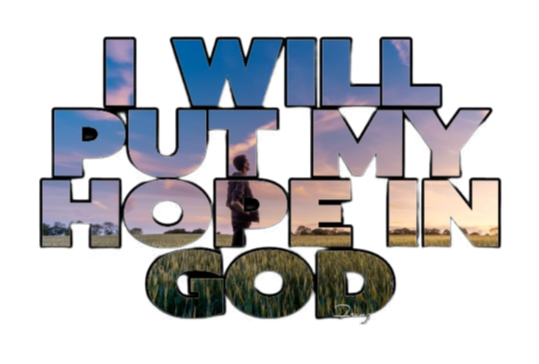
The image is a visually striking design conveying a Christian message of faith and hope. Here's a breakdown of its elements:
* Text: → The primary element is the phrase "I WILL PUT MY HOPE IN GOD," rendered in bold, capitalized letters.
* Typography: → The letters are large and stylized, designed to stand out prominently. The text has a 3D effect with a dark outlining creating depth.
* Imagery: → The text is filled with different landscapes:
* The letters "I" and "WILL" are filled with a vivid sky with fluffy clouds.
* The letters "PUT" and "HO" contain a scene of a person standing in a field.
* The letters "PE IN" are filled with a landscape in the sunset or the sunrise, with a house in the distance.
* The word "GOD" is filled with the view of a wheat field.
* Overall Composition: → The text is centered and the image is set against a solid black background which emphasizes the colors of the images. The whole piece creates a sense of faith.
* Style: → The overall aesthetic is modern, clean, and inspirational. The image is very fitting for social media posts, print media, or other media associated with Christian beliefs.
Article: Finding Hope in God →
In a world often filled with uncertainty, challenges, and moments of despair, where do we turn for strength? Where do we find a harbor of hope? The image serves as a powerful reminder: we place our trust, our faith, and our hope in God.
The visual composition of the image offers a rich tapestry of meaning. The bold declaration, "I WILL PUT MY HOPE IN GOD," is more than just words; it's a commitment, a resolution, a cornerstone of faith. It acknowledges the trials and tribulations of life, while simultaneously asserting the belief in a higher power.
The artistry of the design intensifies the message. The letters are not simply letters; they are vessels of beauty and meaning. The sky is a testament to the vastness of God's power, while the fields reflect nature. They remind us of the order, beauty, and promise inherent in creation. The use of nature is not accidental; they invite us to connect with the Divine.
The image serves as an invitation. It invites us to a place where hope isn't an abstract concept but a tangible reality. It calls us to embrace the journey of faith, to seek strength in moments of weakness, and to find peace amidst chaos.
In a world that often seeks to define us through our possessions, our accomplishments, or our social status, the image brings us back to what truly matters: our relationship with God. It reminds us that our worth is not found in external factors, but in the love, grace, and mercy that God offers.
The image is a message for everyone. It offers a message of courage and hope for those who are seeking purpose and meaning. The image's message stands the test of time. It's a message that can be interpreted and embraced by generations to come.
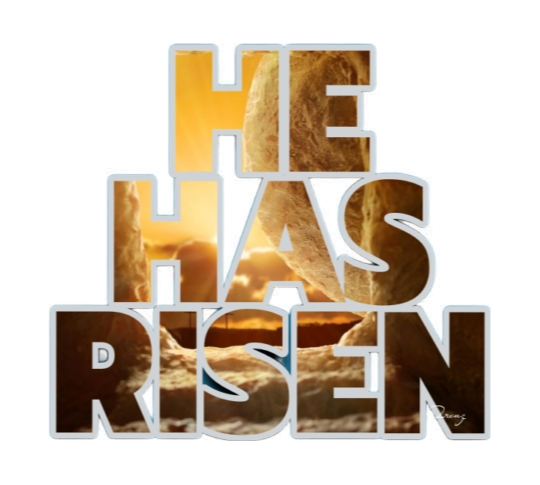
The image is a Christian-themed graphic with the phrase "HE HAS RISEN" prominently displayed. It's a visual declaration of the central tenet of the Christian faith: the resurrection of Jesus Christ. The design is bold and impactful, using a combination of text and imagery to convey its message.
Visual Elements →
* Text: → The words "HE HAS RISEN" are the dominant feature.
* The text is rendered in a clear, easily readable font.
* The words are white with a border, setting them apart from the background.
* Imagery Within the Text: → The letters are not solid. They are filled with a photograph of a landscape, presumably representing the scene of the resurrection.
* The image depict a rocky or mountainous area, with a sunrise or sunset in the background.
* The colors are warm, with shades of gold, orange, and brown. This evokes feelings of hope, glory, and new beginnings.
* Background: → The background is black. This dark background serves to make the text and the image within the text stand out even more, drawing the viewer's focus immediately.
Symbolism and Interpretation →
* "HE HAS RISEN": → This is the core message. It's the Christian proclamation that Jesus Christ conquered death and ascended from the grave. It signifies:
* Victory over death and sin.
* The promise of eternal life for believers.
* The foundation of the Christian faith.
* Imagery of Rocky Landscape: → The image within the letters, representing the tomb.
* The empty tomb is symbolic of Jesus's absence from the grave.
* The sunlight (or rising sun) in the background signifies new life, hope, and the dawn of a new era after the resurrection.
* Color Palette: → The warm colors are important:
* Gold and Yellow: → Represent glory, divinity, and the presence of God.
* Browns: → Evoke a sense of the earth, the physical realm, and perhaps even the tomb.
* Overall Message: → The design aims to celebrate the resurrection of Jesus Christ, which is considered the most important event in Christian theology. It’s a declaration of faith, a message of hope, and a symbol of the victory over death.
Design and Purpose →
* Impactful Design: → The use of both text and imagery ensures the message is visually engaging and memorable.
* Clarity: → The clear font and simple layout make the message easily understood.
* Relevance: → The imagery and message are designed to resonate with Christians, especially around the Easter season.
* Purpose: → The image could be used for a variety of purposes, including:
* Social media posts
* Website banners or graphics
* Printed materials like posters or cards
* Personal displays of faith
In conclusion, → this image is a powerful Christian visual that effectively communicates the core belief in the resurrection of Jesus Christ. The design is well-executed, incorporating meaningful imagery and a clear message to create a visually compelling statement of faith.
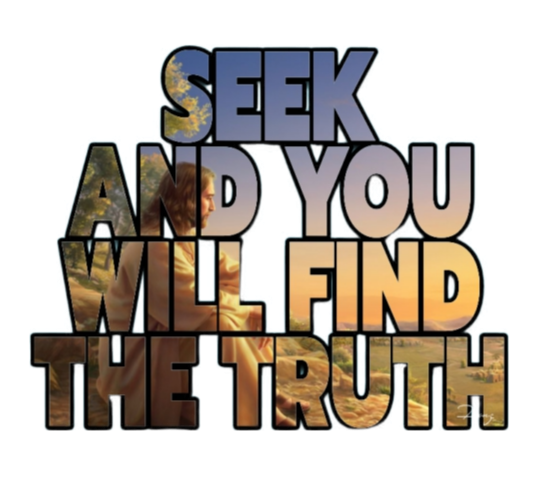
Article: A Visual Invitation to Seek Truth: An Exploration of the Christian Image →
The image presents a powerful visual message with clear religious connotations. It is a motivational poster that evokes a message of faith, seeking truth, and the potential for finding it through spiritual exploration.
Visual Breakdown: →
* Central Text: → The focal point is the phrase, "SEEK AND YOU WILL FIND THE TRUTH." The words are large, bold, and stylized, occupying most of the image's space. This prominent placement immediately draws the viewer's attention to the core message.
* Image within Text: → The text itself is creatively designed. The words are not a solid color but are rendered with an image embedded within them. The image depicts a figure of Jesus, seated and looking towards the right.
* Color and Background: → The background is a solid black, making the text and internal image stand out. The colors used within the text shift from cool to warm, creating a sense of depth. The sky transitions from blue to golden and orange colors creating the impression of a sunset. This gradient effect adds visual appeal and likely symbolizes a transition or journey.
* Jesus Figure: → The image of Jesus is a significant component. Jesus is the focus of christianity, and the image within the text is likely an illustration or depiction of Jesus, which links the idea of seeking truth to the Christian faith.
* Overall Impression: → The design is clean and legible. It avoids clutter, and the message is easily understood. The style is inspirational, suggesting the importance of the pursuit of truth and the likelihood of finding it.
Interpretation and Meaning: →
* Christian Message: → The image is explicitly Christian. The image of Jesus is used and the scripture reference of "Seek and you will find the truth" reflecting the core beliefs of Christianity: faith, spiritual inquiry, and the promise of revelation.
* Emphasis on Seeking: → The phrase, "SEEK AND YOU WILL FIND" emphasizes the active role required to discover truth. The viewer is encouraged to engage in an active search.
* Promise of Revelation: → The implied "truth" refers to spiritual truth, the understanding of God's will and plan for humanity, and ultimately salvation.
* Inspirational and Motivational: → The image is a call to action, encouraging believers to seek, to learn more about the bible, and to grow their faith.
Use and Purpose: →
* Religious Outreach: → This image is intended for use in a religious context. It could be distributed in churches, shared on social media, or used in religious educational materials.
* Personal Reflection: → The image could also serve as a reminder for personal spiritual reflection and commitment to faith.
In Conclusion: →
The image is a clear, concise, and impactful expression of a Christian message. It visually communicates the value of seeking spiritual truth, a core tenet of the Christian faith, and invites viewers to embark on a journey of faith. The image's simplicity and elegant design contribute to its effectiveness in conveying its message.
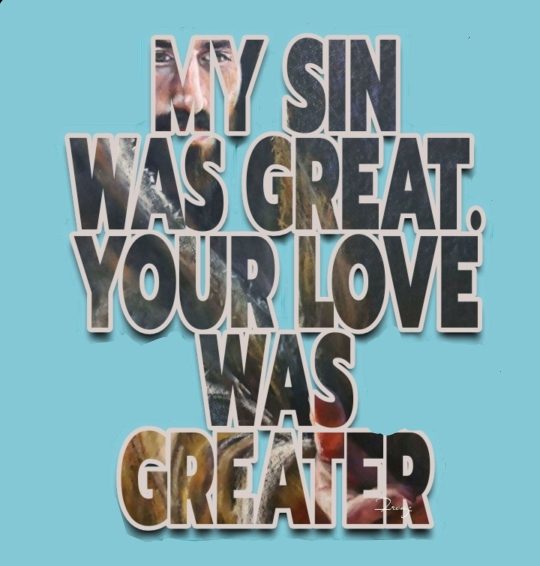
The image is a graphic design with a Christian theme. It features the text "MY SIN WAS GREAT. YOUR LOVE WAS GREATER." The text is stylized in a bold, blocky font with a slight 3D effect created by a white outline. The background is a solid, light blue color.
Text and Meaning →
* Central Message: → The core of the image is the declaration of faith, specifically the concept of God's forgiveness. It highlights the idea that, even if a person's sins are significant or overwhelming ("MY SIN WAS GREAT"), God's love and grace are even more powerful and encompassing ("YOUR LOVE WAS GREATER").
* Christian Theology: → This statement is a common sentiment found in Christian theology. It encapsulates the belief that, through faith in Jesus Christ, people can have their sins forgiven. God's love is seen as unconditional and boundless, always greater than any transgression.
Design Elements →
* Font and Style: → The use of a bold, blocky font gives the text a strong presence. The 3D effect adds depth and makes the words visually stand out. This style is chosen to make a clear and bold statement.
* Imagery within Letters: → The most interesting feature is the image contained within the letters of the text. The images are fragments or details of a person's face or body. Using the hints from the crops, we can identify bits of the face. This could potentially be Jesus' face or the person who's writing these words.
* Color Palette: → The light blue background creates a serene and calming atmosphere. The text uses colors that are muted but are the basis of the photos contained within the letters, which helps to draw attention to the message without being overwhelming.
Interpretation and Significance →
* Personal Reflection: → The message invites introspection and encourages individuals to recognize their imperfections while embracing the hope of forgiveness and redemption.
* Spiritual Comfort: → The statement can provide comfort and reassurance to those struggling with feelings of guilt or shame, emphasizing the power of God's love.
* Wider Appeal: → The message is intended to be shared as encouragement to others, to offer a message of hope.
* Modern Design: → The image has a contemporary design, indicating that the Christian message is relevant and is meant to be shared via social media or other digital formats.
In conclusion: → The image is a compelling visual representation of a central Christian doctrine, emphasizing the power of God's love to overcome sin and offer forgiveness. It is a modern, visually striking statement intended to promote spiritual reflection, offering hope, and possibly a sense of connection for people of faith.
Analysis of the Image: A Message of Faith and Comfort →
The image is a visually striking piece designed to convey a message of hope, support, and divine presence. It's clearly intended to be motivational and inspirational, particularly within a Christian context. Here’s a breakdown of its components:
* Text: → The central element is the bold, white text in a distinctive font:
* "WHEN YOU GO THROUGH DEEP WATERS"
* "I WILL BE WITH YOU"
* Font and Style: → The font is blocky and substantial, giving a sense of strength and permanence. The choice of a simple, readable font ensures the message is easily understood. The white outlined text is the most important element of the image, and it stands out very well against the background.
* Color Scheme and Background: → The use of blue color in the letters, and the reflection in them, with the black background, creates a calming and perhaps watery appearance.
Detailed Article: →
Navigating the Depths: Finding Strength in Faith →
Life is a journey filled with sunshine and storms. We all face trials, moments of uncertainty, and challenges that can feel overwhelming. It's in these moments that we often seek solace, looking for something or someone to help us navigate the tumultuous waters. The image presented, with its powerful message, offers a source of comfort and strength rooted in faith.
The message, "WHEN YOU GO THROUGH DEEP WATERS, I WILL BE WITH YOU," is more than just a collection of words. It's a promise of unwavering support, a declaration of presence when circumstances seem darkest. This phrase is a direct reference to Isaiah 43:2 → in the Bible: "When you pass through the waters, I will be with you; and when you pass through the rivers, they will not sweep over you. When you walk through the fire, you will not be burned; the flames will not set you ablaze."
Interpreting the Message: →
* "Deep Waters" →: This phrase is a potent metaphor. "Deep waters" represents the challenges, hardships, and overwhelming situations we encounter in life. This could be anything from personal struggles, difficult relationships, financial strain, health issues, or any situation that feels as though it's pulling us under. The depth suggests the potential for feeling lost, vulnerable, and even hopeless.
* "I Will Be With You" →: This is the core of the message. It speaks of an ever-present companion, an ally who stands beside us through the darkest times. For those of faith, this is a reference to God. It is a promise of divine support, comfort, and guidance. It implies that we are never truly alone in our struggles.
Why this Message Resonates: →
This simple yet profound message resonates with people for several reasons:
* Universal Human Experience: → Suffering is a universal experience. Everyone faces challenges. This message acknowledges the reality of hardship, validating the emotions and experiences of those who are going through difficult times.
* Hope and Encouragement: → The promise of support and companionship offers a lifeline. It fosters hope, reminding individuals that they can overcome adversity.
* Comfort and Peace: → Knowing that there is a presence, a higher power, an entity of faith, who is with us provides solace and peace. It alleviates feelings of isolation and fear.
* Encouragement to Persevere: → The message is ultimately an encouragement to persevere, to keep going even when it feels impossible. It inspires resilience and reminds us that we are not broken by our struggles, that we have the strength to endure.
In Conclusion: →
The image is more than just an attractive arrangement of words. It's a visual reminder of a message of faith, hope, and enduring love. It offers comfort, strength, and reassurance in times of adversity, reminding us that even in the deepest waters, we are not alone. The artwork serves as a testament to the power of faith and a reminder that we are never truly abandoned on our journey through life
The image is a text-based graphic with a clear Christian message. It features the following elements:
* Text: → The central focus is the message "EMPTY YOURSELF AND LET GOD FILL YOU". The text is arranged vertically, with each line stacked upon the previous one, creating a pillar shape. The font is a bold, sans-serif style, giving it a clear and easy-to-read appearance.
* Color and Fill: → The letters are filled with an image of a sunset or sunrise over a landscape. The sky transitions from a lighter shade at the top (representing early morning or the sky) to a warmer, golden tone near the bottom, implying the setting sun or dawn. The white outline creates a sharp distinction.
* Background: → The background is solid black, making the text and its embedded image pop. This enhances the message's visibility and creates a modern aesthetic.
Interpretation and Meaning →
The message "EMPTY YOURSELF AND LET GOD FILL YOU" is a fundamental concept in Christian faith. It speaks to the idea of spiritual surrender and receiving divine guidance and grace. Here's a breakdown of the message:
* Empty Yourself: → This implies the need to let go of things that separate us from God. It could refer to negative emotions (anger, fear, resentment), selfish desires, worldly concerns, or anything that takes precedence over a relationship with God. This is the first step.
* Let God Fill You: → This is an invitation to allow God to occupy the space left open by letting go of negative things. It's about seeking the Holy Spirit, allowing faith, hope, love, peace, joy, and all the other fruits of the spirit to take root within the person.
* Visual Metaphor: → The sunset/sunrise imagery inside the text subtly reinforces the message. Just as the old is replaced by the new with the sun, the viewer must empty themselves to be filled by God. The rising sun also suggests new beginnings, hope, and renewal, all which are central concepts to Christianity.
Overall Impression →
The image is clean, easily accessible, and direct in its message. It is intended to:
* Inspire: → To encourage a mindset of surrender and faith.
* Encourage Reflection: → To prompt contemplation on one's relationship with God.
* Provide Comfort: → To offer the assurance that when one lets go, God's presence is ready to fill the void.
* Evoke Hope: → The sunset/sunrise visual suggests that even after darkness, there is new light and a fresh start.
Conclusion →
The image is a simple but powerful visual expression of Christian faith, designed to inspire and encourage. Its message is straightforward, its visual elements support its meaning, and it is designed to be easily understood and remembered.
The image is a digital design against a stark black background. The primary feature is the bold, white text "FEAR NOT FOR I AM WITH YOU," arranged in a visually appealing layout, with the text "FEAR NOT" on the top line, "FOR I AM" in the middle, and "WITH YOU" at the bottom, each word appearing with a slight shadow, giving it depth. The words are partially transparent, revealing a soft, cloudy image within each letter. This imagery suggests a heavenly or spiritual realm. The image of Jesus is in the O of the word FOR.
Interpretation and Christian Significance: →
The core message of the image is a message of comfort, reassurance, and hope. It directly quotes the verse from the Bible:
* "Fear Not, For I Am With You": → This is a powerful and frequently cited assurance from God to his followers. In Christianity, the Bible is the guide for understanding the ways of God and to follow His word. It is a message of encouragement, promising divine presence and support to those who may be feeling anxious, worried, or facing difficult circumstances. The message transcends the specific situation, reminding Christians of God's constant presence, protection, and love.
* The Image of Jesus →: The image subtly depicts Jesus, appearing in a long white robe, signifying purity and holiness. It is a reminder that through faith in Jesus, believers can have courage and overcome their fears.
* Visuals →: The incorporation of a soft, cloudy or sky-like background within the text adds a spiritual dimension. It evokes images of heaven, peace, and the presence of God. The use of white, a color commonly associated with purity, light, and goodness, further reinforces the image's uplifting message.
* Overall Tone →: The image projects a message of hope and unwavering trust. It encourages resilience, encouraging people to resist the negative impact of fear.
The Message's Impact: →
* In Times of Difficulty →: The message of "Fear Not, For I Am With You" is particularly resonant during challenging times such as illness, grief, uncertainty, or personal struggles. It offers a source of solace and strength, reminding believers that they are not alone.
* Evangelical Purpose: → It is also used as a tool for sharing faith, offering non-believers an invitation to discover a sense of peace and trust, or to encourage them to seek a relationship with God.
In summary, → the image is a visually engaging expression of faith that conveys a fundamental Christian belief in God's love and support. It is an inspirational message meant to provide comfort, peace, and encouragement to anyone who is willing to accept the message of faith.
The image is a Christian-themed graphic that aims to convey a message of personal transformation and faith. It uses a combination of text, imagery, and color to express the idea that the individual feels they are a better person when they have a relationship with Jesus.
Visual Elements and Their Interpretation →
* Text: → The prominent text reads, "I LIKE ME BETTER WITH JESUS." The bold, large font size ensures that this message is the primary focus. The message directly states the core belief of the image's purpose.
* Font and Style: → The font appears to be a stylized, slightly 3D font, giving it a modern and visually engaging appearance. The letters are outlined in blue and filled with a vibrant gradient of colors.
* Image Background: → The background image features a person standing in a field with the back facing the viewer, gazing towards a sunset or sunrise. The sky is vibrant with fiery shades of orange and yellow, which suggests a sense of hope, peace, and possibly even divine presence. The field can symbolize life, growth, or the world as a whole. The field and sunset create a spiritual background to the main theme.
* Imagery Integration: → The words "WITH JESUS" are cleverly filled with the image of the field, the person and the sunset. This design choice serves to visually integrate Jesus with the environment, the person, and the idea of personal betterment.
* Color Palette: → The color palette is warm and inviting. The use of oranges, yellows, blues, and reds evokes emotions like hope, peace, and divinity. The blue borders add a sense of structure and definition to the message.
Message and Interpretation →
The central message is clear: a person believes they are a better version of themselves when their life is guided by their faith in Jesus. This can be interpreted as:
* Personal Growth: → The image emphasizes how faith can positively influence personal development.
* Relationship with God: → It highlights the value of having a close relationship with Jesus.
* Spiritual Well-being: → The image promotes a sense of wholeness, contentment, and inner peace found through faith.
Overall Effect →
The image aims to be inspiring and encouraging to those who share the same religious beliefs. The combination of visually appealing text, vibrant colors, and relevant imagery is designed to resonate with its target audience. The image successfully uses visual elements to communicate its message and convey a sense of faith, hope, and personal transformation through a connection with Jesus.
The image is a motivational graphic with a clear Christian theme. It uses a textual message layered over a blurred image of a person, representing Jesus, in white robes or a similar religious setting. The overall aesthetic is simple, yet impactful, aiming to inspire hope and anticipation for the future.
Textual Analysis →
* Message: → The primary message is "GREATER THINGS ARE YET TO COME." This phrase is a powerful declaration of optimism, promise, and faith. It suggests that while current circumstances may be challenging or limited, there's a potential for even more significant experiences and blessings in the future.
* Font and Style: → The font used is bold, sans-serif, and stylized. The letters are white with a slight shadow effect, making them stand out against the dark background. This choice of font conveys a sense of strength and clarity. The clean design suggests a sense of modernism, and with a clear message for the reader.
* Arrangement: → The words are arranged in a cascading, slightly overlapping fashion. This gives the text a sense of movement and dynamism, adding visual interest. The layout is easy to read. The arrangement helps the reader follow the order of the words, and it creates a visually-appealing design.
Visual Elements and Imagery →
* Embedded Image: → The image incorporates a blurred or partially obscured photo of Jesus, who is wearing white clothing. This is a subtle but effective way to connect the motivational message to the Christian faith.
* Color Palette: → The image utilizes a cool, somewhat desaturated color palette. Predominantly white or light-colored text against a dark background. The muted tones help in keeping the graphic clean and uncluttered.
* Background: → The dark background allows the text to stand out prominently, and it helps create a sense of depth.
Themes and Interpretations →
* Hope and Faith: → The image is a clear message of hope and faith. It is used to encourage people to believe that good things are coming, especially within a Christian context.
* Christian Theology: → The imagery and message resonate with core Christian beliefs. It speaks to the idea of God's plan and the belief that there is more to come for followers of Christ, which promotes a positive mindset.
* Overcoming Adversity: → The message may be used to encourage people to remain optimistic during times of struggle. It suggests that no matter the current situation, a better future is possible with faith.
Overall Design and Purpose →
The image is designed to be easily shareable on social media or used as a motivational graphic. It is simple, clean, and inspiring. It targets an audience familiar with Christian values and beliefs.
Additional Points →
* The lack of overly ornate elements creates a sense of sincerity and genuineness, which are important in conveying a message of faith.
* The overall tone of the image is gentle, encouraging, and hopeful.
Image Analysis: A Declaration of Faith and Purpose →
The image presents a powerful and direct message, clearly rooted in Christian beliefs. Let's break down the visual elements and the meaning they convey:
* Text: → The central element is the bold statement: "LIFE IS MEANINGLESS WITHOUT GOD". The text is presented in a large, clear font, ensuring immediate readability and impact. The message itself is a core tenet of many Christian denominations. It asserts that true purpose and fulfillment in life are only found through a relationship with God.
* Color & Background: → The text is filled with a scene of a golden-hued landscape, suggesting a sunset. The warm tones within the letters, particularly the yellows and oranges, evoke feelings of hope, warmth, and divine presence. The surrounding black backdrop provides a stark contrast, which makes the message even more prominent.
* Imagery: → The landscape subtly visible within the text adds to the message. It suggests a journey.
* Composition: → The text is well-placed, centered in the frame to maximize visual impact. The straightforwardness of the design ensures that the message is the focal point.
Article: Finding Meaning: The Christian Perspective on Life's Purpose →
In a world that often grapples with questions of meaning and purpose, the Christian faith offers a profound and compelling answer. The core belief, vividly articulated in the image provided, is that "Life is Meaningless Without God." This statement encapsulates a fundamental understanding of the human condition and the path to true fulfillment.
The Source of Meaning: God's Presence →
From a Christian perspective, meaning is not something that can be manufactured or discovered independently. Instead, it is bestowed upon us through a relationship with God. This relationship is founded on faith, trust, and a commitment to living according to His teachings. By embracing God, Christians believe they find:
* Purpose: → Life takes on significance as individuals strive to embody God's love, serve others, and fulfill the unique calling He has for them.
* Hope: → Even in the face of hardship and suffering, the belief in God provides a solid foundation of hope for the future and the promise of eternal life.
* Love: → God's unconditional love is believed to be the ultimate source of healing and transformation, guiding believers to live a life characterized by love for themselves and others.
* Moral Compass: → God's teachings, as found in the Bible, provide a framework for ethical behavior and a clear understanding of right and wrong, shaping how Christians live their lives.
The Search for Meaning Outside of Faith: →
The image implicitly challenges the idea that meaning can be found in worldly pursuits alone. While many people strive for success, relationships, and experiences, Christians often believe that these elements are ultimately empty without the spiritual foundation of faith. The image's assertion is not necessarily that these things are bad, but that they are not sufficient on their own to provide lasting meaning and fulfillment.
Living a Meaningful Life: The Christian Call →
For Christians, the journey towards a meaningful life is a continuous process of growing closer to God. This involves:
* Prayer and Worship: → Connecting with God through prayer, church services, and personal reflection.
* Studying the Bible: → Seeking guidance and understanding through scripture.
* Serving Others: → Emulating Jesus' example of compassion and helping those in need.
* Sharing the Gospel: → Spreading the message of hope and salvation to others.
Conclusion: →
The image serves as a bold and clear statement of faith. It's a reminder that for Christians, true meaning is not found in external achievements but in a relationship with God. It challenges viewers to consider their own beliefs about the purpose of life and to explore the profound implications of faith. It is a call to action, a call to a life of purpose, hope, love, and service – all centered on the unchanging love and grace of God.
The image is a Christian-themed meme or inspirational graphic designed to convey a message of faith and trust in God, particularly in times of difficulty or uncertainty. It combines a textual message with a visual representation of the crucifixion of Jesus Christ.
Visual Elements: →
* Text: → The central element is a bold, stylized text that reads: "EVEN IF IT'S OUT OF YOUR HANDS REMEMBER THAT IT'S STILL IN HIS." The font is a thick, slightly distressed sans-serif, giving it a modern and impactful feel. The use of all caps adds emphasis and a sense of authority.
* Imagery: → The words are overlaid on a cropped section of a painting that depicts Jesus Christ on the cross. The image focuses on the body of Jesus, with the arms spread wide, showing signs of the crucifixion, with the wounds and physical suffering being displayed. The use of this imagery is intended to symbolize the suffering of Jesus Christ, and the willingness to take responsibility for his suffering for the sake of humanity.
* Background: → The entire design is set against a plain black background, which helps the text and imagery stand out.
Interpretation and Message: →
The image's core message revolves around faith, trust, and surrender to God's will. The meaning can be broken down as follows:
* "Even if it's out of your hands..." → This phrase acknowledges that life can be difficult, and there are situations where individuals feel a lack of control or agency. It addresses feelings of helplessness, anxiety, and the challenges of navigating life's uncertainties.
* "...Remember that it's still in His." → This is the core of the message, the key to dealing with difficult situations. The word "His" refers to God. The meaning is that even when situations are beyond a person's control, one should find peace and comfort in the belief that God is ultimately in charge, and that their fate will still be taken care of. It calls on the viewer to have faith and trust in a higher power and that God has everything under control.
* Christian Context: → The imagery of the crucified Jesus Christ gives the message specific meaning within a Christian context. The Crucifixion is the event when Jesus Christ, being crucified to atone for the sins of humanity. The inclusion of this image is very important, and the image as a whole reminds the viewer of Jesus's sacrifice for the sake of humanity, and the image invites viewers to emulate Jesus, the ultimate example of unwavering faith and trust in the divine.
Symbolism: →
* The Cross: → Represents suffering, sacrifice, and redemption in Christian belief. It is a powerful symbol of faith.
* The Wounds: → Symbolize Jesus' suffering for the sins of humanity, emphasizing his love and sacrifice.
* The Black Background: → Provides contrast and draws attention to the message and image, and can also be seen to represent the darkness or trials in which the message would provide the most light.
Overall Tone and Intended Audience: →
The image conveys a tone of reassurance, hope, and encouragement. It is clearly intended for a Christian audience, who will readily understand the symbolism and the message. It appeals to those seeking comfort, strength, and guidance through faith. It might be shared on social media, used as a screensaver, or printed as a piece of inspirational art to provide daily reminders of faith and trust in God.
The image is a visually striking graphic centered around a Christian message of faith and guidance. Let's break down the elements:
* Text: → The primary focus is the text "JESUS GUIDE ME WHEN I'M LOST." This is the core message, a prayerful plea for Jesus's guidance in times of feeling lost or directionless. The use of all capital letters emphasizes the importance and urgency of the request.
* Font and Style: → The words are presented in a bold, modern font. A thick white outline, is applied to each letter, which gives the text a sense of depth and prominence. The blue shadow behind the letters reinforces this visual effect and creates a sense of dimension.
* Imagery: → The words "ME," "WHEN" and "I'M" are filled with a photograph of a person standing on a rock looking at the sea. This suggests a sense of solitude and contemplation, which aligns with the feeling of being lost. The ocean imagery can symbolize vastness, uncertainty, and the challenges of life.
* Color Palette: → The image predominantly uses a palette of blue, white, and black. The blue evokes feelings of calmness, peace, and spirituality. Black provides a strong background, making the text stand out. The contrast between the colors enhances readability and visual impact.
* Overall Design: → The design is clean and impactful. The layered text and the photograph create a visually engaging composition that is easy to understand.
Written Article: →
Finding Your Way: The Comforting Message of Seeking Guidance →
In the journey of life, there are moments when we feel lost, confused, or overwhelmed. We all experience times when the path ahead is unclear, and the feeling of uncertainty can be daunting. During these times, many turn to faith and prayer for comfort, strength, and guidance.
This image embodies this very sentiment. At its heart, the message is simple yet profound: "JESUS GUIDE ME WHEN I'M LOST." This is more than just a sentence; it's a plea for help, a surrender to a higher power, and an acknowledgment of the need for direction.
The image reinforces this message in several ways. The bold, stylized font of the words commands attention, making the message clear and present. The photograph within the text visually mirrors the feeling of being lost. The lone figure standing on a rocky outcrop, gazing at the vast ocean, speaks of solitude, uncertainty, and the search for answers. The ocean's breadth can represent the expansive, sometimes confusing nature of life's experiences.
The use of a soothing color palette, dominated by blues, strengthens the message's underlying themes. Blue is often associated with serenity, peace, and spirituality. It provides a visual representation of the hope and comfort that faith can offer. The white outline around the letters helps the text to stand out.
The design is clear and purposeful. It communicates a sense of depth. The combination of textual and visual elements creates a composition that is easy to understand. It is a message of reassurance, a reminder that we are not alone in our struggles and that help is available to those who seek it.
This simple yet powerful image acts as a call to trust and to embrace faith, to look to a higher power for guidance when we feel lost. It's a reminder that we are not navigating life's challenges alone, and that we can find strength, direction, and peace in times of need.
Image Analysis: A Prayer for Focus →
The image is a visually compelling Christian-themed graphic designed to evoke a sense of reflection and spiritual aspiration. It uses a combination of typography, texture, and color to create a message of seeking God's help in a world filled with distractions.
Key Elements: →
* Text: → The central element is the text, formatted in a multi-layered design. The words are: "DEAR GOD IN A WORLD FULL OF DISTRACTIONS HELP ME TO PUT YOU FIRST." This is a prayer, a direct communication with God, expressing a common Christian sentiment.
* Typography: → The font is a 3D style. The use of a bold, three-dimensional font emphasizes the message, making it stand out. The style gives the words a presence, suggesting weight and importance. The words are in capital letters which gives a feeling of firmness.
* Texture & Background: → The letters themselves aren't a single color but contain various textures. There are natural images inside the letters. This adds depth and a visual interest that evokes a feeling of nature.
* Color Palette: → The background is a warm, golden gradient. This color choice is reminiscent of the sun, which is often associated with divinity.
* Overall Composition: → The layout is carefully arranged, with the words stacked to create a balanced and visually appealing composition.
Meaning and Interpretation: →
The image conveys a very specific message:
* Acknowledging Distractions: → The prayer begins by acknowledging the reality of the world as it is – a place "full of distractions." This could refer to a multitude of things: worldly concerns, technology, entertainment, or even internal struggles that pull one's attention away from God.
* Seeking Guidance: → The heart of the prayer is a request for divine help: "Help me." It expresses a need for strength and guidance in overcoming the challenges of distraction.
* Prioritizing Faith: → The ultimate goal is to "Put you first." This is a fundamental tenet of Christian faith, suggesting a desire to center one's life around God, putting his will and teachings above other priorities.
Christian Values and Themes: →
The image resonates with core Christian values:
* Prayer: → The prayer format itself demonstrates the importance of communication with God.
* Dependence on God: → The request for help underscores the belief that humans need divine assistance to live a fulfilling spiritual life.
* Prioritization of God: → The message reinforces the Christian belief that God should be the central focus and guiding force in one's life.
Overall Impact: →
The image is designed to be inspiring and encouraging. It is a reminder that even in a busy and distracting world, it is possible to connect with God and find peace and purpose.
In conclusion, → this image is a visually appealing and easily understood Christian-themed message. It utilizes simple but effective design elements to convey a core message: seeking God's help in a world of distractions, and making Him the central focus of one's life. It's a gentle reminder to prioritize faith and seek a deeper connection with the divine.
The image is a Christian-themed inspirational graphic. It features text overlaid onto a background of a painting depicting Jesus. The overall aesthetic is meant to evoke feelings of faith, comfort, and reliance on God.
Text Analysis →
* Message: → The prominent text reads, "PUT YOUR HAND IN THE HAND OF THE MAN WHO CALMED THE SEA." This is a direct quote, likely inspired by the biblical accounts of Jesus calming storms, which are found in the Gospels (Matthew 8:23-27, Mark 4:35-41, Luke 8:22-25). The message is an invitation to trust in Jesus and to seek his guidance and support, particularly when facing life's challenges.
* Font and Style: → The font is a bold, sans-serif typeface, likely chosen for its readability and impactful presence. The letters are filled with the image that is a painting of Jesus, further reinforcing the Christian theme. This creates a visually unified look and emphasizes the message.
* Arrangement: → The text is layered vertically and horizontally, filling most of the image space. This layout draws the viewer's eye and makes the message the focal point. The arrangement ensures the core message is immediately clear.
Imagery and Background →
* Background Painting: → The image suggests a depiction of Jesus, the image of Jesus's hand or arm reaching out, that creates a spiritual and powerful presence.
* Color Palette: → The color scheme is dominated by cool blues, whites, browns, and the skin tones of the painting. The background's cool tones likely symbolize the ocean and the divine presence of Jesus and the sky. The color scheme contributes to a sense of peace, serenity, and reverence.
Symbolism and Interpretation →
* Hand in Hand: → The phrase "put your hand in the hand" symbolizes a relationship of trust, intimacy, and reliance. It implies a willingness to surrender control and to lean on someone stronger than oneself. In this context, it's an invitation to trust Jesus.
* Calming the Sea: → The phrase "who calmed the sea" refers to Jesus's miraculous ability to control nature, specifically the tumultuous seas during the biblical storms. This is a metaphor for Jesus's power to calm the storms of life, such as fear, anxiety, and hardship. It's a promise of peace and protection in the face of adversity.
* Overall Meaning: → The image invites viewers to place their trust in Jesus, the one who can calm life's "seas" and provide guidance and peace. It's a call for faith, reliance, and a reminder of the divine presence in times of need.
Overall Aesthetic and Target Audience →
* Style: → The image utilizes a classic, inspirational style, typical of Christian-themed graphics.
* Target Audience: → The primary target audience would be individuals of Christian faith or those seeking comfort and spiritual guidance. The image likely resonates with people who are drawn to messages of hope, faith, and divine intervention.
Conclusion →
This graphic is a visual representation of faith and hope, directly tying its message to core Christian beliefs. It seeks to inspire viewers to trust in Jesus during times of difficulty and find peace in His presence. The design uses a simple but effective combination of text and imagery to communicate its powerful message.
The image is a Christian-themed graphic that aims to inspire faith and offer reassurance. It uses text and imagery to convey a message of unwavering belief and reliance on God.
Visual Elements & Composition: →
* Text: → The dominant element is the phrase, "DON'T LET GO OF GOD'S HANDS." This is rendered in large, bold, and somewhat stylized lettering. The words are strategically arranged to draw the eye and convey the central message.
* Imagery: → The letters of the text are filled with a subtle image of what appears to be hands reaching towards each other, giving a visual representation of the phrase.
* Color Palette: → The image is dominated by deep blues and blacks, creating a background. The text appears in a lighter, almost metallic-looking tone, providing a contrast.
* Font Style: → The font is modern and slightly rounded and clean. The font choice contributes to the image's overall sense of hope and comfort.
* Signature: → The name "Frenz" is on the corner of the image, indicating the artist.
Meaning and Interpretation: →
The message "DON'T LET GO OF GOD'S HANDS" is a common Christian saying that encourages faith and reliance on God during difficult times. Here's a breakdown:
* "Don't Let Go": → This is the core instruction. It urges the viewer to hold onto their faith, to not abandon God, no matter what challenges they face. It implies steadfastness and perseverance.
* "Of God's Hands": → This refers to God's guidance, support, and protection. It's a metaphor for trusting in God's presence and allowing Him to lead one's life.
Potential Audience and Context: →
* Target Audience: → The image is clearly intended for a Christian audience. It would resonate with individuals who value their faith and seek comfort, encouragement, and spiritual direction.
* Context: → It would likely be shared on social media, Christian websites, blogs, or church materials. It may be created and shared as a form of encouragement and motivation.
Overall Message: →
The image is a visual reminder to trust in God, to maintain faith, and to not give up hope, especially during challenging situations. It offers a sense of peace and encouragement, reassuring viewers that they are not alone and that God is there to support them.
The image is a Christian-themed graphic designed to inspire and uplift. It combines text with an image of a person in prayer, visually reinforcing a message of faith and the belief in God's blessings. The design is somewhat stylized, using a bold font and color scheme to capture attention.
Textual Elements →
The central message is conveyed through the following text:
* "WHEN PRAYERS GO UP"
* "GOD'S BLESSINGS COME DOWN"
The font used for the text is large, bold, and slightly stylized. The words are designed to stand out. The choice of words emphasizes the reciprocal nature of prayer and the perceived blessings that follow. The phrase is a common sentiment within Christianity, acting as a motivational phrase to inspire faith.
Visual Elements →
* Person Praying: → The image incorporates a photograph of a person in a posture of prayer. This is meant to further emphasize the message in the words. The praying figure serves as a visual representation of faith and devotion. The body language indicates humility and reverence.
* Color Scheme and Background: → The use of blues and whites on the text, with a sky visual in the background behind the letters, indicates a positive connection to the heavens, reflecting the religious concept of heaven or a direct connection to God. The dark red border and black background make the words and image stand out. The color palette is generally calming, giving an aura of peace and faith.
Composition and Design →
* Placement: → The text is arranged in a way that flows from top to bottom. The prayer theme and words are presented with the individual at the center, suggesting a direct link.
* Style: → The image has a digital, possibly graphic design, feel. The design is simple yet effective, conveying the core message without distractions.
Interpretation and Significance →
* Message: → The primary message is a statement of faith in the power of prayer. It suggests a direct relationship between prayer and receiving divine blessings. It is meant to be encouraging, reinforcing the belief that prayers are heard and answered.
* Target Audience: → The image would appeal to Christians and individuals who share a belief in prayer and a connection with God. It is meant to uplift and encourage them in their faith.
* Purpose: → The purpose of the image is to inspire faith, offer encouragement, and perhaps serve as a reminder of the potential rewards of prayer. It could be shared on social media, displayed as a motivational poster, or used in any setting where the message of faith is welcome.
Overall, the image is a straightforward expression of Christian faith, aimed at providing comfort, inspiration, and strengthening the believer's faith.
The image is a visual proclamation of faith, using a bold, graphic design style to convey a message of unwavering confidence in God's protection and favor. The stark contrast between the text and the black background creates a sense of urgency and emphasizes the message.
Text and Meaning: →
The central text of the image reads: "IF GOD IS FOR US, WHO CAN EVER BE AGAINST US." This is a direct quote from Romans 8:31 in the Bible.
* "If God is for us" →: This foundational statement asserts the believer's relationship with God, a core tenet of Christian faith. It suggests a state of being loved, protected, and guided by a divine power.
* "Who can ever be against us" →: This rhetorical question poses a challenge to any opposition or adversity that might arise. It communicates a sense of invincibility derived from the support of God. It implies that with God on one's side, no external force can ultimately prevail.
Visual Elements and Interpretation: →
* Font and Color: → The text is written in a bold, capitalised font. It is in a dark burgundy colour, outlined in white. This choice gives the message prominence. The colour is powerful, conveying strength, while the outline ensures the words stand out even more on the black background.
* Hidden Imagery: → The image overlays a faint portrait of Christ. He is depicted in a way that suggests he is wounded. It adds a layer of meaning. The wounds could represent Jesus’s sacrifice for humanity. The image of Jesus serves as a visual reminder of the foundation for this confidence - the ultimate sacrifice that made the relationship with God possible.
* Background: → The black background helps the text stand out. It might also suggest a sense of uncertainty or the darkness of the world against which the believer stands, supported by God.
Overall Message and Significance: →
The image's central message is one of encouragement and reassurance for Christians. It speaks to the power of faith, the belief that God is on the believer's side, and that no obstacle can truly defeat someone who trusts in God. It serves as a reminder that in the face of difficulties, challenges, and even persecution, Christians can find strength and courage knowing they are upheld by God. It is a statement of confidence in God's protection and a reminder of the spiritual battle that Christians may face.

The image is a graphic designed to convey a message about the welcoming nature of a church. The text "NO PERFECT PEOPLE ALLOWED" is prominently displayed in large, stylized, 3D-like letters. The letters themselves are filled with images of a church building, including its steeple and architectural details. This image-within-a-letter technique gives the impression of the church embedded within the words, further reinforcing the connection between the message and the place of worship. The letters are set against a stark black background that makes the text stand out.
Message and Interpretation →
The core message is the declaration "NO PERFECT PEOPLE ALLOWED." This is a statement intended to create a welcoming and inclusive atmosphere. It's a recognition that church is a place for people of all backgrounds, flaws, and shortcomings.
Here are some key interpretations:
* Humility and Acceptance: → The phrase directly acknowledges that everyone is imperfect. This sets a tone of humility, inviting people to shed any pretense of perfection. It suggests that the church is a safe space where people can be honest about their struggles and imperfections without judgment.
* Inclusivity: → The message clearly welcomes all people. The message signals that no one needs to have it all figured out or be "perfect" to be accepted.
* Rejection of Hypocrisy: → The phrase can also be seen as a commentary on the potential for hypocrisy within religious institutions. The message implicitly rejects the idea of judgment or self-righteousness and instead encourages love and compassion.
* Focus on Growth: → By acknowledging imperfection, the message implicitly encourages growth and spiritual development. It suggests that the journey of faith is a process of learning, becoming, and overcoming flaws.
* Visual Connection: → The images of a church within the letters of the message reinforce that the "no perfect people allowed" is referring to that very place of worship.
Overall Effect →
The image works to communicate a strong, positive message about the church. The clean design, the visual incorporation of the church building itself, and the direct wording create an instant impact. It's likely intended to be a welcoming invitation for people who may feel hesitant to attend church because they fear judgment or feel unworthy. The message emphasizes that faith is not for the "perfect" but for everyone seeking community, support, and spiritual growth.
The image is a digitally created graphic that presents a Christian message of faith and trust. It prominently displays the phrase "GOD IS IN CONTROL" in a visually appealing and impactful way. The design elements, including the typography and the background image, work together to reinforce the message's meaning and convey a sense of comfort and assurance.
Visual Elements and Their Meaning: →
* Text: → The phrase "GOD IS IN CONTROL" is the central element. The words are in a bold, sans-serif font, providing a strong and clear message. The font style suggests a sense of stability, clarity, and strength.
* Image within the Letters: → Each letter of "GOD IS IN CONTROL" is filled with a photo or picture of bare tree branches and sky, and the images in each letter look unique and natural, possibly implying growth and the power of life. This is a key aspect of the image that enhances its depth and meaning. The inclusion of the sky adds a sense of vastness and represents the divine presence, that is connected to the words as the image fills the letters, suggesting that "God" is present within the everyday world and the idea that He is in control connects to those realities.
* Color Palette: → The image uses a muted color palette of gray, white, and blue. This palette creates a sense of peace, calm, and possibly spirituality.
* Shape and Design: → The text is outlined and has shadows, making the text pop out.
* Background: → The black background helps the message stand out.
Symbolism and Interpretation: →
* "God is in Control": → The primary message, is a core belief within Christianity. The phrase offers comfort, especially in times of difficulty, and suggests that God's providence oversees all aspects of life.
* Bare Trees: → The trees often represent resilience, strength, and endurance. The image of a bare tree can also symbolize hope and renewal, suggesting that even in challenging times, there is the potential for growth and new beginnings.
* Sky Background: → The sky background with trees and clouds symbolizes the ever-presence of God, it reminds the viewers that everything has a deeper meaning.
Overall Impact and Intended Audience: →
The image is intended to provide a source of encouragement and reassurance to those who hold Christian beliefs. It could be shared on social media platforms, used as a desktop wallpaper, or printed and displayed as a form of personal expression.
In conclusion: → The image "God is in Control" is a visual affirmation of faith and trust in a higher power. The combination of typography, image, and color creates a comforting and inspiring message for people who are Christian.
A Visual Blessing: Examining the Christian Message in an Uplifting Image →
This image is a visually appealing and concise expression of Christian values and well-wishes. The core message is a blessing, conveyed through a combination of text and imagery. Let's break down the elements and their significance:
1. The Textual Foundation: →
* "MAY GOD BLESS YOU" →: This is the central phrase, forming the opening of the blessing. It directly invokes divine favor, reflecting a core tenet of the Christian faith. The use of "God" with capital letters emphasizes respect and reverence.
* "WITH JOY, LOVE, HAPPINESS, AND PEACE OF MIND" →: This section specifies the desires for the recipient. These are essential Christian virtues and desires:
* Joy: → A state of happiness, derived from a relationship with God and the fulfillment of his will.
* Love: → A deep affection and commitment, often associated with God's love for humanity and the Christian's love for others.
* Happiness: → A general feeling of contentment and well-being, which is a result of living a life guided by Christian values.
* Peace of Mind: → A sense of inner tranquility and freedom from worry, achievable through faith and trust in God.
2. The Visual Elements: →
* The Word Design: → The words are arranged vertically in a creative and engaging manner. The text is layered, possibly implying a sense of depth.
* The Color & Imagery: → The words are filled with scenic imagery that creates depth to each word:
* "May God Bless You" →: This is colored with a cloudy sky with a sunset, indicating the heaven.
* "Joy" →: Filled with an orange sky, symbolizing optimism.
* "Love" →: The word "Love" is filled with a bright sky where the sun shines, implying the presence of love.
* "Happiness" →: Mountains are filled, which symbolizes stability.
* "Peace of Mind" →: A green forest is filled, symbolizing serenity.
3. Overall Impact & Meaning: →
The image is designed to be a positive and uplifting message. It combines a direct and easily understood blessing with visually engaging elements. This makes the message accessible to anyone who may be looking for a source of comfort or inspiration.
* Encouragement: → The image is essentially an encouragement to the recipient, conveying the message of positivity.
* Spiritual Focus: → The core message revolves around God's blessings and the virtues associated with Christian values.
* Personalization: → It could be shared to express affection, support, or well wishes, and can also provide motivation.
In Conclusion: →
This image is a beautiful example of how visual elements can be used to convey a Christian message. It's a message of hope, love, and well-being, encapsulated in an aesthetically pleasing design. It's a simple yet profound expression of faith and a wish for a life enriched by the virtues of Christianity.
The image is a text-based graphic with a strong visual impact. It features the following phrase in bold, stylized lettering:
"I WOULD RATHER OFFEND SOMEONE INTO HEAVEN THAN TO FLATTER SOMEONE INTO HELL"
The text is layered over a background gradient of warm colors (oranges, reds, and hints of white), evoking a sense of either a sunrise or sunset. There are also silhouettes included for visual impact, a flying bird on the left side of the background and a person on the right side. The text itself is outlined in white and shadowed, making it stand out against the background. The overall aesthetic is somewhat aggressive or assertive, fitting the sentiment being expressed.
Interpretation from a Christian Perspective: →
This phrase encapsulates a core tenet of Christian faith: the importance of truth, even when it's difficult or unpopular, over the allure of acceptance and approval. Here's a breakdown of the message:
* "I WOULD RATHER OFFEND SOMEONE INTO HEAVEN..." →: This indicates a willingness to speak truth, even if it causes discomfort or offense. It's the idea that sometimes, the message of the Gospel, with its call to repentance and transformation, will be challenging. The "offense" here could represent the difficult truths about sin, the need for forgiveness, and the exclusivity of salvation through Jesus Christ. The ultimate goal, however, is to lead a person to eternal life with God (heaven).
* "...THAN TO FLATTER SOMEONE INTO HELL" →: This presents the contrast: the rejection of comforting lies that lead someone astray. "Flattery" suggests a willingness to compromise the truth to make the message more palatable, to avoid conflict, or to gain approval. The "hell" symbolizes the eternal separation from God that results from rejecting the Gospel.
* Underlying Themes: → The core message is one of love, truth, and the eternal consequences of choices. Christians believe that sharing the Gospel, even if it's difficult, is an act of love. This is because they want to see others experience the joy of salvation and avoid the eternal pain of hell.
Biblical Basis: →
The sentiment expressed aligns with several key biblical principles:
* Love and Truth: → The Bible teaches that love must be rooted in truth. (1 Corinthians 13:6: "rejoices with the truth")
* Repentance and Salvation: → Christians believe that salvation comes through faith in Jesus Christ and repentance from sin. The Gospel message, which can be offensive to those who resist it, is essential for receiving salvation. (Matthew 3:2, Acts 3:19)
* The Narrow Path: → Jesus said that the path to eternal life is narrow, while the path to destruction is wide. This suggests that the Christian faith requires making choices that may not be popular. (Matthew 7:13-14)
* Speak the Truth in Love: → Ephesians 4:15 instructs believers to "speak the truth in love." This implies that while truth is paramount, it must be communicated with genuine concern and compassion.
In Conclusion: →
The image expresses a commitment to truth and a concern for the eternal well-being of others. It reflects the view that the truth of the Gospel, even when it is challenging, is essential for the salvation of the soul. This image reflects a core Christian belief in the importance of speaking the truth, even when it is difficult, to help others find salvation. The imagery suggests that if a person is truly a Christian, they would not risk an individual going to hell just to avoid conflict or maintain a favorable image.

The Call to Arms of Faith: A Christian Perspective on Courage and Trust →
The image presents a simple yet powerful message, visually and spiritually. It’s a direct appeal, a call to action rooted in faith, and a gentle rebuke against the debilitating nature of worry. Let's break down the message and its implications:
Visual Elements and Interpretation: →
* Text: → The dominant feature is the text itself: "GOD WANTS YOU TO BE A WARRIOR NOT A WORRIER." This is the core message, clearly articulated and emphasized by its size and placement.
* Font and Style: → The font is bold and impactful, designed to grab the viewer's attention. The slightly outlined letters give a sense of depth and significance. The choice of this font suggests the authority and importance of the message.
* Color Palette/Background: → The lettering is filled with a gradient reminiscent of a sunset or sunrise, casting a warm and inviting glow. The gradient could represent hope, new beginnings, or the presence of the divine. The use of colors within the letters and the black background emphasizes the message's importance. The backdrop creates a contrast that makes the words pop out. The color gradient gives the feeling of something divine.
The Spiritual Message: →
* God's Will: → The image begins with "GOD WANTS YOU..." placing the message firmly within a religious context. It establishes the belief that this is a divine directive, a call from a higher power. It suggests that the individual has a duty to adopt a specific approach to life.
* The Warrior Metaphor: → "A WARRIOR" is a powerful metaphor. It implies a mindset of strength, courage, resilience, and perseverance in the face of adversity. In a Christian context, a "warrior" is someone who actively fights against sin, temptation, and spiritual struggles. It is a call to be proactive, not passive, in one's faith. The warrior fights a battle for the soul and faith.
* The Counterpoint: "NOT A WORRIER": → This is the direct contrast. "Worrier" represents anxiety, fear, doubt, and a lack of trust in God's plan. Worry can be paralyzing and can hinder a person's ability to experience and express faith. It highlights the destructive nature of dwelling on concerns instead of turning to faith.
* Implications: → The message encourages the individual to embrace a life of action, faith, and trust in a higher power. It calls for a shift from a passive state of anxiety to an active stance of strength and resilience. The message challenges individuals to overcome doubts and replace fear with faith.
Christian Context: →
This image resonates deeply within a Christian framework. It aligns with several key principles:
* Trust in God: → The Bible repeatedly emphasizes the importance of trusting in God, surrendering anxieties, and believing in his sovereignty.
* Faith Over Fear: → The image encourages believers to choose faith over fear. It calls them to trust God's plan for their lives.
* Spiritual Warfare: → Christians often view life as a spiritual battle against evil forces. The "warrior" metaphor is apt, representing the need to actively combat temptation and evil.
* Seeking Guidance and Strength: → The image implies a need to seek guidance from God, through prayer, scripture, and the community of believers.
* The Encouragement to be a Believer in Action: → Encourages Christians to live out their faith actively by resisting temptation and taking action.
In Conclusion: →
This image is a concise and effective message that encourages viewers to reflect on their attitude toward life's challenges. It is a gentle call to action, encouraging people to embrace faith and trust in God. The image is a reminder that faith is not just about believing; it is about actively engaging with life, armed with courage and hope.
"God's Word is Your Most Powerful Weapon": A Visual Sermon →
The image is a striking visual statement rooted in Christian faith. It's a declaration of the power and importance of the Bible in a believer's life, presented with a strong visual impact. Let's break down the components and meaning:
Visual Elements: →
* Typography and Text: → The core of the image is the bold, large-scale typography. The message is clear and direct: "GOD'S WORD IS YOUR MOST POWERFUL WEAPON." The font is stylized, with a textured appearance, possibly mimicking wood grain, which adds a layer of visual interest and depth. The outline and drop shadow give the words a 3D effect, making them stand out prominently.
* Color Palette: → The color scheme is relatively limited, but effective. The text utilizes shades of brown, beige, and white with blue around it, and a black background, which creates a dramatic contrast and draws the viewer's eye immediately to the message.
* Composition: → The text is centrally aligned, reinforcing the message's importance. The design feels intentional, creating an atmosphere and focus.
* Signatures: → The image has what appears to be a signature on the bottom right, of the image, which suggests that it was an original design created by the artist.
Meaning and Interpretation: →
* Central Message: → The core message is a powerful affirmation of the Bible's importance. It frames the scriptures as a "weapon," implying that God's Word is a tool for spiritual warfare, defense against evil, and victory over life's challenges.
* God's Word: → The Bible, the written Word of God, is revered as the ultimate authority and guide for Christians. The image emphasizes the importance of reading, studying, and applying the teachings of the scriptures.
* "Most Powerful Weapon": → This phrase underscores the belief that the Bible possesses unmatched power. In Christian theology, this power comes from its ability to reveal God's will, offer salvation, provide comfort, and equip believers to live a righteous life. It suggests that the Bible can be used to overcome obstacles.
* Audience and Context: → The image is clearly intended for a Christian audience. It serves as a reminder, an encouragement, and a call to action—to engage with the Bible.
Overall Impression: →
The image is a simple but effective visual sermon. It is visually arresting due to its bold design and color scheme. It is intended to be motivational, inspirational and the overall mood of the picture is intended to strengthen the faith of Christians. It is a reminder that God's Word is a vital and central part of a Christian life.
The image is a Christian-themed graphic, designed to resemble a weather forecast. The key elements are:
* Text: → The main text reads "TODAY'S FORECAST: GOD REIGNS AND THE SON SHINES". The text is large, bold, and prominent.
* Font & Design: → The font has a 3D effect and a warm, golden tone, possibly suggesting sunlight. The text is outlined in a blue color and placed against a black background.
* Imagery: → The text is filled with a painting of Jesus and a lamb.
Article: →
Today's Spiritual Forecast: Embracing God's Reign and the Radiance of the Son →
In a world often clouded by uncertainty, turmoil, and the relentless march of time, there's a constant, a source of unwavering hope that transcends the daily worries. This is the message conveyed in a powerful image, designed like a weather forecast, and boldly proclaims a spiritual truth: "TODAY'S FORECAST: GOD REIGNS AND THE SON SHINES."
The Foundation: God's Unwavering Reign →
The initial message is clear: God reigns. This is not merely a statement; it's a declaration of sovereignty. It speaks to God's ultimate authority, His control over all things. This is a message of comfort in a chaotic world. To know that God is in charge, that His plans and purposes will ultimately prevail, brings a sense of peace and security. The "forecast" begins with this solid foundation of God's reign, reminding believers that they are under His protection and care.
The Light of Hope: The Son Shines →
Complementing God's reign is the radiant light of the Son, a reference to Jesus Christ. The "Son shines" signifies the presence of hope, grace, and salvation through Jesus. It’s a reminder of His love, sacrifice, and the promise of eternal life. The Son's shining is a metaphor for His presence in the lives of believers, illuminating their paths and offering guidance in moments of confusion.
The Beauty in the Background →
The background in the image is filled with a warm, yellow glow showing Jesus. It is an illustration of God's love shining throughout his creation and people.
Living the Forecast →
The message encourages an active response to this daily "forecast." This means:
* Trusting in God's Sovereignty: → Surrendering anxieties and placing complete trust in God's will.
* Seeking the Light of the Son: → Embracing the teachings and example of Jesus, allowing His grace to guide your actions.
* Spreading Hope: → Sharing this message with others, offering reassurance and comfort to those in need.
In Conclusion →
The image is a reminder that in the midst of an ever-changing world, there are unchanging truths that bring comfort and joy. It's a declaration of a daily forecast that provides a foundation of faith. Embrace God's reign, allow the Son's light to shine in your heart, and spread the message of hope to the world. This is the forecast we can all trust.
"Wait, Let Me Tell You About Jesus": A Visual Invitation →
The image is a striking visual statement, a graphic designed to immediately capture attention and convey a clear message. It presents a blend of textual invitation with an underlying image, designed to provoke thought and perhaps, evoke a sense of spiritual connection.
Visual Components: →
* Text Overlay: → The dominant feature is the large, bold text that dominates the image. The message "Wait, Let Me Tell You About Jesus" is layered across the scene.
* Font and Style: → The text is rendered in a blocky, sans-serif font, perhaps intended to feel modern and easy to read. The text has a white outline with a blue shadow which adds dimension and helps the words stand out against the background.
* Arrangement: → The layout of the words creates a visual hierarchy, with "Wait" and "Let Me" placed prominently at the top, guiding the eye down to the core message, "Tell You About Jesus."
* Background Image: → Subtly interwoven behind the words is an image of the legs of the crucified Jesus, and the image has a sepia tone.
* The Background Image Hints → The image's style and composition suggests a divine being, which is in line with the message.
* Color Palette: → The color scheme is limited. The white-outlined text against the blue outline provides a clean contrast. The black background sets a mysterious tone. The sepia tones in the image offer a gentle warmth that balances the sharp text.
Interpretation and Meaning: →
* Invitation to Faith: → The phrase "Wait, Let Me Tell You About Jesus" serves as a direct invitation. It signals a desire to share something important, specifically a personal testimonial or information about the figure of Jesus.
* Emphasis on the Personal: → The tone of the phrase is conversational, suggesting a friendly approach.
* Christian Message: → The explicit mention of "Jesus" clearly identifies the image as conveying a Christian message.
The image is a Christian-themed graphic designed to make a statement about faith and identity. It uses a visually appealing design to convey a message of belonging and spiritual connection.
Visual Elements →
* Text: → The central element is the text, which reads: "I TOOK A DNA TEST. GOD IS MY FATHER AND JESUS IS MY BIG BROTHER." The text is presented in a clear, bold font, making it easily readable. The phrases are separated in a way to make them stand out.
* Background within the Letters: → The artist used the technique of filling the letters with a background of an eye-catching scenic view. The background shows the sky, which adds depth and visual interest to the text. There are birds, the ocean, and the clouds, which adds the imagery of nature to the theme.
* Color Palette: → The overall color scheme is a combination of blues, whites, and blacks, creating a cool and calming effect. The letters have a bluish-white hue, which creates a sense of depth.
* Border: → The text is contained within a blue-colored border, which adds to the overall design and creates a clear separation from the black background.
Message and Interpretation →
The image's message is a declaration of faith, using the concept of a "DNA test" to make a point about spiritual identity. The message's meaning can be interpreted as follows:
* "I Took a DNA Test": → This statement is meant to be a metaphor. It is not necessarily taken literally. A DNA test determines one's biological heritage. The statement is designed to draw the viewer in and have them curious. It's a modern-day statement designed to reflect a sense of curiosity to the viewer.
* "God is my Father": → This is a core tenet of Christianity, expressing a personal relationship with God. The statement expresses that the author believes that God is a part of his life.
* "And Jesus is My Big Brother": → This phrase signifies a relationship with Jesus Christ. It reflects the belief that Jesus is a guide, protector, and a member of the author's family. Jesus is considered the Son of God, and the statement expresses that Jesus is an important figure in the author's life.
* Overall: → The image is a bold statement of Christian faith, using the metaphor of a DNA test to convey the idea of spiritual heritage and belonging. It emphasizes the close relationship the author feels with both God and Jesus.
Potential Audience →
This image is clearly targeted toward a Christian audience. It is likely to resonate with people who identify with the Christian faith and appreciate expressions of faith through visual means. It's a simple, direct, and impactful message that can be easily shared and understood.
Overall, the image is a well-designed, emotionally resonant Christian statement intended to convey a message of belonging, identity, and faith.
Overall Composition and Message: →
The image is a digitally created graphic with a clear Christian theme. It combines elements of everyday life with spiritual concepts to create a relatable message. The dominant message is that the essentials for life are coffee and a strong connection to Jesus Christ.
Textual Elements: →
The primary message is conveyed through the text: "ALL YOU NEED IS COFFEE AND A WHOLE LOT OF JESUS". The text is stylized and integrated visually.
* Font and Style: → The text is bold and the font is quite decorative, which suggests a desire to grab attention.
* Placement and Arrangement: → The words are layered over and around an image of a cup of coffee. The placement of the words around the image, with the cross silhouette providing a visual connection to the theme.
Visual Elements and Symbolism: →
* Coffee Cup: → The central image is of a coffee cup, partially filled with coffee. This element represents the practical, everyday needs of life, as well as the comfort and enjoyment that coffee provides.
* Sunset/Sky and Cross Silhouette: → Behind the words "COFFEE" is an image of a sunset or sunrise. Behind the sunset is a silhouette of a cross. This directly connects the message to the core of Christian faith.
* Background: → The background is black, which makes the text and images more prominent.
Meaning and Interpretation: →
* Blending the Secular and the Sacred: → The image humorously combines the secular enjoyment of coffee with the religious devotion to Jesus.
* Core Values: → The message suggests that faith and a relationship with Jesus are foundational to a fulfilling life. The "whole lot" emphasizes the importance of a deep and meaningful connection to faith.
* Comfort and Hope: → The use of the sunset/sunrise image provides a sense of peace, hope, and the promise of a new day. The idea is that even in daily life, faith can be found and relied upon.
Target Audience: →
The image is clearly intended for Christians, or those who are open to Christianity. It’s relatable to people who enjoy coffee and want a spiritual connection, and the message is concise, easy to remember, and encourages positive values.
The image is a visual message designed to convey a theological or devotional point. It uses text as the primary element, emphasizing a key message about how the Bible should be engaged with. The design choices contribute to the impact of the message.
Visual Elements & Design: →
* Color Palette: → The primary colors are blue as the background, and the text's color appears to be a gradient of black and brown. This color combination creates a visual contrast.
* Text: → The text is the focal point, the message is divided into four lines.
* Font: → The text uses a bold, strong font. It appears to be somewhat distorted or warped. This adds a sense of depth and visual interest.
* Background: → Behind the text, a combination of a cross and a Bible.
Message & Interpretation: →
The central message is a direct comparison between how we should treat the Bible and the way we treat food. The image is making a point about how the bible should be used.
* "The Bible is meant to be bread for daily use..." → This suggests that the Bible should be a regular, essential part of one's life, like the daily sustenance of bread.
* "...not cake for special occasions." → This implies that the Bible shouldn't be reserved only for extraordinary events or crises. Cake is often associated with celebrations and special times. The message is to make the Bible a part of our everyday lives rather than a tool saved only for special instances.
Target Audience & Context: →
This image is designed for a Christian audience. It speaks to how believers should approach their relationship with scripture. It is likely meant to encourage:
* Regular Bible Reading: → The message promotes the idea of daily study and reflection on the Bible.
* Spiritual Nourishment: → The image emphasizes the Bible as a source of spiritual food and guidance.
* Everyday Relevance: → It suggests that the Bible's teachings are relevant to all aspects of life, not just special occasions.
Overall Impact: →
The image is effective in conveying its message. It's simple, direct, and uses a familiar analogy to make its point. The design choices, while not overly complex, work to enhance the message and make it visually appealing. It serves as a visual reminder or a call to action for Christians.
Image Analysis: "Feed Your Faith" →
Overall Impression: → The image is a motivational graphic with a clear Christian message. It uses a visual combination of text, imagery, and color to communicate a call to nurture and strengthen one's faith. The dark background serves to make the text and embedded images pop, drawing the viewer's eye to the core message.
Elements and Interpretation: →
* Text: →
* The primary message is "FEED YOUR FAITH" in bold, capital letters. This is the core message, a directive suggesting that faith requires ongoing nourishment and attention to grow.
* The font is clean and modern, contributing to a sense of clarity and directness.
* The placement of the text, filling the space of the image, emphasizes the importance of the phrase.
* Imagery Embedded in the Text: →
* "FEED" →: The letter "F" is filled with images of the ocean and birds flying in the sky. This suggests freedom.
* "YOUR" →: "Y" is filled with the image of a person in the middle, in what appears to be a robe, representing Jesus.
* "FAITH" →: The imagery of the ocean continuing inside the letters "A," "I," "T," and "H" reinforces the idea of faith as a vast, potentially overwhelming, and powerful force. The crashing waves could also evoke feelings of turmoil or challenge, suggesting that faith can be tested and strengthened through trials.
* Color Palette: →
* The dominant colors are blues and whites, evoking a sense of peace, hope, and purity.
* The image of birds and the ocean provide a sense of freedom, vastness, and spirituality.
* The warm color of the person in the middle, makes it feel comforting.
* Background: →
* The black background creates a stark contrast, making the white-outlined text and embedded images stand out. This makes the message immediately and easily readable.
Christian Themes and Symbols: →
* Jesus Christ Representation: → The figure in a long robe, with their back to the viewer, may represent Jesus. The symbolism of Jesus standing between the "your" letters, further emphasizes that our faith should be rooted in Christ.
* Biblical Message: → The phrase "Feed Your Faith" echoes the importance of spiritual nourishment found throughout Christian teachings. It encourages believers to actively cultivate their faith through prayer, scripture reading, worship, and community.
* Freedom and Spirituality: → The inclusion of birds and the ocean may symbolize freedom and the limitless nature of faith. They often represent the presence of God.
Overall Message: →
The image effectively conveys a simple yet profound message about the Christian faith. It calls believers to actively cultivate their faith, emphasizing the importance of spiritual nourishment and the role of Jesus in the Christian journey.
The image is a digital graphic with a black background. Large, bold white-outlined letters spell out the phrase: "A LIFEGUARD WHO WALKS ON WATER." The letters are filled with an image of a person walking on water. The letters are filled with the image of Jesus seemingly walking on water with bare feet. The imagery within the letters of the words shows a clear depiction of Jesus walking on water.
Interpretation and Christian Significance: →
This image is rich in Christian symbolism, drawing heavily on key narratives and concepts from the Bible. Here's a breakdown:
* The Lifeguard Metaphor: →
* A "lifeguard" is a person who rescues others from danger, specifically from drowning. This image immediately casts the figure as a savior or rescuer.
* In a Christian context, this points directly to Jesus Christ. Christians believe that Jesus saves humanity from spiritual "drowning" (sin, eternal separation from God). He offers salvation, forgiveness, and a way to overcome the spiritual dangers of life.
* "Walks on Water" →
* This phrase directly references one of the most iconic miracles performed by Jesus, as described in the Gospels (Matthew 14:22-33, Mark 6:45-52, John 6:16-21).
* Walking on water is a demonstration of divine power, authority over nature, and Jesus's unique relationship with God.
* This further reinforces the identification of the figure with Jesus. It's a visual reminder of his miraculous abilities and his divinity.
* Overall Message of Hope, Safety, and Salvation: →
* The image communicates a message of hope. It suggests that there is a "lifeguard" watching over people, offering protection and rescue from peril.
* It underscores the themes of faith, trust, and the belief that there is someone, such as Jesus, who can help in times of need.
* The black background creates a contrast with the light color letters, emphasizes the message of hope in a dark world.
Possible Implications for the Viewer →
* Call to Faith: → The image could be used to encourage faith, trust in God, and the acceptance of Jesus as savior.
* Reassurance: → For believers, the image could be a source of comfort, reminding them that they are not alone and that they have a protector in their lives.
* Evangelistic Tool: → The image can be used as a tool for evangelism, to convey the Christian message in a visual and easily understood format.
* Personal Reflection: → The image could be used for personal reflection, inviting viewers to consider their own relationship with Jesus and their need for a savior.
In conclusion: → The image is a clear and powerful piece of Christian art. It visually embodies the central tenets of the Christian faith: the saving power of Jesus Christ, his divine nature, and his role as the rescuer of humanity. The image is to be seen by Christians as a source of comfort, inspiration, and a reminder of the hope offered through faith.
Image Analysis: Faith and Preference for Divine Guidance →
The image is a powerful visual statement, a blend of aesthetics and religious conviction, conveying a clear message about the prioritization of faith over personal opinions. Let's break down its components:
Visual Elements: →
* Silhouette: → The dominant feature is the silhouette of a woman gazing upwards. Her posture conveys a sense of reverence, introspection, and submission. The fact that she's a silhouette allows the viewer to project themselves into the scene; it's a universal image of someone in contemplation and worship.
* Background: → The backdrop of the image is a stunning sunset or sunrise. The sky is a gradient of warm colors, oranges, reds, and darker clouds. This setting evokes a sense of peace, grandeur, and divine presence. The beauty of the natural world often serves as a symbol of God's creation and majesty.
* Text: → Overlaid on the image is a white, slightly distressed text that reads: "I WILL ACCEPTS GOD'S WORD OVER YOUR OPINION EVERY TIME." The choice of font appears to be a simple but impactful one. The text is clearly legible, even with the dramatic backdrop, and the contrast in color makes it stand out.
Symbolism and Interpretation: →
* The Upward Gaze: → The woman's upward gaze is crucial. It is a common visual representation of turning towards the divine, praying, or seeking guidance from a higher power.
* The Sunset/Sunrise: → The time of day, with its warm colors and the promise of a new day, represents hope, renewal, and the presence of a higher power in everyday life.
* "God's Word" vs. "Your Opinion": → The core message is a clear assertion of faith. The image explicitly states a preference for divine guidance (God's Word, which references to the Bible) over personal opinions. This highlights the importance of faith as a source of truth and moral compass, surpassing other viewpoints.
* "Every Time": → The phrase "every time" reinforces the commitment to a life guided by faith. It suggests consistency, conviction, and a firm stance on the matter.
Overall Message: →
The image communicates a strong Christian message of prioritizing faith in God and his word over personal views. It emphasizes the importance of seeking divine wisdom and guidance. This could resonate with believers seeking reassurance, spiritual direction, or facing difficult decisions. It's a visual declaration of prioritizing faith as the foundation for one's life. It offers a message of hope and reliance on a power greater than oneself.
In Essence: → This image is a powerful visual representation of Christian faith and devotion. It encourages viewers to reflect on their own beliefs and priorities, prompting them to consider the role of faith in their own lives and to place more faith in God's Word.
Image Analysis: A Spiritual Crossroads →
The image presents a clear and powerful message rooted in Christian faith, using visual elements to convey a profound truth about the relationship between a person and the Bible, and the choices that shape that relationship. Let's break down the key components:
* Visual Elements: →
* The Book: → The dominant visual element is a closed Bible, its worn leather and gold-lettered title ("HOLY BIBLE") suggesting reverence and the passage of time. The way it is lit, with a beam of light illuminating it, further emphasizes its importance and significance. The book is positioned slightly off-center, inviting the viewer to engage with its meaning. The wear and tear of the book can be interpreted as the Bible's enduring nature through time and trials, and the weight of faith placed on its teachings.
* Lighting: → The selective lighting is crucial. The beam of light is shining on the book itself, suggesting that the Holy Bible is a light in the darkness.
* Background: → The background appears to be a wooden surface. This, combined with the lighting, lends a sense of history and grounding.
* Textual Message: →
* The Dichotomy: → The text presents a stark choice: "This Book will keep you from sin. Or sin will keep you from this Book." It establishes a direct cause-and-effect relationship between engaging with the Bible and avoiding sin, and the inverse relationship.
* Core Concept: → The core message is that the Bible (in this context, the Holy Bible, which is the central sacred text of Christianity) is a tool for guidance, instruction, and ultimately, salvation. It offers a path away from sin, a concept central to Christian theology. However, the image also warns that a life dominated by sin can create a barrier, preventing a person from accessing the Bible's guidance.
* Implication: → This message suggests that a conscious effort is required. One must choose to engage with the Bible, to read, study, and apply its teachings to their life. The inverse is also implied: if someone chooses to give in to sin, this choice can distance them from the teachings and guidance of the Bible.
* Overall Impression: →
* The image conveys a clear, concise, and impactful message. It's a gentle reminder that faith is an active process, a continual choice. It encourages the reader to seek the wisdom and guidance found within the Holy Bible and to resist the temptations that lead to sin.
* The image successfully uses visual and textual elements to create a memorable and thought-provoking statement about faith, choices, and spiritual growth.
Detailed Article: The Bible, Sin, and the Path Forward →
The image we're exploring presents a profound Christian truth in a simple, yet striking way. It shows a closed Bible, bathed in a beam of light, accompanied by the concise statement: "This Book will keep you from sin. Or sin will keep you from this Book." This straightforward message serves as a spiritual compass, pointing towards the pivotal role the Bible plays in the believer's journey.
The Bible: A Source of Guidance →
The Bible, the Holy Scripture, is more than just a book; it's the foundation of Christian faith. It contains the teachings of Jesus Christ and the accounts of God's interactions with humanity. It's seen as a source of guidance, comfort, and wisdom. Its pages offer direction on how to live a life that honors God and aligns with His will. The image, therefore, emphasizes that the Bible is not merely a collection of stories or a historical document, but a living guide, offering a framework for living a life free from the enslavement of sin.
The Concept of Sin →
Christian theology teaches that sin is any thought, word, or deed that violates God's laws and character. Sin separates individuals from God and leads to spiritual death. The image suggests that sin is a destructive force that can corrupt the life. By following the teaching within the Bible, one finds a pathway to overcome sin, by accepting faith in Jesus Christ.
The Choice Before Us: →
The core of the image's message lies in the choice it presents. "This Book will keep you from sin." This reflects the idea that through reading, understanding, and applying biblical principles, a person can resist temptation, cultivate righteous behavior, and walk a path that leads away from sin.
However, the image also offers a sobering warning: "Or sin will keep you from this Book." This points to a potential consequence of unchecked sin. When individuals continually choose actions that contradict God's will, they create distance between themselves and the Holy Book, thus diminishing the opportunity to hear God's word.
Living the Message: →
The message encourages us to actively engage with the Bible. This means reading it regularly, studying its teachings, meditating on its meaning, and applying its principles to our daily lives. It requires a commitment to spiritual discipline and a willingness to seek God's guidance.
The image acts as a powerful reminder that our choices have consequences. It calls on us to examine our own lives and consider the direction we are heading. Are we allowing the Bible to guide us away from sin, or are we letting sin keep us from embracing the transformative power of its message?
Conclusion: →
In essence, the image encapsulates the central message of Christian faith in a visual form. It's a reminder that the Bible is not just a book; it's a lifeline, a guide, and a source of profound truth. It presents a clear choice, one that shapes our spiritual journey. By choosing to engage with the Bible and striving to live according to its teachings, we can find the strength to resist sin, walk in the light, and embrace a life filled with purpose, meaning, and the promise of eternal life.
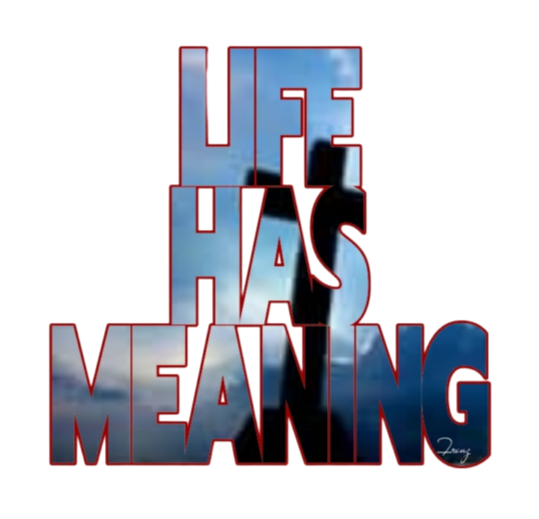
* Composition: → The image is dominated by the text "LIFE HAS MEANING." The words are arranged vertically, with "LIFE" at the top, "HAS" in the middle, and "MEANING" at the bottom.
* Typography: → The text is presented in a bold, capital letter font with a distinct visual style. The letters are blocky with a metallic or mirrored appearance. The edges of the letters are outlined in red, providing contrast and definition.
* Color and Texture: → The letters have a gradient effect, reflecting a cloudy sky. This gives the words a sense of depth and complexity, with a glossy appearance. The red outline adds a striking contrast, highlighting the words against the black background.
* Background: → The backdrop is a stark black, which makes the text stand out dramatically. This simplicity allows the viewer to focus on the message.
* Signature: → There appears to be a signature, "Zrong," in the bottom right corner of the word "MEANING."
Interpretation and Possible Meanings →
The image is a statement about the value and significance of life. Here's a breakdown of potential interpretations:
* A Simple Affirmation: → The most straightforward interpretation is a positive assertion that life possesses inherent meaning. It's a reminder that our existence is not empty or random. This message can be uplifting and encouraging, especially during times of uncertainty.
* A Call to Find Purpose: → The image could be interpreted as an invitation to actively seek out and discover the meaning of life. It suggests that meaning isn't necessarily a given but something we cultivate and find in our experiences.
* Hope and Optimism: → The sky reflected in the letters can symbolize hope, dreams, and aspirations. The message, set against a dark backdrop, suggests that even amidst challenging or dark times, life still holds purpose.
* Inspirational Tool: → The image is designed to be eye-catching and memorable, which makes it potentially suitable for use as a poster, social media graphic, or as part of a website.
* Faith Based: → The phrase "Life has meaning" has very religious connotations and can be seen as a part of the Christian faith. This is because the message emphasizes the idea that our lives are meaningful and purposeful because they are created by God.
Overall Impact →
The combination of the bold text, the striking visual style, and the simple message makes the image effective. The image's impact is immediate, drawing the viewer in with its visual appeal. The positive affirmation can resonate on a personal level, promoting a sense of hope and optimism.
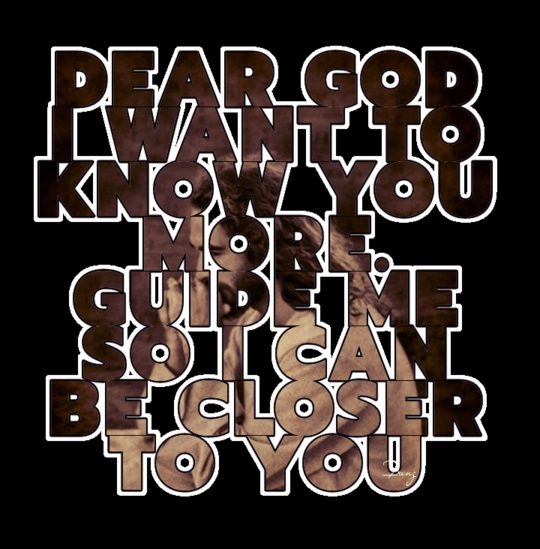
The image is a text-based design, likely intended as a devotional or inspirational message. It has a strong Christian theme due to the direct address to God and the desire for a closer relationship. The overall aesthetic is modern, emphasizing the words themselves with a stylistic font choice and a visually interesting background.
Detailed Breakdown →
* Textual Content: → The central message is clear and heartfelt: "DEAR GOD, I WANT TO KNOW YOU MORE. GUIDE ME SO I CAN BE CLOSER TO YOU."
* "DEAR GOD": → Starts with a direct and personal address. This shows an attitude of prayer, supplication, and intimacy. It sets the tone for the entire message.
* "I WANT TO KNOW YOU MORE": → Expresses a desire for spiritual growth, seeking deeper understanding of God. This is the core of the devotion.
* "GUIDE ME": → Implies a reliance on divine guidance. The speaker recognizes their need for direction in life.
* "SO I CAN BE CLOSER TO YOU": → The ultimate goal is a closer relationship with God. This encapsulates the essence of Christian faith, which is often framed as a journey towards intimacy with the divine.
* Font and Design: →
* Font: → The text utilizes a bold, all-caps font with a distinct, slightly stylized look. This may be a custom font for this image, or a unique take on a font.
* Arrangement: → The words are stacked vertically, creating a visually interesting arrangement. The vertical arrangement helps to convey the message.
* Color and Background: → The font color appears to be a warm, earthy tone, possibly a brown or sepia. The background of the letters seem to be filled with a picture of a lion. The use of the color in contrast to the black background makes the text stand out.
* Underlying Image: → The letters are made up of, or have a background containing, an image of a lion. The lion could be a symbol of the Christian faith, symbolizing Jesus Christ in Christianity, or simply a way to make the design more visually interesting.
Interpretation & Possible Significance →
* Personal Devotion: → The image is intended for personal reflection, prayer, or sharing on social media.
* Relationship with God: → The message emphasizes the desire for a personal relationship with God, characterized by growth, guidance, and closeness.
* Seeking Spiritual Growth: → The image encourages viewers to seek a deeper understanding of their faith and a deeper connection with God.
* Encouragement and Inspiration: → It's a message of hope, faith, and the pursuit of a more meaningful spiritual life.
Target Audience →
The intended audience: Christians, or anyone interested in spirituality, who resonate with the desire to grow closer to God. The language is clear, simple, and immediately accessible.
In Summary →
The image is a well-designed and emotive piece of text-based art. It successfully conveys a message of Christian devotion and inspires viewers to seek a closer relationship with God. The clean design, combined with the earnest words, makes it a positive and shareable message that emphasizes faith, personal growth, and seeking divine guidance.

Image Analysis: A Call to Active Faith →
The image is a simple but powerful visual statement. It primarily consists of two main components:
* The Text: → The text is the most prominent element. It is divided into two columns, providing a clear and easy-to-read message:
* Left Column: → "DON'T ASK / GOD TO GUIDE / YOUR STEPS"
* Right Column: → "IF YOU ARE / NOT WILLING / TO MOVE / YOUR FEET"
* The arrangement of words in blocks creates a natural flow while emphasizing key phrases to highlight the meaning.
* The Visuals: → The background shows a pair of legs from the knees down, clad in dark jeans and wearing classic black Converse sneakers. The perspective is a first-person view, as if the person is looking down at their own feet. The ground beneath is earthy, slightly blurred, suggesting a natural outdoor setting.
Interpretation: A Christian Perspective →
The image conveys a message that resonates strongly with Christian values. Here's a breakdown of the message from a faith-based standpoint:
* Asking for Guidance: → The image begins with a request, "DON'T ASK GOD TO GUIDE YOUR STEPS." This hints at a common Christian practice of prayer – seeking God's will and direction in life. Christians often pray for guidance in making decisions, facing challenges, and living a life pleasing to God.
* The Condition: Willingness to Act: → The other part of the message sets the conditions. "IF YOU ARE NOT WILLING TO MOVE YOUR FEET," which suggests that seeking God's guidance without any intention to act accordingly is contradictory. It’s not enough to pray for direction. Faith must be followed by action.
* Active Faith: → The message is, essentially, one about active faith. → It’s about taking responsibility. In the Christian context, it encourages Christians to be willing to use their faith for good works, and for helping others.
* Practical Application: → The imagery of feet and steps emphasizes the practical, daily application of faith. The "feet" represent moving towards and through life's challenges, putting into motion what we believe. We cannot simply wait for God to miraculously change our situation without our effort.
* Biblical Echoes: → The message echoes biblical themes:
* Faith and Works: → The image aligns with the concept of faith and works. It can be linked to the verse, "Faith by itself, if it is not accompanied by action, is dead" (James 2:17).
* Seeking God's Will: → The image implicitly acknowledges the need to discern God's will. The implication is that if we want to follow God's direction, we need to act.
* The Great Commission: → This image motivates the faithful to action to accomplish what they believe in, this resonates with the Great Commission, where believers are called to go out and share the Gospel, to serve and to make disciples (Matthew 28:19-20).
Overall Message: →
The image delivers a clear message: True Christian faith is more than just prayer; it requires action. → It's about seeking God's guidance, but also about actively moving forward, taking steps of faith, and living out one's beliefs in the world. It's a call to take responsibility for our lives and be willing to move our "feet" in response to God's call. This image is a great reminder that a good life starts with faith, then with actions.
Possible Uses: →
The image would be very suitable for:
* Social media posts: → Sharing on Christian-focused platforms to encourage believers.
* Church bulletins or websites: → To highlight the theme of active faith.
* Devotional material: → To provide reflection points for personal growth.
* Motivational posters: → To inspire individuals.
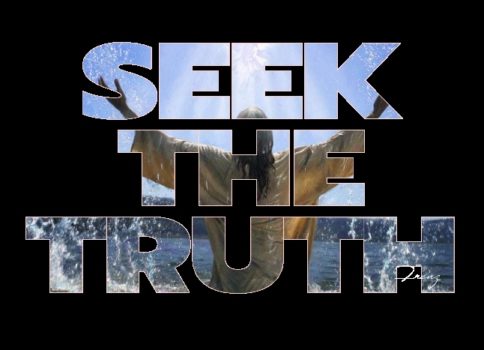
This image is a visually compelling piece of Christian artwork that uses a layered approach to convey a message of spiritual seeking and revelation. Let's break down its elements and their potential interpretations:
1. Visual Elements and Composition: →
* Text: → The dominant feature is the phrase "SEEK THE TRUTH" presented in bold, capitalized letters. The font is a simple, blocky sans-serif, lending a sense of directness and clarity to the message.
* Image Overlay: → The text isn't just a flat graphic. It's been skillfully filled with images, creating a unique and textured effect. The word "SEEK" appears to be filled with a blue sky and a person with their arms outstretched, possibly representing an act of seeking. The word "THE" is filled with a person wearing a garment, possibly a religious figure with arms extended in a posture of acceptance. The word "TRUTH" is filled with water and more images, possibly representing a spiritual experience of the baptism of water of the gospel of truth.
* Color Palette: → The image's primary colors are white text, blue sky, water, and the beige of the figure's garment. These colors evoke a sense of peace, hope, and spirituality.
* Background: → The backdrop is a solid black, providing a stark contrast that makes the text and images pop. The black background also creates a sense of depth.
2. Symbolism and Interpretation: →
* "Seek the Truth": → This core message is a fundamental principle in Christianity. It encourages believers to actively search for spiritual understanding, knowledge of God, and alignment with His will. It emphasizes the importance of inquiry, study, and a sincere heart.
* Image within the Letters: → The images embedded within the letters add layers of meaning:
* Sky and Reaching Hands: → The inclusion of the sky and outstretched hands in the word "SEEK" suggests that the act of seeking is a dynamic one, reaching out towards the divine.
* The religious figure with open arms: → The figure with extended arms, within the word "THE" potentially symbolizes Christ's role as a mediator or the believer's embrace of faith and truth.
* Water: → The water within the word "TRUTH" is representative of a spiritual experience of the baptism of water of the gospel of truth.
* Overall Message: → The image as a whole calls the viewer to the active pursuit of a spiritual truth. It is in the water where the person experiences baptism of the gospel of truth.
3. Christian Context and Relevance: →
* Scriptural Basis: → The call to seek truth is rooted in various biblical passages. For instance:
* "Ask, and it will be given to you; seek, and you will find; knock, and it will be opened to you." (Matthew 7:7)
* "Sanctify them by your truth; your word is truth." (John 17:17)
* Personal Reflection: → The image prompts viewers to consider:
* What is their personal definition of truth?
* How actively are they seeking truth in their lives?
* What obstacles do they face in their search for spiritual understanding?
4. Aesthetic and Emotional Impact: →
* Visual Appeal: → The image is visually striking due to its simplicity and effective use of contrast.
* Emotional Response: → The image may evoke feelings of inspiration, hope, and a desire for spiritual growth. It is likely to stir introspection and encourage individuals to evaluate their relationship with faith and spirituality.
In Conclusion: →
This Christian image serves as a visual reminder of the call to seek spiritual truth. The use of text, embedded images, and a straightforward design conveys a direct and compelling message. This artwork can be used to inspire reflection, provide encouragement, and prompt Christians to consider their journey of faith and their ongoing quest for spiritual knowledge.
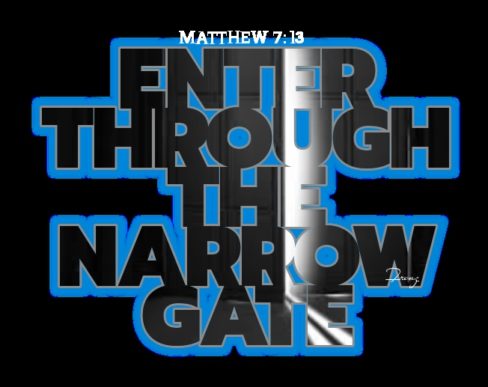
Here's a detailed analysis of the image, drawing upon its visual elements and the associated biblical context:
Image Overview →
The image is a visually striking graphic with a clear Christian message. The words "ENTER THROUGH THE NARROW GATE" are prominently displayed, set against a black background. The words are stylized in a bold, blocky font with a silver metallic texture, giving them a strong visual presence. A blue outline frames the text, providing contrast and making the words pop. At the top of the image, the scripture reference "Matthew 7:13" is noted.
Visual Elements and Design →
* Text: → The core of the image is the scripture quote. The choice of the bold, blocky font conveys a sense of strength and decisiveness. The size and prominent positioning of the text make the message the immediate focus of the viewer.
* Color Palette: → The use of black, silver and blue creates a sophisticated and modern look. The blue outline serves to highlight and separate the main message from the background, while the metallic texture of the font gives it a sleek feel.
* Background: → The black background helps to accentuate the text, creating a contrast that draws the eye.
Biblical Context and Meaning →
The image is based on Matthew 7:13, which reads: "Enter through the narrow gate. For wide is the gate and broad is the road that leads to destruction, and many enter through it."
* The Narrow Gate: → In the Christian faith, the "narrow gate" symbolizes the path of righteousness, faith, and following Jesus. It represents a more difficult path that involves sacrifice, self-discipline, and adhering to God's teachings.
* The Wide Gate: → The "wide gate" represents the path of least resistance, where individuals may pursue their desires without regard for moral or spiritual guidelines. It's depicted as a path that leads to destruction or separation from God.
* The Choice: → The scripture emphasizes the importance of making a conscious choice. The image serves as a visual reminder to consider the path one chooses to follow and the potential consequences of that choice.
Overall Message and Purpose →
The image's purpose is to:
* Encourage Reflection: → It prompts viewers to contemplate the choices they make in their lives and the spiritual direction they are headed.
* Promote Faith: → It encourages individuals to seek the "narrow gate" through faith in God and the teachings of Jesus.
* Inspire Action: → It inspires individuals to live their lives according to Christian values.
* Communicate Scripture: → It serves as a visual reminder of a key biblical message, making it more accessible and memorable.
In Conclusion →
The image is a visually appealing and effective tool for conveying a powerful Christian message. Its clear typography, contrasted colors, and biblical reference work together to prompt reflection, encourage faith, and inspire individuals to consider the path of righteousness. It serves as a modern and compelling interpretation of a timeless message.
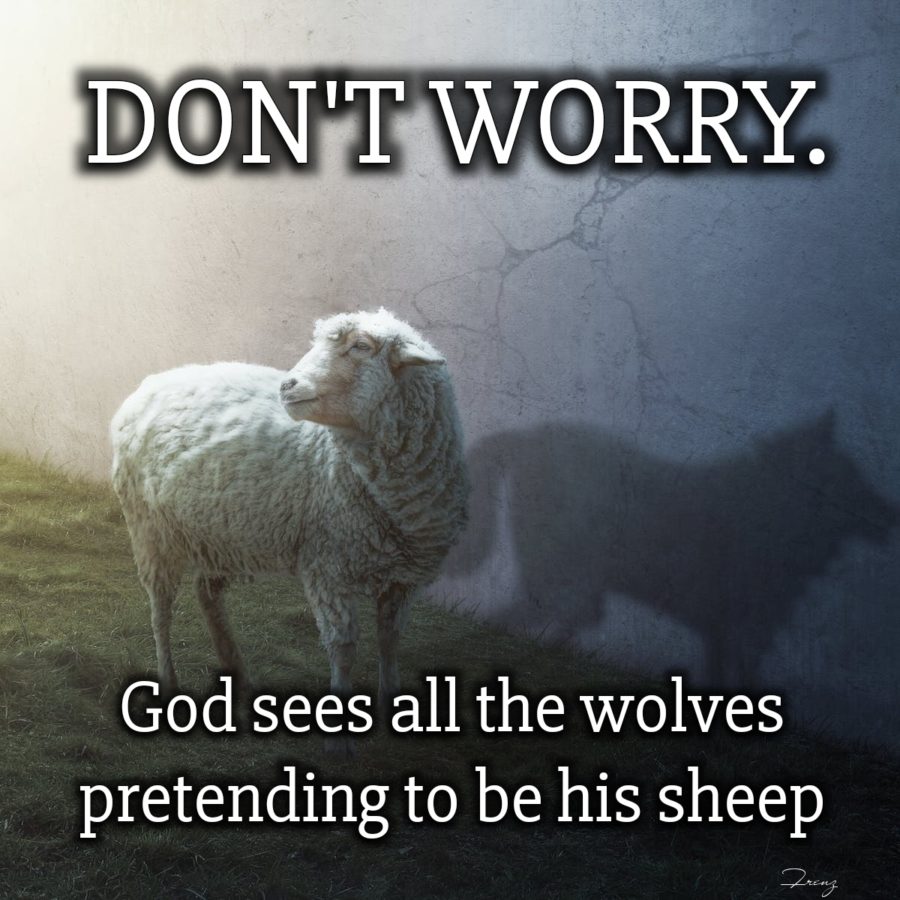
The image is a Christian-themed meme or inspirational quote. It combines visual elements with a message of reassurance and faith. The central theme is that God is aware of those who feign piety or goodness while harboring malicious intent.
Visual Elements →
* The Sheep: → A prominent, detailed image of a sheep is placed in the foreground. The sheep appears calm and serene, facing to the side. This imagery symbolizes the faithful, the innocent, or those who are considered to be followers of God.
* The Wolf's Shadow: → A shadowy outline of a wolf is visible in the background, directly behind the sheep. This is the most significant element in the image. The wolf's presence represents those who are deceptive, malicious, or those posing as something they are not. This detail emphasizes the contrast between good and evil, authenticity and pretense.
* Background: → The background has a soft, moody, and slightly ominous quality, as if a storm is brewing. This further enhances the idea that there is a struggle or challenge.
* Text: → The image includes two lines of text that are essential to conveying the message:
* *"DON'T WORRY."* This is placed at the top of the image to provide a sense of comfort and ease.
* *"God sees all the wolves pretending to be his sheep."* This is positioned below the image to offer the specific message about faith and the awareness of deceit.
Message/Interpretation →
The primary message of the image is one of reassurance and warning, rooted in Christian beliefs. The image suggests:
* Trust in God: → The "Don't worry" line sets the tone, implying that despite potential threats or challenges (represented by the wolf), there is no need for anxiety.
* God's Awareness: → The core statement highlights God's omnipotence and knowledge. It suggests that God is aware of those who are deceptive and manipulative, trying to appear good or righteous while concealing evil. This is a reminder of the importance of true faith and character.
* The Presence of Deception: → The wolf's shadow is a reminder that deception and hypocrisy exist. The viewer is encouraged to be vigilant, and the imagery suggests there is a difference between true and false followers.
* Encouragement to Stay True: → In essence, the message is to remain true to one's faith and values, as God sees the hidden motives of all.
Use of Visuals →
The image skillfully uses visual elements to convey its message:
* The serene sheep contrasts sharply with the ominous shadow of the wolf. This is a visual representation of good versus evil.
* The placement of the wolf's shadow is behind the sheep implying the true nature of the "wolf" which is hidden from view.
* The use of a somewhat somber background suggests that a potential conflict or challenge is present.
Overall, the image is a Christian-themed visual metaphor designed to offer comfort and encourage faith in the face of potential deception or evil. It aims to remind viewers of God's awareness and justice.
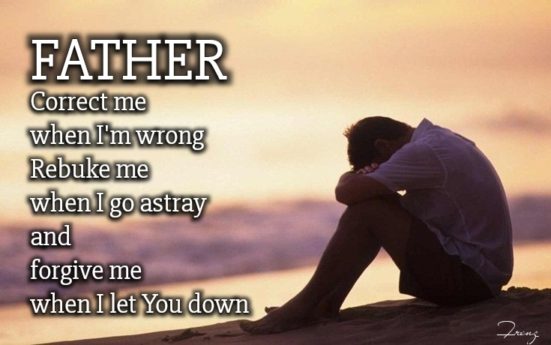
Image Analysis →
* Visual Elements: → The image combines several key elements.
* Background: → A serene scene, at sunset or sunrise, with soft, warm colors, suggesting a sense of peace and tranquility. This potentially symbolizes the broader context of faith and a relationship with God.
* Person: → A solitary figure, a man, is silhouetted in a pose of humility or despair, sitting with his head in his hands. This evokes a sense of vulnerability and introspection.
* Text: → Overlaying the image is the word "FATHER" in bold, capital letters, indicating the intended addressee. Beneath this are a series of requests: "Correct me when I'm wrong, Rebuke me when I go astray, and forgive me when I let You down." This text directly addresses God or a divine figure.
* Symbolism and Themes: →
* Faith and Prayer: → The image is designed to evoke feelings of devotion and prayer.
* Repentance and Forgiveness: → The text emphasizes the need for correction, rebuke, and forgiveness, which are central themes in many religious contexts.
* Humility: → The posture of the figure reflects a sense of humility and submission, essential in many spiritual practices.
* Yearning for Guidance: → The plea for correction and guidance signifies a desire to do what is right.
* Relationship: → The image underscores the nature of a relationship between a person and a higher power.
Detailed Article →
A Prayer in Silhouette: Exploring Faith, Forgiveness, and the Father Figure →
The image before us is a visual embodiment of a prayer. It's a poignant reflection on faith, humility, and the human desire for guidance and forgiveness. The photograph uses a combination of visual elements and carefully chosen text to communicate a message of devotion and seeking divine connection.
The backdrop of a serene seascape, bathed in the golden hues of either sunrise or sunset, establishes a tranquil and contemplative atmosphere. This setting, with its connotations of natural beauty and peace, serves as a visual framework for the deeper spiritual themes that are about to unfold.
The focal point is the solitary figure of a man, silhouetted in a posture of supplication. His head is bowed, cradled in his hands, creating an intimate sense of vulnerability and introspection. This position indicates a position of introspection. It suggests the act of communication, seeking, and humility, which are all elements that are part of many faiths.
Overlaying the image is a heartfelt prayer directed towards the divine figure referred to as "FATHER." The text is not just written. It is an expression of sincere needs and desires. It opens with a plea for correction, acknowledging the capacity for errors. The plea for rebuke emphasizes the need for guidance when straying. It is a recognition of imperfection and a plea for support. Finally, the request for forgiveness demonstrates a sense of remorse and reliance on mercy.
The image is therefore about faith, repentance, and the enduring need for guidance, forgiveness, and connection to something greater than oneself. It is a call to humility and a recognition of human imperfection. It appeals to all.
In its simplicity and artistry, this image presents a potent message that is open to interpretation, but the underlying themes resonate deeply with the themes of faith, humility, and the search for connection and redemption.
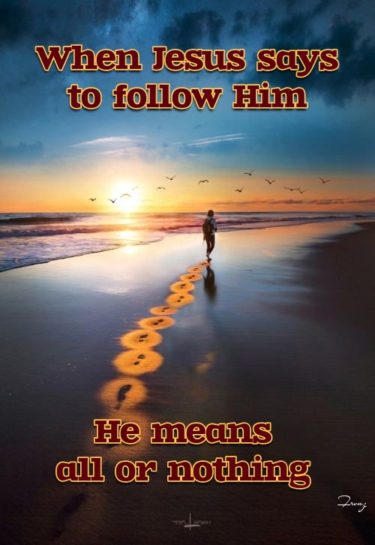
The Image: A Visual Testament of Christian Faith →
This image is a powerful visual representation of a core tenet of Christian faith: the call to follow Jesus. It uses evocative imagery and a clear textual message to convey its point. Let's break down the elements:
Visual Elements: →
* Setting: → The scene is a serene and beautiful beach at what appears to be sunrise or sunset. The sky is a blend of blues and oranges, suggesting peace, hope, and a sense of new beginnings. The ocean stretches out to the horizon, emphasizing vastness and the journey ahead.
* The Individual: → A lone figure is walking away from the viewer, towards the sunrise and down the beach. This silhouette represents the individual believer, taking the first step toward the path of following Jesus. The figure symbolizes a person of faith, following the call to discipleship.
* The Footprints: → A striking detail of the image is the trail of illuminated footprints leading the person forward. These footprints are the primary visual cue signifying the path of following Jesus. They represent guidance and indicate the way to follow in Jesus' footsteps, highlighting the importance of following Jesus, even if the path is unclear.
* The Birds: → Birds are flying in the sky, adding a sense of freedom, aspiration, and hope. They symbolize the spiritual journey, freedom, and the upward aspiration of the soul.
Textual Message: →
The text overlay reinforces the visual message:
* "When Jesus says to follow Him" →: This sets the context. It's a direct reference to Jesus' teachings in the Gospels, where he calls people to become his disciples and follow him.
* "He means all or nothing" →: This is the core message. It declares the uncompromising nature of faith and the commitment required to follow Jesus. It means that faith is not a part-time commitment; rather, it requires complete devotion and the willingness to surrender everything to Jesus.
The Meaning: →
The image’s overall message is a call to the core of Christian faith, specifically to follow Jesus in all aspects of one's life. It signifies the importance of commitment, self-surrender, and the acceptance of faith as a lifestyle choice. The all or nothing text promotes this view and indicates that the path of discipleship is not a casual choice.
* The Call to Discipleship: → The image starts with the reminder of Jesus' call to follow him and it's an invitation to a spiritual journey.
* The Path of Faith: → Following Jesus is a challenging path, and the image hints at that.
In essence, the image is a reminder that the Christian faith calls for absolute devotion, a complete surrender of oneself, and that anything less than "all" may result in "nothing" of faith. → The image powerfully and artfully brings the message to life, reminding believers of the commitment required of them and inviting those who may be on the fringe to embrace faith.
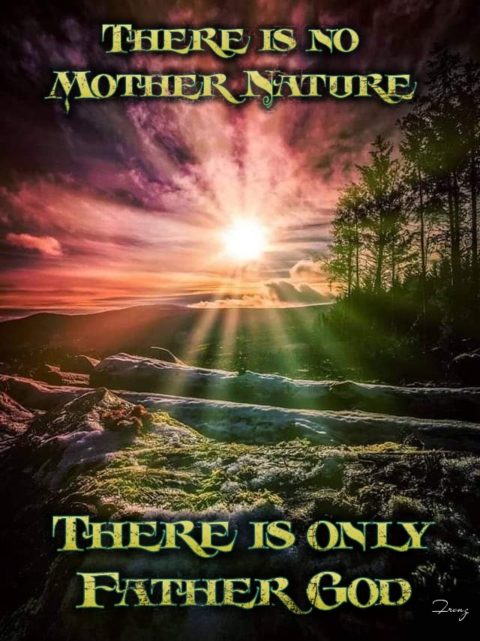
The image is a visually striking piece designed to convey a Christian theological message. It combines a breathtaking natural landscape with a bold textual assertion. The aesthetic is likely meant to be uplifting and to create a sense of awe and reverence.
Visual Elements: →
* Landscape: → The backdrop is a beautifully rendered scene. It features a vibrant sunset or sunrise, with a glowing sun radiating light. The landscape includes mountains, trees, and what seems to be mossy or frosted ground. The use of light and shadow adds depth and drama.
* Text: → The central focus of the image is the text, which is presented in a prominent, decorative font. The text is arranged in two distinct parts:
* "THERE IS NO MOTHER NATURE"
* "THERE IS ONLY FATHER GOD"
* Color Palette: → The color scheme is rich and warm, dominated by reds, oranges, purples, and greens. This creates a feeling of warmth, beauty, and grandeur.
* Composition: → The composition is designed to draw the viewer's eye from the landscape to the text and back. The natural setting provides a visual foundation for the message.
Theological Interpretation: →
The image's message is explicitly Christian. It makes a definitive statement:
* Rejection of "Mother Nature": → This is a direct dismissal of the concept of "Mother Nature" as an autonomous, divine entity. It rejects any sort of nature worship or pantheistic view that equates the natural world with a divine being.
* Assertion of "Father God": → The counter-assertion is that the only divine being is "Father God." This is a common term in Christian theology referring to God as a paternal figure. In Christian belief, God is the creator, sustainer, and ultimate authority.
Possible Interpretations & Implications: →
* Creator vs. Creation: → This image strongly emphasizes the Christian belief in a clear distinction between the Creator (God) and the creation (the natural world). It suggests that the beauty and wonder of nature are seen as a reflection of God's glory, not as a divine entity itself.
* Anti-Paganism/Pantheism: → The image could be seen as a polemical statement against pagan or pantheistic beliefs that may view the natural world as sacred or containing divine entities.
* Emphasis on Divine Paternity: → The use of "Father God" underscores the Christian belief in God's personal relationship with humanity, and the concept of a benevolent, caring, and loving God.
Overall, the image is a potent blend of visual artistry and religious doctrine. It's a clear, visually appealing expression of a specific Christian worldview, communicating that the beauty of nature is a reflection of divine creation rather than a deity in its own right.
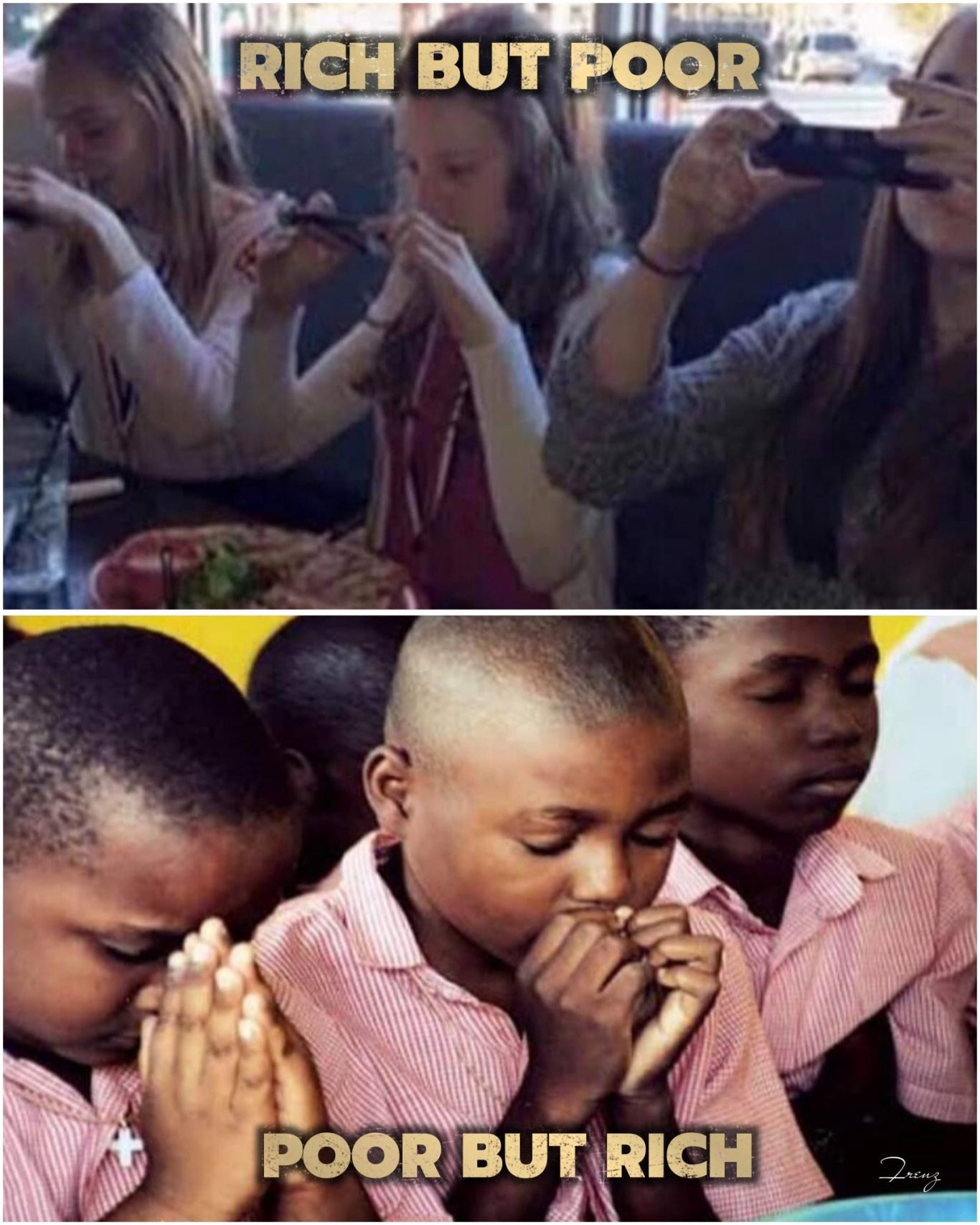
The image is a visual juxtaposition that explores the concept of wealth versus spiritual richness. It's divided into two parts, each portraying a different scene.
* Top Image: "Rich but Poor" →: This section shows three young women in a restaurant setting. They appear to be using smartphones or similar devices to take pictures of their food or themselves. The setting, combined with the act of photographing their meal, suggests a lifestyle of affluence and indulgence. However, the implied meaning, as indicated by the text overlay, is that these individuals, despite their material wealth, lack something deeper, such as gratitude or a connection to something greater than themselves. The focus is on the fleeting satisfaction of material things and their potential to distract from more meaningful experiences.
* Bottom Image: "Poor but Rich" →: This section depicts a group of young African children, with their hands clasped in prayer. They are shown with closed eyes and focused expressions. The children wear simple clothes and the focus is on their expression of faith. The image conveys a sense of connection to a deeper source of comfort and peace which suggests a sense of spiritual richness that transcends material possessions.
Overall Message: →
The image's core message is a commentary on values. It critiques the idea that material wealth equates to a fulfilled life. It suggests that true richness comes not from possessions or fleeting experiences, but from spiritual connection, gratitude, and contentment. It challenges viewers to consider where they find true value in their lives.
Article Title: The Paradox of Riches: Finding True Wealth Beyond the Material →
In a world obsessed with appearances, material possessions, and the constant pursuit of more, it's easy to lose sight of what truly matters. This image serves as a powerful visual reminder of this truth. It presents a compelling contrast, forcing us to reflect on the nature of wealth and the sources of genuine fulfillment.
The top half of the image depicts a scene familiar to many. Young women in a restaurant, surrounded by the trappings of modern life, are captured documenting their meal, perhaps for social media. The image subtly questions this focus on the superficial. It suggests that the constant pursuit of material pleasures can lead to a sense of emptiness, a feeling of lacking something deeper despite having the resources to obtain what one desires.
In stark contrast, the bottom half shows a group of children, likely from a less privileged background. They are engaged in prayer, their faces reflecting a profound sense of peace and devotion. This image is a visual reminder of the profound spiritual richness that can exist regardless of material conditions. It suggests that true wealth lies in the ability to find joy in simple things, the strength of faith, and the comfort of a deeper connection.
The image's strength is in its simplicity and its direct challenge to our pre-conceived notions of wealth and poverty. It makes us consider whether our societal values are truly aligned with our long-term well-being. Are we chasing the wrong kind of riches? Are we mistaking possessions for true connection?
The image is aimed at Christian audience.
It serves as a gentle reminder that true wealth is not measured in dollars and cents, but in the depth of our character, the strength of our faith, and the love that we share with others.
Conclusion: →
This image is not just a picture; it's a sermon. It prompts us to question our priorities, to reconsider what we value, and to examine the sources of true wealth in our own lives. It reminds us that while material comforts can offer temporary satisfaction, lasting happiness is found in the richness of the human spirit. It urges us to aspire not only to material wealth but also to cultivate the spiritual wealth that truly makes us "rich."
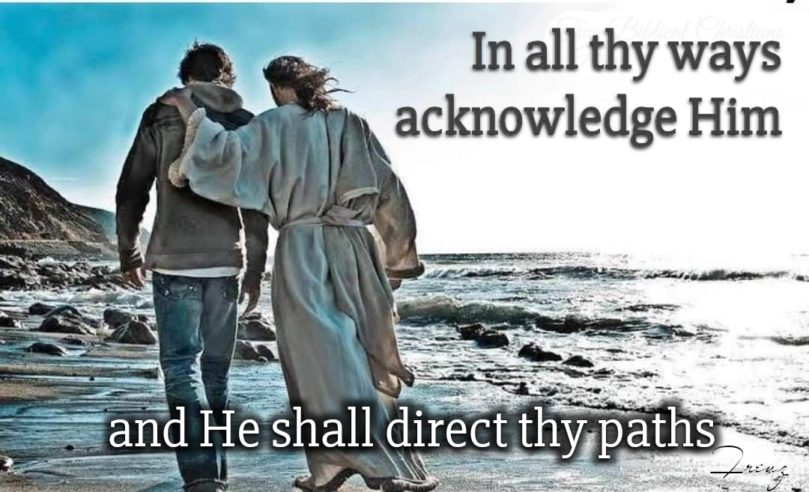
Image Analysis: "In All Thy Ways" →
Overall Impression →
The image is a digital artwork that combines a visual scene with a biblical verse. It's designed to evoke a feeling of comfort, guidance, and faith.
Visual Elements →
* The Scene: → The primary visual is of two figures walking along a shoreline. One figure is dressed in a contemporary style (jeans, hoodie) and the other is depicted in traditional biblical garb (flowing robes, long hair). They are walking side-by-side, the robed figure has their arm around the other. The setting is a beach or coastline, with water and a rugged, mountainous background. The lighting suggests a sunny day.
* The Text: → Overlayed on the image is a scriptural quote. The text reads, "In all thy ways acknowledge Him, and He shall direct thy paths." This verse appears in bold, adding emphasis.
Interpretation and Meaning →
* Symbolism: → The image is rich in symbolic meaning, largely influenced by Christian faith:
* The figures: → The figure in contemporary clothing represents a "modern" person. The figure in robes, could be interpreted as Jesus Christ, offering comfort, guidance, and support. The act of walking together symbolizes companionship, the journey of life, and following Christ.
* The Shoreline: → The beach or coastline represents the challenges and unknown of life.
* The Quote: → The verse is a direct quote from Proverbs 3:6, and it calls for trust, faith, and seeking guidance from God in every aspect of life. The promise is that if we do this, God will "direct our paths," meaning he will guide us along the correct life journey.
* Message: → The image, when combined with the text, carries a message of comfort, hope, and reassurance. It is designed to encourage faith and trust in God, highlighting that through faith we can have guidance and support in navigating life's journey.
Overall Tone and Style →
The image has a gentle, encouraging, and spiritual tone. The color palette is relatively soft. The image style looks like the imagery for something like an inspirational card or a social media post, as the image is visually appealing while communicating a particular religious message.
In conclusion: → The image is a thoughtful and artistically created representation of faith, hope, and guidance based on Christian beliefs.
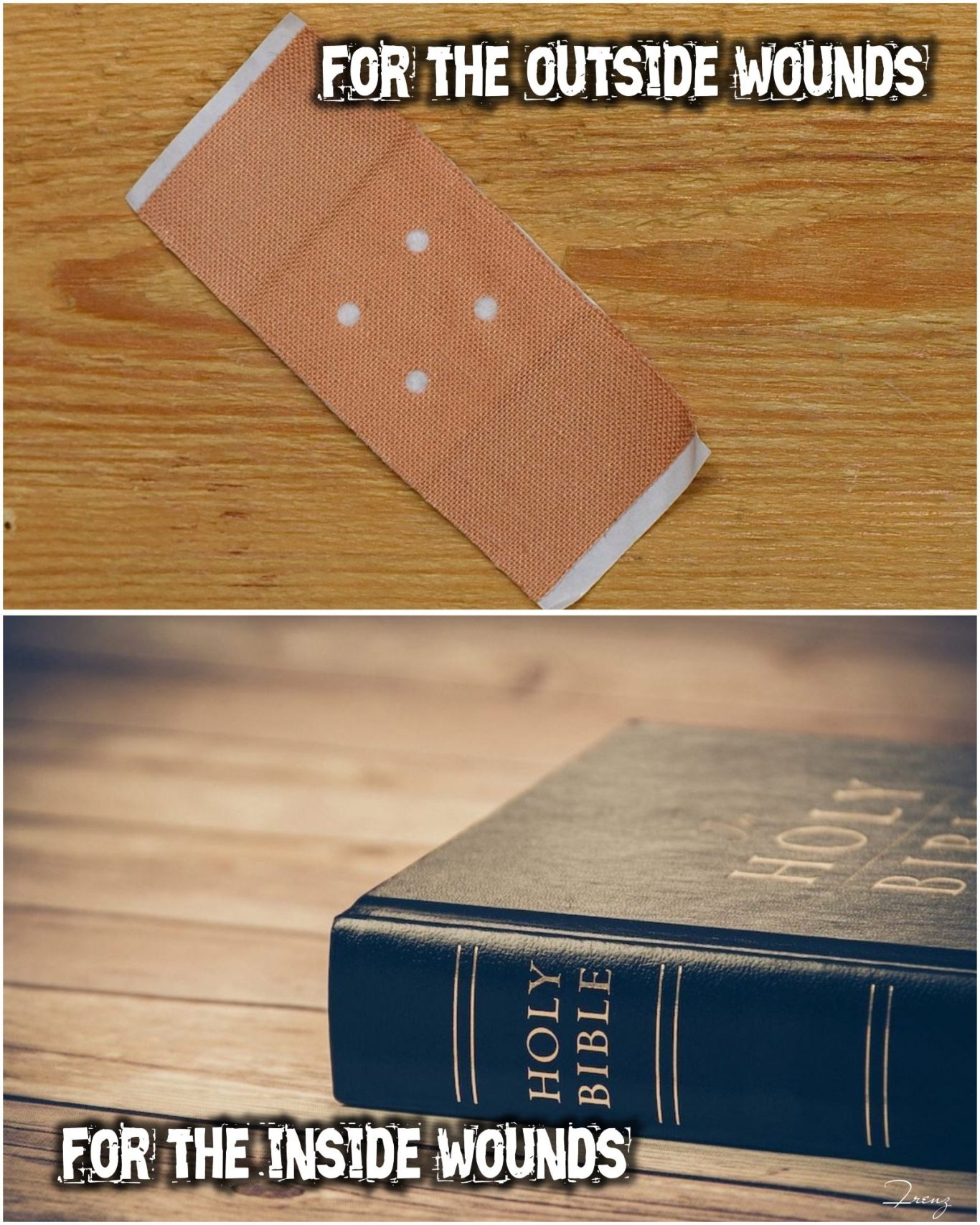
The Healing Power of Faith: A Visual Metaphor →
This image is a powerful visual representation of the role faith plays in healing, both the seen and unseen wounds that life inflicts. It's a clear illustration of the Christian belief that the Bible provides spiritual comfort and guidance, much like a bandage offers physical relief.
Visual Breakdown →
The image is divided into two distinct panels, each featuring a key symbol:
* Panel 1: The Bandage → The top panel depicts a standard adhesive bandage, commonly used to treat external cuts and abrasions. The bandage is placed on a wooden surface, adding to the realistic portrayal of care. The bold text overlaid "FOR THE OUTSIDE WOUNDS" explicitly connects the bandage with physical healing.
* Panel 2: The Bible → The bottom panel presents a closed, leather-bound Bible. The title "HOLY BIBLE" is visible on the spine. The text "FOR THE INSIDE WOUNDS" suggests the Bible is the tool to heal spiritual and emotional scars.
Message and Meaning →
The central message is clear: Just as a bandage is used to treat physical injuries, the Bible is intended to heal emotional, psychological, and spiritual wounds.
The contrast of the visuals highlights a few key ideas:
* Dual Nature of Wounds: → The image acknowledges that humans experience both external, physical pain and internal, emotional pain.
* Practical Application of Faith: → The image suggests faith, as represented by the Bible, provides solace, guidance, and strength to cope with life's trials.
* Biblical as Comfort: → The implication is that reading, studying, and living by the Bible provides spiritual healing, peace, and a sense of direction.
* Holistic Healing: → It implies that true healing involves both physical and spiritual/emotional well-being.
Cultural Significance →
This type of imagery has a strong resonance within the Christian community. It is a succinct way of summarizing core beliefs about the Bible's importance, its capacity to provide comfort, and its role in guiding believers through hardship.
Overall →
The image is a simple but effective visual metaphor. It effectively conveys the message of faith being a source of healing and comfort, offering guidance for "inside wounds" while acknowledging the need for care for "outside wounds". It is easily understandable and memorable, making it a potent representation of faith's transformative power.

The image depicts a serene beach scene at sunset. The primary visual elements are:
* Background: → The backdrop is a vibrant sunset, with a sky ablaze with orange, yellow, and hints of purple clouds. The sun itself is positioned near the horizon.
* Foreground: → The foreground shows a sandy beach with gentle waves lapping at the shore. Footprints trail from the left toward the middle of the image, ending near a figure sitting on the sand.
* Central Figure: → A person is silhouetted, seated on the beach, gazing out at the ocean. Their posture conveys a sense of contemplation or solitude.
* Text Overlay: → The image is superimposed with text in a stylistic font: "Better to lose people than to lose God." and underneath, a signature.
Interpreting the Image: A Christian Perspective →
The image and accompanying text are deeply resonant with core Christian principles. Here's how:
* God's Supremacy: → The central message, "Better to lose people than to lose God," highlights the paramount importance of one's relationship with God. It suggests that the love and devotion to God should be the guiding principle in a Christian's life, even when it means sacrificing relationships or facing difficult choices. This aligns with Jesus' teachings on putting God first (Matthew 6:33), and loving God above all else (Matthew 22:37-38).
* Suffering for Faith: → The image can evoke a sense of solitude and perhaps even potential rejection. It speaks to the reality that following Christian values might sometimes lead to conflict with others. People may disagree with a Christian's beliefs or decisions. The text implies a willingness to endure this discomfort rather than compromise one's faith.
* Finding Peace in God: → The serene beach setting provides a visual counterpoint to the potentially challenging message. It suggests that despite the trials one might face, there is solace, beauty, and peace to be found in a connection with God. The sunset and ocean evoke a sense of the awe and wonder of God's creation, a place where someone can find peace and contemplation.
* Following in the Footsteps: → The footprints on the beach can be interpreted to symbolize the journey of faith, the path Christians should take. By following this path, one can be on the right track to God.
* Trusting in the Plan: → In times of suffering, trust in God can lead one to the realization that everything is part of God's plan, that can sometimes be a source of comfort and peace.
Article: Finding Strength in Faith - Embracing the Uncomfortable Truth →
In the tapestry of human existence, relationships are often considered the most precious threads. Love, friendship, and family weave a complex and beautiful pattern. Yet, there comes a time when the patterns we so carefully create are tested. The image of a solitary figure on a beach, gazing at a fiery sunset, accompanied by the profound words, "Better to lose people than to lose God," challenges us to reconsider the deepest priorities in our lives.
This statement, while seemingly harsh at first glance, embodies a core tenet of the Christian faith. It's a call to elevate our relationship with God above all other relationships, even those we cherish most.
The message doesn't advocate for isolation or the willful rejection of loved ones. Instead, it acknowledges that our loyalty to God will sometimes place us in opposition to the values, beliefs, or actions of others. As Christians, we are called to love everyone, but we are also called to adhere to the teachings of Jesus Christ. This can mean standing firm in our convictions, even when it leads to misunderstandings, disagreements, or the difficult experience of parting ways.
The image of the person on the beach is powerful. It evokes a sense of introspection, perhaps even a feeling of being misunderstood or alone. The setting sun paints a picture of beauty and hope, which is a reminder that while the path may be arduous, faith offers comfort and peace. The ocean is a reminder of God's creation and how awe-inspiring and wonderful it is.
This message is not always easy to embrace. Humans crave belonging and acceptance. To choose God above all else can be a difficult decision, as it can involve sacrifice and even rejection. It's important to remember that this sacrifice is not about winning, but about integrity and faith.
The text encourages us to make a conscious decision to prioritize our relationship with God, understanding that it may result in loss. However, by keeping God at the center of our lives, we embrace a source of eternal peace, unwavering love, and a strength that can sustain us through any hardship.
In the end, the message isn't about losing people; it's about finding the most essential truth: the truth in God. When we are faithful to God, the other relationships will then be strengthened. The choice is a reminder that sometimes the most profound connections are found not in the approval of others, but in our unwavering devotion to the divine. It's about choosing a relationship with God that is a beacon in the darkness and a source of unending love, peace, and guidance.
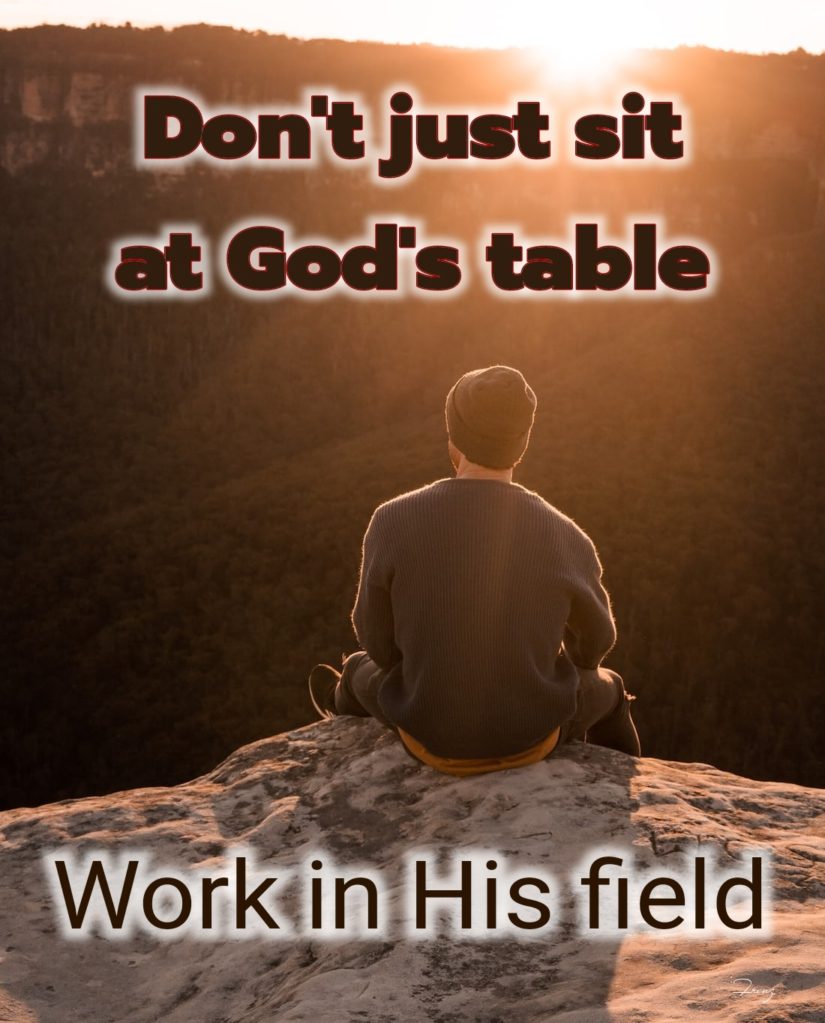
The image presents a serene and reflective scene set against a backdrop of nature. The focal point is a person, seen from the back, seated atop a rocky outcrop. The person is wearing a dark sweater and a beanie, their posture suggesting contemplation. The backdrop is a mountainous landscape, at sunrise or sunset, as the sky is awash in warm, golden light. Superimposed on the image are two phrases in bold, white text with a dark border. The top text reads, "Don't just sit at God's table," and the text at the bottom states, "Work in His field."
Interpretation and Christian Message: →
The image carries a clear Christian message, emphasizing the importance of active faith rather than passive belief. Let's break down the core elements:
* "Don't just sit at God's table": → This phrase alludes to the concept of receiving God's blessings, love, and grace. It suggests that while it is good to partake in fellowship, worship, and the promises of God (represented by "sitting at the table"), it is not the entirety of what God calls us to do.
* "Work in His field": → This phrase is a call to action. The "field" often symbolizes the world, the community, and the opportunities for service. It encourages believers to actively participate in spreading the message of Christ, helping others, and putting their faith into practice. This can involve acts of kindness, evangelism, helping the less fortunate, or using one's skills to serve God's purposes.
* The Individual in Nature: → The person sitting alone at the top of a cliff with the sunset or sunrise in the background provides the visual image of someone pondering the words: "Don't just sit at God's table. Work in His field." This reinforces the message that faith requires reflection, but the message encourages the viewer to get out and do what is asked.
* The Tone: → The warm lighting and the serene setting create a sense of peace and inspiration. The image encourages action and movement in line with one's faith.
Overall Meaning: →
The image's message is a call to move beyond a mere passive faith. It encourages believers to live out their faith, engage in service, and actively participate in the work of God in the world. It highlights the importance of a dynamic relationship with God – one that involves both receiving His grace and actively working for His kingdom.
The image is a visual representation of a Christian belief. The core message is conveyed through several elements:
* The Road Sign: → The prominent image is a "One Way" road sign, directing people in one direction. This immediately sets the tone of exclusivity. The sign itself is a common symbol of guidance and a single path.
* The Arrow: → The arrow on the sign further reinforces the concept of a singular route.
* Text Overlay: → The text surrounding the sign is the core message. It explicitly states the belief that only one way to heaven exists and that anyone suggesting otherwise is calling Jesus a liar.
* Background: → A blue sky, sometimes with subtle cloud, provides a backdrop. A cross in the background is a powerful and direct symbol of Christianity.
Article: The Only Way: A Christian Perspective on Salvation →
The question of how to attain eternal life, the promise of heaven, is a fundamental one explored by all faiths. Christianity, as depicted in this image, provides a definitive answer. This message is rooted in the teachings of the Bible and centers on the belief that Jesus Christ is the *only* way to salvation.
The Core Belief: Jesus as the Path →
The image’s central assertion, "Saying there are many ways to Heaven is simply calling Jesus a liar," reflects a core Christian doctrine: Jesus is the exclusive path to God. This belief stems from the teachings in the New Testament, particularly in the words of Jesus himself. In the Gospel of John 14:6, Jesus declares, "I am the way and the truth and the life. No one comes to the Father except through me." This scripture affirms that Jesus is not just *a* way, but *the* way. The "One Way" sign visually echoes this exclusive claim.
Why This Belief Matters →
For Christians, the idea of a single path to salvation is crucial for several reasons:
* God's Love and Sacrifice: → Christian theology emphasizes God's immeasurable love for humanity, as demonstrated by the sacrifice of Jesus Christ. Jesus’ death on the cross is considered the ultimate atonement for humanity's sins. If other paths to salvation existed, the necessity of Jesus’ sacrifice would be questioned, undermining the core Christian beliefs.
* The Role of Faith: → A central tenet of Christianity is faith in Jesus Christ. The Bible teaches that by believing in Jesus, repenting of sins, and following His teachings, one can achieve salvation. If there are alternative paths, the emphasis on faith in Jesus is diminished.
* Biblical Consistency: → The image reflects a commitment to interpret the Bible as a consistent and unified message. Many passages in the Bible support the idea that only through Jesus can one be reconciled with God.
The Impact of this Teaching: →
The belief that Jesus is the only way to salvation has profound implications for Christians:
* Evangelism: → It compels Christians to share the message of Jesus with others, out of a deep love and concern for their eternal destiny.
* Personal Dedication: → It encourages a lifestyle centered on Jesus’ teachings, fostering a commitment to love, forgiveness, and obedience.
* Hope and Assurance: → It offers a solid foundation of hope and assurance in the face of mortality, providing a sense of purpose.
Conclusion: →
The image serves as a concise and powerful visual statement of a core Christian belief. It is a declaration of faith in the exclusivity of Jesus Christ as the path to eternal life. From this perspective, to believe in other paths is seen as a direct denial of the teachings of Jesus and the truth of Christianity. This doctrine, while possibly controversial, serves as a foundational belief that shapes the identity, actions, and hopes of Christians worldwide.
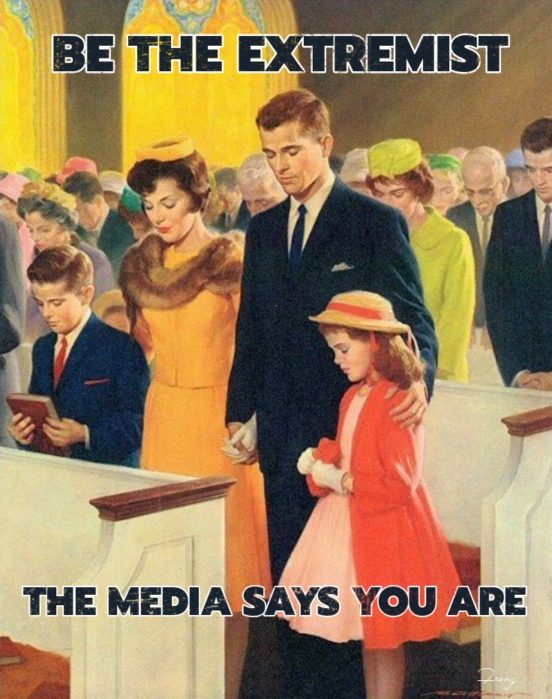
The image is a digitally altered retro-style illustration, reminiscent of mid-20th-century advertisements or magazine covers. It depicts a well-dressed family – a man, a woman, two children (a boy and a girl) – inside a church. They are standing in a pew, seemingly in prayer, with their heads bowed and hands clasped or held in front of them. Other people, also dressed in formal attire, fill the background, further establishing the church setting. The overall aesthetic is one of idealized suburban life.
The text "BE THE EXTREMIST" is superimposed across the top of the image. Below, the text "THE MEDIA SAYS YOU ARE" appears at the bottom.
Interpretation and Meanings: →
1. Anti-Media Sentiment: → This is the most obvious interpretation. The image suggests that the media labels Christians as extremists. The text, therefore, encourages Christians to embrace this label, implying that the media's perception is flawed or biased. It could be viewed as a call to "own" the perceived negativity and maintain their beliefs despite external criticism. This interpretation taps into a common sentiment among some Christian communities that they are unfairly targeted by mainstream media.
2. Encouraging Religious Perseverance: → The image might be urging believers to stay firm in their faith, regardless of how the outside world sees them. "Being the extremist" could mean fully embracing their faith and not compromising on their religious principles even if it goes against the prevailing societal norms. In this sense, it could be a message of strength and resilience.
Style and Tone: →
* Retro Style: → The use of a vintage-style illustration is striking. It can evoke nostalgia and create a sense of authenticity while also communicating a message of traditional values. It may be implying that their faith has always been and will remain strong, regardless of the changing times.
* Confrontational Tone: → The direct and simple text used is bold and defiant. The image is created to grab attention and encourage a strong reaction from viewers. The starkness of the message, combined with the image's retro style, amplifies the overall message.
Overall: →
This image could easily be shared to motivate, create solidarity, and maintain strong convictions. The image’s message is designed to provoke an emotional response, and its meaning will be interpreted differently depending on the viewer's existing beliefs.
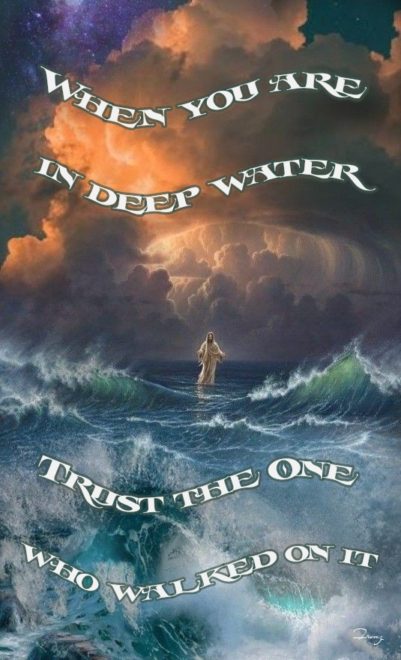
The image is a visually striking piece that blends a dramatic natural scene with a religious message. The dominant features are:
* The Scene: → The focal point is the ocean, depicted with large, turbulent waves. The water's color shifts from a dark, deep blue in the lower portion to a lighter, more vibrant blue-green where the waves crest. The sky above is dynamic, with swirling clouds that transition from deep blues and purples to fiery oranges and yellows, representing a storm or an impending sunrise/sunset.
* The Figure: → In the center of the scene, seemingly walking on water, is a figure typically recognized as Jesus. The figure is robed and appears to be facing the viewer. This imagery is a direct reference to the biblical account of Jesus walking on the water.
* Text: → The image is overlaid with text, arranged to reinforce the visual message:
* "WHEN YOU ARE" (placed above the waves)
* "IN DEEP WATER" (placed between the waves and the figure)
* "TRUST THE ONE" (placed below the figure)
* "WHO WALKED ON IT" (placed beneath the waves)
Interpretation and Christian Significance →
The image is a powerful message of faith and reassurance within a Christian context. It can be interpreted as follows:
1. Facing Challenges: → The phrase "When you are in deep water" immediately establishes the image as a metaphor for life's difficulties and trials. "Deep water" symbolizes situations that are overwhelming, frightening, or feel like they could engulf you. This could represent struggles with health, relationships, finances, or any hardship that feels challenging to overcome.
2. Trust and Faith: → "Trust the One who walked on it" provides the central message of hope. The "One" refers to Jesus. The act of Jesus walking on water, as described in the Gospels, demonstrates his power and mastery over the forces of nature, representing his ability to overcome the impossible. Therefore, the message is to put your trust in Jesus when facing troubles, in the faith that he can offer assistance, guide you through the difficulties, and help you overcome them.
3. Hope and Reassurance: → The overall composition is intended to comfort the viewer and instil faith. The chaotic water is balanced by the calm presence of Jesus, creating a visual representation of finding peace and guidance during difficulties. The message reassures the viewer that they are not alone in their struggles and that there is a source of support available.
Artistic and Compositional Elements →
* Color Palette: → The image makes strong use of color symbolism. The dark, turbulent blue of the water contrasts with the fiery sky to represent the intensity and uncertainty of hardship, while the light and the figure of Jesus are meant to bring a sense of hope and calm to the image.
* Lighting: → The light appears to focus on Jesus, highlighting his presence and reinforcing him as the image's central figure.
* Typography: → The typeface used for the text seems to have an ornate, classic feel that reinforces the image's message of faith and tradition.
In Conclusion →
This image is a poignant and visually persuasive piece of Christian art. The use of biblical imagery, striking visuals, and uplifting language creates a powerful message of faith, trust, and reassurance for those facing difficulties. It’s a reminder that during challenging times, there is a source of strength, and guidance available, rooted in the figure of Jesus, who is believed to be with them.
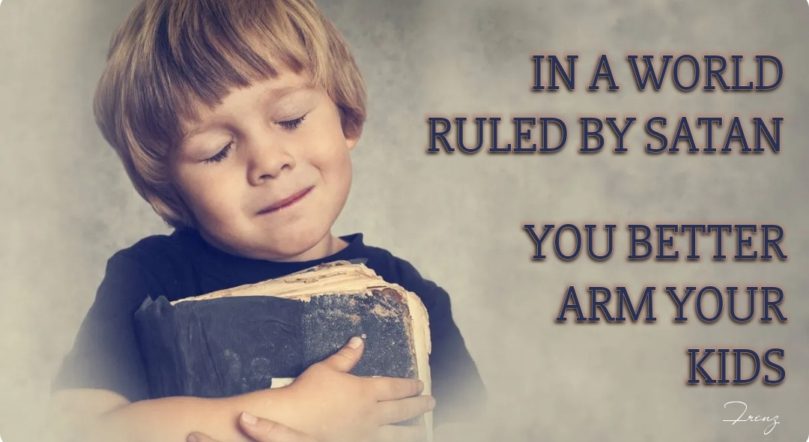
Overall Composition and Visuals: →
* Central Focus: → The image features a young boy as the primary subject. He's positioned on the left side, appearing to be holding and embracing a large, aged book. His eyes are closed, and he has a serene or content expression. The warm tone of the image adds to the general idea of the subject.
* Color Palette: → The image is dominated by soft, muted colors. The boy's skin tones are pale, the background is a blended light grey, and the text has a darker tone. This creates a sense of calm, while the dark tone text highlights the importance of the message.
* Background: → The background is a simple gradient, adding a sense of isolation and the overall tone for the message it portrays.
* Text Overlay: → The right side of the image contains the text: "IN A WORLD RULED BY SATAN, YOU BETTER ARM YOUR KIDS". This is the central message of the image.
Meaning and Interpretation: →
The image conveys a strong message with a Christian background, aimed at parents and guardians:
* "In a World Ruled by Satan": → This phrase presents a theological perspective, reflecting a Christian belief in the constant battle between good and evil. "Satan" represents evil, corruption, and the forces that oppose God and what is seen as good. This part sets up a sense of danger and conflict in the world.
* "You Better Arm Your Kids": → The second part of the phrase gives instruction on how to deal with the problem mentioned before. The word "arm" implies that parents are instructed to prepare their children for the spiritual battles of life.
* The Boy and the Book: → The boy holding the book is intended to be the "weapon" used to arm the kids. The book is the Bible, symbolizing faith, religious instruction, and the teachings of Christianity. The boy's expression of calm suggests that this "arming" brings peace and comfort.
Christian Themes and Implications: →
* Spiritual Warfare: → The image taps into the concept of spiritual warfare, a common theme in Christian theology. It implies that life is a battle against evil forces, and Christians must be equipped to fight.
* Protection of Children: → It emphasizes the parents' responsibility to safeguard their children's spiritual well-being. The image makes the claim that there is danger in the world, so the kids need "armaments" and the best one is faith.
* Importance of Faith: → The implication is that religious belief and the teachings of the Bible are critical defenses against the influence of evil.
Overall Tone and Messages: →
* Defensive and Protective: → The image has a tone of protectiveness and a sense of urgency. It is an invitation to stay vigilant against the evils of the world.
* Conservative Religious Perspective: → This image strongly suggests that only faith is a good "weapon" to arm the children to fight the evils of the world. It likely caters to a more conservative religious viewpoint.
In Conclusion: →
This image is a piece of Christian propaganda. The image tries to convey a strong message about protecting children in a world perceived as hostile by the use of visual elements, such as the boy and the aged book. The message tries to instill fear about the world and then offers a solution: religious instruction.

The image depicts a scene that appears to be a visual commentary on Christian beliefs surrounding Judgment Day. Let's break down the elements:
* Central Figure: → A man, dressed in a suit, stands prominently in the center. His posture suggests a plea or proclamation.
* Surrounding Figures: → Around him, several figures are reaching upwards. They appear emaciated and like the undead.
* Background: → The background is a fiery, ominous setting, implying Hell or a place of torment.
* Text Overlay: → The text "Your career can't save you on JUDGEMENT DAY" is emblazoned at the bottom.
Interpretation through a Christian Lens: →
The image is a stark visual metaphor of the Christian concept of Judgment Day, where all people will be judged by God for their actions during their lives. Here's how the elements relate to Christian beliefs:
* The Man in the Suit: → Represents an individual who may have focused on worldly success (career, possessions) during his life. The suit is indicative of the work culture and the pursuit of social status.
* The Reaching Figures: → These could represent those who are not among the saved, i.e., not believers in Jesus Christ. They are reaching up as if for help, symbolizing the torment of those who are not in Heaven.
* The Fiery Background: → This suggests Hell or the place of eternal separation from God, where unrepentant sinners face punishment.
* The Text Overlay: → This is the core message. It warns that worldly achievements or career success will be irrelevant on Judgment Day. It suggests that only faith in Jesus Christ can offer salvation, which is the central tenet of Christianity.
Detailed Article: The Futility of Worldly Success in the Face of Divine Judgment →
The image before us is a powerful and provocative visual representation of a core tenet of Christian faith: Judgment Day. The artwork serves as a stark reminder that material success, career achievements, and worldly aspirations hold no weight when confronted with the ultimate judgment of God.
The central figure of the image stands as a symbol of the individual, perhaps someone who has dedicated their life to pursuing career advancement, wealth, or social status. Clad in a suit, he embodies the modern individual, steeped in work culture and driven by ambition. The suit represents the tools used to achieve a career, and ultimately, what a person believes is vital to their status in life. However, his stance and upward arm imply a desperate plea or proclamation in the face of a spiritual crisis.
Surrounding the central figure are several figures, stretching upwards, their gaunt and possibly undead forms adding a palpable sense of terror and desperation to the scene. They symbolize those who have not found salvation through faith in Jesus Christ and are condemned to suffer the eternal consequences of their sins. These figures reaching up may represent those still trying to find salvation when it's too late.
The fiery, ominous background serves as the backdrop to this scene of eternal judgment. The imagery resonates with traditional depictions of Hell, or a place of torment for those separated from God. This setting adds a sense of urgency and finality to the message.
The accompanying text, "Your career can't save you on JUDGMENT DAY," encapsulates the image's primary message. The pursuit of wealth, fame, or a high-powered career has no value in the face of divine judgment. This statement directly challenges the common values of worldly societies that often prioritize material success. The image warns that the only true security and salvation lie in a personal relationship with God through faith in Jesus Christ, the central message of Christian teachings.
The power of this image lies in its simple yet impactful symbolism. The image makes a bold statement, urging the viewer to examine their lives and priorities. It encourages a contemplation of the eternal nature of life and the importance of spiritual preparation. Through its visual elements and text, it serves as a potent call to embrace faith as the sole means of escaping the judgment that awaits all humanity.
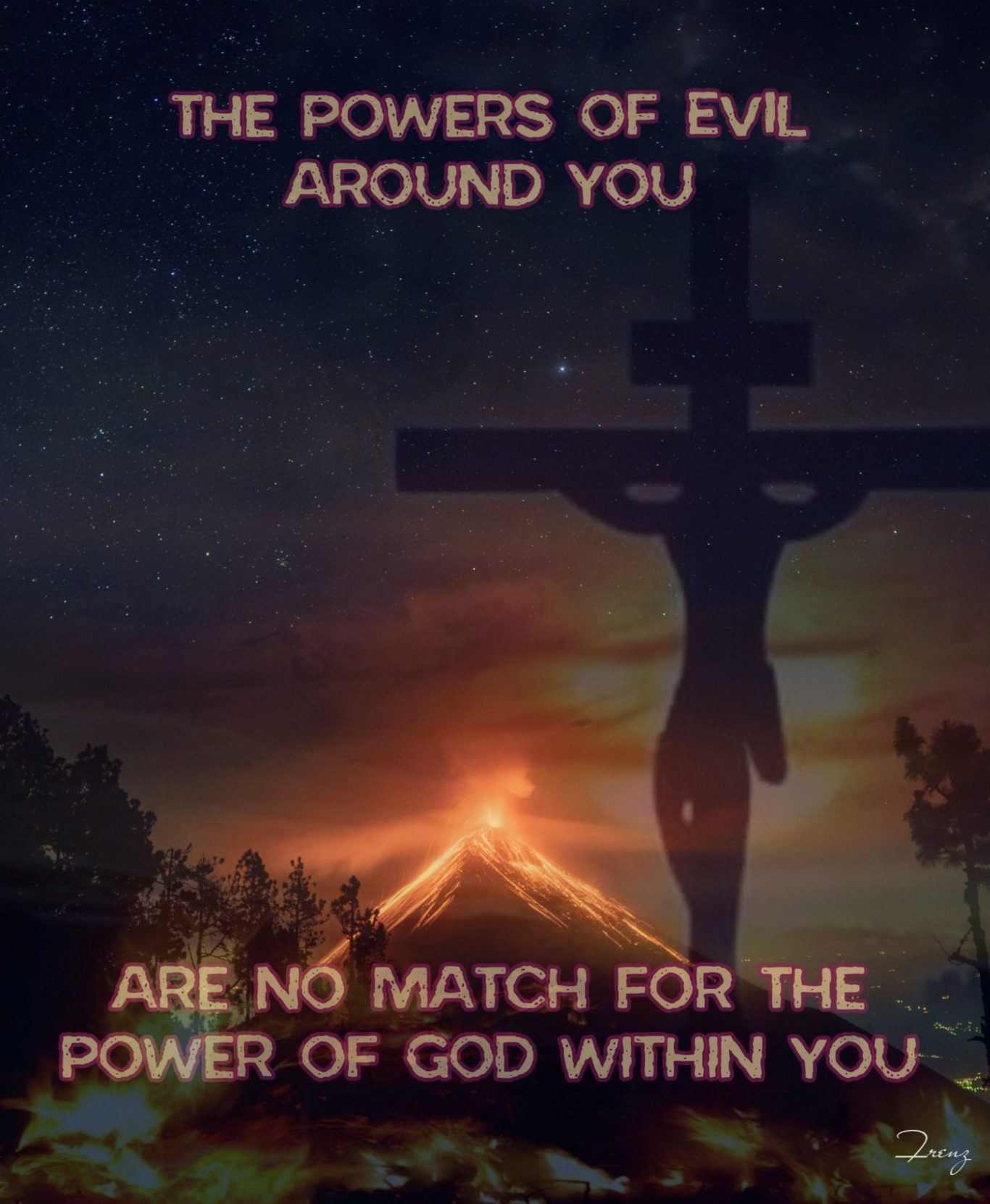
The image is a visually striking piece that uses symbolism to convey a message of faith, hope, and inner strength. It's clearly meant to be inspirational and to encourage viewers to embrace their spirituality in the face of adversity. The color palette is primarily dark and dramatic, creating a sense of tension that is then contrasted by the central theme of divine power.
Key Elements and Their Meanings: →
1. The Cross: → The central and most prominent element. It's a clear symbol of Christianity, representing Jesus Christ's sacrifice, salvation, hope, and faith. It also implies the triumph over evil.
2. Silhouette of Crucified Jesus: → The faint shadow adds an extra layer of spirituality and faith to the image. It shows the great importance of faith for Christians and it can mean that with Jesus by your side, all challenges can be overcome.
3. Volcanic Eruption: → This is the most visible and notable sign of chaos, destruction, and evil that can also be seen as a reference to hell and the devil. The volcanic eruption is a powerful visual, representing the threats and dangers that surround us. Its fiery nature reinforces the "powers of evil."
4. Night Sky with Stars: → The inclusion of a starry sky suggests the vastness of the universe, the mysterious nature of life, and the power of a higher force.
5. The Text: → The words are crucial to the message, working together to define and clarify the imagery. They are arranged in two parts:
* "THE POWERS OF EVIL AROUND YOU": Establishes the source of concern, that evil exists and is all around.
* "ARE NO MATCH FOR THE POWER OF GOD WITHIN YOU": This is the message of hope. It asserts that inner faith in God is more powerful than external evil.
6. Color Palette: → The dominant dark and fiery colors are important:
* Darkness: → Suggests evil, the unknown, and the challenges of life.
* Fiery Orange and Red: → Associated with the volcanic eruption, further emphasize the "powers of evil". They can symbolize passion, danger, and the intensity of spiritual battles.
Interpretation and Message: →
The image's core message is a strong affirmation of faith and the belief in the power of the divine. It encourages viewers to:
* Acknowledge Evil: → Recognize that evil and challenges exist in the world.
* Find Strength Within: → Believe in the power of God and the strength of your faith to overcome those challenges.
* Embrace Hope: → Trust that spiritual power is greater than any external threat.
Target Audience: →
This image would appeal to Christians and individuals who are religious or who believe in a higher power. It speaks to those seeking comfort, inspiration, and a sense of empowerment in the face of adversity.
Overall: →
This image is a powerful and symbolic work of art. It's designed to evoke a sense of both fear and hope, ultimately delivering a message of faith. The visual elements work together seamlessly to create a compelling statement about the strength of the human spirit and the power of belief.
The Beat of Faith: A Christian Reflection on the Gift of Life
The image presents a powerful message rooted in Christian faith, using the simple yet profound imagery of a beating heart. Let's delve into the elements and interpret their significance:
Visual Elements & Their Symbolic Meaning: →
* The Silhouette of a Hand Holding a Heart: → The central visual element is a hand cupping a glowing, heart-shaped object. The heart, a universal symbol of love, life, and emotion, takes center stage. The hand is the hand of a human, emphasizing the personal aspect of the message. The silhouette creates a sense of mystery, suggesting the unseen force behind the visible.
* The Heart's Glow: → The heart itself appears to be radiating light, possibly from the sun peeking through the clouds in the background. This luminosity symbolizes the life-giving force that animates the heart. It could represent hope, faith, and the very essence of being.
* The Warm Background: → The warm, sunset-like background with its shades of red, orange, and pink adds a touch of warmth and serenity. It enhances the sense of peace and comfort associated with God's love.
Text and Its Biblical Implications: →
The text overlays the image, reinforcing the message:
* "Your heart beats 72 times a minute." →: This is a factual statement, establishing a foundation for a deeper theological idea.
* "Every time it beats, it does so with the permission of its Creator." →: Here lies the core of the Christian message. This statement is the heart of the image, attributing the very function of the human body to God. It implies that every breath, every heartbeat, every moment of life is a gift, a blessing from the divine.
Deeper Meanings & Christian Interpretations: →
* Divine Sovereignty: → The text emphasizes God's control over life. The Creator is the ultimate source of life and existence. This resonates with the Christian belief that God is sovereign.
* Gratitude and Thanksgiving: → The message encourages gratitude. It implores the reader to appreciate the gift of life as something that is not simply a given, but something granted by God. It fosters a sense of reverence and acknowledgment for the blessings we often take for granted.
* Spiritual Significance: → The imagery can be used to remind Christians of God's constant presence in their lives. It's a metaphor for God's love and care, which sustains us at every moment, even when we are not consciously aware of it.
* Theological Implications: → The image aligns with several key Christian doctrines:
* Creation: → God as the Creator of all things, including the human body.
* Life: → The sacredness and value of human life, from the first heartbeat.
* Dependence on God: → The reliance on God for sustenance, and life itself.
In essence, the image and text combination serve as a devotional reminder. → It encourages viewers to pause, reflect, and acknowledge the divine power that animates every aspect of existence, beginning with the very rhythm of our heartbeats. It prompts a moment of appreciation for the gift of life and reinforces the understanding that our every breath is a testament to the grace of God.
The image uses visual and textual elements to convey a specific message about faith and the church. Here's a breakdown:
* Visuals: →
* The Woman: → The central figure is a woman, with a pensive or perhaps slightly distraught expression. She is looking upwards, which can symbolize searching, seeking answers, or looking towards a higher power. The soft lighting and diffused background gives a sense of spirituality, making the woman seem as though she may be lost in thought.
* Color Palette: → The image has a muted, earthy color palette. This reinforces the somber mood of the message, while also conveying a timelessness and sincerity.
* Text: →
* Quote: → The text presents a clear statement. It is a direct address to the reader, stating that if someone's faith in God is lost due to being hurt by the Church, their faith was not truly in God.
* Contrast: → It draws a sharp contrast between faith in "PEOPLE" and faith in "GOD," implicitly suggesting that the former is unreliable and the latter is the true and solid foundation.
* Font & Layout: → The text is clear and readable, using a simple font that avoids distraction.
* Overall Impression: → The image’s overall mood is one of introspection and potentially judgment. The visual presentation is designed to evoke an emotional response, to prompt the viewer to consider their own relationship with their faith and the role of the church.
Article: Where Does Your Faith Lie? →
The Church. For many, it is a place of solace, guidance, and community. It's a place where you turn in times of trouble, and for others, it's home. But for others, it can be a source of pain, disillusionment, and even doubt. The message in the image above confronts this complex reality head-on. It poses a poignant question, that can cut the heart of any faithful person to the core.
The image’s central message is a challenging one: "If being hurt by the church causes you to lose faith in God, then your faith was in PEOPLE, not in GOD." This statement cuts to the core of faith, reminding us that faith is not about perfection or the absence of flaws. It is about something more fundamental.
The message is directed towards those who have been hurt or disappointed by the Church: those who have experienced hypocrisy, abuse of power, judgment, or any other form of betrayal. It acknowledges the real pain caused by the actions of individuals and institutions that are meant to be sources of faith.
* Why This Message Matters: →
* Distinguishing God from Humans: → The message highlights the crucial distinction between the divine and the human. The Church, like any human institution, is inherently flawed. Its members and leaders make mistakes, often causing damage. This image reminds us that God is above these flaws.
* The Foundation of Faith: → It encourages a reevaluation of the very foundation of one's faith. Is your belief rooted in a set of people, a community, or a particular institution? Or is it firmly grounded in a relationship with the Divine?
* Navigating Disappointment: →
* Addressing the Hurt: → The image does not dismiss the pain caused by the Church's actions. It acknowledges the validity of the hurt, anger, and disappointment that people feel when betrayed by those they trust.
* Finding Strength: → It is a reminder that while the actions of humans can be hurtful and disappointing, faith can act as a shield to protect you, your sanity, and peace of mind.
* In Conclusion: →
* This image encourages us to look past the imperfection of others, and look to God as a higher power.
* It is about understanding the true source of one's beliefs and strengthening that foundation. It asks us to consider whether our faith is strong enough to weather the storms of human fallibility and to find solace in God's presence.

The image is a visually striking and emotionally resonant piece designed to communicate the core Christian belief that God loves each individual deeply and unconditionally. It's a message of comfort, affirmation, and hope, meant to be inspiring and encouraging.
Visual Elements and Their Symbolism: →
1. The Open Book: → This is the foundation of the image. The open book symbolizes the Bible, the word of God. It is the source of guidance, truth, and the means by which Christians learn about God's love and plan for humanity. The book's presence also suggests that the message of God's love can be found and understood through the scriptures.
2. The Heart Shape: → The heart shape is formed by the pages of the open book. This is the central and most potent symbol, representing love, affection, and the very core of the Christian message. It's an obvious visual connection between the Bible (the source) and the love of God. The pages folded to make a heart further reinforces that God's love is central to the teachings of the Bible.
3. The Sunset/Sunrise Background: → The backdrop of a vibrant sunset or sunrise (depending on your interpretation) is carefully chosen. It evokes several positive emotions:
* Beauty and Grandeur: → Sunsets are known to be beautiful, and represent the majesty of God's creation.
* Hope and New Beginnings: → A sunrise represents a new day, hope, and the promise of renewal. A sunset can also indicate peace, calmness, and the end of the day, implying that God's love endures always.
* Warmth and Light: → The warm colors (orange, yellow, gold) associated with the sun suggest a feeling of warmth, joy, comfort, and the divine light.
4. The Text ("God is madly in love with you"): → The words are written in an elegant, flowing script. The color gold blends seamlessly with the warm tones of the background.
* Emphasis on God: → It identifies God as the source and object of this boundless love.
* "Madly" →: This word is a powerful adjective. "Madly" conveys the extreme, passionate, and unconditional nature of God's love. It communicates the depth and intensity of that love, suggesting a love that transcends all logic and expectations.
* "In love with you": → This personalizes the message. This is not just a general statement about God's love for humanity; it is a direct message addressed to "you," the individual viewer, making it a deeply personal and intimate expression.
Composition and Design: →
* Color Palette: → The image utilizes a harmonious color scheme, primarily consisting of warm colors (orange, gold, and yellow) with the cool tones of blue in the sky. The color palette creates a sense of warmth, peace, and comfort, further enhancing the message of love.
* Focus and Balance: → The heart created by the pages is the focal point of the image. The text provides a gentle balance by being above and below the heart, forming a visual and symbolic structure.
Overall Interpretation: →
The image is a powerful visual testament to the Christian message of love. It skillfully combines symbolism (the Bible, the heart, the sunset) with a compelling and personal message ("God is madly in love with you"). The visual design, along with the wording, work together to invite the viewer to feel the warmth of divine love, providing comfort, affirmation, and hope, reinforcing their relationship with God. The image is likely designed to inspire reflection, strengthen faith, and remind individuals of their personal worth in the eyes of God.
The Essence of Faith: A Reflection on Life, Death, and Eternity →
The image before us is a powerful visual testament to Christian faith, its message interwoven with hope, mortality, and the promise of eternal life. It combines a striking landscape with poignant text, crafting a potent reminder of what truly matters.
Visual Elements and Their Significance: →
* The Cross: → Dominating the center is a simple, rustic wooden cross. This symbol is the cornerstone of Christian faith, representing the sacrifice of Jesus Christ for the salvation of humanity. Its placement at the heart of the image immediately draws the viewer's eye and signifies the central role of faith in the believer's life.
* The Landscape: → The backdrop features a serene and open landscape. The fields of long grass and the sky ablaze with a sunset or sunrise (depending on your interpretation) evoke a sense of peace, tranquility, and the beauty of God's creation. The vastness of the land reflects the boundless nature of eternity.
* The Lighting: → The golden light of the sky adds a warm and inviting atmosphere, hinting at a sense of hope, promise, and spiritual enlightenment. The use of light is significant, and further enhances the beauty of the landscape.
* Font and Text: → The script chosen for the text adds to the aesthetic, with a gentle, flowing font. This adds an artistic touch.
The Message: Words that Resonate →
The image's message is articulated in three key phrases:
* "Tomorrow isn't promised." This stark opening statement underscores the fragility of life. It serves as a gentle reminder of human mortality, the uncertainty of the future, and the importance of living each day with intention and purpose. This is a core concept in all types of faith: the importance of living well today, without deferring the things that you value.
* "But when you live for Jesus..." This phrase acts as a bridge, connecting the awareness of life's impermanence to the promise of faith. It highlights the central act of dedication and living life according to Christian values, with God at the center of the believer's actions.
* "...Eternity is." This powerful conclusion is the crux of the message. It is the ultimate promise of the Christian faith: that through faith in Jesus, believers are granted eternal life. This is a source of comfort, hope, and inspiration. The promise of eternal life gives a believer something to look forward to, no matter the hardship.
Overall Interpretation: →
The image serves as a meditation on the importance of faith in light of life's transient nature. It speaks to the Christian worldview, where the physical life is seen as a brief journey leading to an eternal existence. It urges viewers to contemplate their priorities and live with a sense of urgency, knowing that tomorrow is not guaranteed. The image is designed to offer hope and to offer perspective; it is a message for anyone who seeks spiritual solace or comfort.
Who might find this image inspiring? →
* Christians: → The image is a direct expression of core Christian beliefs, so it is likely to resonate deeply with them, strengthening their faith.
* Those grieving: → The message of hope and eternity can be very comforting to those who are grieving a loss.
* Those reflecting on life: → It can serve as a reminder of the significance of one's choices.
* Anyone seeking spiritual inspiration: → The beautiful imagery and the simple, profound message of faith and hope can bring peace and comfort.
Image Analysis: "Love Came Down" →
The image is a powerful visual statement with deep religious significance. It evokes a sense of sacrifice, love, and redemption. Here's a breakdown:
Visual Elements: →
* Central Focus: → The primary focus is on a depiction of Jesus carrying the cross. We see the wooden cross being carried on his back and the top of his head which is crowned with a crown of thorns. The image provides an intimate, emotional view. The angle chosen suggests we're looking at Jesus from below, perhaps observing or even witnessing this crucial moment of suffering.
* Color Palette: → The image uses a muted, warm color palette, primarily browns, tans, and golden hues. This color scheme reinforces a sense of antiquity, solemnity, and reverence. The background light hints at the moment when this happened, which is also a pivotal moment when love came down.
* Text: → The words "Love came down" are superimposed onto the image. The font has a graceful script style and uses a dark color with a light glowing outline, catching the eye. The text is strategically placed, with "Love" at the top, emphasizing the divine sacrifice, and "came down" at the bottom, the act of coming down to offer salvation.
Symbolism and Meaning: →
* The Cross: → The cross is the most potent symbol of Christianity, representing the crucifixion of Jesus Christ. It's the instrument of his sacrifice for humanity's sins. The fact that Jesus is bearing the cross here indicates the pain and suffering he endured for the sake of others.
* The Crown of Thorns: → This represents the mockery, humiliation, and physical torment Jesus underwent. The crown of thorns is a symbol of the rejection and suffering he faced.
* The Text: "Love came down." → This is a profound statement in Christian theology. It encapsulates the belief that God, through Jesus, demonstrated His immense love for humanity by entering the world and sacrificing Himself for the salvation of humankind. The "came down" phrase also brings to mind the concept of the Incarnation, the act of God becoming human.
* Overall Theme: → The image's core message is the ultimate expression of love in the Christian faith. It's a message of sacrifice, redemption, and hope.
Interpretations and Context: →
* Christian Belief: → The image strongly conveys the core beliefs of Christianity. Christians believe that Jesus, as the Son of God, willingly suffered and died on the cross to atone for the sins of humanity.
* Personal Reflection: → The image prompts reflection on concepts like sin, forgiveness, suffering, and divine love. Viewers are invited to contemplate the depth of the sacrifice made by Jesus and the impact it has on their lives.
* Easter/Lent: → Images of the cross, and especially Christ bearing the cross, are very common during the seasons of Lent and Easter. The image is very appropriate for these seasons.
* Emotional Impact: → The visual elements and text are designed to evoke a range of emotions, including awe, sorrow, empathy, and ultimately, hope. The image can provide solace and encouragement, reminding viewers of the unconditional love and grace offered by God.
In conclusion, the image is a compelling and emotive portrayal of a central tenet of Christianity. It's a visual prayer that asks viewers to reflect on the sacrifice of Jesus and the profound love that came down to earth.
A Sunset Reflection: Finding Meaning in God's Eyes →
The image is a poignant visual representation of Christian introspection and the prioritization of faith. It speaks to the heart of Christian belief, offering a message of solace, purpose, and the enduring importance of one's relationship with God.
Visual Analysis: →
* Setting: → The scene is a beach at sunset. The warm hues of orange and gold radiating from the setting sun create a serene and peaceful atmosphere. The water gently laps at the shore, adding to the sense of tranquility. The natural beauty of the landscape implies God's creation and is a common visual metaphor for the beauty and power of the Divine.
* Figure: → A solitary figure is silhouetted against the setting sun. They are positioned with their back to the viewer, gazing out toward the horizon. This anonymity allows the viewer to project themselves into the scene, encouraging a sense of personal reflection and identification. The figure appears to be sitting, potentially in a posture of prayer or contemplation. The backpack suggests a journey, whether physical or spiritual.
* Text: → The overlaid text is the core message of the image. Written in a graceful, slightly stylized font, it emphasizes the value that the individual places on their relationship with God, especially at the end of their daily activities.
Interpretation and Christian Themes: →
The image encapsulates several key Christian themes:
* Contemplation and Prayer: → The visual cues encourage introspection and reflection. The solitary figure and the setting sun evoke a sense of prayer and communion with God. Christians often find solace and guidance in prayer, especially when facing life's challenges or seeking direction.
* End-of-Day Reflection and Examination: → The phrase "At the end of the day" implies a time for evaluation of one's actions, thoughts, and motivations. Christians are encouraged to examine their behavior and align it with biblical teachings. It's a time for self-reflection and a critical assessment of whether one's actions have pleased God.
* Focus on God's Perspective: → The central message, "what really matters is what God thinks of me," is profoundly Christian. It underscores the belief that God's judgment and love are the ultimate measures of value. For Christians, salvation and eternal life are dependent on God's grace and acceptance. This statement suggests that material possessions, worldly achievements, or societal approval are ultimately secondary to the individual's relationship with God.
* Humility and Surrender: → The act of turning towards God’s perspective implies humility and surrender. It acknowledges that God's understanding of each person is the most important and profound, and it underscores a willingness to accept God's will for one's life.
Meaning and Audience: →
The image is designed to resonate with Christians. It speaks to their core values and beliefs, offering comfort, affirmation, and a reminder of their priorities. The message is clear and straightforward, making it easily accessible to a wide audience. It serves as a visual reminder of the importance of faith, love, and personal accountability.
* It's an image that can evoke feelings of hope, and encouragement. It’s a comforting message for believers seeking guidance, reassurance, and a sense of peace in their daily lives.
Conclusion: →
The image is a powerful and well-crafted visual expression of Christian faith. It effectively combines visual elements with a concise and meaningful message. By prioritizing the relationship with God and encouraging introspection, the image acts as a reminder of what ultimately matters in life and acts as a beacon for spiritual guidance.
The image is a digitally created inspirational graphic, clearly aimed at a Christian audience. It combines a scenic backdrop with a message of faith, using both visual and textual elements to convey its message. The aesthetic is designed to be uplifting and contemplative.
Visual Elements: →
* Background: → The background is a golden-hued landscape, representing a sunrise or sunset. This evokes feelings of peace, hope, and new beginnings. The warm colors create a sense of serenity and light, symbolic of God's presence and guidance.
* Figure: → The silhouette of a person is seated on a high point, looking out over the landscape. Their posture suggests contemplation, introspection, and a sense of solitude. The silhouette makes the figure relatable to a broader audience, allowing viewers to project their own emotions and experiences.
* Text: → The text is the focal point of the message:
* "Jesus" is written in a flowing, elegant script, highlighted by a shadow and positioned prominently. This is to draw immediate attention to the name of Jesus.
* "is my ROCK" is in a straightforward, bold font. "Rock" is capitalized for emphasis.
* "He is how I ROLL" utilizes a similar font to "is my ROCK"
Interpretation and Christian Themes: →
* Jesus as a Rock: → This is the core message. In Christian theology, "rock" is a powerful metaphor for Jesus. It represents:
* Stability and Strength: → Jesus is the firm foundation, the unwavering support in a believer's life. This provides the believer with a sense of security and protection amidst life's challenges.
* Refuge: → Jesus is a safe haven, a place to turn to for comfort and solace during times of trouble.
* Immutability: → Jesus remains constant and unchanging. The believer can always rely on God, even when everything else around them is uncertain.
* "He is how I ROLL" - A play on words: → The phrase is a modern twist on the traditional metaphor. It is a declaration of faith and a playful expression of how faith can guide and shape one's life. This implies that faith in Jesus informs the way the individual lives, makes decisions, and navigates life.
* Contemplation and Reflection: → The image of a person looking out over the landscape encourages contemplation and prayer. It suggests a need to reflect on the presence of Jesus in one's life and how that impacts one's decisions and actions.
* Hope and Renewal: → The warm colors and the scenic setting suggest a sense of hope, and new beginnings, associated with a relationship with Christ.
Target Audience and Intended Impact: →
* The image is clearly aimed at a Christian audience.
* The intended impact is to:
* Inspire and encourage believers.
* Remind them of the central role Jesus plays in their lives.
* Promote a sense of peace, security, and reliance on faith.
* Encourage reflection on their relationship with Jesus and how it affects their actions ("how I roll").
* Offer a message of hope and renewal.
Overall, this image serves as a visual reminder of the central tenets of Christian faith, providing an encouraging message for those seeking faith or a renewed sense of purpose.


The image is a meme with a clear Christian message. Here's a breakdown:
* Visuals: →
* Man in a Pulpit: → A man, representing a preacher or pastor, stands behind a wooden podium, reminiscent of a church pulpit.
* Raised Arm: → The man's right arm is raised high in a gesture of triumph or proclamation.
* Expression: → He has an upward gaze, conveying a sense of awe or excitement. His face is lit up with the joy of the good news.
* Holy Book: → On the podium is an open Bible.
* Symbolism: → A tray with bread is seen on top of the open book, a possible depiction of the Holy Communion.
* Background: → The background is a simple wooden paneling, adding a rustic and potentially traditional feel.
* Text: → Overlaid text provides the core of the meme:
* "I've read the final chapter..."
* "Spoiler Alert"
* "GOD WINS!!!"
* Message: → The image conveys a message of Christian faith, specifically that God's victory is assured. It uses humor and a "spoiler alert" format to make its point.
Article: The Ultimate Spoiler: God Wins! →
In the age of movie trailers, book reviews, and social media buzz, the fear of spoilers is real. Nobody likes to have a pivotal plot twist ruined. But what if there was a "spoiler" we all knew, a cosmic reveal that has been the central theme of countless stories and countless lives?
The meme circulating online, featuring a joyful preacher and the emphatic declaration "GOD WINS!!!", encapsulates this idea perfectly. It's a playful reminder of the core belief that underpins Christian faith: the ultimate victory of good over evil, of hope over despair, of life over death.
The image itself is a carefully crafted piece of visual storytelling. The raised arm of the preacher isn't just a gesture of excitement; it's a symbol of proclamation. He's not whispering a secret; he's shouting the Good News from the metaphorical rooftops. The open Bible on the podium, the source of his truth, and the implied presence of Holy Communion underscores the central theme that God's ultimate victory is a shared hope.
The "Spoiler Alert" adds a layer of modern humor. It acknowledges that many might be familiar with the story – the Bible – and the ending. But rather than shying away from this familiarity, the meme embraces it. The ending isn't a secret, it is the cornerstone of the entire faith. It's a celebration of the certainty of God's ultimate triumph over evil.
What makes this image so resonant? It speaks to a deep-seated human desire for hope. The world can be a challenging place, filled with struggles, suffering, and uncertainty. In moments of darkness, it is easy to lose perspective and question if everything is truly as it seems. This image, with its simple yet powerful message, offers a comforting reassurance.
The "God wins" meme reminds us that the story doesn't end with despair. It reminds us that no matter how long the final chapter may be, we can have faith in the power of God's victory.
This isn't about a literal "spoiler" in the traditional sense. Instead, it’s a reminder of the good news:
* Hope: → No matter the trials, there is a hope and purpose beyond suffering.
* Faith: → It encourages trust and belief in something greater than ourselves.
* Redemption: → It promotes the idea that no matter how far someone has strayed, there is a path back to the light.
So, if you're searching for a reason to smile, a reason to believe, or a good dose of faith in the face of trials, remember this meme. It's a playful reminder of a profound truth: God wins!
The image is a visually striking composition that aims to convey a message of Christian faith and personal worth. The juxtaposition of a lone figure in a majestic landscape with a heartfelt quote is designed to resonate with believers and perhaps inspire introspection.
Visual Elements & Their Interpretation: →
* The Background: Majestic Mountain Scenery: → The backdrop is a breathtaking view of towering mountains, possibly the Himalayas or a similar range. The snow-capped peaks and dramatic cloud formations create a sense of awe, grandeur, and spiritual vastness. The expansive landscape can symbolize both the challenges and the beauty of life's journey. It also suggests the immensity of God's creation.
* The Figure: A Hiker/Adventurer: → The individual in the foreground is a lone figure, standing and looking out at the mountain view. They're dressed in hiking attire (backpack, shorts, jacket), reinforcing the idea of a journey or a pilgrimage. This figure represents an individual on a spiritual path or simply seeking meaning in life. The hiker's solitude emphasizes the personal aspect of faith and the individual's relationship with God.
* The Rock Cairn and Cross: → A simple cairn (a pile of stones) is situated in the foreground. The cairn has a cross on top of it. A cairn is often used as a marker in the wilderness, indicating a path or a destination. The addition of a cross transforms the cairn into a powerful symbol of Christianity.
* The Text: "I May Not Be Perfect, But Jesus Thinks I'm To Die For": → This text is the core message of the image. The first part acknowledges human imperfection – a common theme in Christian theology. The second part makes a bold statement about the core belief of Christianity: that Jesus Christ died for the sins of humanity. The message is designed to evoke feelings of love, hope, and personal value, even in the face of perceived flaws.
Overall Message and Interpretation: →
The image is a visual representation of a Christian message of hope and love. It seeks to comfort, reassure, and inspire by communicating the following key ideas:
* Acceptance of Imperfection: → Recognizing human flaws and limitations.
* Unconditional Love: → Highlighting that Jesus values and loves all individuals.
* Salvation and Redemption: → Referring to the belief that Jesus's sacrifice offers a path to redemption and eternal life.
* Personal Worth: → Emphasizing that each person has value in the eyes of God.
Possible Audiences and Uses: →
* Christian believers: → The image would appeal to Christians, reinforcing core beliefs and values.
* People searching for meaning: → The image may resonate with those seeking purpose, hope, or a connection to something greater.
* Social media/Christian outreach: → The image could be used on social media platforms to inspire, uplift, and evangelize.
* Personal inspiration: → The image is designed to be a personal reminder of faith, hope, and self-worth.
The image is a visually appealing and emotionally charged Christian-themed graphic. It's designed to evoke feelings of faith, hope, and the importance of a personal relationship with Jesus Christ. The composition is well-balanced, using both imagery and text to convey its message.
Visual Elements: →
* Color Palette: → The image is dominated by warm, inviting colors: golds, oranges, and deep purples. These colors create a sense of hope, light, and the divine. The gradient effect further enhances the impression of light radiating outwards.
* Silhouette of a Person: → In the foreground, a silhouetted figure stands with outstretched arms. The posture suggests worship, surrender, and a sense of reaching out towards a higher power. The anonymity of the figure allows the viewer to project themselves into the scene, fostering a sense of personal connection.
* Blurred Cross: → In the background, a subtle, blurred outline of a cross is visible. The cross, a central symbol of Christianity, represents Jesus Christ's sacrifice and the foundation of Christian faith. The blur emphasizes the importance of the message over the visual detail of the cross.
* Light Effects: → Rays of light emanate from the background, enhancing the feeling of hope and the divine. The light creates an atmosphere of glory and serenity.
* Text: → Elegant script font conveys a message of urgency and importance.
* "Jesus" → is prominently displayed at the top, emphasizing the focal point of the message.
* "It's best to know Him, meet Him before you meet Him" →: This is the core message, urging viewers to establish a relationship with Jesus now, before the time of judgment or death.
Message and Interpretation: →
The primary message of the image is a call to faith and a reminder of the importance of a personal relationship with Jesus Christ. It is a reminder to the viewers that it is important to know and meet him before it's too late.
* Knowing and meeting: → The message encourages readers to become familiar with Jesus through prayer, reading the Bible, and fellowship with other believers.
* Urgency and Purpose: → The phrase "before you meet Him" implies a sense of urgency, hinting at the possibility of meeting Jesus in judgment or the afterlife. It serves as a call to action to seek a relationship with Christ in the present.
* Hope and Encouragement: → Despite the underlying theme of mortality, the overall tone is one of hope. The warm colors, the light, and the posture of the figure suggest an open door to grace, redemption, and eternal life.
Target Audience and Purpose: →
The image targets a Christian audience or individuals who are open to exploring their faith. It's designed to:
* Inspire and motivate: → Encourage believers to strengthen their faith and relationship with God.
* Evangelize: → Reach out to those unfamiliar with Christianity, inviting them to learn more about Jesus.
* Offer Comfort and Assurance: → Provide solace and hope to viewers, especially those facing challenges or seeking meaning in their lives.
* Serve as a reminder → that those who live on earth should start a relationship with God.
Overall Assessment: →
The image is a visually effective and theologically sound representation of Christian beliefs. It successfully combines imagery and text to communicate a clear, concise, and emotionally resonant message of faith, hope, and the importance of knowing Jesus Christ.
This image is a powerful visual representation of Christian faith and belief, directly connecting the idea of heroism with the figure of Jesus Christ. Let's break down its elements:
Visual Components: →
* Subject: → The central figure is a depiction of Jesus Christ, seen from the back. He's carrying a large wooden cross on his shoulders. This is a direct reference to the biblical narrative of Jesus's crucifixion, where he was forced to carry the cross to the site of his execution.
* Attire/Appearance: → Jesus is shown with long, flowing hair and a crown of thorns, further emphasizing the suffering and sacrifice associated with his death. His back appears to be bare, and possibly showing marks of wounds.
* Setting: → The background suggests a natural, outdoor setting, a landscape. The use of soft, warm lighting (a sunset or sunrise) can evoke feelings of hope, reverence, and the promise of new beginnings, which are core themes in Christianity. The overall feel is one of humility and suffering.
* Text: → The text overlay is the most important part of this image. The text reads: "NOT ALL SUPERHEROES WEAR CAPES, MINE WORE A CROSS". The style of the text appears aged and is slightly worn.
Theological Interpretation: →
* Super Hero Analogy: → The phrase "Not all superheroes wear capes" is a modern idiom that implies that real heroes can be found in ordinary life. The image subverts this expectation. It uses the concept of a "superhero" and redirects it to Jesus. This emphasizes the extraordinary acts of self-sacrifice, love, and forgiveness that Jesus performed.
* The Cross as a Symbol: → The cross is the single most important symbol in Christianity. It represents Jesus's crucifixion and death. The cross is a symbol of redemption, sacrifice, and atonement for the sins of humanity. The image highlights the idea that Jesus chose to bear the weight of the cross willingly, signifying his ultimate act of love and his acceptance of God's will.
* Suffering and Sacrifice: → The depiction of Jesus carrying the cross and wearing a crown of thorns is a direct acknowledgement of suffering. Christians believe that Jesus suffered in his human form to atone for the sins of the world. The image emphasizes the core tenet of Christianity: Jesus's sacrifice for humanity's salvation.
* Rejection and Redemption: → Jesus's journey is seen as one of rejection by some, and ultimately, a path to redemption for those who believe in him. The image likely encourages a message of reflection and faith.
* Personal Connection: → "Mine wore a cross" personalizes the image, potentially encouraging the viewer to think about their own relationship with Jesus and to identify with the Christian faith.
Overall Message: →
This image presents a compelling and contemporary Christian message:
* Heroism Redefined: → It redefines the concept of heroism to include self-sacrifice, suffering, and love. Jesus is the ultimate hero because he faced death in order to save others.
* Focus on Sacrifice and Love: → It highlights the central tenets of Christian belief: love, sacrifice, and the power of faith. It also emphasizes that Jesus’s actions were not for himself, but for others.
* Call to Faith and Reflection: → The image is meant to evoke feelings of reverence, compassion, and faith in the viewer, as it invites them to reflect on the sacrifice Jesus made.
Effectiveness: →
The image's simplicity and visual impact make it effective. The imagery is clear and direct, making it accessible to a wide audience. The combination of the modern idiom with the classic Christian imagery creates a powerful, memorable, and impactful message.
In conclusion, this image serves as a powerful visual reminder of the Christian faith. It uses modern language to connect the figure of Jesus to the idea of a superhero, while also reminding the viewer of the themes of suffering, sacrifice, redemption, and ultimate love, which are essential elements of Christian belief.
Visual Elements →
* Text: → The primary element is the bold, stylized text that spells out the message. The words are arranged in a hierarchical fashion:
* "JESUS" is at the top.
* "CHRIST" and "IS LORD" are in the middle.
* "NOT A" and "CUSS WORD" are at the bottom.
* Font and Style: → The font is a thick, blocky, and impactful style, giving a sense of boldness and strength. Each word is outlined in white against a darker color.
* Color and Background: → The overall color scheme uses a sunset-like orange, yellow and red gradient within each word, the text appears to be embedded in a fiery background. The background is solid black.
* Signature: → At the very bottom, next to "WORD" is a small signature "frenz" (or possibly a similar name).
Message and Interpretation →
* Core Message: → The image directly communicates a statement of Christian faith and a rebuke of using sacred terms casually or profanely. It elevates "Jesus Christ is Lord" as a declaration of faith and contrasts it with the status of "cuss words."
* Christian Theology: → This message directly relates to the Christian belief in the divinity of Jesus Christ and the importance of reverent speech, and the emphasis of respect for religious terms.
* Tone: → The image uses a direct and declarative tone. It doesn't mince words but conveys its message in a clear and unambiguous manner.
* Audience: → The image is intended to resonate with Christians or those familiar with Christian beliefs. It could be intended to encourage believers to be mindful of their language and to share their faith with others.
Symbolic Elements →
* Fiery Background: → The use of sunset-like colors of orange, yellow and red inside of the words symbolize the power and holiness of God.
* Bold Typography: → The visual strength of the font choice reinforces the image's message, emphasizing the importance and power of faith in Jesus.
Overall Impact →
The image is designed to make a statement of faith and a condemnation of inappropriate use of religious phrases. It's visually striking due to its color choices and bold typography. The combination of these elements creates a simple and powerful message.
Understanding the Image: A Message of Christian Hope →
The image is a powerful visual statement that conveys a message of hope, help, and faith, drawing heavily on Christian symbolism and beliefs. The image’s effectiveness comes from its simple composition and the evocative imagery used. Let's break down the elements:
Visual Elements and Interpretation: →
* The Hand(s): → The central and most impactful element is the outstretched hand. This is a clear symbol of offering help, guidance, and support. It’s directed downwards towards another hand reaching up. The light surrounding the hand suggests a divine or heavenly presence. It represents Jesus Christ reaching out to offer aid. The second hand, reaching upward, symbolizes a person in need of help, reaching out in faith, seeking assistance, and asking for help.
* The Text: → The words superimposed on the image form a complete sentence: "He will help you overcome." This text reinforces the visual message by declaring the core idea of the image. The message highlights the divine support available and provides reassurance that difficulties can be conquered with help and that help will be provided.
* Color and Light: → The use of warm, golden tones in the background and around the text creates a feeling of peace and hope. The brighter light on the hand emphasizes its importance and divinity. This light creates a sense of the divine presence, of hope, and of positive energy.
* Overall Composition: → The composition is designed to lead the eye from the top to the bottom. The text and light guide the viewer's gaze from the hand to the other hand below, and the image communicates a message of faith and support.
The Christian Message: →
The image is a visual representation of key Christian beliefs:
* God's Love and Grace: → The outstretched hand represents God's constant offer of help, love, and grace to humanity. It is a reminder that God is always there for those who call upon Him.
* Overcoming Challenges: → "Overcome" speaks to the Christian belief in the ability to overcome adversity, sin, and difficulties through faith in Jesus Christ. The image promises strength and resilience to face and conquer life's trials.
* Faith and Prayer: → The image encourages and symbolizes faith in God and the possibility of overcoming obstacles through prayer and trust in divine help.
Overall Impact and Intended Audience: →
The image is designed to resonate with a Christian audience. The message of hope and support resonates with anyone facing hardships. The image inspires those struggling with the challenges of life, reminding them that they are not alone and that divine help is always available.
In conclusion: → This image is a simple yet powerful visual message designed to bring reassurance, hope, and encouragement to those who hold Christian beliefs. It uses visual and textual elements to create an accessible and emotionally resonant expression of faith and the offer of help in life's challenges.
The image is a visually compelling piece that combines imagery with a direct religious message. It's designed to evoke a sense of faith and commitment. The bold text, the symbolic background, and the implied action all work together to convey a strong Christian belief.
Visual Elements and Their Meaning: →
* Text: → The central message, "HIS WAY IS THE ONLY WAY," is the focal point.
* Font and Style: → The text is in a large, bold, sans-serif font, giving it a sense of prominence and authority. The white text against the blue border makes it stand out. The "distressed" effect on the border adds a touch of ruggedness, perhaps suggesting the challenges and hardships that can come with the Christian faith.
* Meaning: → The text conveys the core belief that the path to spiritual salvation, understanding, and ultimately, a fulfilling life, lies in following the teachings and example of Jesus Christ, or, "His Way."
* Background Image: → This visual element adds a strong layer of symbolism and reinforces the message.
* Figure: → A man, seen from behind, is walking forward. He is carrying a large wooden cross on his shoulder. This is a direct reference to Jesus Christ's carrying of the cross to his crucifixion.
* Environment: → The setting appears to be a natural environment, perhaps a field or a grassy area. The light and the sky suggest a sense of hope, possibly representing a new day or eternal life.
* Color Scheme: → The dominant colors are white, blue, black, and natural colors.
* White: → represents purity and spiritual light.
* Blue: → associated with faith, truth, heaven, and spirituality.
* Black: → the background, which allows the words to stand out.
* Natural Colors: → The background of the man represents being in nature, earth, new beginnings, and a field for sowing seeds.
Symbolism and Interpretation: →
* The Cross: → The cross is the central and most overt Christian symbol, representing:
* Sacrifice: → The sacrifice Jesus made for humanity's sins.
* Suffering: → The suffering that Jesus endured.
* Resurrection: → Christ's victory over death and the promise of eternal life.
* Christian Commitment: → Carrying the cross symbolizes following Christ and embracing a life of faith, which can be difficult at times.
* The Man: → The man carrying the cross represents:
* The Individual Believer: → Every Christian is called to follow Christ's example.
* Facing the Challenges: → The man's forward walk could represent the journey of faith, even when facing obstacles, and the call for all believers to carry on the faith for eternal life with Christ.
Christian Message and Themes: →
* Exclusivity: → The phrase "His Way Is the Only Way" speaks to the core Christian belief that salvation is found through faith in Jesus Christ alone. This message is often seen as exclusive to other faiths.
* Faith and Commitment: → The image encourages a commitment to the Christian faith.
* Hope and Salvation: → The image points to the promise of eternal life and hope.
* Personal Journey: → The man carrying the cross suggests that the journey of faith is a personal one.
Overall, the image is a powerful visual statement that delivers a clear Christian message. It aims to inspire faith, commitment, and a sense of purpose by pointing to the importance of following the teachings of Jesus Christ.
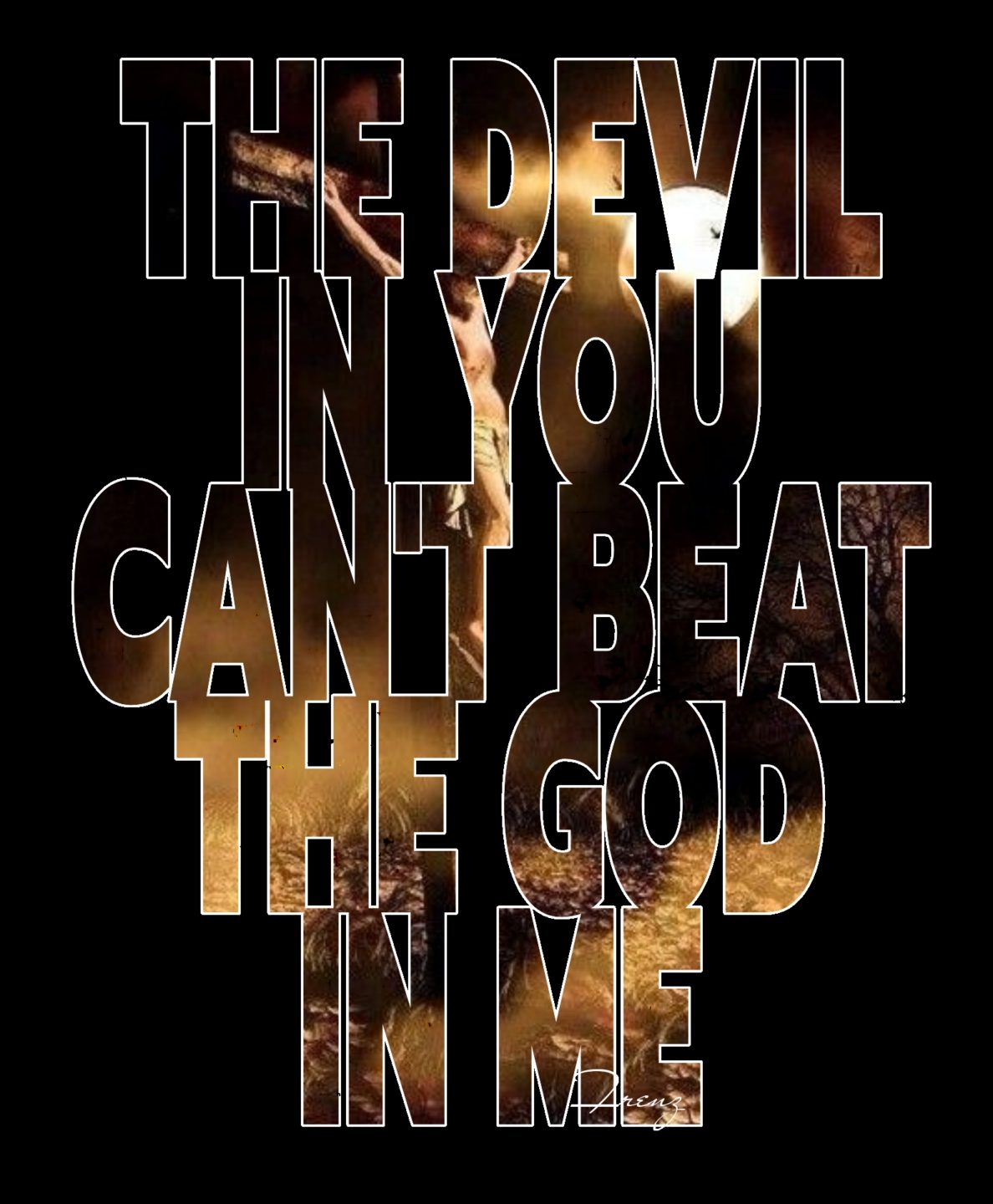
The image is a visually striking piece of Christian art that uses typography and embedded imagery to convey a powerful message. It's designed to be impactful and thought-provoking, drawing viewers into a reflection on good versus evil, faith, and the presence of divine power within. The composition utilizes a contrast between the starkness of the black background and the images embedded within the lettering.
Text and Message: →
The core of the image is the text: "THE DEVIL IN YOU CAN'T BEAT THE GOD IN ME." This message encapsulates a central tenet of Christian faith. Let's break it down:
* "THE DEVIL IN YOU" →: This phrase acknowledges the presence of temptation, sin, and negative influences that exist within individuals. In Christian theology, the "devil" often represents the embodiment of evil or negative spiritual forces.
* "CAN'T BEAT" →: This is a statement of faith and assurance. It asserts the ultimate power and triumph of the divine. It suggests that the negative forces or sinful inclinations within a person are ultimately subordinate to the strength of God.
* "THE GOD IN ME" →: This is the key message. It implies that through faith in Christ, the Holy Spirit can dwell within a person, providing strength, guidance, and the power to overcome evil. It's a statement of hope, the idea of the indwelling spirit of God.
Embedded Imagery and Symbolism: →
The imagery used within the text further reinforces the message:
* The Crucifixion (Hint 1 and 2): → Embedded within the text, specifically near the "DEVIL", is an image of the crucifixion of Jesus Christ. This is the defining symbol of Christianity. It represents sacrifice, redemption, and the ultimate victory over sin and death. The placement of the crucifixion, with the "devil" nearby, is a symbolic contrast representing the struggle between good and evil. The image of Christ reinforces the power of God that can conquer the devil.
* Lion(Hint 3 and 4): → The Lion is a Symbol of Jesus Christ. This animal often represents strength, courage, and majesty. Lions are associated with royalty and authority and used to depict Jesus Christ.
Overall Interpretation: →
The image functions as a declaration of faith and spiritual encouragement. The viewer is reminded that although they may face internal struggles and temptations (the "devil in you"), the indwelling power of God, which can be found through faith in Christ, is ultimately stronger. The juxtaposition of the crucifixion with the message strengthens the idea of overcoming evil through Christian faith.
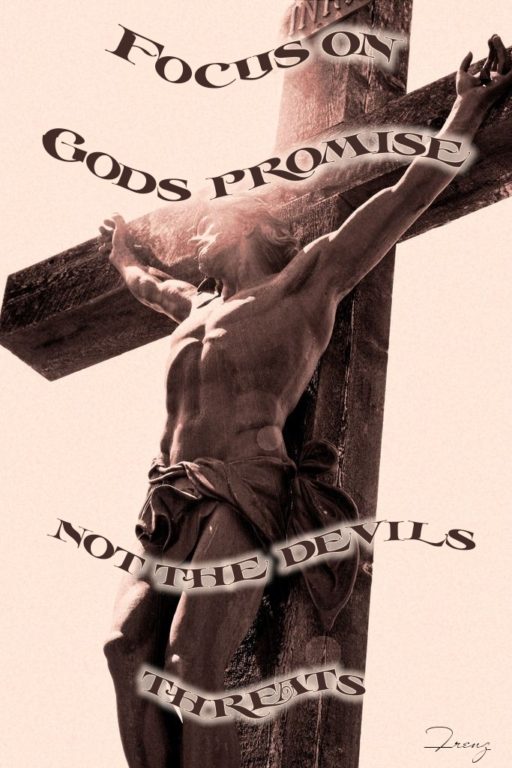
The image is a Christian-themed visual, a common type in devotional and inspirational contexts. It depicts a figure of Jesus Christ on the cross. The message is conveyed through both the imagery and the overlaid text. The tone is somber and focuses on faith and resilience.
Visual Elements →
* Subject: → The central figure is Jesus Christ, shown crucified. His head is tilted back, and his body is contorted to show suffering. A loincloth modestly covers the lower portion of his body.
* Setting: → The scene takes place on a cross outside. The background is a pale, almost featureless wash of color (possibly a light pink). This emphasizes the figure of Jesus.
* Color Palette: → The image is rendered in a limited palette of browns and tans, further evoking a sense of solemnity and age.
* Lighting: → The lighting suggests a soft, diffused light source, adding to the gentle effect.
Textual Elements →
The image includes text arranged around the figure:
* "Focus on God's Promise" →: This is the main call to action. It tells the viewer where their attention should be directed.
* "Not the Devil's Threats" →: This is a contrast, directing the viewer to ignore the threats and dangers.
Interpretation and Meaning →
The image is intended to be a reminder of faith and resilience in the face of trials and tribulations.
* Suffering & Sacrifice: → The depiction of Jesus on the cross references the ultimate act of sacrifice in Christianity. The suffering depicted in the physical form is intended to evoke a sense of empathy and inspire a believer to turn towards faith.
* Focus on the Positive: → The text is an encouragement to direct attention towards the positive aspects of faith – "God's Promise" – rather than the negativity, the fear, or the temptations that the "Devil" presents.
* Spiritual Guidance: → The image may be used as a visual aid during prayer, reflection, or meditation on the Christian faith and the nature of God's relationship with humanity.
Purpose and Audience →
The primary audience for this image would be Christians. It's intended to be used for devotional purposes, perhaps as a graphic for a website, a social media post, or for a print.
Final Note: →
The image, in general, is designed to bolster faith in difficult times. By focusing on God's promise and not on the devil's threats, it encourages believers to persevere in their faith.

The image is a digitally rendered composition with strong Christian symbolism. It depicts a roughly hewn wooden cross with a portion of the vertical beam visible. Overlaid on the cross are key symbols of Jesus Christ's crucifixion:
* Crown of Thorns: → A thorny crown is draped over the top portion of the cross, representing the crown of thorns placed on Jesus' head by Roman soldiers during his trial and mocking.
* Nails: → Two large, iron nails are driven into the wooden beam of the cross, evoking the image of the nails used to crucify Jesus.
* Hammer: → A heavy hammer lies near the nails, likely the tool used to drive the nails into the cross.
* Blood: → The cross shows blood stains and the hammer, nails show the blood of Jesus Christ.
* Background: → The background is a tan, cloth-like texture, possibly representing the garment or shroud used in the crucifixion.
* Text: → The image is superimposed with the following text in a bold, stylized font:
* "When You're"
* "Wounded"
* "Talk To"
* "The Man"
* "With Scars"
Interpretation & Christian Significance →
The image serves as a visual representation of Christian faith, particularly focused on:
* The Suffering and Sacrifice of Jesus Christ: → The crown of thorns, nails, hammer, and blood are explicit references to the physical suffering endured by Jesus during his crucifixion. The central message is his sacrifice for humanity's sins.
* Empathy and Hope: → The text's message "When you're wounded, talk to the man with scars" is a powerful call to draw comfort and seek solace in Jesus during times of personal hardship. It suggests that Jesus, through his own suffering, understands and can relate to human pain. The scars symbolize that he is not unfamiliar with suffering.
* Connection to God: → The image encourages a personal connection with Christ, suggesting that believers should turn to him in times of difficulty. The image implies that Jesus remains accessible and attentive to those who are suffering.
* Faith and Redemption: → The imagery reinforces the central tenets of Christianity: that through Jesus' sacrifice, believers can find forgiveness, healing, and eternal life.
Visual and Stylistic Choices →
* Color Palette: → The earthy tones of the wood, the red blood, and the tan background evoke a sense of rawness and suffering.
* Placement of Elements: → The composition strategically places the key symbols of crucifixion at the center, highlighting their importance.
* Font and Text Placement: → The font and layout ensure the message is clear and the viewer’s attention is directed from top to bottom.
In Conclusion →
This image is a concise and moving expression of Christian faith. It combines potent visual symbols of Jesus's crucifixion with a message of hope, empathy, and the invitation to find solace in the Savior during times of pain and struggle. It functions as a visual reminder of the central beliefs of Christianity and encourages a personal relationship with Jesus.
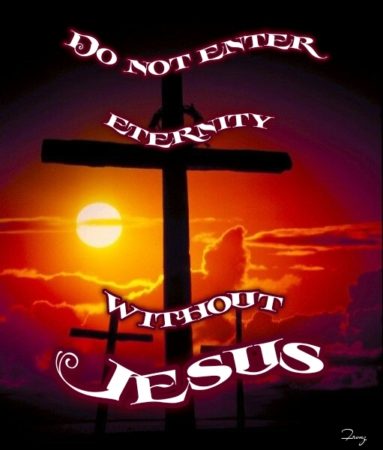
Image Analysis: A Christian Message of Faith and Salvation →
The image is a visually powerful Christian statement, conveying a message of faith, salvation, and the importance of Jesus Christ. Let's examine its elements:
* The Dominant Crosses: → The central focus is the large, dark silhouette of the Christian cross. It's the most prominent visual element, immediately signaling the Christian faith. The cross serves as a symbol of Jesus Christ's sacrifice, atonement for sin, and the foundation of Christian belief. The image contains smaller crosses behind the larger one.
* The Sunset/Sunrise Backdrop: → The background features a vivid sunset or sunrise with warm hues of orange, red, and yellow. This suggests a new beginning, hope, or the transition from earthly life to eternal life. It also evokes a sense of beauty and transcendence, symbolizing the glory of God.
* The Textual Message: → The words are the key to the image's explicit message. They form a directive, a warning, and a call to action.
* "Do Not Enter Eternity": → This phrase serves as a strong warning, emphasizing the consequences of not having a relationship with Jesus. The concept of "eternity" implies the afterlife and the ultimate destination of the soul.
* "Without Jesus": → This is the heart of the message. It specifies the only means of gaining entrance into eternity. It states that faith in Jesus is essential for salvation.
* Overall Tone: → The image combines a solemn, almost urgent tone. The dark color of the crosses contrasts against the bright sunset, creating a contrast that amplifies the text's message.
Interpretation & Christian Theology →
The image communicates a core tenet of Christian faith: salvation through Jesus Christ. The key ideas being communicated are:
1. The Reality of Eternity: → Christianity believes in a life after death, whether it be heaven or hell.
2. The Need for Salvation: → Christians believe that humans are separated from God due to sin. Salvation refers to the act of being saved from sin and its consequences.
3. Jesus Christ as the Savior: → Christianity teaches that Jesus Christ, the son of God, died on the cross as a sacrifice for humanity's sins. Believers can obtain forgiveness and have eternal life through faith in Jesus.
4. The Exclusivity of Jesus: → The image emphasizes the belief that Jesus Christ is the only way to enter eternity and be saved. It emphasizes that eternal life cannot be obtained without faith in Jesus.
In Summary →
The image is a clear, direct visual expression of the Christian gospel. Its intention is to persuade viewers to think about their relationship with Jesus, consider the concept of eternity, and contemplate the path to salvation. It is a reminder of a fundamental belief within Christianity.

The image powerfully communicates the idea of ongoing spiritual growth and development within the Christian faith. It uses a combination of visual elements and text to convey the message that being a Christian is a journey, not a destination, and that transformation is a continuous process.
Visual Elements →
* Background: → The background is a stunning landscape. It appears to be a mountain range at sunset or sunrise, with warm, glowing colors (oranges, reds, and yellows) filling the sky and reflecting onto the mountains. The light creates a sense of hope, beauty, and serenity. This natural beauty can also symbolize the creation and the grandeur of God's work.
* Person: → A silhouette of a person is positioned in the foreground, silhouetted against the bright backdrop. The person is standing, which suggests strength and resilience. This silhouette also serves as a visual metaphor for the individual Christian.
* Text Overlay: → The image features the text "CHRISTIAN UNDER CONSTRUCTION" in a bold, white font with a thick, black outline. This overlay is the central message of the image. The font style is clear and easily readable. The use of capital letters conveys a sense of importance and emphasizes the message. The placement of the text is strategic: it overlays the landscape but also encompasses the person, reinforcing that this is a personal journey of transformation.
Symbolism and Interpretation →
* "Christian": → This word immediately establishes the context of the image. It refers to someone who identifies as a follower of Jesus Christ.
* "Under Construction": → This phrase is the key metaphor. It represents the idea that a Christian's life, character, and faith are constantly being built up, refined, and perfected. This implies that it's a process of ongoing growth, learning, and development. It acknowledges that Christians are not perfect but are constantly striving to become more like Christ. The building aspect, which has stages of creating, altering and testing can be similar to the spiritual transformation process.
* The Landscape: → The landscape of a beautiful mountain range and a vast sky evokes a sense of grandeur and an understanding that God can be everywhere. The natural beauty suggests the potential for spiritual growth and transformation can be within anyone, at any time.
* The Silhouette: → The silhouette of the person emphasizes the individual's journey. It suggests the person's commitment to their faith, and the ongoing progress in their spiritual journey.
Overall Message and Impact →
The image's overall message is encouraging and uplifting. It serves as a reminder that:
* Faith is a Process: → Being a Christian is not about achieving perfection but about continually striving to grow closer to God and reflect Christ's character in our lives.
* We are Not Alone: → The vast and beautiful background reminds us that this journey is connected to something bigger than ourselves – God's grander plan and creation.
* Change Takes Time and Effort: → The "under construction" metaphor acknowledges that personal and spiritual growth takes time, effort, and is an ongoing process. There will be challenges and moments of learning.
Conclusion →
"Christian Under Construction" is a visually compelling image with a powerful message. It effectively communicates the core idea of spiritual growth within the Christian faith using a carefully chosen blend of text, symbolism, and striking imagery. The message is both encouraging and realistic, reminding Christians that they are works in progress and that faith is an ongoing journey. It is a message of hope, perseverance, and the beauty of striving to become more Christ-like.
The image is a devotional piece conveying a message of love, truth-telling, and faith in God's role in individual lives. It's visually simple but spiritually rich, aiming to inspire reflection and a particular way of interacting with others, based on Christian principles.
Visual Elements and Symbolism →
* The Open Book: → The most prominent visual element is an open book, likely representing the Bible. The pages are spread wide, with light emanating from within. This symbolizes:
* Revelation and Enlightenment: → The open book suggests that truth is being revealed and that knowledge and understanding are readily available.
* Source of Truth: → The Bible, as the word of God, is presented as the source of truth, the foundation upon which the message is based.
* Openness and Accessibility: → The open pages suggest that the truth, in this context, is meant to be accessible and understood.
* The Background: → The background is a gradient of blues, transitioning to a brighter, almost white area where the book is positioned. This use of color adds to the sense of spirituality and the divine:
* Peace and Calm: → Blues often evoke feelings of peace and tranquility, creating a contemplative atmosphere.
* Light and the Divine: → The bright, almost glowing area surrounding the book conveys a sense of the divine presence, emphasizing the connection between the truth and God.
* Font and Text: → The elegant script font adds to the inspirational tone. The message is divided into two main parts.
The Message →
The image's core message is communicated through the text:
* "Love them enough to tell them the Truth." → This statement is the first critical element. It emphasizes the importance of speaking truth, even if it's difficult or might be unwelcome.
* Christian Principle: → The core message resonates with the Christian value of love (agape love) being the fundamental aspect of all Christian activities.
* Truth and Salvation: → The image infers that truth is a pathway to spiritual growth and, for Christians, potentially to salvation.
* Courage and Caring: → Love is what drives the speaker to speak the truth. It often requires both courage and a deep concern for the other person's well-being.
* "How they handle it is between them and God." → This adds a crucial layer to the message. After telling the truth, the speaker is not responsible for the outcome, or the other person's reaction to what was said. The emphasis shifts to the individual's relationship with God.
* Respecting Free Will: → The image affirms the concept of free will. How a person responds to the truth is their choice.
* Trusting in God: → The speaker is meant to trust that the recipient’s response will be handled between God and the person.
Interpretation within a Christian Context →
The message of the image is in line with important tenets of Christian faith:
* Truth as Essential: → In Christianity, the Bible is regarded as the ultimate truth. The image encourages adherence to truth.
* Love as the Foundation: → The command to "love your neighbor as yourself" is fundamental to Christian teaching. This love extends to speaking the truth, even when difficult, to help others.
* God's Sovereignty: → The second part of the message aligns with the idea of God's sovereignty. God is ultimately in control of the world and knows all that is happening.
* Personal Responsibility: → The image indirectly encourages people to reflect on how they receive the truth in their lives.
In Conclusion →
The image is a simple yet powerful message of faith, love, and trust. It encourages the speaker to speak truth, but reminds them to leave judgment and the ultimate outcome to God. It's a call to action, reminding viewers of the importance of love and speaking the truth to their fellow human beings. The open book, the use of light, and the thoughtful wording combine to create an encouraging message.

The image is a Christian-themed motivational poster or meme. It conveys a sense of urgency and calls for spiritual reflection and action. The combination of the image and the text aims to inspire viewers to prioritize their relationship with God.
Visual Elements →
* Photograph: → The photograph features a man from the back with his hands touching his head. The lighting suggests either sunrise or sunset. The sun's rays are shining directly behind his head.
* Color Palette: → The image has warm tones, primarily consisting of oranges, yellows, and browns. This warm color palette contributes to a sense of serenity and evokes feelings of peace or introspection.
* Text: → The text is prominently displayed in white letters. The font has a slightly distressed, textured look, which adds to the image's feeling of being hand made.
Text Analysis and Message →
* "GET RIGHT WITH GOD": → This phrase is the central message. It urges the viewer to align their lives with God's will, values, and teachings. It encourages seeking forgiveness for sins, cultivating a deeper relationship, and living a life of faith.
* "TOMORROW MAY NEVER COME": → This is a call to action. It underscores the immediacy and urgency of getting right with God. It reminds viewers of the uncertainty of life and the possibility of sudden death or a life-altering event.
Interpretation and Deeper Meanings →
The image can be interpreted in several ways:
* Urgency and Opportunity: → The combination of the image and text creates a feeling of urgency. The person might be in a reflective mood while the text suggests there is no time like the present.
* Seeking Solitude: → The man facing away from the viewer shows a sense of privacy while the sun is shining on him as if God himself is looking to him.
Overall Impact →
The image is designed to resonate with individuals within a Christian or religious context. The text and image are likely meant to inspire reflection, prompt a call to faith, and encourage a sense of urgency to make amends and prioritize one's relationship with God. The warm, inviting visual adds a layer of solace, encouragement, and contemplation to the message.
Analysis of the Image and its Christian Message: →
The image is a visually appealing composition designed to convey a specific spiritual message, firmly rooted in Christian beliefs. Here's a breakdown:
1. Visual Elements: →
* Sunset/Sunrise: → The backdrop is a stunning image of a sunset (or sunrise, depending on interpretation). The sun is positioned centrally, casting a golden glow across the water and reflecting a brilliant light towards the viewer. This symbolizes hope, new beginnings, and the presence of God's light in the world. The colors are rich and warm, evoking feelings of peace, serenity, and awe.
* Text Overlay: → The text is overlaid on the image, with the message written in two stanzas. It's positioned to complement the visual elements, using a clear font that's readable against the background.
2. Textual Message: →
* The Core Argument: → The primary message is a comparison between the value of a spiritually focused friend and the value of a large group of worldly friends. The text explicitly states that it's "better to have one spiritual friend who leads you to God than to have thousands of friends who are focused on worldly things."
* Key Concepts: →
* Spiritual Friend: → This refers to a person who actively helps you grow in your faith, who offers guidance, and who embodies Christian values. This person would likely be a fellow believer who shares your commitment to Christ and helps you deepen your relationship with God.
* Leads you to God: → This phrase underscores the purpose of the spiritual friend: to help you know God better, to deepen your faith, and to live a life aligned with Christian teachings.
* Worldly Things: → This concept typically refers to aspects of life that are outside of a faith-based life. Things like material possessions, power, fame, social status, pleasure, and anything that would distract one from following a faith-filled life.
* The Implied Value System: → The message implicitly promotes a value system where spiritual growth and a relationship with God are of paramount importance. It suggests that external friendships should be secondary to a meaningful relationship with God.
3. Christian Interpretation: →
* Biblical Basis: → The message aligns with several biblical principles and teachings.
* Community of Believers: → The Bible emphasizes the importance of fellowship within the Christian community. Believers are encouraged to support one another, share their faith, and encourage each other in their spiritual journeys (Hebrews 10:24-25).
* Seeking God Above All Else: → The primary commandment is to love God with all your heart, soul, mind, and strength. This message implies that one's focus should be on seeking a relationship with God above all worldly things.
* Discernment: → Christians are encouraged to be discerning in their relationships and choose those who will help them grow spiritually (1 Corinthians 15:33).
* Prioritizing Spiritual Growth: → The image encourages readers to focus on their spiritual development, prioritizing a relationship with God over material possessions and focusing on things that are not considered holy.
4. The Overall Impact: →
* Inspirational and Encouraging: → The image aims to inspire and encourage believers to prioritize their spiritual growth and seek out friendships that align with their faith.
* A Call to Reflection: → It challenges viewers to evaluate their relationships and consider whether they are positively influencing their faith journey.
* Visual Reminder: → The image serves as a constant reminder of the importance of a spiritual life and the impact friends can have on your life.
* Message Delivery: → The warm colors of the sunset/sunrise make the message more inviting.
In Conclusion: →
The image provides a clear, uplifting Christian message. It uses a beautiful visual to draw viewers in and then delivers a powerful message about the importance of spiritual friendships and prioritizing a life dedicated to God. It embodies the Christian principles of faith, community, and a commitment to spiritual growth.
A Search for Truth: Finding Jesus →
The image is a powerful visual statement of faith, intended to convey the central tenet of Christian belief: that Jesus Christ is the ultimate source of truth. It combines evocative imagery with a direct, concise message to create a resonant and meaningful statement.
Visual Elements and Their Significance: →
* The Figure: → A central figure, clearly representing Jesus Christ, stands on an elevated rocky outcrop. He is depicted in traditional attire: a long, flowing robe, reminiscent of biblical depictions. He gazes upwards, away from the viewer's direct gaze, which creates an air of contemplation and perhaps also a connection to a higher power, such as God. He is holding a staff, a symbol of leadership, authority, and guidance, also connotating that he is a shepherd looking over his flock.
* The Scenery: → The setting is a serene, natural landscape. The scene is bathed in warm, golden light, with a soft light in the top right and sky in the top left that suggest both sunrise or sunset, adding to the impression of serenity and the promise of a new day or a peaceful end. This warm light contributes to a sense of hope and the beauty of nature, and the image includes a body of water, reflecting the sky and light. The water's reflective quality suggests clarity and truth. The landscape suggests a journey, or a path, the image itself represents.
* The Text: → The text, presented with elegant script, is the primary message of the image:
*"Anyone who really wants the truth ends up at Jesus."*
The text is positioned prominently at the bottom, allowing the image to connect with it. The style of the font lends a traditional and comforting feel, adding to the image’s sentiment. The font choice adds to the overall message's impact.
Interpretation and Underlying Message: →
The image communicates a clear message about the search for truth. The overall meaning is that searching for truth inevitably leads to the figure of Jesus.
Here's a breakdown of the message:
* The Quest for Truth: → The core idea is that humanity has an inherent desire to seek out the truth. It suggests an active search, a genuine and earnest desire to know what is real and meaningful.
* Jesus as the Endpoint: → The image asserts that Jesus is the ultimate destination of this search. It claims that finding Jesus is synonymous with finding truth. This is a central tenet of Christian faith, the idea that Jesus embodies the way, the truth, and the life.
* Visual Reinforcement: → The composition reinforces the message. The Jesus figure, framed by nature, is positioned as a beacon of hope and enlightenment. The imagery is soothing, suggesting that the truth is accessible and found through a spiritual quest.
* The Pathway to Jesus: → The image does not explicitly show the "journey," but it evokes the idea. The viewer is invited to consider their own search, and the image provides an affirmation: the search for truth is not fruitless but ends in the arms of Jesus.
Overall Impact: →
The image is designed to be inspiring and consoling. It can be used to encourage faith in Jesus as the source of truth. The beauty of the imagery and the simplicity of the text combine to create a strong, memorable message that resonates deeply with those who share its belief.
The image is a visually striking inspirational quote, aimed at a Christian audience. It's designed to be thought-provoking and encourage reflection. The bold text against a black background creates a strong contrast, making the message immediately noticeable.
Visual Elements and Design: →
* Typography: → The text is the central focus. The font is a thick, blocky style, providing a sense of weight and importance. The letters are outlined in white, which makes them pop against the dark background and further emphasizes the message.
* Color and Texture: → The letters are filled with a gradient of colors, primarily blues and purples that evoke a cosmic feel, representing the night sky and stars. This is a visual metaphor, tying into the message about the stars. The texture within the letters appears grainy, like a starry night, enhancing the overall theme. The image has a professional look, due to the clean lines, the texture used in the letters and the white outlined.
* Composition: → The text is arranged vertically in a structured, readable format. The words are stacked in a way that allows the message to flow naturally. The use of the black background helps to eliminate distractions and emphasize the words.
* Imagery: → The "starry night" texture within the letters acts as a visual anchor for the quote's focus on the stars and their creator. In the bottom line, we can see a silhouette of trees and mountains, which represents the world God created.
Message and Interpretation: →
* The Quote: → "DON'T FOLLOW THE STARS FOLLOW THE ONE WHO MADE THEM." This is the core message. It is a statement that encourages the viewer to shift their focus from earthly things (the stars, in this context) to something or someone greater.
* Christian Context: → The message strongly suggests a Christian interpretation. "The One Who Made Them" is a direct reference to God. The stars and the cosmos are viewed as creations, reminding the viewer of the power and divine nature of God.
* Meaning and Encouragement: → The message is meant to inspire and guide the audience to look beyond the immediate and find meaning and direction in their faith and relationship with God. It's a call to prioritize the spiritual over the material and to seek guidance from the creator.
Overall, this image is: →
* Aesthetic: → Visually appealing due to its striking design and thoughtful use of color and texture.
* Meaningful: → Provides a powerful message promoting a faith-based perspective.
* Effective: → Captures attention quickly and communicates its message clearly.
* Purposeful: → To encourage the viewer to prioritize their faith in God.
The image presents a provocative statement about the Christian worldview, juxtaposing the experiences of Christians and non-believers (referred to as "unbelievers") in this life and the afterlife. It uses a striking visual style to emphasize the message.
Textual Analysis →
* Central Claim: → The core of the image lies in its two-part declaration:
* "FOR A CHRISTIAN THIS WORLD IS THE ONLY HELL THEY WILL KNOW." - This part suggests that, according to the Christian faith, the hardships, struggles, and suffering experienced in this world are the extent of a Christian's "hell." Because of their faith and the promise of salvation, Christians are believed to be shielded from eternal damnation.
* "FOR AN UNBELIEVER THIS WORLD IS THE ONLY HEAVEN THEY WILL KNOW." - This part presents the counterpoint. The implication here is that for those who do not believe in God or the Christian faith, this earthly existence is their only taste of "heaven." They will not have the hope of a better life in the afterlife, and therefore, all the pleasures and joys of this life are all they will experience.
* Theological Underpinnings: → The message rests on key Christian doctrines:
* Heaven and Hell: → Belief in a literal heaven and hell is fundamental to Christianity.
* Salvation: → Christians believe they can achieve salvation through faith in Jesus Christ. This offers them hope and a promise of eternal life in heaven.
* The Nature of This World: → This life is often seen as a testing ground or a preparation for the afterlife. Christians may experience suffering in this world, but their faith offers them comfort, purpose, and a vision of something beyond the current challenges.
Visual Analysis →
* Typography and Style: →
* The image employs bold, capitalized text for maximum impact, ensuring the message is immediately visible.
* The text is arranged in a clear, easy-to-read layout, divided into two sections to reinforce the contrast between the perspectives of Christians and non-believers.
* The letters have a cloud or sky fill.
* Impact and Effect: →
* The image's style is likely intended to be thought-provoking and even confrontational.
* The straightforward language and the strong visual style leave little room for ambiguity, immediately conveying the central message.
Interpretation and Context →
* Target Audience: → The image appeals to those interested in religious themes, Christianity, faith, and discussions about the afterlife.
* Use and Purpose: → This kind of graphic might be used in various contexts:
* To spark conversation and reflection on faith, mortality, and spirituality.
* As a meme or shareable quote within Christian communities.
* To make a declarative statement about the core beliefs of Christianity.
Overall, the image is a straightforward and compelling visual representation of a central tenet of the Christian faith, offering a perspective on life, death, and the eternal future.
The image is a digital design with a strong religious or spiritual theme, likely targeting a Christian audience. It features a bold message, "DON'T IGNORE GOD'S FRIEND REQUEST," presented in a visually striking manner. The juxtaposition of text and background creates a message that is both aesthetically interesting and emotionally resonant.
Visual Elements and Analysis →
* Text: → The primary element is the text, "DON'T IGNORE GOD'S FRIEND REQUEST," arranged vertically and composed of individual block letters. The lettering style is chunky and slightly irregular, giving it a playful yet assertive feel. The size of each letter is uniform.
* Color and Texture: → The text is filled with an image of the cosmos, and the color scheme is a striking blend of fiery reds, oranges, and purples. The colors and the cosmic texture create a sense of mystery, awe, and the vastness of the divine. The individual elements, each filled with cosmic texture, create a sense of dynamism and movement.
* Border/Outline: → Each letter has a defined white outline. This makes the text stand out from the background and adds a clear, clean line. This technique helps the words pop and makes the message immediately readable.
* Background: → The backdrop is solid black. This stark background serves to emphasize the vibrant text and provides a contrast that makes the message visually impactful. It also helps focus the viewer's attention on the message.
* Imagery and Symbolism: → The use of cosmic imagery could be interpreted as a representation of God's presence or the realm of the spiritual. The fiery reds and oranges could be interpreted as a symbol of passion, fervor, and spiritual energy. The "friend request" is a modern metaphor, making the divine accessible and relatable. It creates a sense of personal connection to the text and to God.
Interpretation of the Message →
The image delivers a clear and direct message:
* Don't Ignore: → This is a directive, an imperative call to action.
* God's Friend Request: → The use of the modern "friend request" metaphor is clever. It makes the idea of a relationship with God accessible and relevant in today's digital age. It suggests that God is actively seeking a connection with individuals, comparable to a friend request on social media. This is meant to prompt people to take action.
Target Audience and Possible Uses →
The image is intended for a Christian audience. It might be used:
* Social Media: → As a shareable image on social media platforms to spark discussion and encouragement.
* Religious Events: → As a visual component in church flyers, banners, or social media posts.
* Inspirational Material: → As a graphic quote, motivational piece, or devotional aid.
* Personal Reflection: → A reminder for individuals to prioritize their relationship with God.
Overall Effect and Style →
The image successfully grabs the viewer's attention through its bold design and relevant message. The use of vibrant colors and cosmic imagery is eye-catching. The use of a modern metaphor helps make a spiritual concept relatable. The overall style is contemporary and engaging, suited for a younger or more tech-savvy audience. It combines artistic creativity with a direct, positive message.

This image is a graphic design piece that conveys a strong religious and spiritual message through a visually striking presentation. The central theme revolves around the Christian belief in heaven and the promise of salvation.
Visual Elements: →
* Text: → The primary element is the phrase "FREE TRIP TO HEAVEN" in bold, uppercase letters. The font choice is modern and blocky, lending a contemporary feel.
* Color and Background: → The background is solid black, which makes the colorful text stand out prominently. Each word of the phrase is filled with a photograph of a blue sky with fluffy white clouds. This creates a direct visual connection to heaven, which is commonly associated with the sky and clouds.
* Outline and Border: → The words are outlined with a dark red border, which is particularly effective against the blue of the sky and clouds. This gives the text a pop and helps it to hold its own against the black background.
Interpretation and Message: →
The image's message is straightforward: it uses visual and textual elements to present the idea of salvation, particularly within a Christian framework.
* "Free Trip": → The use of "free" emphasizes the Christian concept of grace, the unearned gift of salvation. In Christianity, this "trip" is offered to believers without any payment, based on faith and God's mercy.
* "To Heaven": → This directly points to the afterlife, the destination of believers after death. The choice of imagery--the clear blue sky and fluffy white clouds--creates a peaceful and desirable image of heaven, reinforcing the hopeful message.
* Association with Faith: → The text suggests the offer of salvation is available to all, by accepting their faiths in God and Jesus Christ, leading to eternal life.
Design and Style: →
* Contrast and Simplicity: → The strong contrast between the black background and the vibrant text immediately grabs the viewer's attention. The simple design is effective in communicating a clear message without distracting elements.
* Aesthetic Appeal: → The image is visually appealing. The photo within the text gives the phrase dimension.
* Modern Vibe: → The blocky font and the clean design style make the image look contemporary and potentially target a younger audience as well.
Use and Purpose: →
This image is intended to:
* Evangelism: → Used in church pamphlets, social media posts, and religious materials to spread the Christian message.
* Encouragement: → Used as a visual expression of faith, hope, and the promise of eternal life.
* Inspirational Design: → Used as a statement piece, a poster, or wall art to express faith.
Overall Conclusion: →
"Free Trip to Heaven" is a well-executed graphic design that effectively communicates a core Christian belief. The image is visually engaging, with its colors, clean design, and a poignant message centered on the promise of salvation. The use of the cloud imagery adds a sense of peace, hope, and spiritual fulfillment.
The image is a digitally created piece with a strong Christian message. It's designed to be visually appealing and emotionally engaging, with bold colors and clear symbolism. It's intended to encourage the viewer to embrace their faith.
Key Elements and Their Meaning: →
1. Text/Typography: →
* "TIRED OF DARKNESS?": This phrase serves as the attention-grabbing opening. It suggests a state of weariness with negativity, ignorance, or sin – aspects often associated with "darkness" in a religious context. This is the hook, inviting the viewer to consider their current state of being.
* "FOLLOW THE SON": The call to "follow the Son" is the core of the message. In Christianity, "the Son" refers to Jesus Christ. Following him is a call to faith, repentance, and a life aligned with Christian values.
2. Visual Elements and Symbolism: →
* Jesus: → The central figure is Jesus Christ. He's depicted in a classic, recognizable style. He is depicted with long hair, and a beard, and wearing traditional robes. His presence anchors the image in Christian iconography, giving immediate context. His facial expression and posture suggest compassion and guidance.
* The Sheep: → The sheep symbolize the followers of Christ, the faithful. They often represent those who are vulnerable and in need of a shepherd's care. Jesus is often referred to as the "Good Shepherd" who protects and guides his flock.
* Landscape: → The background hints at a landscape or pastoral setting. The presence of flowers and green grass adds a sense of peace and serenity. The sky colors (blue to orange/yellow) imply the transition from day to night, or of darkness to light.
* Color Palette: → The bright, vibrant colors are striking. The blue of the text and the sky contrasts with the warm tones of Jesus' robes and the golden sunset. These colors are intended to be uplifting, hopeful, and to represent the light.
Interpretation and Message: →
The image's message is very clear:
* A Call to Transformation: → The question "Tired of Darkness?" initiates the invitation to seek change. The image assumes that the viewer is at least familiar with Christian symbols and values.
* Embrace Faith: → "Follow the Son" is an immediate call to embrace the faith.
* Finding Salvation and Guidance: → Jesus, presented as the Shepherd, provides protection and guidance, leading to salvation and a fulfilling life. The overall message is one of hope and redemption.
Overall Aesthetic: →
The image has a slightly modern, digitally created aesthetic. The bold text, the layering of elements, and the vibrant colors make it a contemporary visual message.
Target Audience: →
The image is designed for Christians or those open to the Christian faith. It's intended to inspire, encourage, or evangelize.
In conclusion, this is a clear and concise visual message aimed at individuals struggling with their faith, and is intended to promote hope and the path to spiritual enlightenment.
* Text: → The image prominently features the text: "PRAYER, THE ONLY CALL THE GOVERNMENT CAN'T HEAR." The text is presented in a bold, white font outlined in a contrasting red-brown color.
* Background: → The text is overlaid on an image that appears to be of a sunset over a field or landscape. The sky is filled with warm colors (oranges, yellows, and browns), suggesting either sunrise or sunset. The overall tone is warm and inviting.
* Composition: → The text is arranged in a visually appealing way, fitting the message of the image.
Interpretation and Article Possibilities →
The image is clearly meant to convey a message about the power and significance of prayer, especially in relation to government and societal issues. Here's a breakdown and potential article angles:
Core Message: → Prayer is positioned as a form of communication that transcends earthly authority. The "government" is used as a symbol of worldly power and institutions. The image suggests that while governments may be unable to perceive or respond to certain calls, prayer can reach a higher power, implying faith in the idea of a divine being who can influence circumstances.
Possible Article Titles & Themes: →
1. "The Unheard Plea: Why Prayer Matters in a World of Noise" →
* Focus: Exploring the role of prayer in a society dominated by political unrest, societal challenges, or the modern world. This could discuss the feelings of helplessness or frustration people have with governments and how prayer can give them peace.
* Tone: Encouraging, uplifting, hopeful.
2. "Beyond the Halls of Power: The Power of Prayer for a Better World" →
* Focus: Highlighting the use of prayer as a tool to address issues beyond the reach of the political sphere, with the belief that prayer is an active step to change the world.
* Tone: Inspiring, advocating faith as an active tool for change, encouraging engagement.
3. "Silent Strength: Finding Solace and Guidance Through Prayer" →
* Focus: Emphasizing the personal aspect of prayer. Discussing how it offers guidance, support, and peace in difficult times.
* Tone: Personal, relatable, supportive, emphasizing individual faith and well-being.
Article Draft (Example - focusing on the importance of Prayer in Modern Challenges): →
*
→Beyond the Halls of Power: The Power of Prayer for a Better World
In a world saturated with news cycles, political debates, and societal challenges, it's easy to feel lost, overwhelmed, and even powerless. The weight of global events can often seem too heavy to bear, and the structures in place to address these issues sometimes feel inaccessible. But within this landscape of complexity and uncertainty, there is a silent strength, a source of hope that transcends the limitations of worldly power: prayer.
The image's powerful message, "PRAYER, THE ONLY CALL THE GOVERNMENT CAN'T HEAR," speaks to a fundamental truth. While governments may enact policies, enforce laws, and attempt to address problems, there is a realm of communication that exists beyond their reach. Prayer, in this context, is presented as a bridge, a connection to something greater than ourselves, a force capable of influencing the fabric of reality itself.
Why is prayer so vital?
* →It fosters hope: Prayer offers a pathway to hope when hope seems lost. The act of offering prayers reminds us that there are things bigger than ourselves.
* →It promotes perspective: Prayer allows us to step back from the noise and chaos of the world and to find a more balanced perspective.
* →It strengthens community: When we gather in prayer, we connect with others of similar faith, bolstering our sense of unity and common purpose.
* →It empowers action: Prayer is not merely a passive practice. It can motivate us to act with compassion and justice, inspired by the faith we seek.
In moments of adversity, prayer can become a sanctuary. In times of joy, it can become a celebration. For those seeking to improve their lives, and of those seeking to improve the world, it can become an essential tool.
This is not to disregard the importance of activism, social justice, and responsible governance. Instead, it is to remind us that there is a dimension of life that is both invisible and profoundly powerful. It's a call to acknowledge that the journey towards a better world requires more than just policy and legislation. It demands, too, the quiet strength of the human spirit, reaching out to something beyond the boundaries of the visible.
Let the image of the image, with its sunset backdrop and the simple, powerful statement, serve as a call to action: to reflect, to connect, and to continue to cultivate a better world.
→*
This is just one example; the article can be tailored to fit different tones and focal points. The image is a powerful reminder that prayer is a form of communication that can be used with the government and that governments can not hear.
The image is a motivational or inspirational graphic with a clear Christian message. It combines bold text with a visually appealing background to create a sense of reassurance and affirmation.
Visual Elements: →
* Text: → The primary focus is the message written in a bold, clear font, set in a slightly distressed style. The text reads:
* "YOU ARE"
* "ON HEAVEN'S"
* "MOST WANTED"
* "LIST"
* Background: → The letters are not a solid color but are filled with a light blue sky with fluffy white clouds, creating a subtle and ethereal effect. This visually represents the heavens and the message it conveys.
* Color Palette: → The color scheme is simple and effective. The contrast between the blue sky within the letters and the solid black background is strong and draws the viewer's eye directly to the message.
* Composition: → The text is centered, emphasizing the importance of the message. The use of large font sizes gives a strong visual impact, demanding attention.
Meaning and Interpretation: →
The message "You Are On Heaven's Most Wanted List" is a modern, metaphorical statement that aims to convey a core Christian belief:
* Love and Worth: → It communicates that you are loved and valued by God. "Most Wanted" usually implies someone is sought after. This suggests a profound and personal relationship between the individual and the divine.
* Redemption and Invitation: → The image is often associated with themes of acceptance, forgiveness, and inclusion. It's an invitation to embrace faith and understand one's inherent value in the eyes of a higher power.
* Optimism and Hope: → The message, accompanied by the sky and clouds imagery, creates a sense of hope and optimism. It offers a positive perspective on faith and life.
Style and Purpose: →
* Modern Aesthetic: → The design is likely aimed at a contemporary audience. The typography and overall style are clean and easy to read.
* Social Media and Outreach: → This type of image is frequently used for inspirational posts on social media, Christian blogs, or religious websites to reach a broad audience with an uplifting message.
* Target Audience: → The graphic is directly geared toward people of faith and those interested in exploring or connecting with Christian principles.
In conclusion, → the image is a well-designed, straightforward piece that captures a specific message of love, value, and purpose based on Christian beliefs. Its clear visual elements and inspirational phrase make it effective in communicating its message.
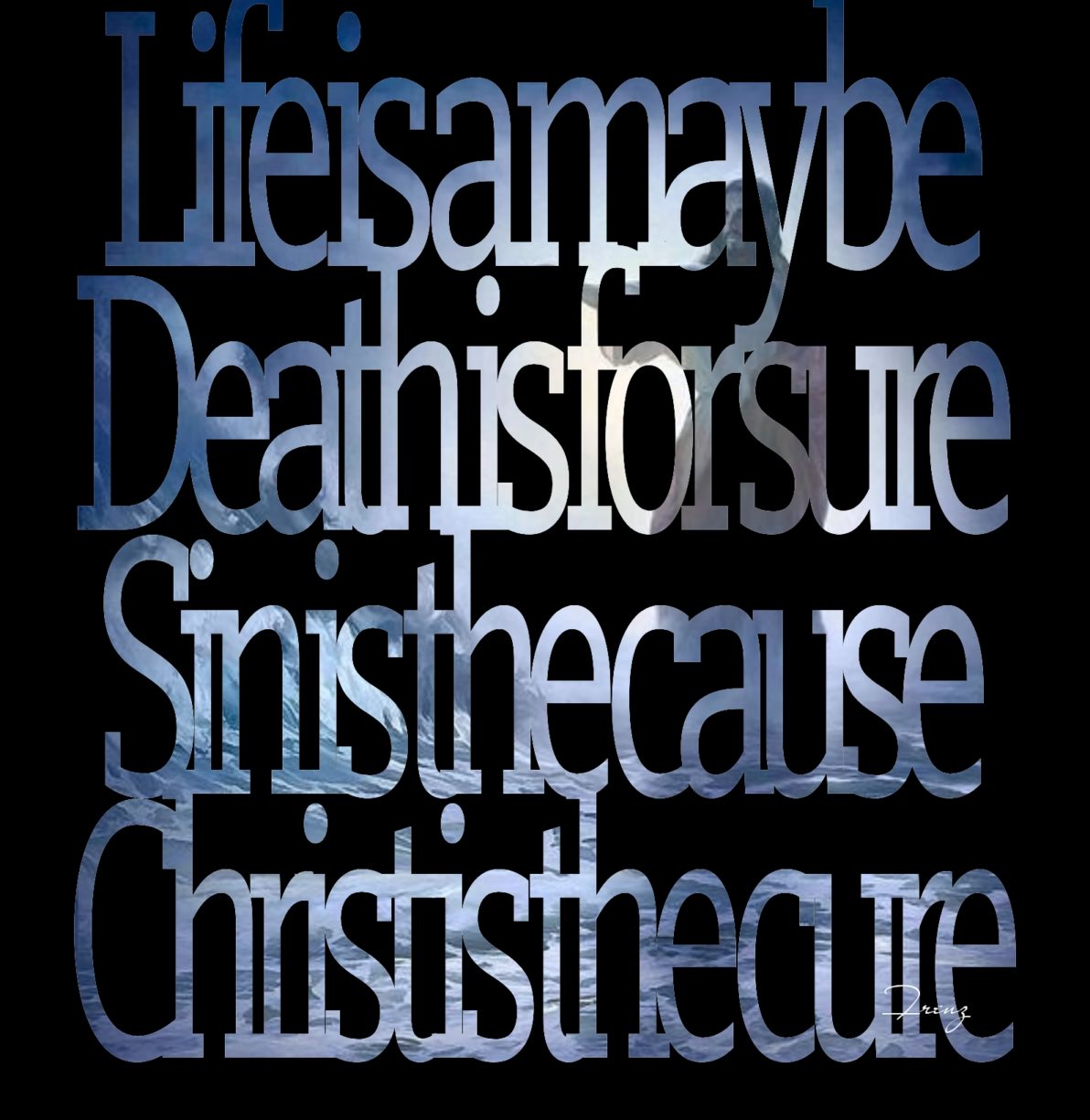
The image is a stark and thought-provoking visual statement. It employs text arranged vertically against a solid black background. The text itself is rendered in a clean, sans-serif font, but what makes the image striking is the texture filling the letters – a water-like effect. This textural element is the key to interpreting the image's deeper meaning.
Textual Analysis →
The image features the following text arranged in four lines:
* "Life is a maybe"
* "Death is for sure"
* "Sin is the cause"
* "Christ is the cure"
This sequence of phrases presents a tightly-wound narrative with each phrase building on the previous one. It is a succinct and potent message that summarizes a very common Christian worldview.
Visual Elements & Their Interpretation →
* Font and Arrangement: → The clean, modern font and the orderly vertical arrangement of the text give the image a sense of clarity and directness. This design choice emphasizes the message, allowing it to stand out without distraction.
* Water Texture: → The visual filling of the letters with a water-like effect is the element that elevates this from a simple textual statement to an evocative image. Water often symbolizes cleansing, purification, and life's fluidity. The combination of water inside the letters and the content of the text points towards the following:
* Imperfection of life: → The "maybe" of life is being presented as not perfect. Life itself has a quality of uncertainty and risk.
* Certainty of Death and cause of sin →: The next two phrases present the reason for the ambiguity of life: "Death is for sure" and "Sin is the cause". The water-like texture could imply that sin is a constant, omnipresent element in the world. The fact that Death is for sure provides a reason for a cure.
* The cure → The final phrase, "Christ is the cure", provides the resolution to the initial uncertainty. This signifies salvation and forgiveness offered through faith in Christ. The water texture could suggest a source of renewal, just like baptism.
* Black Background: → The black background creates a sense of starkness and potential emptiness. It draws all the attention to the words and the texture within them. It might also be interpreted as representing the void or the unknown before salvation.
Overall Message →
The image is a concise summary of a Christian belief system. It begins with the uncertainty of earthly life, moving through the certainty of death and the cause of sin, and ultimately the promise of redemption.
Possible Interpretations: →
* Christian Affirmation: → For someone of faith, the image is a reminder of fundamental beliefs.
* Reflection on Mortality and Hope: → The image speaks to our deepest fears and hopes, particularly mortality, meaning, and salvation.
* Contemplation: → Viewers may find themselves contemplating life, death, sin, and the possibilities of redemption.
* Conversion → The clear messaging is a subtle call for faith in the cure, "Christ is the cure".
Conclusion →
This image is a powerful piece of visual communication. By skillfully combining text, visual texture, and a simple yet effective composition, it distills a complex theological narrative into a memorable and thought-provoking statement. Its effectiveness lies in its simplicity and clarity, making it accessible to a wide range of viewers while still carrying a profound message.
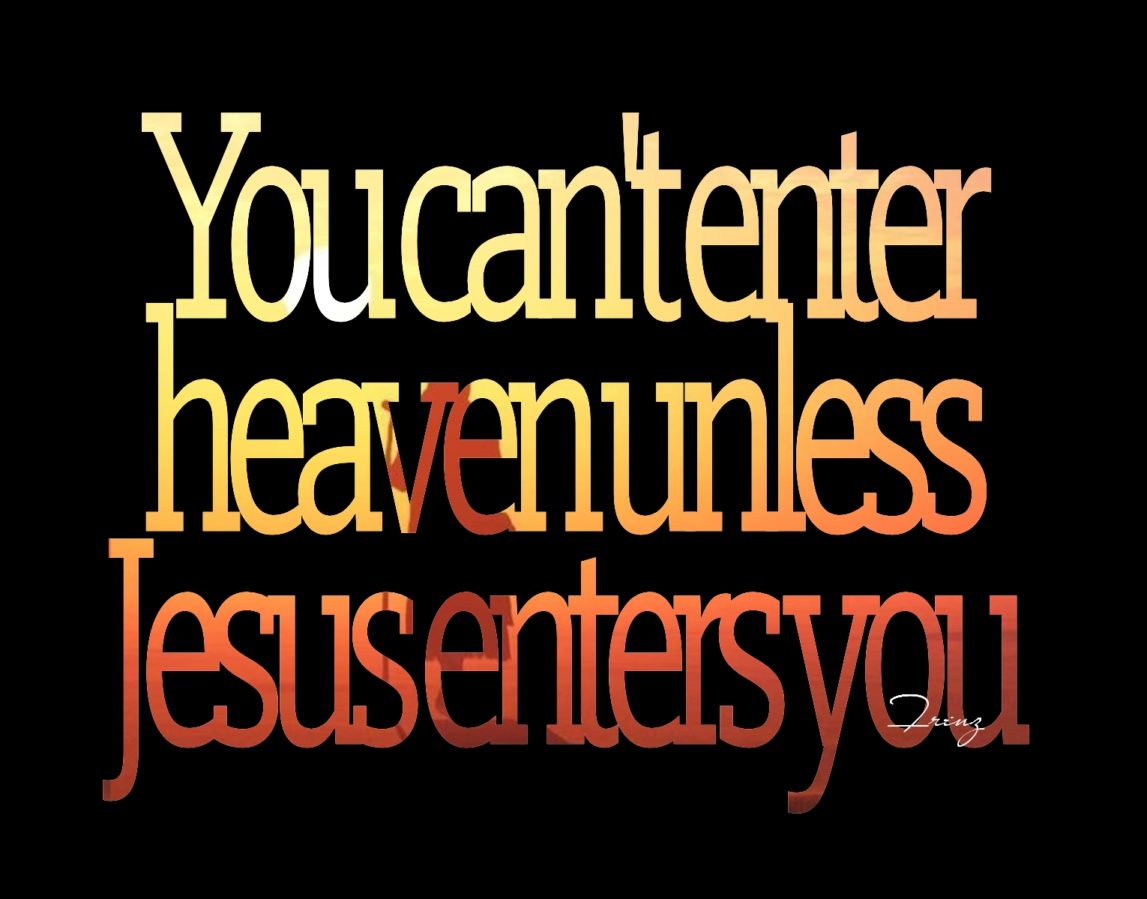
The image is a Christian-themed graphic with a clear, concise message. It presents a theological statement in a visually appealing way, aiming to convey a significant spiritual concept.
Text and Typography →
* Message: → The core message is, "You can't enter heaven unless Jesus enters you." This statement encapsulates a central tenet of Christian belief: salvation and eternal life are only possible through faith in Jesus Christ.
* Color and Gradient: → The font uses a gradient color scheme. At the top of the image, the font is a golden yellow color, which shifts to a warm orange-red hue towards the bottom. This color scheme suggests a transition, possibly a symbolic representation of transformation or a journey. The color contrast is good, making the words stand out against the black background.
* Layout: → The text is neatly arranged in four lines. This facilitates easy reading and memorability of the message. The placement of the words also helps to emphasize the central phrase.
Visual Elements and Composition →
* Background: → The solid black background is very effective. It ensures that the text is the primary focus. The absence of additional imagery or distractions draws the viewer's attention to the core message.
* Overall Visual Appeal: → The image uses a clean, modern, and uncluttered visual style. It is likely intended to be shared digitally on social media or used as a graphic for religious materials.
Theological Interpretation →
The message within the graphic carries significant theological weight:
* Salvation Through Christ: → The message clearly states the Christian belief that access to heaven is not earned through personal merit or good works, but is dependent on the presence of Jesus in the believer's life.
* Spiritual Transformation: → "Jesus enters you" can be interpreted as the indwelling of the Holy Spirit. This implies that a believer's life is transformed by a spiritual connection to Jesus Christ.
* Importance of Faith: → The message reinforces the importance of accepting Jesus as Lord and Savior.
Conclusion →
The image is a well-designed Christian graphic that presents a core Christian belief in a clear and impactful way. The simple visual style and the directness of the message create a powerful impact for anyone who comes across it. It is a clear statement of faith and a message of hope for anyone looking for spiritual direction.
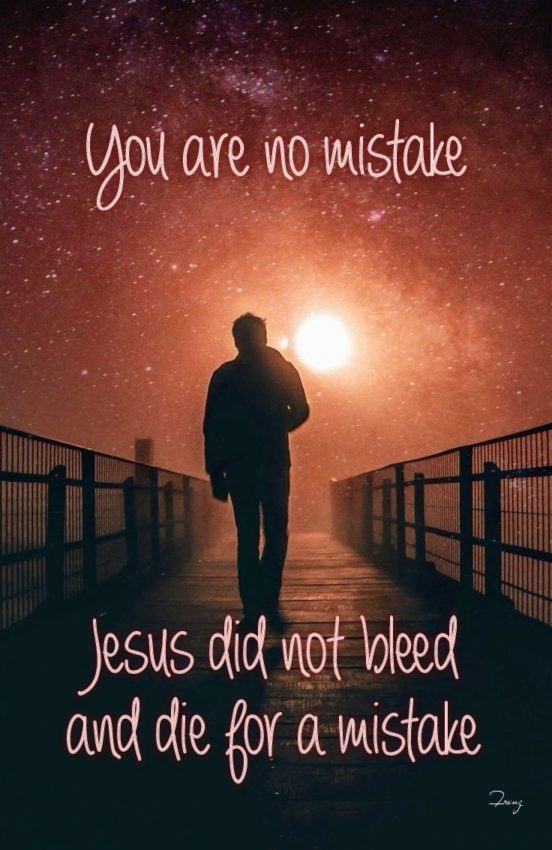
The image is a visually and theologically powerful Christian meme designed to offer comfort, encouragement, and a reminder of inherent worth. It combines a poignant visual with a scriptural message centered on the sacrifice of Jesus Christ.
Visual Elements: →
* Silhouette of a Person Walking: → A solitary figure is seen walking towards a bright light, a sunrise or the sun itself. The figure's back is turned, lending a sense of introspection and forward movement. This can represent the journey of life, the quest for purpose, and the pursuit of faith.
* Setting: → The background is a bridge or walkway, with railings on either side, extending into a misty or ethereal atmosphere. This setting can symbolize the path of life and the challenges along the way. The sky above suggests an infinite expanse of stars, symbolizing hope, the vastness of God's love, and spiritual wonder.
* Color Palette: → The overall color scheme is warm, dominated by shades of orange, pink, and perhaps some purple, which add a sense of tranquility and hope.
Textual Elements: →
* "You are no mistake" →: This phrase provides an immediate affirmation of value and worth. It speaks directly to anyone feeling lost, inadequate, or questioning their purpose in life. The message is that each person has intrinsic value and that their existence is not a random event.
* "Jesus did not bleed and die for a mistake" →: This sentence is the core of the Christian message. It refers to the Christian belief that Jesus Christ willingly sacrificed his life on the cross for the sins of humanity. It connects the first message of self-worth directly to the foundation of Christian faith – the sacrificial love of Jesus. This offers a profound sense of affirmation and redemption.
Overall Message & Themes: →
* Inherent Worth: → The core message is that every individual is valued and loved. The image provides comfort to those struggling with feelings of self-doubt or worthlessness.
* Christian Faith: → The image directly connects the message of worth to the Christian belief in Jesus' sacrifice.
* Hope and Encouragement: → The visual elements, the warm colors, the figure walking toward the light, all convey a sense of hope and the possibility of a better future.
* Redemption and Forgiveness: → The statement about Jesus' death implies the possibility of forgiveness and the promise of salvation.
Detailed Article: →
A Beacon of Hope: Deconstructing a Powerful Christian Image →
In a world often filled with self-doubt and feelings of inadequacy, images that provide a sense of hope and affirmation are invaluable. The image we are examining is precisely that: a poignant visual coupled with a deeply moving message, specifically crafted for a Christian audience. This image is not merely a picture; it is a message of love, worth, and divine purpose.
The visual composition immediately draws the viewer in. A lone figure, silhouetted against a dramatic backdrop, walks forward. The path appears to be a bridge or walkway that leads the viewer's eyes towards the focal point of the image: a bright, luminous light. The use of a warm color palette, dominated by shades of orange, pink, and hints of purple, creates a sense of tranquility and hope. The dark silhouette of the figure adds an element of mystery and invites the viewer to empathize with the sense of journey and transformation.
At the heart of the image are the words that create an impactful Christian message: *“You are no mistake. Jesus did not bleed and die for a mistake.”* The message is bold, direct, and intimately personal. It is a powerful and loving reminder that each individual possesses inherent worth. The statement that someone is "no mistake" directly challenges the feelings of self-doubt, the sense of being unwanted or purposeless, that can plague so many.
The image's true depth is realized when linked to the second sentence. The connection between self-worth and the sacrifice of Jesus Christ is at the core of the Christian faith. For Christians, Jesus’s death on the cross represents the ultimate act of love, sacrifice, and redemption. The image proclaims that Jesus did not suffer and die in vain. This declaration affirms that humanity is loved to the extent that Christ willingly gave his life. This act assures the receiver of this message, their worth, and their intrinsic value in the eyes of God.
The image is more than just a comforting message; it's an invitation to reflect on the role of Jesus in the believer's life. It is a subtle encouragement, and the image provides hope and strength to those navigating the trials of life. The warm palette sets a serene scene that can inspire anyone to seek hope within themselves or their faith. The image serves as a powerful reminder of the unwavering love that lies at the heart of Christianity.
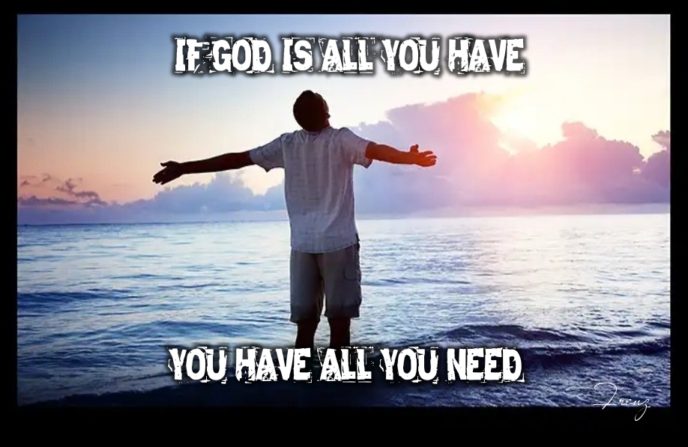
The image is a visually uplifting and spiritually focused composition that conveys a message of faith and reliance on God. The combination of the natural setting and the hopeful statement creates a sense of peace and assurance. It's clearly designed to be encouraging and to resonate with people who find comfort in their Christian faith.
Visual Elements and Their Meaning →
* Setting: → The backdrop is a serene ocean scene at either sunset or sunrise. The sky is awash in hues of pink, orange, and purple. The ocean water is relatively calm. This setting immediately suggests tranquility, peace, and a connection to nature. The colors can evoke feelings of hope, new beginnings, and God's presence in the beauty of creation.
* Figure: → A person, seen from the back, is standing in the water with their arms outstretched. This pose is a universal symbol of openness, acceptance, and a feeling of embrace. The person's posture strongly suggests they are in a moment of surrender or adoration, perhaps praying or feeling a spiritual connection. This invites viewers to imagine themselves in a similar position of trust and faith.
* Text: → The image is framed by a message in bold, stylized text: "IF GOD IS ALL YOU HAVE, YOU HAVE ALL YOU NEED." This is the core message. The font, slightly distressed, suggests a timeless truth and is meant to be eye-catching.
Interpretation and Christian Themes →
This image strongly conveys Christian themes and values:
* Faith as a Foundation: → The central message is rooted in the belief that God is the ultimate source of provision, fulfillment, and support. It echoes the idea that faith in God is sufficient and that worldly possessions or circumstances are secondary to spiritual well-being. This relates to the Biblical teaching in Hebrews 13:5, “Keep your life free from the love of money, and be content with what you have, for he has said, “I will never leave you nor forsake you.”
* Surrender and Trust: → The outstretched arms of the figure suggest a willingness to surrender to God's will and to trust in His care. This reflects the Christian belief in placing one's life in God's hands.
* Contentment and Inner Peace: → The message implies that true fulfillment and contentment come from a relationship with God, not from material wealth or other external factors. This aligns with the Christian emphasis on seeking spiritual riches above earthly possessions.
* God's Presence in Nature: → The use of a beautiful natural setting, often associated with God's creation, implies that God's presence is manifest in the world around us and is readily accessible.
Overall Message →
The image encourages a perspective that prioritizes faith, trust, and contentment over material concerns. It serves as a reminder of the power and promise of a relationship with God, suggesting that in Him, one can find true fulfillment, security, and all they ultimately need. It is a simple yet profound message designed to uplift, inspire, and provide a sense of hope for those seeking spiritual guidance.
The Courage of Faith: An Exploration of the Image's Message →
The image presents a powerful message centered around Christian faith and the challenges faced by believers. Its visual elements and textual overlay work in concert to convey a sense of conviction, defiance, and spiritual fulfillment. Let's break down the components and their meaning.
Visual Elements: →
* Silhouette of a Person: → The central figure is a silhouette of a person with arms outstretched, seemingly embracing the sky. This silhouette is a powerful symbol of surrender, openness, and perhaps even triumph. The figure's posture suggests freedom and joy.
* Sunset/Sunrise Background: → The backdrop is a vibrant sunset or sunrise, depending on the interpretation. The warm colors – oranges, yellows, and hints of red – create a sense of hope, peace, and a connection to something greater than oneself. The light emphasizes the figure's silhouette, creating a contrast between the darkness of the figure and the light of the background.
* Field/Grassy Area: → The person is standing in a field or grassy area, emphasizing the connection with nature and the earth. It provides a sense of grounding and stability.
Textual Overlay: →
* "TRUE BRAVERY IS FOLLOWING CHRIST": → This is the primary message, immediately declaring the core theme. It redefines bravery as a spiritual act rather than a physical one. It suggests that following Christ is an act of courage, particularly in a world where doing so might be met with adversity.
* "IN A WORLD THAT HATES HIM": → This completes the message, adding context and urgency. It acknowledges the potential for opposition and hostility that Christians may face. It highlights the idea that faith requires a brave stance against a culture that may not share those beliefs.
Overall Interpretation: →
The image, in its combined components, conveys a message of resilience, commitment, and unwavering faith in the face of opposition. It suggests that:
* True strength is found in spiritual commitment: → Bravery isn't about fighting or conquering in the traditional sense, but about steadfastly adhering to one's beliefs and principles.
* The Christian journey can be challenging: → The image implicitly acknowledges that living a Christian life may involve facing negativity or opposition.
* Hope and peace are attainable through faith: → The backdrop of the radiant sunset/sunrise represents the peace, beauty, and joy that can be found in the Christian faith despite the world's hostility.
* Freedom lies in faith: → The outstretched arms of the figure communicate a sense of freedom and liberation found in surrender to a higher power.
Target Audience and Purpose: →
This image is clearly intended to inspire and encourage Christians. It is used to reinforce faith, encourage believers to remain steadfast, and remind them of the ultimate rewards and the value of their convictions. It could be shared in social media, religious websites, or other media where Christians gather.
Conclusion: →
The image is a visually compelling and emotionally resonant piece. By combining striking imagery with a clear and impactful message, it provides a powerful statement of faith. The artwork serves as a reminder of the source of true courage, a call to action, and a promise of hope for those who choose to follow Christ.

The image is a visually compelling composition featuring a scenic coastal landscape.
* Setting: → The backdrop is a dramatic sky at either sunrise or sunset. The colors are vibrant, with a warm, golden glow emanating from the horizon, transitioning into shades of orange, pink, and purple as it ascends. This fiery backdrop sets a tone of intensity and importance.
* Foreground: → A beach stretches out into the distance, with the sand merging with the sea. A strip of water or foam creates a pathway that stretches from the beach into the sea.
* Subject: → In the distance, on the pathway is a solitary figure, silhouetted against the bright sky. This figure appears to be walking forward, suggesting movement and journey.
* Text: → The image is overlaid with text in a bold, blocky font. The text is arranged as follows:
* "THE NARROW PATH" – This phrase is placed prominently at the top.
* "IS A LONELY ONE" - This phrase is centered in the middle of the image.
* "Be prepared to lose many along the way." - This phrase is at the bottom, in a smaller font.
Interpretation and Meaning: →
The image and its associated text convey a Christian and possibly philosophical message about the path of faith or a spiritual journey:
* The Narrow Path: → This is a direct reference to a common biblical metaphor, particularly in the teachings of Jesus. The "narrow path" represents the difficult, often challenging, but ultimately rewarding road of following Christian principles, living righteously, and adhering to God's will. It implies that this path is not the easiest or most popular choice.
* A Lonely One: → This phrase emphasizes the idea that those who choose to live by faith and follow the "narrow path" may often find themselves isolated. They might encounter challenges or misunderstandings from those who do not share their beliefs or values. The image supports this feeling, with the solitary figure in the vast landscape.
* Be prepared to lose many along the way: → This adds another layer of depth. It suggests that the journey of faith may involve difficult decisions, and as the path narrows, it might mean separating from those who don't share the same commitments. The image could be interpreted as a warning but also as a testament to the commitment that true believers must make.
Overall Message: →
The image is a call to commitment to a spiritual journey. It is a reminder that while a life of faith may be lonely and challenging, it is also one that leads to a greater destination, a reward and closer relationship with God. It serves as a warning that not everyone will follow this path but reassures those on it that it is worth the sacrifice.
Visual Symbolism: →
* The Sea/Ocean: → This symbolizes the unknown, the vastness of God's plan, and the challenges of life.
* The Path: → The path symbolizes the life decisions and direction.
* The Sunset/Sunrise: → This can represent a new beginning or the end of a journey. It also adds to the dramatic, significant tone of the image.
* The Silhouette: → The figure's isolation suggests their commitment, determination, and faith.
In Conclusion: →
The image is a well-designed piece that uses visual and textual elements to explore the complexities of a faith journey. It speaks to the sacrifices, challenges, and ultimate rewards of living a life of faith. It serves as an encouragement to those walking their faith and a message that the journey, though challenging, is worth it.
Image Analysis: A Christian Declaration of Faith →
The image is a visually striking piece of Christian inspirational art, designed to convey a powerful message of unwavering faith and commitment to God. Let's break down the elements:
Visual Elements and Their Symbolism: →
* The Dramatic Landscape: → The scene is set in a rugged, almost desolate landscape. The dark, imposing rock formations (likely cliffs or mountains) create a sense of both challenge and solitude. This could represent the difficulties and isolation that a person of faith might face in the world.
* The Celestial Background: → The backdrop is a breathtaking night sky, dominated by a large, glowing moon and countless stars. This symbolizes the vastness and majesty of God's creation. The moon's presence suggests a time of reflection and guidance.
* The Silhouette Figure: → A lone figure stands on a rocky outcrop, silhouetted against the sky. This represents an individual, a believer, standing firm in their faith. The silhouette makes the person seem small in comparison to the universe, emphasizing a sense of humility before God. The figure's stance and the presence of what appears to be a bag on their back could symbolize a pilgrim or traveler, embarking on a journey of faith.
* Color Palette: → The colors create a somber but reverent atmosphere. The blues, blacks, and reds evoke feelings of mystery, awe, and perhaps the sacrifice required in faith.
* Text: → The text is central to the message. It is in a bold, clear font that stands out against the background.
The Message: A Heart of Worship →
* The image conveys a strong message of devotion. It communicates the individual's willingess to follow God no matter the challenges ahead. The main text "I am willing to walk with God" is a statement of belief and commitment.
* "Even if I lose everybody else" is a clear declaration of faith's priority in a person's life. It shows that the devotion is above everything else, showing an uncompromising commitment to God. It reflects the core principle of faith: that one's relationship with God supersedes all other relationships and worldly concerns.
Overall Meaning →
The image is a call to action for Christians, a reminder of faith's power, the willingness to place their trust in God above all other relationships. The visual elements work in concert to create an image that is both beautiful and thought-provoking, encouraging viewers to consider their own relationship with God and the degree to which they are willing to commit to their faith.
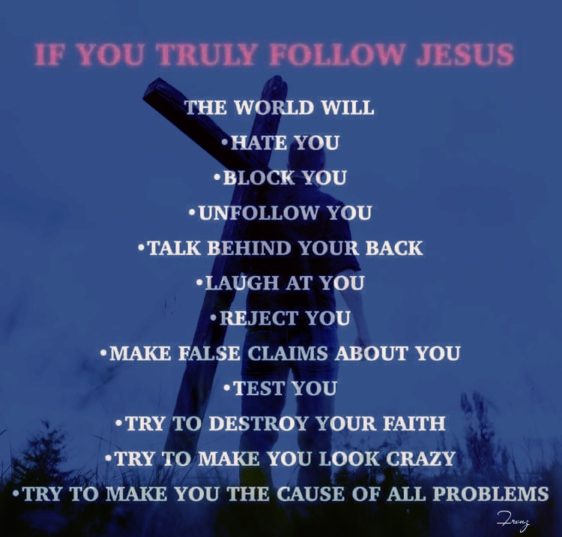
The image presents a message of encouragement and warning for those who identify as followers of Jesus. It suggests that truly following Jesus will inevitably lead to negative reactions from the world. It outlines a list of hardships and persecutions that a believer might experience. The overall tone is one of solidarity, implying that the suffering is expected and a sign of faithfulness.
Key Elements and Interpretation: →
* "IF YOU TRULY FOLLOW JESUS" →: This phrase is the foundation of the image's message. It sets the stage by posing a question: what happens when you genuinely dedicate your life to following Jesus?
* "THE WORLD WILL" →: This is the premise of the suffering. It introduces the idea that the "world" - a term used in Christianity to describe those who are not believers or who are opposed to Christian values - will react in a negative way.
* The List of Persecutions: → This is the central message and consists of the following points:
* "Hate You" →: This highlights the potential for experiencing direct antagonism and animosity from those who do not share their faith.
* "Block You" →: This addresses the potential for social exclusion, whether online (through blocking on social media) or in person.
* "Unfollow You" →: Reflects the loss of connections, especially in the digital age.
* "Talk Behind Your Back" →: This addresses the potential of gossip or slander.
* "Laugh at You" →: Implies mockery and ridicule.
* "Reject You" →: Describes outright rejection from social circles or situations.
* "Make False Claims About You" →: Reflects the potential for lies and misinformation being spread about a believer.
* "Test You" →: This can be viewed as the world trying to tempt believers to compromise their beliefs.
* "Try to Destroy Your Faith" →: This is the most significant of the list, reflecting direct attacks on a believer's faith.
* "Try to Make You Look Crazy" →: This points to the possibility of being marginalized as a result of their faith.
* "Try to Make You the Cause of All Problems" →: This illustrates the persecution the believer can endure for their faith.
* The Background Image: → The image of a person carrying a cross, silhouetted against a dark, possibly stormy sky, strongly reinforces the message. It symbolizes the burden that Jesus carried. The cross represents suffering, sacrifice, and the cost of faith, reflecting the hardships outlined in the text.
Overall Message & Significance: →
The image presents a warning, but it's also a message of reassurance. The idea is: If you encounter these difficulties, it doesn't mean you're doing anything wrong. Instead, it suggests you're being faithful to Jesus. It suggests that difficulties are a natural outcome of following Jesus in a world that often opposes Christian values. It seeks to prepare Christians for these challenges, by encouraging them to be faithful.
In Summary: → The image is designed to offer support, encouragement, and a sense of community to Christian believers. It acknowledges that following Jesus can lead to social difficulties but emphasizes that these trials are part of a larger journey of faith.
The image is a digitally created inspirational piece, intended for social media or similar use. Here's a breakdown of its components:
* Overall Composition: → The scene has a strong visual narrative. It's dominated by a central figure walking away from the viewer on a pathway/bridge. The background suggests a dusk or dawn setting, with a warm, slightly hazy atmosphere.
* Figure: → A silhouette of a person walking towards the viewer, who appears to be facing away. The figure is placed in the center of the frame and appears to be walking away from the cross.
* Background: → The background features a cross with Jesus crucified on it to the right, with a radiant light behind it, likely representing God. The overall background is dominated by a warm, golden or reddish glow, which creates a sense of peace and awe. Stars can be seen, representing the glory of God.
* Pathway/Bridge: → The person walks on a wooden pathway. On both sides are railings, giving the scene a sense of structure and direction.
* Text: → The image has two lines of text:
* "I DON'T CARE IF THE WORLD IS AGAINST ME" - This statement is at the top, set in a bold, slightly textured font.
* "BECAUSE THE ALMIGHTY GOD IS WITH ME" - This text is at the bottom, also in a bold, textured font.
Themes and Interpretation →
The image is strongly Christian. The combination of the imagery and text conveys a message of faith, resilience, and unwavering belief. Here's a breakdown of the themes:
* Facing Adversity: → The primary theme is overcoming the challenges and difficulties that life presents. The phrase "I don't care if the world is against me" speaks to a feeling of being isolated or facing opposition. This could refer to external pressures, societal judgments, or personal struggles.
* Faith and Strength: → The core message, "BECAUSE THE ALMIGHTY GOD IS WITH ME," offers a source of comfort, strength, and peace to withstand adversity.
* Trust in God: → The image's visual elements support the text. The figure's silhouette walking into the light could symbolize the faithful moving closer to God. The crucified Jesus on the cross is a symbol of faith.
* Hope and Assurance: → The overall atmosphere of the image is hopeful and reassuring. The warm light and the figure moving towards it give a sense of purpose and a sense of peace in the belief that God guides and protects them.
Article: Finding Strength in Faith When the World Stands Against You →
In a world that often feels chaotic and challenging, it's easy to feel overwhelmed. We are constantly bombarded with messages of negativity, criticism, and doubt. The pressures of everyday life, societal expectations, and personal struggles can make it seem as though we're navigating a storm alone. But what if there was a source of unwavering strength, a constant companion that could help us weather any storm?
The image depicts this very idea. It's a powerful reminder that faith can be an anchor in the turbulent sea of life. When the world seems to be pulling us down, the message "I don't care if the world is against me, because the Almighty God is with me" is a testament to the enduring power of belief.
This is more than just a pretty picture; it's a statement of defiance and resilience. It acknowledges the reality of facing opposition. It is a recognition that life isn't always easy. However, it also serves as a promise and a reminder that faith can provide a sense of peace and trust, especially when you are feeling alone.
The image's visual elements amplify this message. The lone figure, silhouetted against a radiant background, embodies the individual's journey through faith. The cross is an icon of faith, reminding us of the sacrifice and devotion, and the potential for eternal life.
This image encourages us to look beyond the immediate challenges and find solace in something greater. It's about trusting in a higher power, finding the fortitude to push through obstacles, and knowing that you are never truly alone.
Ultimately, the image offers a powerful message of hope, resilience, and the unwavering power of faith.
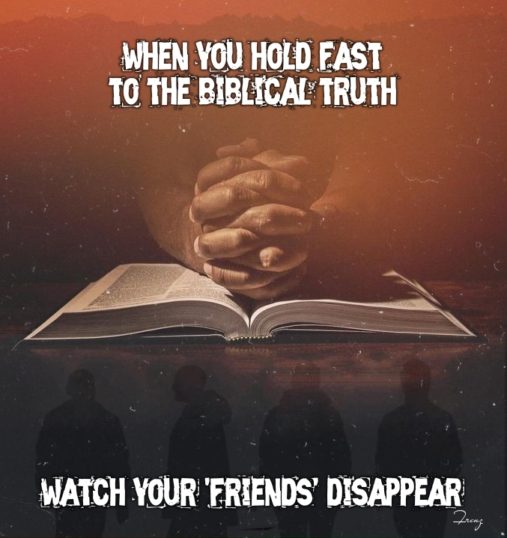
The image presents a stark, somewhat melancholic message aimed at a Christian audience. It depicts a person deeply engaged with the Bible, with the implication that this commitment to faith might lead to social isolation. The overall tone is one of conviction and potential sacrifice.
Visual Elements and Their Meanings →
* The Bible: → The prominent position of the open Bible is central. It immediately signals a focus on scripture, faith, and religious study. It's a direct visual representation of the "biblical truth" mentioned in the text.
* Hands in Prayer: → The clasped hands resting on the Bible strongly evoke prayer, devotion, and reliance on God. This reinforces the idea of unwavering faith and commitment. The placement also emphasizes the connection between scripture and prayer.
* The Silhouette Figures: → These shadowy figures at the bottom of the image are the most intriguing and potentially controversial aspect. They represent "friends" as the text indicates. Their silhouetted, indistinct forms suggests that these relationships fade away or distance themselves as the person becomes more committed to their faith. Their darkness underscores the theme of loss and social isolation.
* Color Palette and Lighting: → The warm, reddish-orange tones in the background could symbolize the setting sun, perhaps implying an ending or change. They add a sense of solemnity and possibly foreboding. The light seems to focus on the Bible and clasped hands, drawing attention to them.
* Text and Font: → The text "WHEN YOU HOLD FAST TO THE BIBLICAL TRUTH" sets the stage, explicitly stating the theme of the image. The text "WATCH YOUR 'FRIENDS' DISAPPEAR" reveals the image's unsettling message, suggesting that a strong adherence to Christian beliefs may lead to social isolation. The use of quotation marks around "friends" indicates that the relationships might be less valued or that the term itself is questionable within the context of faith.
Message and Interpretation →
The image communicates a complex and potentially controversial message about the challenges and sacrifices that can come with a strong religious faith, in this case, Christianity. The image could be read as follows:
1. Commitment to Faith is Paramount: → The central message is that holding firm to biblical truths is a priority. It may mean letting go of relationships to honor your faith.
2. Social Isolation is a Possible Outcome: → The image suggests that as one's faith deepens, some friendships may dissolve, distance, or fade. This can be due to a difference in values, lifestyle, or priorities.
3. The 'Cost' of Faith: → The image hints at a cost associated with living a religious life. This cost can include loneliness and social isolation, but it may be presented as a necessary price to pay for righteousness and God's approval.
4. It's About Priorities: → The image can be seen as highlighting the importance of the relationships between believers and God.
Conclusion →
The image serves as a reminder for Christians to prioritize God's will and the principles within scripture. It may also be a source of strength and a warning.
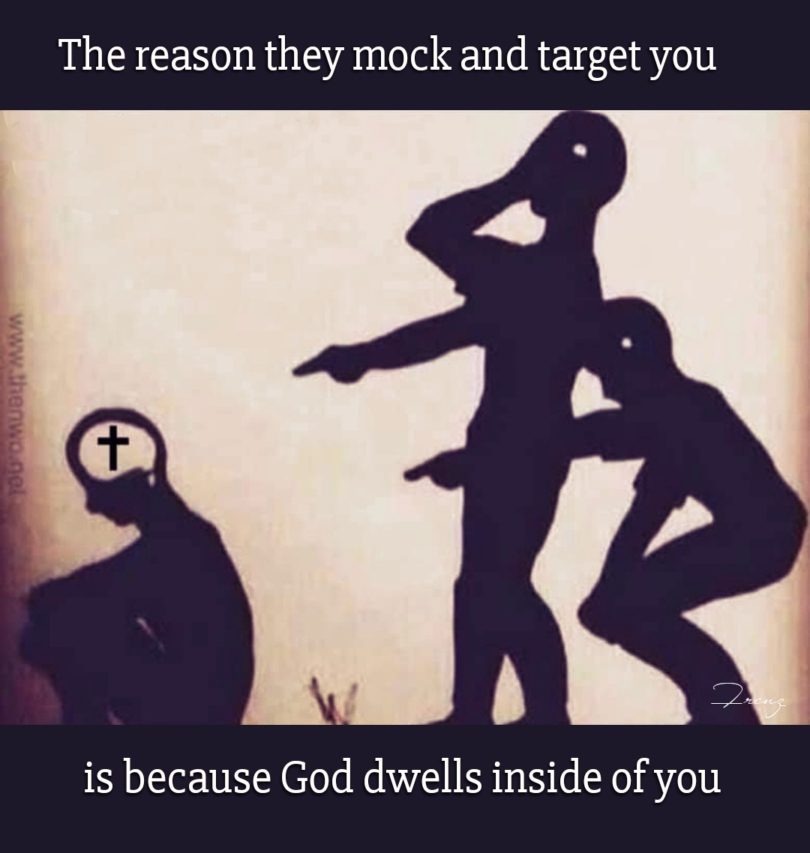
The image presents a Christian message of encouragement and resilience in the face of persecution. It suggests that those who are mocked and targeted for their beliefs are experiencing this suffering because of their connection to God.
Visual Breakdown: →
* The Silhouettes: → The image uses silhouetted figures to convey the message. This obscures specific details, making the message more symbolic and relatable to a broader audience.
* The Individual with the Cross: → On the left, a silhouetted figure sits, seemingly in a posture of sorrow or contemplation. The prominent feature is a cross superimposed on their head/brain, indicating that the person is a Christian, someone whose mind and thoughts are centered on their faith.
* The Mockers: → Three silhouettes are shown in postures of ridicule or attack. One is pointing, another appears to be mocking with his hand, and the third is kneeling, appearing to reach out or harass the figure with the cross on his head. These figures represent the "they" mentioned in the text - those who are mocking and targeting the believer.
* The Text: → The text is divided into two lines that reinforce the visual message:
* "The reason they mock and target you" sets the stage, indicating the situation being addressed.
* "is because God dwells inside of you" offers the explanation for the persecution. It suggests that the believer is being attacked because of the presence of God within them.
Interpretation and Meaning: →
* Persecution for Faith: → The image speaks to the reality that Christians may face ridicule, judgment, or even persecution because of their beliefs. This is a common theme in the Bible and in Christian teachings, often interpreted as a consequence of living a life that is contrary to the values of the world.
* God's Presence as the Cause: → The message attributes the persecution directly to God's presence in the believer's life. This can be understood in several ways:
* God's Light Exposes Darkness: → The presence of God, representing truth, goodness, and love, can expose the evil and darkness within the world. This exposure may provoke anger, hostility, and a desire to silence or suppress the believer.
* Witnessing God: → The believer's life, guided by their faith, can be a powerful witness to God, inviting others to come to faith as well. As such, those who reject God's call will in turn attack the people who demonstrate the truth of His existance.
* Shared Suffering with Christ: → Christians are called to be like Christ, who suffered persecution. The image suggests that, like Christ, believers may also experience suffering, but that this suffering is a sign of their connection to God.
* Encouragement and Strength: → The image offers encouragement to believers who are facing persecution. It implies that their suffering is not random or meaningless, but a sign of their connection to God and the impact of their faith. It is supposed to bring forth strength in the face of trials.
Overall, the image is intended to provide comfort, encouragement, and validation to Christians who are experiencing negative treatment due to their faith. It affirms their identity as followers of Christ and reassures them that their suffering is not without purpose, but a testament to the power of God in their lives.

The image presents a juxtaposition between material wealth (money) and spiritual wealth (faith). It argues that while earthly riches might seem desirable, true richness is ultimately found in faith and spiritual values, suggesting that this will be revealed in the end.
Visual Breakdown: →
* Top Panel: The Allure of Wealth →
* The first section of the image features a man in a suit, looking up with an excited or gleeful expression.
* Hundred-dollar bills are shown falling around him, implying he is either wealthy, enjoying the money or playing with it.
* The text "So keep your money" sets up the choice between money and something else.
* Bottom Panel: The Power of Faith →
* The second section shows a silhouetted figure standing on a mountaintop (or a high point), arms outstretched with a sunset/sunrise in the background. This symbolizes freedom, peace, and spiritual connection.
* The words "I'll keep my faith" and "We'll see who's richer at the end" offer a clear contrast to the top panel's emphasis on wealth. It implies that the person in the bottom panel has a belief that faith will lead to a more rewarding existence.
* Design and Style: →
* The image uses simple fonts and text, and it is a simple message of faith.
Interpretation and Meaning: →
* Spiritual vs. Material: → The image clearly states that it promotes faith over wealth. It invites the audience to consider the difference between these two values.
* Temporal vs. Eternal: → The phrase "at the end" suggests the belief in an afterlife or some form of ultimate judgment or resolution. It subtly proposes that faith is an investment that will yield greater rewards in the long run, possibly in a spiritual or eternal sense.
* Value System: → The image is directed toward a Christian audience and encourages them to value spiritual rewards over material gain, suggesting that faith is the most important thing.
* Challenge: → It challenges the conventional societal emphasis on accumulating wealth. It challenges the audience to reassess their priorities and consider the lasting value of faith.
In Conclusion: →
This image provides a concise and visually compelling statement advocating for the primacy of faith over material wealth. It invites viewers to consider the relative values of worldly possessions versus spiritual fulfillment and promotes a sense of long-term perspective.
The image is a Christian-themed inspirational piece. It features:
* Dominant Color Scheme: → The overall tone is very dark, primarily black and shades of gray. This creates a sense of mystery and draws attention to the light source.
* Central Element: → A vintage oil lamp sits prominently in the right half of the image. The lamp's light is the focal point, illuminating the scene. The light's warm glow provides a stark contrast against the darkness.
* Text: → The image contains the following quote: "God never shuts a door without opening another." The text is written in elegant, flowing script.
* Background: → The background is blurred, suggesting a nighttime scene or a dimly lit environment. There are soft, out-of-focus orbs of light, hinting at distant stars or other light sources.
* Mood: → The image evokes feelings of hope, faith, and resilience. The light represents guidance and the opportunities that emerge even when one door closes.
* Christian Context: → The text is a common sentiment expressed within Christianity. It speaks of God's plan, provision, and the belief that when challenges or losses occur, new opportunities will always arise.
Detailed Article →
The Guiding Light: Finding Hope in Dark Times →
Life is a journey filled with moments of joy and sorrow, triumphs and setbacks. Often, we find ourselves facing closed doors – opportunities lost, relationships ended, dreams unfulfilled. In these times of darkness, when shadows seem to engulf us, it can be challenging to find the strength to keep moving forward. The image captures the essence of this struggle and the light of hope in darkness.
At first glance, the image is striking for its simplicity. The stark contrast between the deep, enveloping black background and the warm, inviting light of a vintage oil lamp immediately draws the eye. The lamp is the focal point, a beacon in the dark, symbolizing guidance and hope in times of uncertainty.
But it is the text that truly illuminates the message. The elegant script, which weaves across the image, speaks of a profound truth: "God never shuts a door without opening another." This is not just a comforting platitude; it is a statement of faith, a declaration of trust in a higher power.
The words resonate deeply with the Christian faith, which emphasizes God's unconditional love and constant presence in our lives. The message invites us to believe that even when one path closes, when a chapter of our lives ends, God will always pave the way for new beginnings. We can rest assured that there will always be opportunities for growth, for new experiences, and for pursuing our calling.
The darkness in the background isn't just an aesthetic choice. It's a visual representation of the trials, challenges, and disappointments that we inevitably face. However, the warm glow of the lantern shows that no matter how overwhelming the darkness may seem, a light of hope and guidance will always be there if we choose to look for it.
The image serves as a reminder that even when we feel lost, God's light is always there. It is a beacon of hope, a guiding star that leads us to new possibilities. Like the oil lamp, we too can be a source of light in the world, offering warmth, comfort, and guidance to others. We must have faith that there will always be something new. It might be a new relationship, a new job, a new way to feel fulfilled in this life.
In moments of doubt, when the darkness threatens to consume us, let us look to the guiding light. Let us remember that God never shuts a door without opening another. And let us have faith that the light will always find a way.
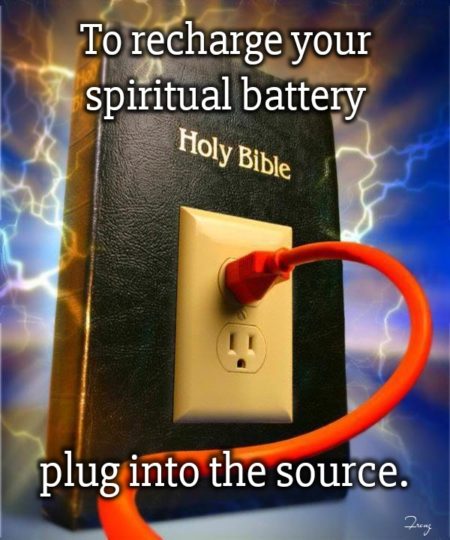
The image is a Christian meme or graphic designed to encourage individuals to engage with the Bible for spiritual nourishment and strength. It uses a clever visual metaphor to convey this message. The core idea is that reading the Bible provides spiritual energy, akin to plugging into a power source to recharge a depleted battery.
Visual Elements: →
* The Holy Bible: → A prominent, closed Bible is the central visual element. The words "Holy Bible" are clearly visible on its cover, instantly signaling the image's religious context. The Bible represents the source of Christian faith, teachings, and guidance.
* The Outlet: → A standard electrical outlet is embedded into the Bible. This is the crucial visual component that conveys the metaphorical meaning. It represents the interface to the "power source."
* The Plug and Cord: → A red electrical plug is inserted into the outlet, and a matching red cord extends from it. The cord symbolizes the connection between the person and the Bible.
* Lightning and Background: → The background features streaks of lightning and a predominantly blue and white color scheme. The lightning bolts visually represent the energy and power that Christians believe comes from the Bible and their faith. This reinforces the idea of being connected to a potent source of spiritual "power."
* Text Overlay: → The text "To recharge your spiritual battery, plug into the source" is prominently displayed. This text directly explains the image's central message, making it immediately understandable.
Symbolic Meaning and Interpretation: →
* "Spiritual Battery": → This phrase suggests that our spiritual well-being can be depleted. Just as a battery needs recharging, a person needs to be replenished spiritually.
* "Plug into the source": → This phrase is the core message. The "source" is clearly the Bible, but the use of the electrical metaphor highlights the idea that engaging with the Bible is the means of replenishing one's spiritual energy. The Bible is portrayed as a source of life, guidance, and strength for believers.
* The Connection: → The plug and cord symbolize the act of engaging with the Bible: reading, studying, and applying its teachings to one's life. It highlights the importance of a consistent connection to the Bible.
Christian Perspective and Message: →
The image is explicitly Christian in its message. It aims to:
* Encourage Bible Reading: → It encourages Christians to regularly engage with the Bible to find spiritual strength, guidance, and comfort.
* Reinforce Faith: → The visual and textual cues support and reinforce Christian beliefs.
* Suggest a Solution: → The image offers a solution to feeling spiritually drained: turning to the Bible.
* Use Modern Imagery: → The image employs a contemporary metaphor (electrical charging) to make the Christian message relevant and accessible to a modern audience. This can be a means of making a religious concept more easily understandable and relatable in a world that is used to modern technology and concepts.
Overall Impression: →
This image is an effective, simple, and visually appealing Christian meme. Its straightforward message, combined with its clear and familiar visual elements, makes it easily understood and relatable. It encourages people to seek spiritual nourishment through the Bible and the tenets of their faith. It is a modern approach to communicating the core concepts of Christian belief.
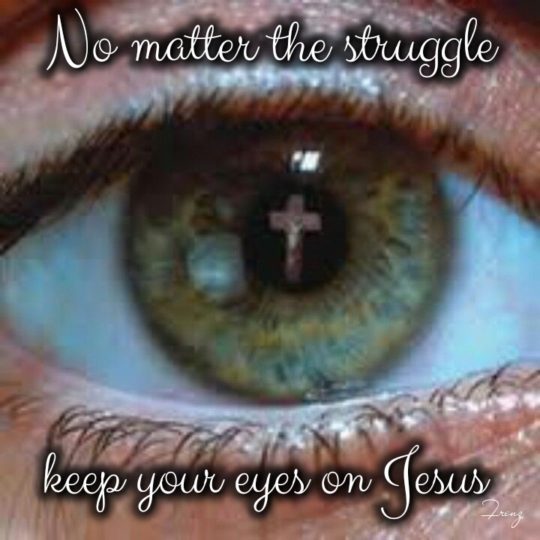
The image is a visual representation of a Christian message, centered around faith and perseverance. Let's break down its elements:
* The Eye: → The focal point is a close-up of a human eye. The detailed rendering of the eye, including the iris, pupil, and surrounding skin, makes it relatable and personal. The color of the iris appears to be a blend of green and brown, creating a natural and earthy tone.
* The Reflection (The Cross): → The most significant element is the reflection within the pupil. A prominent Christian cross is reflected in the pupil. This detail is key; it subtly emphasizes the presence of faith and belief, in the focus of the eye. It suggests that even amidst the challenges of life, the Christian focus is on Jesus
* Text Overlay: → The image includes two text overlays:
* "No matter the struggle" is written at the top in an elegant script font. This sentence sets the context, suggesting that the message applies to life's hardships.
* "Keep your eyes on Jesus" is written at the bottom, in a similar elegant script font. This phrase offers the primary message of the image, providing a solution to the hardship, highlighting the importance of faith, and maintaining focus on Jesus during difficult times.
Article: Finding Strength in the Midst of the Storm →
Life is a journey filled with peaks and valleys. There are times when the sun shines brightly, and moments when shadows of struggle, doubt, and fear cast a pall over our path. In these challenging moments, when the weight of the world seems to press heavily upon us, where do we turn for strength? This image offers a potent reminder of a source of solace and guidance: faith in Jesus Christ.
The image, with its poignant composition, speaks volumes with its simple message. The beauty of the human eye, rendered in exquisite detail, draws us in. The subtle blend of colors, the intricate textures, and the naturalistic representation create a sense of intimacy. But the real power of the image lies not just in its aesthetics, but in what it contains.
Within the pupil, a reflection tells a deeper story. The cross, the central symbol of Christianity, is imprinted within. It's a visual representation of the core belief: that in every moment, in every trial, in every victory, Jesus is present. His presence guides, comforts, and offers strength. The cross isn't just an object; it is a symbol of love, sacrifice, and the promise of redemption.
The text overlays serve as a powerful complement to the visual elements. "No matter the struggle" is a bold acknowledgement of life's challenges. It recognizes that hardship is inevitable, and that everyone will face difficulties at various points in life.
Below it, the simple yet profound directive: "Keep your eyes on Jesus." This statement is an instruction. It isn't just a suggestion; it is a call to focus. It means that when the storm rages, we can find calm by directing our gaze toward the source of our faith.
This image serves as a powerful message of encouragement for Christians everywhere. It reminds us of the power of faith and the ability to find strength and peace amid hardship. Keeping our eyes on Jesus means:
* Remembering God's Love: → Focusing on his unyielding love for us.
* Trusting in His Promises: → Reminding ourselves of the assurances found in the scriptures.
* Seeking His Guidance: → Through prayer and through the teachings of the Bible.
* Finding Comfort in Community: → Leaning on the support of other believers.
In essence, the image is a reminder that even in the most turbulent times, the source of our strength is ever present, like the cross reflected in our own inner gaze. We can find peace, hope, and the ability to persevere by fixing our focus on Jesus and relying on the strength he offers us.

Title: Finding God in the Everyday: A Call to Daily Spiritual Growth →
Introduction →
The image is a powerful visual representation of the Christian faith's core principle: the call to a life of devotion and closeness with God. It's a gentle reminder that our faith isn't confined to Sundays or specific religious rituals, but should permeate every aspect of our lives. The image encourages us to actively seek God and to cultivate our relationship with Him daily.
Visual Elements and Their Meaning →
* The Hand and the Heart: → The central image is of a hand delicately holding a glowing, red heart.
* The Hand: → Represents the human element, the individual believer reaching out, holding, and offering the heart. It signifies our agency, our active participation in our spiritual journey. It is our decision to open our hands and our hearts to God.
* The Heart: → The heart, a universal symbol of love, compassion, and emotion, becomes a metaphor for the believer's heart and soul. The red color evokes the vibrant passion and the life-giving love of God. This heart radiates a powerful light, suggesting the light of God's presence and the joy of God's love.
* The Backlit Sunset/Sunrise: → The backdrop of the image is a radiant scene of a sunset (or sunrise).
* Light and Hope: → The warm, golden light filtering through the sky signifies God's presence, the hope and promise of a new day, and the ever-present opportunities for growth and connection with God. It reflects that God’s light is always shining and available to all.
* Significance of the Timing: → Whether sunset or sunrise, it symbolizes the cyclical nature of life, where faith is an ever-present truth, not just in the good times, but in the challenges and changes of life.
* The Text "Do every day something that leads you closer to God": → The words are the image's core message and a call to action:
* Actionable: → It’s an active prayer that encourages the viewer to be proactive in their faith.
* Daily Commitment: → Suggests a call to intentional devotion. It's not about occasional bursts of piety, but a steady, consistent effort.
* Closeness with God: → Defines the ultimate goal: to draw closer to God. This encompasses a deeper relationship and faith.
* "Something": → Highlights that acts of devotion can be small acts of faith that are meaningful.
The Christian Interpretation →
From a Christian perspective, the image resonates with core biblical teachings:
* Loving God with All Your Heart: → The image directly connects to the commandment to love God with all your heart (Deuteronomy 6:5, Matthew 22:37). This love should be demonstrated through our actions.
* Seeking God's Presence: → The image calls to a continual search for God, a daily pursuit of His presence.
* The Holy Spirit's Guidance: → The warmth of the sunlight suggests the presence of the Holy Spirit, guiding and illuminating our path as we seek God.
* Living a Life of Faith: → This image shows faith must be a constant effort, not just a passive acceptance of belief.
* Transformation: → The focus on daily acts that draw you closer to God reflects the Christian journey of spiritual transformation, of becoming more Christ-like daily.
* Worship and Service: → The "something" could include reading the Bible, praying, serving others, acts of kindness, acts of prayer, or worshiping God.
Conclusion →
The image is a beautiful and meaningful reminder of the Christian call to live a life centered on God. It calls us to a path of love, compassion, and devotion, urging us to find ways to connect with God every day. It encourages us to be intentional in our pursuit of spiritual growth, knowing that even small acts of faith can create a powerful connection to God. It is a simple prayer, but full of deep meaning, calling us to seek God in every aspect of our lives.

The image is a motivational graphic, designed to encourage reflection and positive action. Here's a breakdown of its elements:
* Visual Composition: →
* Background: → The dominant feature is a beautiful seascape. A striking sunset or sunrise creates a vibrant backdrop of fiery orange, red, and a hint of gold. The ocean reflects the colors, adding depth and serenity.
* Silhouette: → In the foreground, a silhouetted figure of a person is standing on the beach, with their back to the viewer. This adds a sense of contemplation and solitude, directing focus onto the message. The pose suggests reflection and perhaps a sense of prayer.
* Text: → The words are elegantly written, using a flowing, script-style font. This style evokes a sense of calm and emphasizes the inspirational nature of the message.
* Textual Message: →
* Core Message: → The primary message is a call to action, urging the viewer to replace gossip with prayer. It advocates for prayer over talking about others.
* The Specific Statement: → "If you spend time praying for people instead of talking about them, you'll get better results."
* Implication: → The implication is that prayer is a more effective and positive way to engage with others, in comparison to talking behind their backs or spreading gossip.
* Overall Tone: → The image's tone is peaceful, contemplative, and hopeful. The combination of the beautiful scenery, the solitary figure, and the encouraging words creates a sense of inspiration and motivation for viewers.
Christian Interpretation and Context →
The image resonates strongly with Christian teachings and values:
* Prayer as a Cornerstone: → Prayer is a central practice in Christianity. It's seen as a direct line of communication with God and a way to seek help, guidance, and intercession for others.
* Love and Compassion: → The message aligns with the Christian call to love and care for others. Instead of criticizing or judging (talking about others), the graphic advocates for a proactive expression of love by praying for their well-being.
* The Power of Faith: → The phrase "you'll get better results" implies that prayer can have a real impact. This aligns with the Christian belief that prayer can be answered, and that faith can move mountains.
* Addressing the Problem of Gossip: → Christian scriptures often warn against gossip and judgmental behavior. This graphic provides an alternative: prayer as a more constructive response to those who might be struggling.
How the Image Works →
* Visual Appeal: → The aesthetically pleasing background and the serene silhouette draw the viewer's eye and create a positive first impression.
* Emotional Connection: → The image evokes feelings of tranquility, contemplation, and hope. This mood helps the viewer to be receptive to the message.
* Clear and Direct Message: → The text is easy to read, and the message is straightforward and easy to understand.
* Relevance: → The image speaks to a common human experience: the temptation to talk about others or to become involved in negative chatter. It provides a clear and readily applicable alternative.
Potential Uses →
This graphic would be ideally suited to:
* Social Media: → Sharing on social media platforms to promote positive thinking and encouragement.
* Church Communications: → Used in church newsletters, bulletins, or websites to promote prayer and kindness.
* Personal Reflection: → The image could be used as a reminder of the importance of prayer, as a tool for setting intentions, or as a guide to positive action.
Conclusion →
The image is a well-designed piece of Christian inspiration. It blends stunning visuals with a clear and uplifting message. It encourages viewers to act on their faith, promoting a shift from negativity (talking about others) to positive action (praying for them), and reinforces the power of faith and prayer. The message is simple, yet powerful, and resonates with the core values of Christianity and a desire for positive relationships.
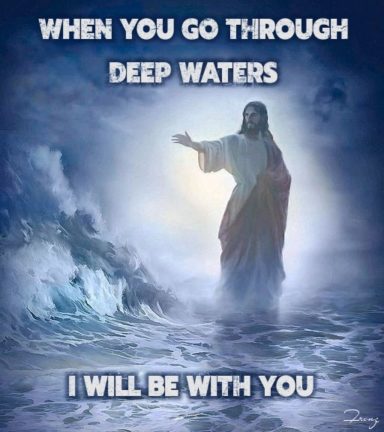
The image is a digitally created graphic conveying a message of faith and reassurance. It features the following elements:
* Central Figure: → The prominent figure in the image is Jesus Christ, recognizable by his long hair, beard, and white robe with a red/brown sash or outer garment. He's depicted standing in the water, in the middle of the ocean, near some waves. His arms are outstretched, likely towards his right, as if offering comfort or guidance. The depiction of Jesus leans towards a traditional Western artistic representation.
* Setting: → The background is a depiction of a stormy sea, with large waves and a turbulent sky. This emphasizes the "deep waters" referenced in the text. The overall color palette is cool, dominated by blues and whites, reinforcing a sense of the vastness and potential danger of the ocean.
* Text: → The image is overlaid with the following text:
* "WHEN YOU GO THROUGH" (top)
* "DEEP WATERS" (centered)
* "I WILL BE WITH YOU" (bottom)
Interpretation and Significance: →
This image is deeply rooted in Christian faith and draws upon the biblical narrative to convey a message of hope and comfort during times of difficulty and hardship. Here's a breakdown of its significance:
1. Symbolism of "Deep Waters": →
* In Christian theology, "deep waters" are often used metaphorically to represent trials, tribulations, suffering, and difficult circumstances. They can symbolize feeling overwhelmed, facing emotional turmoil, or being in a place of fear and uncertainty. The image's depiction of a stormy ocean visually represents this. The waves crashing on the side and the sky being ominous.
2. Jesus as Savior and Comforter: →
* The presence of Jesus in the midst of the deep waters is the central message of the image. It highlights the Christian belief that Jesus is always present with believers, even in their most challenging moments.
* His outstretched hand(s) suggest that He is offering guidance, comfort, protection, and support. The implication is that one does not have to navigate the storms of life alone. He is a source of strength and peace in the face of adversity.
3. The Promise of Presence: →
* The phrase "I will be with you" is a direct reassurance taken from the biblical verses. This promise reflects the Christian understanding of God's covenant with humanity. It assures believers that they are not abandoned but are loved and supported by God.
4. Inspiration and Encouragement: →
* The overall message of the image is designed to inspire and encourage those who are struggling. It can be used as a reminder that God's presence is constant and reliable. It's an invitation to trust in faith, even when faced with overwhelming circumstances.
Use and Context: →
* Religious Literature and Social Media: → This type of image is frequently used in religious contexts, such as:
* *Christian websites, blogs, and social media pages* to share messages of faith and support.
* *Cards and posters* for churches, religious organizations, or personal use.
* *Graphics* for devotional materials or sermons.
* Personal Use: → People may use images like these as a way to:
* *Express their faith* or share their beliefs with others.
* *Find comfort and solace* during difficult times in their own lives.
* *Remind themselves of the promises of God* and the strength they derive from their faith.
In essence, the image is a visual representation of a core Christian belief: that God, through Jesus Christ, is ever-present with believers, offering guidance, protection, and peace during times of adversity. → It's a message of hope and assurance designed to strengthen faith and offer encouragement.
The image is a Christian-themed inspirational graphic. It combines text with a visual representation of doors and light, conveying a message of faith, hope, and divine guidance. The central theme revolves around the belief that God's actions are ultimate and unchallengeable.
Visual Elements and their Significance →
* Text: → The main focus is the message written in large, stylized letters: "GOD WILL OPEN DOORS NO ONE CAN SHUT." The bold font and illuminated edges draw attention to the message and emphasize its importance.
* Background: → The image appears to feature a backdrop suggestive of ornate doors, perhaps in a building or structure. This element symbolizes opportunities, paths, or journeys, while the vertical lines of light may be a representation of the holy spirit.
* Color Palette: → The color scheme is warm, with shades of brown, orange, and gold dominating. These colors can evoke feelings of warmth, hope, and inspiration.
Meaning and Message →
The core message of the image is drawn from religious beliefs. It speaks to the following key points:
* Divine Sovereignty: → The statement "God will open doors" implies that God is in control and directs events in people's lives. The doors are presented as opportunities, or paths that God opens up.
* Divine Protection and Power: → The phrase "no one can shut" underscores the idea that God's power is ultimate and cannot be overcome. When God opens a door, it is meant to remain open despite any external resistance.
* Faith and Trust: → The graphic encourages trust in God's plan and the acceptance of divine guidance. It's a reminder that with faith, there are no barriers to God's purpose.
Overall, the image aims to provide comfort, hope, and assurance to those who are religious, urging them to trust in God's plan and have faith that the opportunities and blessings that God opens for them will be safe and secure →
The image is a Christian-themed inspirational piece, designed to offer comfort and encouragement. It combines a visually appealing background with a reassuring message of faith, trust, and divine care.
Visual Elements →
* Hands: → The focal point is a pair of hands reaching towards each other, with the suggestion of a loving embrace. This imagery often symbolizes connection, help, love, giving or receiving and divine guidance or human connection. The hands are rendered with a warm, inviting tone.
* Background: → The background is a soft, fiery or glowing gradient of reddish and orange hues. This warm palette evokes a sense of spirituality and warmth, suggesting both passion and a feeling of safety.
* Text: → The words are written in a cursive, stylized font with a golden or light-colored glow, which complements the background. The text is artfully arranged to draw the eye across the image. The text emphasizes the core message of the image.
* Composition: → The overall composition is balanced. The hands are positioned to be the visual center of the image. The text is carefully curved around the elements and adds visual interest and draws the eye.
Message and Interpretation →
The text conveys a message of faith and trust in God. Here's a breakdown of the key phrases and their meaning:
* "The same God that brings the sun up in the morning and lowers the sun at night..." →: This opening line points to God's consistent presence and care in the natural world. It compares God's actions of bringing the sun up and putting it down to the divine nature of God's control.
* "...is watching over you." →: This conveys the idea of God's constant care, attention, and protection over the person viewing the image.
* "Do not worry. Trust Him." →: This is the core message. It's a direct exhortation to let go of anxiety and place faith in God.
Religious and Cultural Significance →
The image's message resonates strongly with Christian teachings, specifically on faith, trust, and God's providence. The image taps into a fundamental Christian belief that God is always present and watching over his followers. The message encourages the viewer to let go of worry, surrender concerns to God and trust that God is in control of one's life.
Overall, this image is a visual expression of Christian faith and encouragement. It aims to offer solace and assurance to those who are facing challenges or anxieties by reminding them of God's constant presence and care.
* Typography: → The image is dominated by bold, sans-serif typography. The text is arranged in a clear and hierarchical manner, with the words "IF THEY PULL YOU AWAY FROM GOD LET THEM GO" forming a complete sentence. The typeface has a slightly retro or digital aesthetic, with a hint of a distressed texture.
* Color Palette: → The image uses a warm, earth-toned color palette, featuring shades of cream, orange, and brown. The text is primarily a creamy color with a deeper orange gradient within the letters, suggesting light shining through. The color is set against a solid black background, which creates contrast and makes the text pop. The overall color scheme conveys a sense of warmth, possibly reflecting a sense of light or hope.
* Layout and Composition: → The text is centered on the black background, creating a sense of balance and importance. The size and placement of the words guide the viewer's eye. The size of the words emphasizes the central message.
Message and Interpretation →
The text in the image explicitly conveys a strong message about faith and relationships. The core message, "If they pull you away from God, let them go," is a declaration of prioritizing one's relationship with God above all others.
* Emphasis on Faith: → The statement is primarily a statement about faith.
* Prioritizing God: → The sentiment suggests a firm commitment to one's spiritual life. It implies that if certain relationships or influences negatively impact one's spiritual growth, they should be distanced from.
* Emotional Strength: → The message also conveys emotional strength and self-respect. It is a call to prioritize one's own well-being and spiritual health.
Context and Potential Meanings in a Christian Context →
This message is often resonating within a Christian context.
* Biblical Principles: → The message could be interpreted as aligning with biblical teachings about the importance of putting God first.
* Faith as a Priority: → The image is essentially advocating for prioritizing one's faith above everything else. This is often considered the cornerstone of a Christian life, where the relationship with God is the most crucial.
* Community and Relationships: → The image addresses the subject of relationships. While the Christian faith is all about loving and helping others, it acknowledges that not all relationships support one's spiritual growth. In such cases, it is necessary to let go.
* Strength in Letting Go: → The phrase "let them go" is a directive, but it's also an act of self-preservation and spiritual freedom. It speaks to recognizing unhealthy or detrimental influences and having the strength to detach from them.
Overall Impression →
The image is visually striking, with its clean layout, bold typography, and evocative color palette. The simple message is powerful, making it suitable for sharing on social media or other platforms where it can convey a clear and direct message.
In summary, this image is a powerful affirmation of faith. It prioritizes spiritual well-being and encourages setting boundaries to foster a strong relationship with God.
Image Analysis: A Prayer for Purification →
The image presents a powerful and contemplative visual that likely resonates deeply with those of Christian faith. It combines a stunning landscape with a heartfelt prayer, offering a message of seeking spiritual cleansing and aligning oneself with God's will. Let's break down the elements and explore their meaning:
Visual Components: →
* The Scenery: → The backdrop is a breathtaking mountain vista. A person stands on a rocky outcropping, a summit, with layers of rolling hills fading into the distance, culminating in a majestic mountain peak bathed in the golden light of dawn or dusk. The sky transitions from warm hues of gold and orange to cooler blues. This imagery evokes feelings of grandeur, vastness, serenity, and a sense of perspective.
* The Figure: → A person is silhouetted, facing away from the viewer and towards the landscape. This positioning has symbolic value; it suggests a focus on something external, perhaps the wonders of creation or a higher power. The solitary figure on the mountaintop also conveys a sense of introspection and connection with the divine.
* The Text: → Overlaying the image is a prayer written in an elegant, stylized font, most likely used to add spiritual depth to the message:
* "Lord cleanse me" - The opening phrases directly invoke God, setting the tone for a prayer of supplication.
* "of anything" - This phrase opens the door to introspection, the supplicant wants God to examine everything inside.
* "that breaks Your Heart" - This concluding phrase adds an important perspective. The prayer isn't just about personal purification; it's about aligning oneself with God's will and avoiding actions or attitudes that cause God pain.
Interpretation & Symbolic Meaning →
* Spiritual Cleansing: → The core message is a plea for spiritual purification. The person is seeking a transformation, a removal of anything that hinders their relationship with God or falls short of His ideals.
* Humility & Repentance: → The prayer implies humility, recognizing one's imperfections and shortcomings. It acknowledges a desire to be better, to live a life that pleases God.
* Aligning with God's Will: → The prayer goes beyond just personal purification; it is a desire to empathize with God, feel His pain, and strive to avoid actions or attitudes that cause Him grief. This is about cultivating a deeper, more intimate relationship with the divine.
* Finding Perspective in Nature: → The stunning landscape is a vehicle for the message. Being surrounded by a majestic sight can invoke in the viewer a sense of humility, awe, and a desire for alignment with a greater plan. It is a place of introspection, a place to feel connected to God.
* Solitude & Introspection: → The solitary figure on the mountaintop speaks to the idea of seeking God in quiet moments, away from distractions, and the noise of life.
Overall Message: →
The image communicates a powerful message of spiritual renewal, self-reflection, and a deep desire for a more intimate relationship with God. It invites the viewer to:
1. Examine their actions and attitudes: → The prayer encourages an examination of one's life for anything that might be displeasing to God.
2. Seek forgiveness and guidance: → The message calls for forgiveness, and assistance in living a more Christ-like life.
3. Find peace and perspective in nature: → The imagery creates a serene, inspiring visual that encourages introspection and a connection to the divine.
The image is suitable for a wide audience, including people of faith, individuals struggling with life challenges, and anyone seeking personal growth and spiritual insight. It's an accessible visual prayer for purification, inviting a reflection on life, seeking self-improvement, and aligning with a higher power's will.
The image is a digital artwork designed to convey a message of faith, hope, and perseverance, with a distinct Christian undertone. It combines visual elements with a textual message to create an impactful statement. Here's a breakdown:
* Visual Elements: →
* Setting: → The primary visual is of a person sitting on the edge of a high cliff, overlooking a vast and turbulent sea or ocean. The sky is dramatic, with dark, swirling clouds contrasting with a hint of light and the sun at the horizon. The scene is evocative of a feeling of isolation, vulnerability, and perhaps, a sense of facing adversity or a difficult situation.
* Figure: → A lone figure, a man, sits with his head down, conveying a sense of weariness, contemplation, or perhaps despair. The person is small in comparison to the vast landscape.
* Composition: → The composition uses the rule of thirds, with the person and the cliff forming a strong vertical element and leading the eye to the sea and the sky. The image's overall tone is dark and melancholic, which may serve to emphasize the difficult times or trials being faced.
* Textual Elements: →
* Inscription: → The primary message is "If God brings you to it, He will bring you through it." This text is superimposed onto the image in a curved format, fitting into the visual elements and flowing with the overall landscape. The words are in a bold, impactful font, which serves to catch the viewer's attention.
* Meaning: → The text is a popular expression used in Christian circles to encourage and offer hope. It suggests that if God allows someone to encounter a difficult situation or challenge ("brings you to it"), then He will also provide the strength and guidance needed to overcome it ("bring you through it").
* Overall Impression: → The combination of the visual and textual elements creates a powerful message of faith, resilience, and hope during difficult times. It suggests that even in the face of adversity, there is divine support and guidance to be found.
Article: Finding Strength in the Storm: A Message of Hope and Perseverance →
In a world often marked by uncertainty and hardship, the search for solace and encouragement is a universal human endeavor. The image before us offers a profound message of hope and resilience, blending powerful visual symbolism with an uplifting affirmation: "If God brings you to it, He will bring you through it."
The image is a visual embodiment of faith, a poignant reminder that even in the darkest of times, there is a source of strength and guidance. The solitary figure perched on the precipice of a cliff, gazing out at a turbulent sea, immediately evokes a sense of isolation, vulnerability, and perhaps even despair. The stormy sky, the vast and unpredictable ocean – all symbolize the difficulties, trials, and challenges that life throws our way.
The lone figure, with his head bowed, resonates with a sense of weariness and contemplation. He represents all of us at those moments in life when we feel overwhelmed, when the burdens we carry seem too heavy to bear, and when the path ahead appears uncertain.
Yet, within this dramatic scene, lies a message of profound hope. The inscription, “If God brings you to it, He will bring you through it,” offers a powerful perspective. This is not merely a platitude; it is a deeply rooted belief that underscores the Christian faith. It speaks of divine providence, of a God who is present not just in the good times but, more importantly, in the midst of our storms.
This affirmation carries several significant implications:
* Acceptance: → It acknowledges that hardship is a part of life. The phrase "If God brings you to it" suggests that difficulties are not random occurrences but can be part of a larger purpose, part of the journey.
* Faith: → It encourages faith in a higher power, a belief that there is a force that orchestrates our experiences and watches over us.
* Resilience: → The words are a promise of survival. If God allows one to face challenges, they are also given the tools and the strength to overcome them.
* Hope: → It offers hope, reminding us that even when we are in the midst of a storm, there is an end in sight.
This image is more than just a picture; it is a reminder of the power of faith in overcoming adversity. It’s a message that encourages us to find strength within ourselves, to lean on our spiritual beliefs, and to persevere, knowing that even in our darkest moments, we are not alone. It reminds us that in the heart of struggle, there is always the promise of hope and the unwavering assurance that we will come through.
The image is a digitally created design with a clear Christian message. It combines text with sunset imagery to create a visually appealing and thought-provoking piece. The use of stylized text and vibrant colors contributes to its impact.
Text and Message →
The central message is conveyed through the phrase: "Wise men still seek Him." →
* "Wise men" →: This phrase directly references the biblical account of the wise men (Magi) who followed a star to find the newborn Jesus. These men were scholars, astrologers, and rulers, representing those who diligently sought wisdom and understanding.
* "Still seek" →: This highlights the ongoing nature of the search. The wise men of the original story embarked on a journey; the image suggests this search is an ongoing process for believers. The word "still" implies a perseverance in seeking.
* "Him" →: This refers to Jesus Christ, the central figure of Christianity. The image encourages individuals to continue the pursuit of faith, knowledge of and relationship with Jesus Christ.
Visual Elements and Composition →
* Text Design: → The words are displayed in a bold, stylized font that has a 3D effect. The text is outlined in a bright blue, which makes it stand out.
* Sunset Imagery: → The letters themselves are filled with the vibrant colors of a sunset. This adds a sense of beauty, hope, and the promise of new beginnings to the message. This imagery is potentially symbolic of God's presence and glory. The sunset in the letters creates different hues within the text
* Contrast: → The text is set against a stark black background, which draws the viewer's eye to the text and colors of the sunset. This contrast helps to highlight the words and creates a dynamic visual experience.
Symbolism and Interpretation →
* Light and Hope: → The sunset imagery evokes feelings of warmth, beauty, and hope. This aligns with the Christian belief in Jesus as the "light of the world" and the promise of salvation.
* Journey and Seeking: → The theme of seeking implies a journey, an active pursuit of faith and a continuous effort to grow spiritually.
* Wisdom and Understanding: → The message invites the viewer to seek wisdom and understanding through their faith in Jesus Christ.
Overall Meaning and Intended Audience →
The image's central message encourages a continued spiritual quest, highlighting the importance of seeking Jesus. The primary audience would be Christians, as the phrase is deeply rooted in Christian theology. It's designed to inspire and to remind believers of the need to be constantly searching for greater understanding of God and His Word.
The image communicates a clear message: that the quest for Christ, like the journey of the wise men, should be a persistent and ongoing endeavor, bringing together faith, hope and seeking.
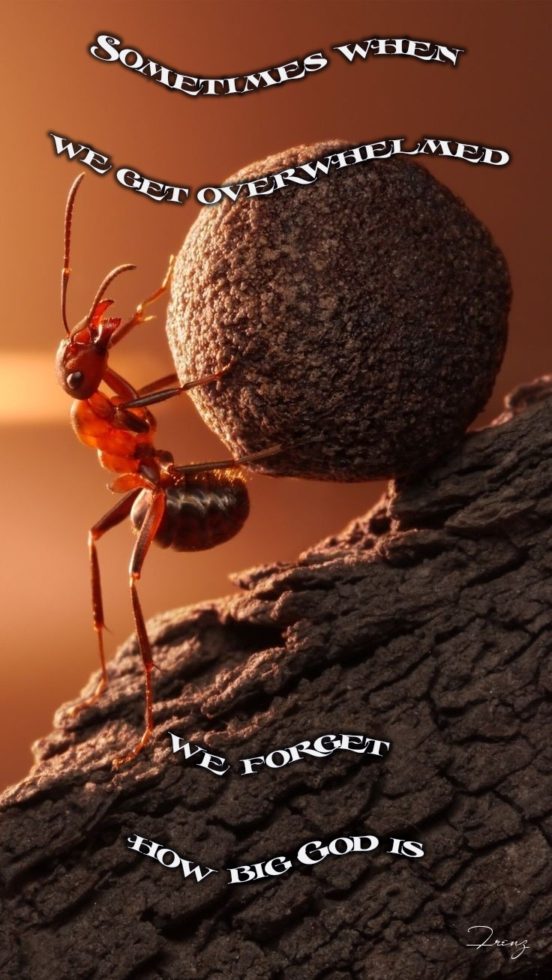
The image is a visually striking and emotionally resonant depiction of an ant struggling to carry a large stone. The text overlay reinforces a Christian message of faith and trust in God, particularly during times of hardship and overwhelming challenges.
Visual Elements: →
* The Ant: → The ant is the central figure. It's rendered in detail, showing its small size in contrast to the enormous stone it's attempting to move. Its posture of strain and determination evokes empathy and a sense of struggle. Its reddish hue provides a visual contrast with the darker brown of the stone and the bark.
* The Stone: → The stone is rendered as large and heavy, emphasizing the magnitude of the ant's task. It’s textured, further suggesting its weight and the difficulty of carrying it.
* The Bark: → The rough, textured surface of the tree bark provides a grounding element for the scene, giving a sense of realism and context. The bark's darkness contrasts with the brightness of the ant.
* Lighting and Color: → The warm, soft lighting creates a sense of depth and draws attention to the ant. The color palette is primarily earthy tones (brown, red, and orange) with a bit of warmth.
Text and Message: →
* "Sometimes when we get overwhelmed..." →: This phrase establishes the initial connection. The image taps into the universal experience of feeling stressed, burdened, and unable to cope.
* "...We forget how big God is." →: The second part of the message delivers the core Christian message. The implication is that when we are overwhelmed, we lose sight of the power, presence, and care of God. We become focused solely on our struggles and lose perspective. The image is a reminder to keep faith.
Interpretation and Christian Context: →
* The Ant as a Metaphor: → The ant represents humanity or individual believers. The stone represents the challenges, burdens, and difficulties that we face in life.
* God's Role: → The message implies that God is bigger than any challenge we face. He has the power to help us, guide us, and sustain us through hard times. It’s an encouragement to trust in God's strength rather than relying solely on our own.
* Faith and Trust: → The image promotes the importance of faith and trust in God. It calls on Christians to remember God's promises, love, and support even when circumstances feel impossible.
* The Power of Perspective: → The image is a visual reminder to step back, and to find our perspective in the grander scale of life. By looking up to God, we find strength and are able to endure.
In Conclusion: →
This image is a simple yet powerful visual parable with a clear Christian message. It combines a relatable human experience (feeling overwhelmed) with a call for faith and trust in God. It's a reminder that even when facing enormous challenges, we can find strength and hope by turning to God and remembering His boundless love. It reminds us to look up to God to see his promises.

The image is a digital graphic designed to evoke a sense of faith, reassurance, and divine power, specifically within a Christian context. It uses a dramatic sky scene as a backdrop and overlays text that conveys a message of trust and care from God.
Visual Elements and Symbolism: →
* Dramatic Sky: → The background is dominated by a vibrant and striking sky. It features a range of warm colors, with reds, oranges, yellows, and blues blending together. The clouds are textured and layered, creating depth and visual interest. This dramatic sky can be interpreted as:
* Awe and Wonder: → The sheer grandeur of the sky is intended to inspire a sense of awe, reminding the viewer of the vastness and power of creation.
* Divine Presence: → The lighting and color gradients suggest the presence of a divine being. Sun rays breaking through the clouds can be seen as the hand of God reaching down.
* Hope and Promise: → The bright colors of the sunset/sunrise can represent hope, promise, and the promise of a new day, a metaphor for faith and spiritual renewal.
* Text Overlay: → The image is heavily reliant on text to convey its message. The text is rendered in a stylized font, often with a 3D-like effect, and is positioned to catch the viewer's eye:
* "I MADE ALL OF THIS OUT OF NOTHING": → This statement directly references the biblical account of creation (Genesis 1:1-3), where God created the universe "out of nothing". This line immediately establishes a divine creator.
* "TRUST ME": → Placed prominently, this emphasizes the core message. It's a direct appeal to the viewer's faith and encourages them to surrender to God's plan.
* "I CAN TAKE CARE OF YOU": → This phrase is a message of reassurance. It promises protection, guidance, and provision. It reassures the viewer that they are loved and cared for.
Message and Interpretation: →
The image delivers a clear Christian message of faith and reliance on God. It conveys the following key ideas:
1. Creation and Divine Power: → God is presented as the all-powerful creator of the universe, emphasizing His unlimited capabilities.
2. Trust and Faith: → The image calls for trust in God. It urges the viewer to surrender their worries and anxieties and to place their faith in a higher power.
3. Care and Protection: → The promise "I can take care of you" offers solace and reassurance, suggesting God's active involvement in the lives of believers.
4. Personal Relationship: → The language used is direct and personal ("Trust me," "I can take care of you"), creating a sense of intimacy and connection with the divine.
Overall effect: →
The image's intent is to uplift and comfort the viewer. It's meant to evoke a sense of peace, encourage faith, and reinforce the belief that God is always present and caring. It's likely used as a social media post, a greeting card, a prayer aid, or a motivational visual. Its design is simple but effective.
The image presents a visually appealing picture of a bird, likely digitally enhanced to feature vibrant red and pink hues. The bird is perched on a branch, set against a blurred natural background. Overlaid on the image are the words:
* "The evidence"
* "for a Creator"
* "is overwhelming"
Article: Beauty, Wonder, and the Whispers of Creation →
In a world saturated with noise, it's easy to overlook the quiet wonders that speak to us every day. Sometimes, the most profound truths are found not in grand pronouncements, but in the subtle beauty that surrounds us. This image, of a small, exquisitely colored bird, invites us to contemplate the world through the lens of faith, particularly a Christian perspective.
The image itself is a testament to design. The bird, with its remarkable plumage, stands as a vibrant example of the complexity and artistry found in the natural world. The careful arrangement of the feathers, the subtle shading of the colors, the delicate features of its beak and eye—all speak of a purpose and a plan.
The text overlaid on the image – "The evidence for a Creator is overwhelming" – offers a core Christian belief. It suggests that the beauty and intricate details found in nature are not simply random occurrences, but rather evidence of a divine Creator, namely God.
This perspective encourages Christians to see the world not just as a collection of physical objects, but as a reflection of God’s character. The bird, the trees, the changing seasons, the vastness of the sky – all can be understood as expressions of God's creativity, love, and power.
Key Christian Concepts Illustrated: →
* Creationism: → The image aligns with the creationist belief, which holds that the universe and everything within it were intentionally created by God.
* Theology of Nature: → The image subtly reflects the theological concept that nature can serve as a vehicle for understanding God.
* Beauty as Revelation: → The image emphasizes the Christian view that beauty is not merely aesthetic but also a spiritual revelation.
* Overwhelming Evidence: → The text underlines the Christian belief that the evidence for God’s existence and creative work is abundantly visible.
Beyond the Image: Living in Awe →
This image serves as a gentle reminder to pause and appreciate the world around us. It encourages us to actively look for moments of wonder, to notice the details that often go unnoticed. A Christian worldview encourages believers to see every sunset, every flower, and every bird as a whisper of God’s presence and a reflection of his beauty.
By embracing this perspective, Christians can find themselves constantly surrounded by inspiration. It invites us to live with a deeper sense of awe, gratefulness, and a heightened awareness of the divine hand at work in the world.
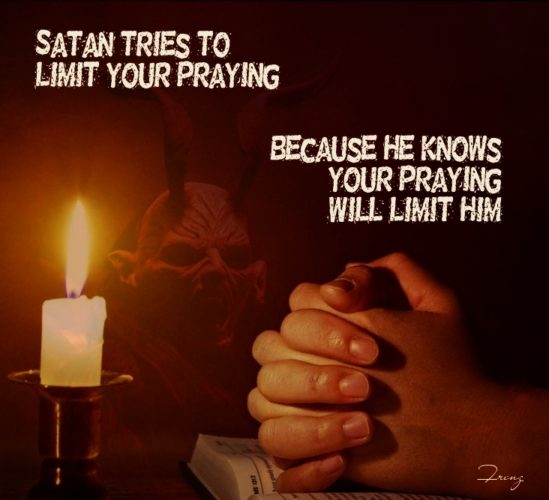
The image is a Christian meme or motivational graphic that conveys a message about prayer and spiritual warfare. Here's a breakdown:
* Visual Elements: →
* Central Image: → The image's focus is on a pair of hands clasped in prayer over an open book, presumably a Bible. A lit candle in a candlestick is placed on the left side, providing warm light and an atmosphere of reverence. A shadowy, devil-like figure with horns lurks in the background, adding an element of fear and representing Satan.
* Text: → Two lines of text are visible on the top of the image, and a two-line text is visible on the bottom of the image, conveying the main message of the image. The text's font appears distressed, as if emphasizing the hardships of the spiritual battle it talks about.
* Color Scheme: → The image uses a dark, warm color palette (primarily reds and browns), setting a dramatic and serious mood. The light from the candle and the brightness of the praying hands stand in sharp contrast to the shadowy figure, emphasizing the battle between good and evil.
* Message: → The image's core message is that Satan actively tries to hinder prayer because he understands prayer's power to limit his influence. It encourages believers to pray regularly and to persevere in their faith, recognizing prayer as a means of spiritual defense and victory.
Article: The Battle for Your Prayer Life →
In the spiritual realm, a silent war wages daily. It's a battle fought not with weapons but with faith, a battle with the potential to shape our lives, and even the world around us. At the heart of this struggle lies a powerful weapon: prayer. The image we're analyzing beautifully illustrates this reality, presenting a stark visual representation of the ongoing spiritual struggle.
The Enemy of Prayer: →
The image's shadow in the background, representing Satan, is a visual cue, a warning that the enemy seeks to disrupt our connection with the divine. Why? Because prayer is a formidable force. It is a means of communication with a power source, where God is available for His followers to seek His help and guidance. It is an expression of trust, humility, and dependence on a higher power.
Satan understands the power of prayer. He recognizes that the more we pray, the less influence he has over our lives. Prayer creates an impenetrable barrier against temptation, despair, and the many schemes Satan uses to ensnare us. By limiting prayer, Satan tries to break our connection to God, leaving us vulnerable and alone in our struggles.
The Power of Persistence: →
The image of the praying hands emphasizes the act of supplication. The open Bible symbolizes the Word of God, the foundation of our faith and the source of divine guidance. It implies that through prayer, we can strengthen our relationship with God and the faith to overcome the struggles.
Practical Application: →
* Make Prayer a Priority: → Just as the image encourages, we must prioritize prayer in our daily lives. This means carving out time to talk to God, regardless of the demands on our schedule.
* Pray Regularly: → Consistent prayer, like any other form of exercise, builds strength. Regular prayer transforms our hearts and minds.
* Be Persistent: → Satan will try to discourage us and make us think our prayers are unanswered. However, we are commanded to persevere.
* Pray Boldly: → We are to come boldly before God’s throne, knowing that He hears our prayers and will answer according to His will.
Conclusion: →
The image serves as a potent reminder of our spiritual battle. It encourages us to arm ourselves with the shield of prayer. This article emphasizes the importance of prayer and calls for us to take our prayer life seriously.
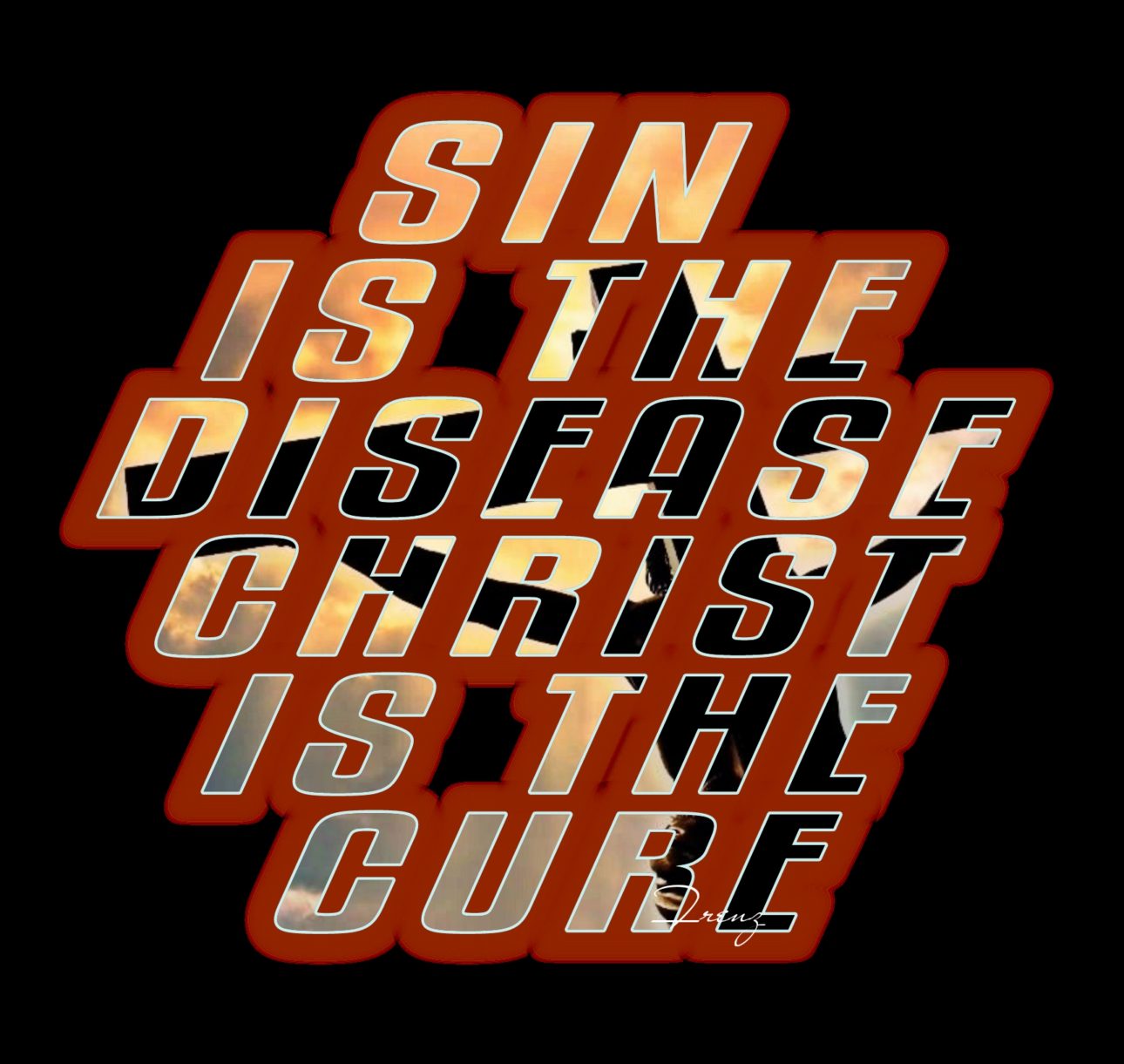
The image is a striking visual statement presented against a stark black background. The core element is a bold typographic composition arranged in a cascading style:
* Text: → The central message is a Christian proclamation. The text reads, "SIN IS THE DISEASE CHRIST IS THE CURE." The words are large and prominent, designed to immediately capture the viewer's attention.
* Typography and Design: →
* Font: → The text is rendered in a bold, sans-serif font, which gives it a powerful and modern feel. The letters have a distinctive outline that creates a strong visual separation from the background.
* Color and Layering: → The words are filled with a light, golden hue. The letters have a silver outline and have a bright orange shadow, which adds depth and a three-dimensional quality. The image's effect is a gradient feel, with light and dark areas that resemble clouds or a sunset. The contrast of the colorful letters against the black background ensures readability.
* Composition: → The words are arranged in a layout, visually creating a sense of motion and emphasis. The overall design feels dynamic and eye-catching.
Christian Context and Interpretation →
The phrase "SIN IS THE DISEASE CHRIST IS THE CURE" is a core Christian message:
* Sin as a Disease: → The image portrays sin as a disease. In Christian theology, sin represents separation from God, brokenness, and the inherent flaws within human nature. It leads to spiritual death and eternal separation from God. The disease analogy highlights the destructive nature of sin.
* Christ as the Cure: → The image proclaims that Christ is the cure for sin. Christians believe that Jesus Christ's death on the cross atoned for the sins of humanity. Through faith in Jesus and acceptance of his sacrifice, Christians believe they can be forgiven, reconciled with God, and experience eternal life. Christ is the remedy for the disease of sin.
Overall Message and Purpose →
The image serves as a statement of Christian faith, conveying a specific theological message in a visually compelling way:
* Proclamation and Evangelism: → The image's boldness makes it an effective tool for expressing faith and sharing the Christian message.
* Emphasis: → The image is intended to evoke a sense of urgency and hope.
* Hope and Redemption: → The image offers a message of hope. It conveys that, even in the face of sin, there is a solution: Christ and his redemptive love.
Overall Conclusion →
The image is a clear and impactful statement. It uses design to effectively communicate a message of sin, and a solution. The image's simplicity, combined with its striking visuals, make it a highly effective piece of Christian visual communication. It is a call to faith, a promise of redemption, and a testament to the core beliefs of the Christian faith.
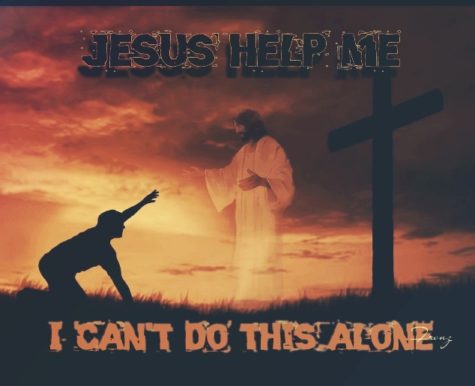
The image is a Christian-themed composition, visually representing a plea for help and reliance on Jesus. It utilizes evocative imagery and text to convey a message of faith, vulnerability, and dependence on a higher power. The composition is designed to be emotionally impactful and resonates with themes of seeking guidance, support, and strength.
Visual Elements and Composition →
* Color Palette: → The image is dominated by warm, sunset-like colors: oranges, reds, and dusky yellows. This palette creates a sense of drama, perhaps symbolizing a challenging time or a period of transition. The colors also evoke feelings of warmth, hope, and a sense of divine presence.
* Central Figures: → The image features three primary figures:
* Jesus: → Jesus is depicted as a luminous figure, standing with outstretched arms. His form is ethereal, suggesting his spiritual presence and the power of the divine.
* A Person in Silhouette: → A person is kneeling on the ground, facing Jesus with one arm outstretched in a gesture of supplication. Their body language is one of vulnerability, dependence, and a plea for help.
* The Cross: → A large, dark silhouette of a Christian cross stands in the background. The cross is a powerful symbol of Christianity, representing sacrifice, redemption, and faith.
* Foreground and Background: → The composition is split, the silhouette is in the foreground while Jesus and the cross are in the background. This creates depth and draws the viewer's eye to the central plea for help. The ground is visible, creating a sense of reality within the spiritual vision. The sky is painted with warm colors and provides a backdrop, creating an atmosphere that enhances the sense of serenity.
* Text: → The text is strategically placed at the top and bottom of the image, reinforcing the message. The message's font style is bold and a bit rough around the edges, emphasizing the gravity of the situation.
Symbolism and Message →
* Jesus's Presence: → Jesus's presence is a clear message of hope, guidance, and help.
* The Kneeling Figure: → The kneeling person in the foreground represents humanity's vulnerability, struggles, and need for spiritual assistance. The outstretched arm is a gesture of seeking help, hope, and a plea for support.
* The Cross: → The cross symbolizes the foundation of Christian belief and offers a sense of faith, sacrifice, and redemption. It reminds viewers of the ultimate act of love and sacrifice by Jesus.
* Text: → The combination of "Jesus Help Me" and "I Can't Do This Alone" makes the message clear. It speaks to the core values of Christian faith: reliance on God, admitting one's limitations, and seeking divine help.
* Overall Message: → The image is a clear call to faith, urging the viewer to call upon Jesus for assistance in times of struggle and to find strength and guidance through religious faith.
Interpretation and Potential Audiences →
* Christian Believers: → The image is clearly aimed at Christians. The visual elements and message reflect the core beliefs of the faith. It could be used in various settings, such as:
* Prayer cards or inspirational materials.
* Social media posts promoting faith and encouragement.
* Religious websites or blogs.
* People Seeking Spiritual Guidance: → The image could also resonate with people who are struggling, facing difficulties, or searching for faith. It invites viewers to reflect on their own challenges and consider turning to a higher power for support.
Overall, this image is a visual representation of Christian beliefs. Its message is intended to inspire faith, offer solace, and encourage viewers to seek comfort and strength from Jesus in challenging times.
Visual Description: →
* Silhouette of a Person: → The focal point is a silhouette of a woman, sitting with her legs crossed. The pose suggests contemplation or prayer. The person is positioned against a breathtaking sunset or sunrise.
* Sky and Light: → The background is dominated by a vibrant sky with warm hues of orange, yellow, and hints of red. The light is suggestive of a setting or rising sun, which creates a sense of peace, hope, and serenity. The clouds are textured, creating a dynamic and visually rich backdrop.
* Text: → Two lines of text are at the top that read: "God has a reason for allowing things to happen." Below, there is another three lines of text that says "We may never understand His wisdom but we simply have to trust His will.". All text is in a cursive, elegant font that complements the image's soft and hopeful tone.
* Composition: → The composition is well-balanced. The person is the central element, with the text and sky supporting the overall message. The silhouette allows the viewer to project their own feelings and experiences onto the image.
Message and Interpretation: →
The image delivers a clear message of faith, trust, and acceptance. The key points are:
* Divine Purpose: → The first phrase, "God has a reason for allowing things to happen," suggests a belief in a higher power and a divine plan. It implies that even in difficult or seemingly random events, there is a purpose or lesson to be learned.
* Limits of Human Understanding: → The second phrase, "We may never understand His wisdom," acknowledges that the complexities of life and the decisions of the divine might be beyond human comprehension. It encourages humility in the face of the unknown.
* Trust and Faith: → The last line, "but we simply have to trust His will," promotes the importance of faith and trust. It's an invitation to surrender to a divine plan, even when the reasons for circumstances are unclear. It suggests that despite not fully understanding, one must place their faith in a higher power.
Overall Impression: →
The image evokes feelings of peace, hope, and reliance on faith. It is a reminder to trust in a divine plan and to believe that every event has a reason, even if it is not immediately apparent. The visual elements—the serene sunset and the contemplative pose—add to the feeling of tranquility and invite the viewer to reflect on their own faith and trust. The image can be seen as a form of inspirational art or Christian devotional material.
The image presents a thought-provoking question: "WHAT IF GOD ASKED YOU FOR A SIGN?" It's a question designed to prompt reflection on faith, belief, and one's relationship with the divine. The question implies a scenario of reciprocity, where a person is challenged to demonstrate their faith or the validity of their prayers.
Visual Analysis →
* Typography and Style: → The words are rendered in a bold, stylized font. The letters have a three-dimensional effect, suggesting depth and perhaps a sense of weightiness. They are outlined in a soft pink, which separates them from the background. The style evokes a feeling of boldness and conviction.
* Color Palette: → The background within the letters features a mix of deep reds, purples, and oranges, reminiscent of a nebula or a cosmic scene. This choice is significant, because it visually connects the message to the vastness of the universe and the mysteries often associated with spirituality and faith.
* Background: → The background is entirely black, making the words pop out at the viewer. The darkness enhances the sense of mystery and contemplation that the image strives to create.
* Overall Aesthetic: → The image has a contemporary aesthetic. The font and color choices suggest a desire to create a visually appealing piece that can be used in many mediums such as prints, social media posts, and other content to evoke a strong reaction from its viewers.
Symbolism and Interpretation →
* The Question: → The core of the image is the question itself. It's a direct challenge to the viewer's understanding of faith. Asking what a sign means to you indicates the deep reflection necessary for a deep conviction.
* The Cosmic Imagery: → The nebula-like patterns within the letters symbolize the infinite possibilities, the unseen, and the divine presence in the universe. It suggests that the act of asking for a sign isn't a simple request, but rather an invitation to explore the boundaries of one's belief system.
Christian Context →
* Faith and Doubt: → The image resonates with Christian themes of faith and doubt. The query, "What if God asked you for a sign?" can be interpreted as a call to demonstrate one's belief. It prompts one to examine their faith in the face of the unknown.
* Biblical References: → The concept of asking for a sign is present in various biblical stories. (See Matthew 12:38-42). The image's question indirectly refers to the possibility of signs as indicators of God's presence or actions.
* Personal Relationship with God: → This image is a call for the viewer to consider their own individual faith and relationship with God. It invites one to wonder about what actions and behaviors they undertake to maintain a strong spiritual relationship.
In Conclusion →
The image is a powerful piece of visual communication. The question, combined with the artistic design, compels viewers to contemplate the nature of faith, the significance of signs, and their own personal connection with the divine. It serves as a thought-provoking piece to spark deep discussions about personal beliefs and the relationship between humanity and the spiritual realm.
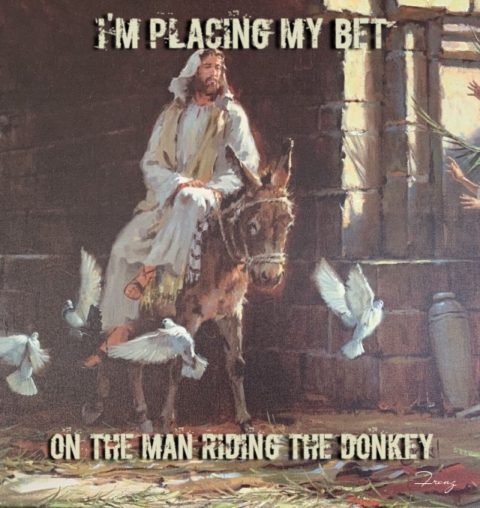
The image is a digitally altered meme featuring a depiction of Jesus riding a donkey, which is a familiar scene from the Christian narrative of the "Triumphal Entry" into Jerusalem. The image is a painting/artwork. There are white doves flying near Jesus and the donkey. The text superimposed on the image reads: "I'M PLACING MY BET ON THE MAN RIDING THE DONKEY".
Symbolism and Biblical Context →
* Jesus on a Donkey: → This is the central symbol. It directly references the story in the Gospels (Matthew 21:1-11, Mark 11:1-11, Luke 19:28-44, John 12:12-19) where Jesus enters Jerusalem on a donkey. This act is significant for several reasons:
* Fulfillment of Prophecy: → It's often interpreted as a fulfillment of the prophecy in Zechariah 9:9, which speaks of a king coming to Jerusalem "riding on a donkey."
* Humility: → Riding a donkey, rather than a horse, symbolized humility and peace. Kings and military leaders often rode horses, but a donkey represented a gentler approach.
* Welcoming and Acceptance: → This event marked the beginning of the week of Jesus's crucifixion, with a large crowd welcoming him into Jerusalem as the Messiah.
* Doves: → Doves often symbolize peace, innocence, and the Holy Spirit in Christian iconography. Their presence here adds to the sense of spiritual atmosphere and could also relate to Jesus's teachings of peace.
* Triumphal Entry: → The imagery of Jesus being welcomed by a crowd on his arrival in Jerusalem.
* Text ("I'M PLACING MY BET ON THE MAN RIDING THE DONKEY"): → This is the comedic aspect of the meme. It turns a significant biblical event into a gambling situation. It suggests that placing a bet is an easy and obvious choice, and a sign of support to Jesus. It creates a sarcastic tone, since it might mean that anyone who would bet against Jesus's actions is foolish.
Overall Interpretation and Possible Meanings →
1. Satirical Humor: → The primary purpose is to generate humor. It uses the familiar image of Jesus riding a donkey but frames the scene in the context of placing a bet.
2. Familiarity with Biblical Stories: → To fully appreciate the meme, the viewer needs to be aware of the story of the Triumphal Entry.
3. Reverence mixed with sarcasm: → The meme acknowledges the religious context, but also provides an irreverent, lighthearted perspective. It shows a kind of admiration, since the viewer knows that Jesus will succeed his journey.
4. Social Media Context: → This is typical meme humor, playing on religious figures and moments to create a chuckle. It's meant to be shared and enjoyed within online communities.
5. Emphasis on Jesus's Identity: → The "man riding the donkey" phrasing serves as a gentle reminder of who Jesus is.
In Conclusion →
The image is a humorous take on the biblical story of Jesus's entry into Jerusalem. It relies on the visual recognizability of the scene and the common knowledge of the story's significance. The text adds a modern twist, creating a humorous and potentially engaging meme for a religious audience.
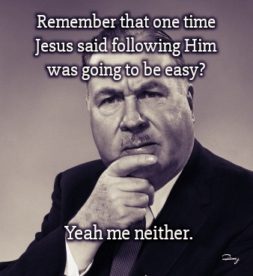
The image is a meme, combining text with a photo of a man. The text expresses a humorous skepticism about the idea of following Jesus being easy. Let's break it down:
* Text: → The text reads:
* "Remember that one time Jesus said following Him was going to be easy?"
* "Yeah me neither."
This text employs sarcasm. It implies the expectation or hope that following Jesus would be simple, but then dismisses this idea with humor. The text suggests that faith is often accompanied by difficulties or challenges.
* Image: → The person depicted has a stern expression and is considering something. This adds to the tone of the meme, giving a feeling of relatable reflection.
Article: The Hard Road, the Honest Faith →
In the Christian faith, the path to discipleship is often portrayed as a journey of growth, challenge, and commitment. The meme, with its sarcastic question and relatable tone, reflects a truth known by many believers: faith isn't always easy.
The Bible offers guidance and hope but also acknowledges the difficulties. Jesus himself never promised an effortless life for those who followed him. In the Gospel of Matthew (16:24), he states, "If anyone wants to come after me, let him deny himself, and take up his cross, and follow me." The "cross" is a symbol of suffering and sacrifice.
Why the Difficulty? →
* Spiritual Warfare: → The apostle Paul speaks of spiritual warfare, meaning that Christians face opposition from the forces of evil. This can manifest as internal struggles (doubt, temptation) and external trials (persecution, hardship).
* Personal Growth: → Following Jesus often involves the difficult process of self-denial, repenting of sins, and growing in virtues. This requires effort, self-reflection, and a willingness to change.
* Persecution: → In some parts of the world, Christians face open persecution for their faith. Even in places where persecution is not as overt, Christians may experience social isolation, disapproval, or other forms of hardship because of their beliefs.
The Value of the Struggle →
The challenges in the Christian walk are not without purpose. They can serve to:
* Strengthen Faith: → Overcoming obstacles can build resilience and a deeper trust in God.
* Refine Character: → Facing difficulties can refine a person's character, producing virtues like patience, perseverance, and compassion.
* Demonstrate True Faith: → The struggle can prove the sincerity of belief and the depth of commitment.
Finding Hope in the Hard Times →
Though the path may be difficult, the Christian faith offers hope in the face of adversity.
* God's Presence: → Christians believe that God is always with them, offering comfort, guidance, and strength in times of trouble.
* The Promises of Jesus: → Jesus promised that he would never leave his followers nor forsake them.
* The Power of Prayer: → Prayer provides a means of communicating with God, seeking help and guidance.
* The Promise of Eternal Life: → A central tenet of Christianity is the promise of eternal life with God. This offers hope that transcends any earthly suffering.
Conclusion →
The meme's humor reminds us that the journey of faith involves its share of bumps in the road. It also opens the door to a deeper discussion about the nature of discipleship, the challenges faced by believers, and the unwavering hope found in the Christian faith. Recognizing the difficulties is not a sign of weakness but a step towards a more authentic and resilient faith.
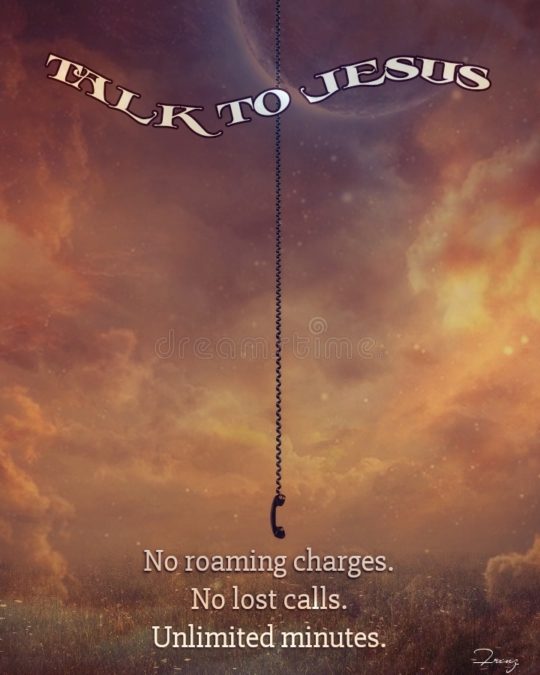
"Talk to Jesus": A Modern Prayer in a Digital Age →
This image is a striking piece of Christian art, cleverly blending the modern world of communication with the timeless act of prayer. It speaks directly to the viewer, offering a clear message of faith and connection with Jesus Christ.
Visual Elements and Their Significance: →
* The Celestial Backdrop: → The image's background is a dramatic, ethereal scene of a cloudy sunset or sunrise. The colors are warm and inviting, creating a sense of peace, hope, and the presence of something greater than the earthly realm. This celestial backdrop immediately positions the message within a spiritual context.
* The Telephone Cord: → The most prominent element is the telephone cord, seemingly connecting the words "TALK TO JESUS" suspended in the sky with a classic telephone handset that dangles in the bottom center. The cord acts as a visual representation of prayer as a means of communication. It is a bridge between the earthly and the heavenly.
* The Words "TALK TO JESUS": → The text is arranged in a stylish and eye-catching way, curving over the scene. The words are bold and easily readable, ensuring that the message immediately catches the viewer's attention. The placement in the sky suggests a direct connection to the divine, while the font and style give it a contemporary feel.
* The Phone Handset: → The inclusion of a telephone handset is particularly significant. It represents the act of calling, of reaching out to Jesus. It is a direct invitation, inviting the viewer to engage in communication and spiritual dialogue.
* The Text Below: → The image includes the text "No roaming charges. No lost calls. Unlimited minutes." This is the key element that bridges the divine with the modern day. This text suggests that there are no barriers to speaking to Jesus. Communication is always available.
Interpreting the Message: →
The primary message of the image is a direct and inviting one: "Talk to Jesus." This is not a passive suggestion but a call to action. The image suggests that communication with Jesus is open and accessible to everyone.
* A Call to Prayer: → The core message is to pray. It encourages the viewer to seek a personal relationship with Jesus and to communicate with him openly and honestly.
* Accessibility of Faith: → The text "No roaming charges. No lost calls. Unlimited minutes." emphasizes that the connection to Jesus is always available. The phone metaphor suggests that faith is not something distant or exclusive but something readily accessible.
* Hope and Assurance: → The hopeful colors of the backdrop set a tone of reassurance. It conveys the idea that Jesus is always listening, and that the act of faith offers the potential for peace, guidance, and comfort.
Overall Impression: →
The image is a clever and effective piece of religious art. It uses modern visual language and references to communicate a timeless message of faith, hope, and personal connection with Jesus. It encourages the viewer to pray, offering the promise of a constant and unwavering connection.
Title: The Ascent of Prayer and the Descent of Blessings: An Analysis of a Christian Image →
Introduction: →
The image is a visually compelling piece conveying a fundamental message within Christian faith: the power of prayer and the corresponding bestowal of blessings. The design uses typography, color, and a subtle visual texture to create a clear and uplifting statement.
Visual Analysis: →
* Typography and Layout: → The core message, "PRAYER GOES UP, BLESSINGS COME DOWN," is displayed in a bold, stacked format. The use of all-caps creates a sense of emphasis and importance. The phrase is arranged in a way that mimics the directional flow of prayer (up) and blessings (down), reinforcing the message visually.
* Color Palette: → The image primarily uses a color scheme featuring:
* Bold, black and yellow: → The word is colored black, which is a good contrast.
* Blue Outlines: → Each word is outlined in bright blue, providing a defining edge to each word.
* Texture/Background: → The background of the words seem to be a pattern. This adds a unique dimension to the image.
Interpretation and Christian Significance: →
* Prayer as a Pathway: → The phrase "Prayer Goes Up" emphasizes the act of prayer as a direct communication with God. In Christian belief, prayer is a fundamental practice, the act of bringing one's needs, thanks, and concerns before God. It is considered a means to nurture a personal relationship with God and seek His guidance. The upward direction suggests a connection between the earthly and the divine realm.
* Blessings as a Response: → The second part of the phrase, "Blessings Come Down," highlights the result of prayer. This reinforces the belief that God responds to the prayers of His people. These "blessings" can manifest in various forms: comfort, guidance, provision, answered prayers, strength, and spiritual growth. It’s a promise of God's grace and favor.
* Cause and Effect: → The image clearly illustrates a cause-and-effect relationship: prayer (the cause) initiates the reception of blessings (the effect). This underlines the importance of consistent prayer in one's Christian journey.
* Theme of Faith and Hope: → The message fosters a sense of hope and faith. It encourages believers to trust in God's responsiveness and goodness.
Overall Impact and Intended Audience: →
The image is clearly designed for a Christian audience. The straightforward message is easily understood and resonates with core Christian beliefs. Its purpose is to encourage, inspire, and remind believers of the connection between prayer and God's blessings. It's likely intended for use on social media, in churches, on Christian websites, or as a personal reminder of faith. The image evokes a sense of hope, faith, and connection with God, making it a simple yet powerful message.
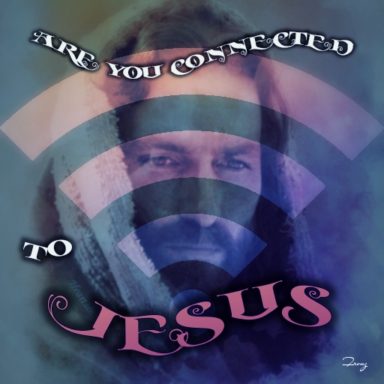
The image is a digitally altered graphic that aims to convey a message about spiritual connection within a Christian framework. Here's a breakdown of its elements:
* Central Figure: Jesus's Face: → The primary image is a depiction of Jesus Christ's face. This is a familiar representation, using a soft, somewhat idealized style often seen in Christian art. It's a direct visual cue, immediately associating the image with Christianity.
* Wi-Fi Symbol Overlaid: → The iconic Wi-Fi signal symbol (the curved bars radiating outwards) is superimposed over Jesus's face. This is the core element that creates the visual juxtaposition and the message.
* Text: "ARE YOU CONNECTED TO JESUS?": → The text is split, with "ARE YOU CONNECTED" arched above and "TO JESUS" positioned below. The font is stylized, but the message is direct.
* Color Palette: → The image uses a muted color palette, likely to create a reverent or contemplative mood.
Interpretation and Meaning →
The image functions through a clever use of metaphor and technology. Its purpose is to spark reflection and possibly a challenge for Christian beliefs.
* The Connection Metaphor: → The Wi-Fi symbol is not just a visual element; it represents the idea of connection. It's the core concept that can spark a meaningful conversation about faith. The image asks the viewer: *Are you connected?*.
* Spiritual vs. Digital Connection: → The image cleverly juxtaposes the tangible, sometimes superficial, world of digital connectivity with the often-perceived intangible and spiritual world of faith. It implicitly prompts the viewer to compare these two modes of "connection."
* Challenge and Invitation: → The image is both a question and a subtle invitation. It asks the viewer to consider the nature of their relationship with Jesus.
* Contemporary Relevance: → The image taps into the common human experience of always being connected through technology. By framing the spiritual relationship with Jesus in the context of constant digital connection, it brings the spiritual question into a contemporary setting.
Article →
Are You Wi-Fi Connected to Jesus? Exploring the Intersection of Faith and Technology →
In an age of instant communication and near-constant digital connectivity, our lives are increasingly defined by signals, networks, and the ubiquitous Wi-Fi symbol. But what if the notion of "being connected" took on a different, deeper meaning? A recent graphic has captured attention by juxtaposing the iconic Wi-Fi symbol with the image of Jesus Christ, posing a powerful question: "Are You Connected To Jesus?"
The image is a thought-provoking exploration of faith in the digital age. It brings the concept of spiritual connection into the modern day. The core message is simple, yet profound: Is your relationship with Jesus as strong and constant as your connection to the internet?
The image challenges us to examine the nature of our faith in a world saturated with technology. Are we truly connected to something greater, or are we merely skimming the surface of spiritual understanding? The image also serves as a gentle reminder of the importance of nurturing our spiritual lives in an age of distraction.
The artwork employs visual metaphor. The Wi-Fi symbol, a familiar emblem of connectivity, is superimposed on the image of Jesus. The image asks the viewer to reflect on a different kind of "connection"—the spiritual bond with Christ. The question is both a challenge and an invitation.
The graphic also recognizes the constant bombardment of information and activities which might distract us from the teachings of Jesus. It suggests that just as we prioritize maintaining our digital connections, we should also cultivate a meaningful relationship with our faith. It highlights that the connection to faith is as important, if not more important, than being online.
The image, while visually simple, can be interpreted in several ways. The message invites reflection on:
* Priority: → What do you prioritize? Is it the digital world or your faith?
* Depth: → How deeply do you engage with your faith?
* Relevance: → How do you integrate your faith into your daily life, including your use of technology?
Ultimately, the "Are You Connected To Jesus?" image is more than just a clever graphic. It is a catalyst for introspection. It reminds us to consider our relationship with Jesus in the fast-paced, digitally driven world. It is a call to examine how we foster and maintain the connections that truly matter.
Image Analysis: "Worry vs. Prayer" →
The image is a visually striking piece that effectively conveys a Christian message about dealing with life's challenges. It juxtaposes worry with prayer, suggesting that the latter is a more constructive and spiritually sound response.
Visual Elements and Composition: →
* Text: → The central message is conveyed through elegantly designed text: "If it's enough to WORRY about, than it's enough to PRAY about." The font is stylized, with white lettering that appears to curve and arc as though floating against the backdrop. The words "WORRY" and "PRAY" are emphasized with slightly larger font and a distinctive design, drawing the viewer's eye to the central contrast.
* Background: → The background evokes a sense of serenity and hope. It seems to depict a night scene, possibly a shoreline, with a dark blue sky filled with countless small, glowing lights. These lights could represent stars or lanterns or candles released into the night sky, adding a layer of visual symbolism related to hope and remembrance, depending on the culture and custom.
* Foreground: → In the foreground, a pair of hands are clasped together in a gesture of prayer. The hands are silhouetted, adding depth to the image while maintaining a connection to faith and supplication. A small candle is present at the base, with a soft flickering flame, providing a physical representation of faith's light, especially when darkness is a threat.
* Color Palette: → The dominant colors are the deep blues and blacks of the night sky, contrasted with the bright white of the text and the warm yellow-orange of the candle flame and the other illuminated lights. This contrast draws attention to the message while also creating a calming, peaceful atmosphere.
Message and Interpretation: →
The core message is straightforward: if a situation is significant enough to cause worry, it's significant enough to warrant prayer. This is a common Christian sentiment, encouraging reliance on faith and seeking divine guidance in the face of difficulties. The image's composition reinforces this message by:
* Emphasizing Choice: → The juxtaposition of "Worry" and "Pray" directly presents a choice. The image suggests that prayer should be the chosen response over worry.
* Encouraging Action: → It moves beyond just recognizing the presence of problems. It suggests a proactive step – praying – as a way to address those problems and find solutions.
* Visual Symbolism: → The visual components like the candle, the sky lanterns, and the praying hands all work to symbolize hope, light, and the presence of God (or a higher power) in the midst of darkness or uncertainty.
Possible Interpretations: →
* Trust in Divine Guidance: → The image promotes trust in a higher power. It encourages viewers to rely on faith as a means of navigating difficult situations.
* Shift in Perspective: → The artwork gently nudges the viewer to change their perspective: from a place of worry to a place of faith and action.
* Comfort and Hope: → The scene's lighting and atmosphere provide a sense of comfort and hope. The image may be intended to be both uplifting and reassuring.
Overall Impression: →
The image is a well-crafted piece of inspirational art that effectively communicates a key Christian principle. Its message is clear, its imagery is symbolic, and its tone is encouraging. This artwork is intended to serve as a reminder that even in the darkest times, prayer can bring hope and guidance, transforming feelings of worry into feelings of faith and action.
The image is a digital composition that conveys a strong Christian message. It combines a scenic landscape with bold text, suggesting the importance of faith and the role of individuals in reflecting Jesus Christ. The overall tone is inspirational and encouraging.
Visual Elements: →
* Background Landscape: → The image features a stunning landscape bathed in the warm hues of a sunset or sunrise. The sky transitions from a deep blue at the top to vibrant oranges and yellows near the horizon. This color palette evokes feelings of peace, hope, and divine presence. The landscape appears to be a coastline, with water stretching towards the sun.
* Figure of a Person: → The silhouette of a man, stands on a rocky outcropping, gazing out at the water and the sun. The person is positioned centrally, drawing the viewer's eye. The figure's posture suggests contemplation, reflection, and a connection to the surrounding beauty. This placement also invites the viewer to identify with the person in the image.
* Text: → The image prominently features three phrases:
* "YOU MAY BE THE ONLY": Positioned at the top, it encourages individuals to be aware of their influence on others.
* "JESUS": Centered in a large, decorative font. This is the focal point and the central theme of the image. The stylized font with flourishes adds a sense of reverence and importance.
* "SOME PEOPLE SEE": This is written in a curved text format on the bottom, emphasizing the idea that believers embody Christ's presence to those around them.
Interpretation and Message: →
The image's core message is that believers can be the embodiment of Jesus Christ for those around them. The phrases and images work together to convey several important ideas:
* Influence and Example: → The image underscores the responsibility of Christians to live their lives in a way that reflects the teachings of Jesus.
* Witnessing: → The image reminds believers that their actions, words, and the way they live their lives are visible to others. They may be the only visible source of Christ's love, grace, and mercy to others.
* Hope and Encouragement: → The beautiful landscape reinforces the idea that hope and salvation are attainable through Jesus Christ.
Overall Tone: →
The combination of a beautiful natural setting and the clear message of faith creates a feeling of hope, peace, and personal responsibility. The image is clearly designed to encourage faith, and to encourage people to reflect Christ to those around them.

The image depicts a silhouette of a person kneeling or squatting on a sandy beach, facing towards a radiant sunrise or sunset over the ocean. The person appears to be wearing a backpack, suggesting they are on a journey. The sky is ablaze with golden and orange hues, hinting at hope, new beginnings, and spiritual light. The primary focus of the image, besides the person, is the text superimposed over the scene: "DON'T PICK UP WHAT GOD TOLD YOU TO PUT DOWN."
Interpretation and Article →
Title: The Spiritual Weight of Letting Go: Finding Freedom in God's Guidance →
The image serves as a powerful visual reminder of a critical aspect of the Christian faith: obedience to God and the courage to release burdens He directs us to relinquish. The scene's serene beauty underscores that letting go, while potentially challenging, can lead to a profound sense of peace and spiritual growth.
The Call to Discernment: →
The core message of the image, "DON'T PICK UP WHAT GOD TOLD YOU TO PUT DOWN," speaks to the constant need for spiritual discernment within a Christian life. It urges us to be attentive to God's voice, conveyed through prayer, scripture, and the guidance of the Holy Spirit. It's a reminder that not everything we encounter or desire is part of God's plan for our lives.
* Identifying the "Burden": → The "things" God might ask us to put down can encompass many things:
* Unforgiveness: → Holding onto grudges, anger, or resentment towards others.
* Material Obsessions: → Placing too much value on possessions or wealth.
* Pride and Self-Reliance: → Ignoring God's direction and relying solely on our own abilities.
* Fear and Anxiety: → Allowing worry to consume us rather than trusting God's provision.
* Sinful Habits: → Behaviors or patterns of thought that separate us from God.
The Journey of Obedience: →
The person kneeling or squatting on the beach represents the journey of following Christ. The backpack symbolizes the burdens we carry, the things we cling to that may weigh us down. The person's posture suggests contemplation, prayer, and the act of actively listening to God's will.
* The Sunrise/Sunset as Hope: → The backdrop of the sunrise (or sunset) symbolizes hope and the promise of a new day. Letting go of the burdens God tells us to release can lead to new opportunities, growth, and closer communion with God. The light illuminating the horizon represents God’s love and guidance, shining on the path ahead.
Finding Freedom: →
The message encourages us to release the burden God directs us to relinquish, it implies a commitment to freedom and peace. The image reminds us that we should allow God to guide us into our lives. As our burden is lifted, it’s like a new start, and a closer walk to God
* Trust and Surrender: → Letting go requires faith and trust. It necessitates a willingness to surrender our own desires and plans to God's greater purpose. It means recognizing that He knows what is best for us, even if we don't understand it at the moment.
* The Promise of Redemption: → The sunrise/sunset at the horizon suggests that letting go can lead to spiritual transformation, growth, and a deepening of our relationship with God.
* Obedience as a path to freedom: → The image suggests the possibility of a new and lighter experience in our journey. The freedom to live a life of purpose and peace is a promise, as well as living in harmony with our creator.
In Conclusion: →
The image is a potent call to reflection. It urges Christians to reflect on their lives, and to ask themselves: "Are there burdens I am still clinging to that God is calling me to release?" It’s a reminder that the journey of faith is not always about what we acquire, but also about what we let go of in order to find freedom. The beauty of the scenery coupled with the message encourages viewers to engage with their faith more intentionally and embrace God’s will. In a world that often encourages us to accumulate and hold on, the image offers a different perspective: that true freedom and peace can be found in the act of surrender and obedience.
The image is a visual representation of the core tenets of the Christian faith, presented as a sequence of events. It tells the story of Jesus Christ, from his birth to his eventual return. The image is meant to be an inspirational message, emphasizing the central importance of Jesus in Christian belief.
Detailed Breakdown of the Image Segments: →
1. "He Came" →:
* Visuals: → This segment depicts the Nativity scene. A bright star shines down, presumably the Star of Bethlehem, guiding the three wise men on camels. A silhouette of a stable is visible.
* Symbolism: → This part represents the Incarnation – the belief that God became human in the form of Jesus. The star symbolizes divine guidance and the revelation of Christ's birth. The wise men represent the seeking of Christ and the recognition of his significance by non-Jewish people (Gentiles). The stable signifies Jesus’ humble beginnings and his arrival in the world.
* Christian Significance: → The birth of Jesus is the foundational event in Christian belief. It's the moment when God’s son, the Messiah, entered the world, fulfilling prophecies and beginning the path toward salvation.
2. "He Died" →:
* Visuals: → The image shows the Crucifixion, with a central cross bearing the silhouette of Jesus. The scene is bathed in the light of sunset.
* Symbolism: → The cross symbolizes the sacrifice Jesus made for the sins of humanity. The crucifixion represents Jesus's suffering, death, and the ultimate act of love and redemption in Christian theology. The sunset sky can represent the darkness of that moment.
* Christian Significance: → The death of Jesus on the cross is considered the central act of atonement in Christianity. It is believed that Jesus, through his sacrifice, paid the price for humanity's sins, offering the opportunity for forgiveness and reconciliation with God.
3. "He Resurrected" →:
* Visuals: → This segment shows an empty tomb. The entrance to the tomb is open, showing the inside, bathed in the light of the rising sun. A linen cloth lies abandoned. In the distance, there are three crosses.
* Symbolism: → The empty tomb is the most powerful symbol of the Resurrection. It represents Jesus's victory over death and sin. The rising sun signifies new life, hope, and the triumph of good over evil. The linen cloth represents the cloths in which Jesus body was wrapped. The three crosses in the background are from the place of the crucifixion, further indicating this as a reminder.
* Christian Significance: → The Resurrection is the central tenet of the Christian faith. It confirms Jesus's divine nature, his victory over death, and the promise of eternal life for those who believe in him. It is the foundation of Christian hope.
4. "He Is Coming Back" →:
* Visuals: → This image presents a silhouette of Jesus looking back, with a beautiful blue sky and clouds.
* Symbolism: → This part signifies the Second Coming or the Parousia – the belief that Jesus will return again to Earth to judge the living and the dead.
* Christian Significance: → The Second Coming is the ultimate promise of Christianity. It represents the fulfillment of God's plan, the final judgment, and the establishment of God's kingdom on Earth. It is the hope and anticipation for Christians.
Overall Message and Significance →
The image uses a visual narrative to communicate a concise and powerful message of Christian belief. It encapsulates the whole Gospel message:
* God becoming human
* Jesus's sacrifice
* Jesus's resurrection
* The promise of Christ's return and the final judgment.
The design uses vivid imagery and simple text to convey its message quickly, making it suitable for inspirational purposes. The progression from darkness to light also symbolizes spiritual journeys, hope, and victory. It serves as a reminder of the core tenets of Christianity and a call to faith and anticipation.
* Text: → The central element is the quote: "He must become greater, I must become less." This is the primary message.
* Visuals: → The words are arranged in a layered fashion, as if they are overlapping, and the background consists of a starry night sky and a horizon line. The colors are primarily shades of blue and white, giving a sense of depth and serenity.
* Overall Impression: → The image conveys a sense of humility, self-sacrifice, and focus on a higher power. The starry background evokes a sense of vastness and the divine.
Christian Interpretation: →
The quote "He must become greater, I must become less" is a direct reference to the teachings of John the Baptist in the Bible. John the Baptist, a prophet who prepared the way for Jesus Christ, understood his role as pointing to the coming Messiah. He saw Jesus's importance and his own role as secondary. The core belief in Christianity is that Jesus Christ is the Son of God, and that to follow him is to prioritize him, which means "He must become greater," and in contrast to him, "I must become less" (meaning oneself). The quote highlights the concept of putting Christ first, acknowledging his authority, and diminishing oneself in comparison to God's glory.
Article: →
The Pathway to Faith: Embracing Humility in the Christian Journey →
The image before us, a striking tapestry of words and celestial imagery, serves as a powerful visual encapsulation of a core Christian principle. The quote, "He must become greater, I must become less," spoken by John the Baptist, is more than just a collection of words; it's a pathway to genuine faith, a call to humility, and a roadmap to spiritual growth.
A Foundation in Biblical Truth: →
The source of this profound declaration is found in the Gospel of John. John the Baptist, a figure of great renown in his time, was known for his ascetic lifestyle and powerful preaching, and was tasked with heralding the arrival of Jesus Christ. When questioned about his own role, he offered a simple and elegant answer: "He must become greater, I must become less."
This statement encapsulates the essence of the Christian message. It acknowledges the supreme importance of Jesus Christ, the Son of God, and underscores the Christian's call to selflessness. It is not about personal glory or self-aggrandizement; it is about recognizing the immense power and love of God and aligning oneself with His will.
Deconstructing the Ego: →
The "I" in the statement represents our ego, our self-centeredness, our desire for recognition and control. The process of "becoming less" is a journey of surrendering our ego to the will of God. This involves putting aside our pride, our ambitions, and our self-reliance, and instead embracing humility, service, and dependence on God. It involves the conscious choice to prioritize God's glory over our own desires.
This transformation isn't easy. It requires continual self-reflection, repentance, and a commitment to living a life that honors God in every aspect. The goal is not to disappear or become insignificant, but rather to find true meaning and purpose in service to a higher power.
The Promise of Growth: →
As we diminish in our own estimation, we discover the true richness of our faith. By putting Christ first, we allow his love and grace to fill the space we have vacated, and the result is not an emptiness but a fullness of joy, peace, and purpose. Through this lens, the challenges of life become opportunities for growth, and the burdens we carry become lighter.
The Visual Metaphor: →
The image of the starry night sky and the horizon adds layers of meaning. The vastness of the stars speaks of God's infinite power and love. The subtle color gradients draw attention to the vastness that lies behind the darkness. The words, illuminated against this backdrop, are a reminder that our lives on earth are a small part of a greater story, and that our perspective should always be focused on the eternal.
Living the Message: →
The call to "become less" is not a passive one. It demands active participation in our faith. It means:
* Prioritizing Prayer: → Communicating with God regularly and seeking his guidance.
* Serving Others: → Putting the needs of others before our own.
* Practicing Humility: → Recognizing our dependence on God and acknowledging our limitations.
* Studying the Word: → Learning and understanding the teachings of Jesus Christ.
The image with its powerful message, serves as a reminder of the transforming power of faith. By embracing this essential principle, we embark on a journey of growth, selflessness, and a deeper relationship with the divine.
The image presents a stark contrast, using visual and textual elements to explore a Christian theme of faith, sacrifice, and the challenges of discipleship. It juxtaposes a readily accessible symbol of faith (a rosary) with the arduous symbol of sacrifice (a cross) carried by a figure representing Jesus. The underlying message is a call to action, prompting viewers to reflect on the depth of their own faith and commitment.
Visual Elements and Interpretation →
* Upper Half: →
* Hand Holding Rosary: → A hand delicately holds a rosary. This symbolizes the outward practice of faith, something accessible to anyone. The rosary itself is a tool for prayer and reflection, commonly used by Catholics. The lighting is gentle, creating a sense of serenity.
* Background: → A soft, neutral background with a subtle gradient suggests a calm and introspective environment.
* Text: "EVERYONE CAN WEAR ONE" → This text conveys the ease with which one can outwardly express their faith. Wearing a rosary is a visual display of faith.
* Lower Half: →
* Silhouette of Person Carrying Cross: → A silhouetted figure, representing Jesus, struggles to carry a large cross, a visual symbol of his crucifixion and ultimate sacrifice. The figure embodies the hardship, suffering, and burden associated with following Christ.
* Sunset/Sunrise Background: → The background of a colorful sunset or sunrise signifies the transition from darkness to light or the end of a challenging day, implying the weight of bearing the cross. The vibrant colors create an emotive visual contrast, while the grassy knoll reinforces the context of suffering outside the city, as Jesus did.
* Text: "BUT CAN YOU BEAR ONE?" → This text poses a challenging question to the viewer. It moves beyond the surface of outward observance to the deeper question of one's true faith and willingness to endure suffering for the sake of belief.
* Question Mark: → The large question mark emphasizes the central inquiry: are you ready to carry your cross, embrace the challenges of faith, and make the sacrifices of a true follower?
Symbolism and Message →
* Rosary vs. Cross: → The image's core lies in the contrast between the rosary and the cross. The rosary is associated with ease, comfort, and a generally passive adherence to a religion. The cross symbolizes sacrifice, suffering, and the challenges one might face when following their faith.
* The Call to Discipleship: → The artwork encourages viewers to go beyond the superficial expression of faith (wearing a rosary) and consider the deeper implications of Christian discipleship, which includes sacrifice, obedience, and endurance in the face of adversity.
* The Question of Commitment: → The main message of the image revolves around commitment to faith. The image challenges viewers to reflect on their own lives and whether they are willing to embrace the difficult aspects of faith, to "bear their own cross," as Jesus commanded.
Overall Effect →
The image is a powerful, thought-provoking visual representation of faith. The visual and textual contrasts create a strong impact, inviting the audience to reflect on their personal faith journey and whether they are prepared to fully commit to the tenets of their belief, embracing the challenges and sacrifices that come with discipleship.
The image presents a powerful and concise message, intended to evoke Christian beliefs. The text is the primary focus, and the visual design supports the message rather than distracting from it. The font is bold and clear, making the words easy to read, and the visual style hints towards depth and textured background.
Text Analysis →
The image's core message is contained within the four lines of text. Let's break down each line and its Christian implications:
* "HE CAME TO PAY A" →: This clearly refers to a pivotal figure in Christianity, Jesus Christ. The phrase "He came" indicates a divine intervention, the arrival of someone from a higher realm to Earth. This signals the beginning of a crucial act that would be accomplished by the main figure.
* "DEBT HE DID NOT OWE" →: This sets the stage for the central act of the message. The "debt" is the burden of sin, the spiritual weight of human wrongdoing that separates people from God. In Christian theology, Jesus is viewed as sinless, so he didn't incur this debt. He is the only one to pay it.
* "BECAUSE WE OWED A" →: This line highlights the fundamental premise of Christian belief. The pronoun "we" refers to humanity, and "owed" clarifies that humans are the ones in debt.
* "DEBT WE COULD NOT PAY" →: This is where the crux of the message lies. This declares that humans are incapable of paying the debt of their sins on their own. This emphasizes humanity's need for divine intervention, and the belief in Jesus as the savior who fulfills this need.
Visual Design and Composition →
* Text-Focused: → The entire image is built around the text. This is key to ensuring the viewer focuses on the message itself.
* Font Choice: → The font used has a somewhat bold, and impactful style. The outlined style gives a modern yet timeless feel.
* Background: → The choice of using a background with depth and texture and color that blends well to the text, it may be hinting at the idea of an impression, or an important message. The image wants the user to feel a deeper message.
Interpretation and Message →
The overall message is a condensed expression of the Christian Gospel:
* Humanity's Sin: → Humans are burdened by sin, creating a debt that they can never pay themselves.
* Jesus's Sacrifice: → Jesus, though sinless, willingly took upon Himself the punishment for humanity's sins. He paid the debt that humans could not.
* Salvation: → Through faith in Jesus's sacrifice, believers can be freed from the debt of sin and reconciled to God.
Overall, the image is a potent visual representation of core Christian beliefs, communicating the central narrative of redemption and sacrifice with a concise and compelling design. →
The image depicts a visual representation of Jesus Christ, specifically focusing on his crucifixion. Here's a breakdown of the visual elements and their significance:
* Subject: → The central figure is unmistakably Jesus. His features are partially visible, but we can see his head crowned with thorns (a symbol of the suffering and mockery he endured). The way he is shown as a part of his cross.
* Artistic Style: → The image has a somber, sepia-toned or muted color palette, which helps to emphasize the gravity of the scene and is meant to create a sense of reverence or solemnity.
* Text: → The text overlay is the most explicit part of the message:
* "DYING FOR ME WAS THE MOST HE COULD DO" →: This phrase directly references the core belief of Christianity – that Jesus sacrificed his life (died on the cross) as an act of atonement for the sins of humanity. It emphasizes the ultimate act of love and sacrifice.
* "LIVING FOR HIM IS THE LEAST I CAN DO" →: This is the personal response of a believer. It conveys the idea that in response to Jesus' sacrifice, a Christian should live their life in dedication to him. It expresses gratitude, devotion, and a desire to honor Jesus through their actions and lifestyle.
Interpretation and Meaning →
The image, combining the visual elements with the text, communicates a powerful message that resonates deeply within Christian faith:
1. The Sacrifice of Jesus: → The image directly speaks to the central tenet of Christian belief – that Jesus died on the cross as a sacrifice for the sins of humanity. This sacrifice is seen as the ultimate act of love, as Jesus willingly bore the pain, suffering, and death that humanity deserved because of sin.
2. Reponse and Gratitude →: The second part of the message, "Living for Him is the least I can do," expresses a believer's sense of gratitude and obligation. In light of Jesus' sacrifice, a Christian is called to live a life that reflects and honors that sacrifice. This can include:
* Following Jesus' teachings.
* Seeking a relationship with God through prayer and devotion.
* Loving and serving others.
* Striving to live a life free from sin.
3. Relationship and Devotion: → The combination of image and text emphasizes a personal relationship with Jesus. It is not just about understanding the events of the crucifixion, but also about how that impacts one's life and actions. The message encourages a life of devotion and gratitude in response to Jesus' sacrifice.
4. Visual Reminders: → The visual element of the crown of thorns would be highly symbolic for Christians, as they relate the crown of thorns as Jesus' humiliation and suffering on the cross.
Conclusion →
This image serves as a reminder of Jesus' sacrifice and a call to live a life of devotion in response. It visually communicates the core tenets of Christian faith: the sacrifice of Jesus on the cross and the believer's obligation to live a life dedicated to him. It is a reminder of the love shown to the individual, and a commitment to live a life filled with faith and good works.
The image presents a visually striking message aimed at conveying a Christian worldview. Here's a breakdown of the key elements:
* Central Message: → The word "CHANGED" is prominently displayed, suggesting a transformation or a shift.
* Surrounding Words: → Floating around "CHANGED" are words like "MORALS," "CHURCHES," "PEOPLE," "SOCIETIES," suggesting these areas undergo changes.
* Underlying Statement: → "BUT GOD'S WORD STAYS THE SAME" is positioned below, emphasizing the unchanging nature of the Bible and divine truth.
* Visuals: → The background is a swirling, celestial scene, representing the vastness of the world or the spiritual realm. The use of light and color gradients creates an atmosphere of intensity and of spiritual significance.
Article: The Unchanging Truth in a Changing World →
In a world of constant flux, where trends come and go, and societal norms shift like sand dunes, it's easy to feel disoriented. The very fabric of our lives, from our personal values to the structures of our institutions, seems to be in a perpetual state of *change*. The image captures this reality, highlighting that morals, churches, people, and societies are all susceptible to transformation over time.
It’s undeniable: morals → evolve. What was once considered acceptable may now be condemned, and vice versa. The rise and fall of cultural expectations constantly reshape how we understand right and wrong. The structures of churches → and their practices are also subject to change, influenced by the surrounding culture and the changing needs of their congregations. Our people →, as we age and grow, also experience great change, whether it is internal growth or external forces. The very way we structure our societies → - from government to law to customs - is continuously changing, reflecting evolving perspectives and values.
But amidst this constant state of flux, there exists a bedrock of stability, a foundation upon which we can build our lives with confidence. The image declares this truth with unwavering conviction: "BUT GOD'S WORD STAYS THE SAME." →
As Christians, we believe that the Bible is the inspired Word of God, an eternal testament of truth, love, and redemption. It's a timeless guide that transcends the limitations of any era.
* It provides unchanging principles: → The Bible's teachings on love, forgiveness, compassion, justice, and truth remain relevant regardless of societal trends.
* It offers a fixed moral compass: → It guides us through the ethical complexities of life, providing a framework for discerning good from evil, right from wrong. The scripture clearly outlines God's view on morality.
* It promises hope in a changing world: → It speaks of God's unwavering love, His plan for humanity, and the eternal promise of salvation through Jesus Christ. This hope transcends any earthly transformation.
* It equips us to navigate change: → By studying God's Word, we gain wisdom, understanding, and discernment. We are equipped to engage with the world around us, to live with purpose, and to respond to change with grace and conviction.
The image is about acknowledging the reality of it while focusing our gaze on the immovable truth of God’s word. It's a call to anchor our lives in the unchanging promises of the Gospel, even as the world around us continues to transform. We are called to not only know the Word of God, but to also live and apply it in our everyday lives as we seek to change this world by the power of Christ. By doing so, we can live with purpose, and in a world that changes around us, we can be assured that "God's Word stays the same."
The image is a Christian-themed piece, designed to convey a message of hope, comfort, and the presence of God in the lives of those who may be lacking a father figure. It uses visual elements and text to communicate a sense of divine care and protection.
Visual Elements and Their Interpretation →
* The Boy: → The central figure is a young boy, seen from the back. He is sitting on a beach. His posture suggests a moment of reflection, contemplation, or possibly sadness or loneliness. He may represent the fatherless or those who feel abandoned or in need of guidance.
* Jesus Figure: → A translucent figure of Jesus Christ is visible in the background. The way he is depicted is reminiscent of traditional Christian representations. His presence represents the spiritual father, protector, and source of solace.
* The Setting: → The beach setting is a place of reflection and meditation. The ocean, waves, and the sky are suggestive of a peaceful, hopeful ambiance, it suggests an open space for introspection.
* The Text: → The text "God is a father to the fatherless" is the core message of the image. It's presented in a stylized font, emphasizing the importance of the words. The text is blue with a white outline.
* The Bible Verse: → The inclusion of "Psalm 68:5" underneath the text provides biblical context and reinforces the message's roots in scripture.
Symbolism →
* Boy: → represents vulnerability, those without earthly fathers, and the need for spiritual guidance and protection.
* Jesus: → Symbolizes divine love, support, and care. It acts as the eternal father figure.
* Beach: → Represents a place of introspection, calmness, and a potential for healing.
* Color Scheme: → The predominant blue, brown, and white color palette evokes feelings of calm and tranquility.
Message and Intended Audience →
The image's primary message is one of hope and comfort for those who may be feeling the absence of a father or lack a positive male role model in their lives. It reassures viewers that God is a caring, loving Father who provides guidance, protection, and love to those who may be struggling with feelings of abandonment, isolation, or insecurity.
The intended audience is Christians, or anyone open to Christian beliefs, who may be seeking comfort, reassurance, or a deeper understanding of God's love and care. It is intended to provide a sense of peace, belonging, and security in times of need.
Overall Artistic Approach →
The image combines elements of a photograph with added graphic elements and text to create a specific emotional impact. It's a simple yet powerful visual representation that is highly relatable to viewers and conveys the specific religious message.
In conclusion, → this image is a clear and emotionally resonant expression of Christian faith. It skillfully uses visual cues and text to communicate the message of God's unconditional love, care, and fatherly guidance, offering comfort and hope to those who may be facing challenges in their lives.
Article: The Peace of Christ: A Sanctuary for the Soul →
The image presented is a deeply symbolic Christian artwork that encapsulates core tenets of faith. It visually articulates a message of spiritual peace and the transformative power of Christ's presence in our lives. Let's break down the elements and their significance:
Visual Breakdown: →
* Central Figure: Jesus Christ: → The focal point is a depiction of Jesus Christ. He is presented in a serene and compassionate manner, with gentle eyes and a contemplative expression. His long hair and beard are traditional representations of Jesus. His appearance suggests a state of deep empathy and loving-kindness.
* The Lamb: → Jesus holds a small, fluffy lamb in his arms. This is a powerful symbol. The lamb represents innocence, vulnerability, and sacrifice. This imagery is strongly linked to Jesus' role as the "Lamb of God," who takes away the sins of the world. The act of holding the lamb signifies protection, care, and the shepherd's love for his flock.
* Color and Tone: → The image utilizes soft, calming colors with a gentle, almost ethereal quality. The overall aesthetic evokes feelings of tranquility, serenity, and hope.
* Text Overlay: → The text overlay reinforces the message: "Peace floods the soul when Christ rules the heart." This is the heart of the image's message.
Message and Interpretation: →
The artwork's primary message is simple but profound: True peace and spiritual fulfillment are found when Christ is the guiding force in one's life. →
* "Peace floods the soul" →: This suggests a sense of inner calm, serenity, and freedom from fear and anxiety. It describes a state of well-being that is a direct result of the next part of the statement.
* "When Christ rules the heart" →: The phrase focuses on the principle of making a conscious choice to welcome Jesus Christ into one's life. It implies surrender, trust, and a willingness to follow his teachings. It also speaks to letting go of our personal ego and worldly temptations to embrace the teachings of Christ.
Symbolic Significance and Context: →
* The Shepherd and the Flock: → The imagery of Jesus holding a lamb is reminiscent of the biblical parable of the Good Shepherd. Jesus often described himself as the shepherd who protects and cares for his sheep (his followers). The lamb in this context represents individuals, and Christ’s embrace symbolizes his love, protection, and guidance.
* The Heart as a Metaphor: → The "heart" is used here as a metaphor for our inner self, our thoughts, emotions, and intentions. When Christ "rules" the heart, it means that our actions and decisions are guided by Christian principles, such as love, compassion, forgiveness, and faith.
* Spiritual Transformation: → The image implicitly advocates for spiritual transformation. It is not just about believing in Christ, but actively embracing his teachings and allowing them to shape our lives.
Overall Impression: →
The image is a visual prayer, a reminder, and an invitation. It is a call to find solace in one's relationship with Christ. It offers a message of comfort, reminding the viewer that peace is not a destination but a state of being, a gift offered to those who embrace faith and allow Christ to be the master of their heart. It appeals to individuals seeking a sense of security, purpose, and meaning, inviting them to find solace and meaning in their Christian faith.
Image Analysis: A Prayer Away - Finding Solace in Christian Faith →
The image is a powerful and evocative representation of Christian faith, specifically highlighting the act of prayer and the belief in God's readily available help. Let's break down its components:
Visual Elements: →
* Subject: → The central focus is a woman with her eyes closed and hands clasped in prayer. The positioning of the hands, with fingers intertwined, is a classic posture associated with seeking divine intervention.
* Composition: → The close-up shot emphasizes the intimacy of prayer. The blurred background draws attention to the emotional state of the person, suggesting introspection and a moment of connection with God. The soft, sepia tones enhance this sense of solemnity and reverence.
* Text: → The words "GOD'S HELP IS ONLY A PRAYER AWAY" are superimposed over the image, arranged to integrate into the artwork. The text acts as the central message, the text font looks as it is engraved or carved.
Symbolism and Meaning in a Christian Context: →
* Prayer: → The image's core symbol is prayer. In Christianity, prayer is a fundamental act of faith, communication with God, and seeking his guidance and assistance. The person's closed eyes and clasped hands symbolize a state of humility, surrender, and focused devotion.
* God's Help: → The text emphasizes the Christian belief that God is always accessible and willing to help those who call upon him. The phrase "God's Help" points to the divine power that Christians believe is ready to intervene in their lives, offering comfort, strength, and solutions to challenges.
* Accessibility: → The phrase "A Prayer Away" underscores the immediacy of God's presence. It suggests that help is not distant or difficult to obtain but rather readily available through prayer. This conveys a message of hope and reassurance to believers.
* Faith and Comfort: → The image and its message are meant to provide comfort and solace to those facing difficulties. It's a reminder that in times of need, Christians can turn to prayer for support. The sepia tone and soft lighting also provide a sense of peace, offering the viewer to draw upon God's promise of assistance, reminding them that He is within reach through prayer.
Overall Interpretation: →
This image is a strong visual representation of core Christian beliefs. It communicates the idea that through prayer, individuals can connect with God and receive his assistance. It speaks to the importance of faith, humility, and the constant availability of divine support, and also the necessity of prayer. The image's design evokes a sense of tranquility and hope, inviting viewers to reflect on their own spiritual journey.
The image is a sentimental and devotional depiction of Jesus Christ surrounded by children. The overall aesthetic is soft and warm, with a sepia-toned color palette, giving it a timeless and slightly nostalgic feel.
Here's a breakdown:
* Central Figure: Jesus Christ: → The central figure is clearly meant to represent Jesus. He is depicted with long hair and a beard, draped in flowing robes. His expression is gentle and loving, as he looks down upon the children surrounding him.
* The Children: → Three children are depicted, positioned in close proximity to Jesus. They look up at him with expressions of wonder, curiosity, and affection. Their presence underscores themes of innocence, faith, and the importance of children in the Christian faith.
* The Text: "Jesus Loves You": → The bold text overlaid on the image is a clear and direct statement of the Christian message. It encapsulates the core belief in Jesus's unconditional love for humanity. The font is stylized, adding to the image's overall sentimental and devotional quality.
* Overall Impression: → The image is designed to evoke feelings of comfort, reassurance, and spiritual connection. It is intended to inspire viewers to feel a sense of belonging and acceptance within the Christian faith.
Detailed Article: "The Everlasting Embrace: A Testament to Christian Love" →
The image before us is more than just a picture; it's a visual testament to the heart of the Christian faith. It's an invitation to meditate on the core beliefs that have sustained believers for centuries: the boundless love of Jesus Christ.
At the heart of the image is the figure of Jesus, depicted as a compassionate and gentle presence. His features—the long hair and beard often associated with depictions of Christ—are secondary to the expression that truly captures the essence of his being. The eyes, cast with an unwavering gaze of love and tenderness towards the children gathered around him, invite the viewer to share in this embrace.
Surrounding Jesus are three children, each a symbol of the innocence and openness that the Christian faith often associates with a child's faith. Their gazes are turned upward towards Jesus, reflecting a sense of awe, trust, and unwavering belief. Their presence highlights the important role of children in the Christian narrative, where Jesus famously welcomed them, saying, "Let the little children come to me, and do not hinder them, for to such belongs the kingdom of heaven" (Matthew 19:14). The children in the image visually embody the pure and unadulterated faith that Jesus cherished.
The overlaid text, "JESUS LOVES YOU," is the declarative heart of the image. It's a simple yet profound statement that encapsulates the entirety of the Gospel message. This message of unconditional love, freely given to all, forms the foundation of Christian ethics, community, and hope. It serves as a constant reminder of God's grace and the enduring promise of salvation.
The sepia-toned color palette further contributes to the image's emotional impact. The soft tones create a feeling of warmth, comfort, and nostalgia. It's as if the scene is drawn from an era of timeless simplicity, where faith and love were the guiding principles of life.
Conclusion →
This image, in its simplicity and directness, communicates the most crucial message of Christianity: the unending and unwavering love of Jesus for all. It speaks to the heart, offering solace, encouragement, and a reminder of the profound truth that each person is loved, valued, and welcomed into the embrace of faith. It serves as a visual reminder that faith is not merely a set of doctrines but a relationship, a source of hope, and an invitation to a life lived in the love of Christ.
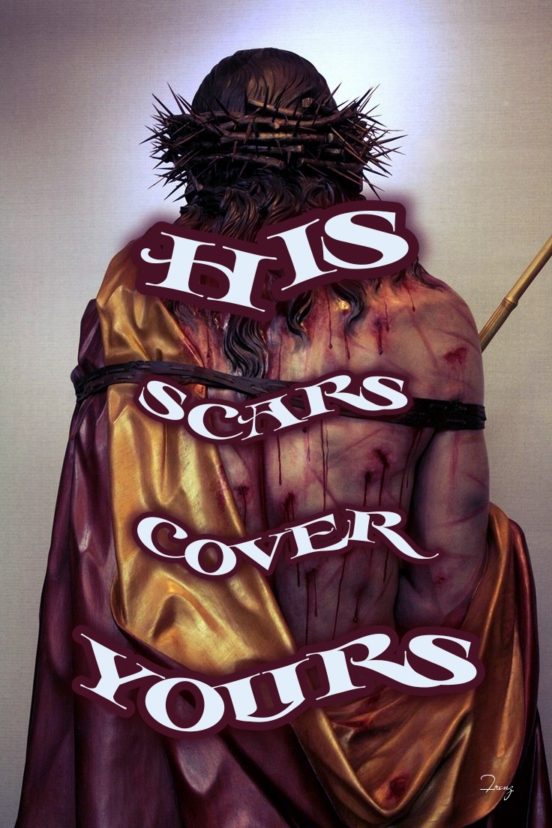
The image is a deeply religious and poignant depiction of Jesus Christ. It evokes themes of suffering, sacrifice, and the promise of salvation through the Christian faith. The visual elements are combined with a direct message meant to resonate with viewers, encouraging a sense of hope and comfort.
Visual Elements and Symbolism: →
* The Figure of Christ: → The central figure is unmistakably a representation of Jesus Christ. We see the back of a sculpture of Christ, identifiable by the crown of thorns and the wounds on his back, indicating his suffering during the crucifixion. The posture suggests submission and the weight of his ordeal. The depiction draws attention to the physical pain he endured.
* The Crown of Thorns: → This is a clear symbol of Jesus's suffering, humiliation, and the mockery he faced before his crucifixion. It also acts as a visual representation of the crown of glory that is his.
* Wounds and Blood: → The wounds on the back of the figure are visible reminders of the scourging he endured. The blood dripping down emphasizes the physical pain and the sacrifice. This visual detail evokes sympathy and a sense of reverence.
* Drapery: → The golden/yellow and dark red/purple drapery partially covering the body adds a touch of artistic elegance and solemnity. It symbolizes the royalty and divinity of Jesus. The color combination (gold and red) have associations with royalty and sacrifice, respectively, and strengthen the divine narrative.
* The Spear → the spear that pierced Jesus on the cross is also on the image on the right side
* Text: → The text overlaid on the image, "HIS SCARS COVER YOURS," is the core message. It directly addresses the viewer, suggesting that Christ's suffering and sacrifice on the cross have atoned for the sins of humanity. This promise of forgiveness and salvation is a fundamental belief in Christianity. The text is a powerful statement about the core tenets of Christianity: the sacrifice of Jesus for the sins of humanity.
* Style: → The image has a style that blends both realistic and symbolic elements. The detailed representation of the wounds and the sculpture itself offers a sense of realism. The text's bold typeface gives a strong visual message.
Interpretation and Themes: →
The image can be understood as an invitation to find solace and hope in the Christian faith. The message speaks to the comfort that comes from Christ's sacrifice, offering redemption for our sins. The image's primary themes are:
* Sacrifice: → Jesus's willingness to suffer and die for humanity's sake.
* Redemption and Forgiveness: → The belief that through Jesus's sacrifice, humanity can be forgiven for its sins.
* Hope and Comfort: → The image conveys the message that even in suffering, there is hope for salvation and a promise of a better future in the presence of God.
* Empathy and Compassion: → The image evokes empathy for Christ's suffering and invites the viewer to reflect on the burdens and scars in their own lives.
Overall Message: →
The image serves as a powerful religious message, particularly for Christians. It is a declaration of faith, a reminder of sacrifice, and an invitation for viewers to turn to their faith. The words and image work together to deliver a message of comfort, forgiveness, and everlasting hope. It implies that Christ's wounds, borne for humanity, can provide comfort, heal the spiritual wounds of those who believe, and provide eternal life.

The image conveys a strong message of faith, hope, and a prayer for well-being. It uses a combination of visual elements and text to express a wish for the removal of suffering and the embrace of positive experiences. The style is reminiscent of inspirational imagery often shared within Christian communities.
Visual Elements: →
* Background: → The background depicts a serene sunset over water. The colors are warm and inviting, with hues of orange, yellow, and some hints of pink or red, suggesting the end of a day. This setting adds a sense of peace and tranquility, aligning with the message of the image.
* Central Figure: → A figure is partially visible emerging from the water, framed by a splash of water with a beautiful light effect in the shape of a circle, presumably illuminated by the sun. This creates the appearance of the figure rising above the water, adding symbolism to the imagery. This also symbolizes a transformative and uplifting journey.
* Text: → The text is overlaid on top of the image. The font is bold and stylized, with a white or light-colored text with dark border, which stands out well against the background. The text is arranged in a way that follows the curve of the water, which adds to the sense of movement. The text is arranged in a way that it stands out, but doesn't fully obstruct the background.
Textual Message: →
The core message is the prayer:
*"MAY GOD REMOVE YOUR PAIN, WORRIES, AND PROBLEMS, AND REPLACE THEM WITH HEALTH, HAPPINESS, AND PEACE."*
This is a common sentiment in Christian prayer, seeking divine intervention to alleviate suffering and replace it with positive attributes. The language is direct and sincere.
Symbolism and Interpretation: →
* Water: → The presence of water can symbolize cleansing, rebirth, and transformation. The act of emerging from the water can be interpreted as overcoming challenges or finding renewal.
* Sunset: → A sunset is commonly associated with endings and beginnings, and a time of reflection. It can be seen as a hopeful sign for a new dawn.
* The Prayer: → The words are a simple but powerful expression of faith and a longing for a better life. They offer comfort and hope to the viewer.
Overall Meaning and Target Audience: →
The image is clearly intended to be inspirational and supportive, especially to those of the Christian faith. It conveys a sense of hope, faith, and the belief in divine intervention. It's to be shared within religious communities and can be used to offer comfort to those facing difficulties or to celebrate moments of positivity. It evokes a sense of unity in faith, making the viewer feel that they are not alone and that their struggles will pass.
Overall, the image is a well-designed and comforting piece that effectively communicates a message of faith, hope, and prayer for well-being.
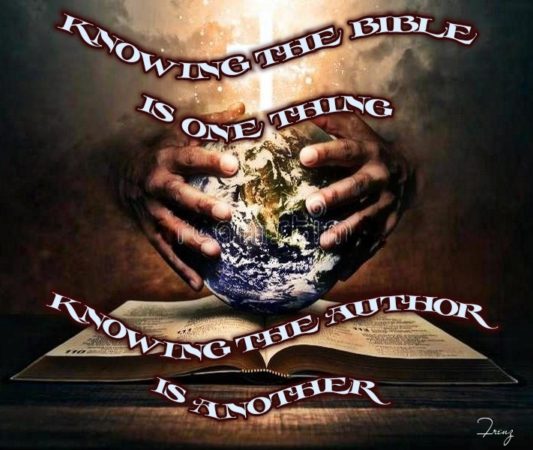
The image is a Christian-themed graphic designed to convey a message about faith, knowledge, and the importance of understanding the Bible. It uses symbolism and text to create a visually impactful statement.
Visual Elements & Their Significance: →
* Central Image: Hands Holding the Earth: → The focal point of the image is a pair of hands cradling a globe. This is a potent symbol:
* God's Authority and Care: → The hands
represent God, who is presented as the creator and protector of the world. The gentle way the hands hold the Earth shows care and responsibility.
* Humanity's Place: → The globe also implicitly represents all of humanity, held within God's grasp.
* Open Bible: → Beneath the globe and hands is an open book, clearly identifiable as the Bible. The open pages symbolize:
* Revelation: → The Bible as a source of God's word and a means to understand His will.
* Access to Truth: → The open book indicates that knowledge is available and readily accessible to those who seek it.
* Light/Cross in the Background: → The light emanating from behind the hands is suggestive of a divine light. The hints of a cross shape in this light further reinforce this as Christian symbolism.
* Font and Text: → The text "KNOWING THE BIBLE IS ONE THING; KNOWING THE AUTHOR IS ANOTHER" is a prominent feature. The font is stylised to evoke a spiritual or historical feeling. The words themselves are crucial to understanding the graphic’s message.
The Message and Its Interpretation: →
The graphic’s core message is the distinction between knowing the Bible as a collection of texts and knowing the Author of the Bible – God Himself. Here’s how to interpret the message:
* "Knowing the Bible is one thing..." →: This acknowledges the value of reading, studying, and understanding the Bible. Knowing biblical stories, verses, and doctrines provides important knowledge, insight and a foundation of faith.
* "...Knowing the Author is another" →: This elevates knowing God above mere intellectual knowledge of the Bible. It is not enough to simply understand the words; you must also establish a personal relationship with the author, God. This includes prayer, faith, and actively seeking to understand God's character.
Overall Significance: →
The image's power lies in its ability to summarise a complex theological idea in a visual way. It suggests that the ultimate goal of a Christian's relationship with the Bible shouldn't be limited to just textual study. It should lead to a deeper connection with the Divine. The message stresses the need for a real and lived experience of faith that goes beyond book-knowledge.
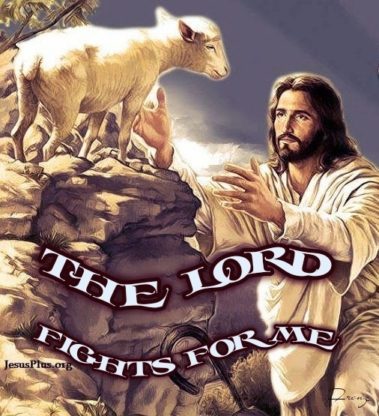
The image is a digitally created artwork primarily conveying a message of faith and divine protection. It features several key elements that reinforce this theme:
* Jesus Christ: → The central figure is a depiction of Jesus Christ, a common and recognizable representation. He's shown with brown hair and a beard, dressed in a simple robe, often associated with the garments of the time. He is gesturing with open hands, potentially in a gesture of comfort, blessing, or teaching.
* The Lamb: → A lamb is placed prominently in the image. The lamb sits on a rock.
* The Landscape: → The figures are positioned on a rocky landscape, enhancing the sense of a humble or natural setting. The background color and the soft light suggest a calm and peaceful setting.
* Text: → The text, "THE LORD FIGHTS FOR ME," is superimposed over the image. It's written in a stylized font and positioned to be easily read.
* Other Symbolic Objects: → An additional object such as a shepherd's hook, a classic tool of shepherding, hints at Jesus's role as the "Good Shepherd."
Symbolism and Interpretation: →
The image utilizes several powerful symbols with specific meanings within the Christian faith:
* Jesus as the Shepherd: → The image evokes the imagery of Jesus as the "Good Shepherd," a central metaphor in Christianity. He guides and protects his flock (believers). The presence of the lamb reinforces this. This symbol is often connected to Jesus's love for his followers, as seen in John 10:11-18.
* The Lamb as a Symbol of Innocence and Sacrifice: → The lamb often represents innocence and purity. In Christianity, it is frequently associated with Jesus's sacrifice on the cross for the sins of humanity. The presence of the lamb symbolizes protection and redemption.
* God's Protection: → The central message of "The Lord Fights For Me" is a declaration of faith in divine protection. This is a common belief within Christianity, where believers trust that God will defend them from harm and assist them in overcoming challenges.
* Comfort and Assurance: → The overall atmosphere of the image, with Jesus's gesture and the calm environment, suggests comfort and assurance to the viewer. It's a message of hope, that God is present in their lives and will protect them in times of need.
Overall Message and Purpose: →
The primary purpose of the image is to convey a message of Christian faith, hope, and protection. It's intended to:
* Encourage Faith: → To strengthen the faith of believers by reminding them of God's presence and care.
* Offer Comfort: → To provide solace and assurance in times of difficulty or doubt.
* Inspire Trust: → To promote the idea that those who put their faith in God are protected.
* Promote Christian Values: → The image upholds the core Christian values of love, sacrifice, and divine intervention.
* Share a message: → The image is likely shared to spread a message of hope and faith, and for religious education.
Conclusion: →
The image serves as a clear and direct statement of faith, using familiar Christian symbolism to convey a message of divine protection, love, and hope. It would be used as a form of encouragement, or to remind others that they are not alone in facing challenges.
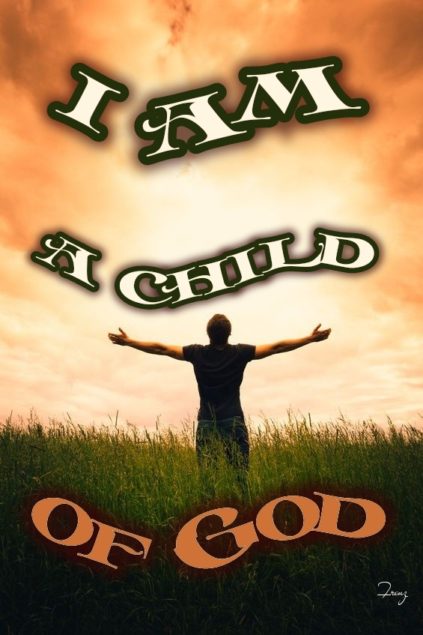
The image is a visually uplifting Christian message designed to convey a sense of peace, belonging, and the individual's relationship with God. It blends a serene natural landscape with bold text, creating a direct and impactful message.
Visual Elements and Interpretation: →
* Central Figure: → The focal point of the image is a person standing with arms outstretched, facing the sky. The person's back is turned, emphasizing the act of looking towards a higher power and inviting the viewer to project themselves into the scene. The posture, with arms spread wide, suggests openness, vulnerability, and a welcoming of God's presence. This gesture can be interpreted as a sign of prayer, worship, and embracing God's love.
* Landscape Setting: → The scene is set in a field of tall green grass under a warm-toned, sunset or sunrise sky. This natural environment adds to the overall feeling of serenity and peace. The open space symbolizes freedom, expansiveness, and the potential for connection with something greater. The sky's colors, often associated with hope, promise, and spiritual connection, contribute to the emotional impact.
* Text Overlay: → The text "I AM A CHILD OF GOD" is prominently displayed across the image. The text is stylized with a green outline with a white color, standing out against the landscape. The words "I AM" are placed at the top, followed by "A CHILD" in the middle, and "OF GOD" at the bottom. The arrangement of the words creates a visual emphasis on each phrase and helps establish the core message: the individual's identity as a child of God.
* Color Palette: → The dominant colors are green, brown, and orange tones, lending a warm and comforting feel to the image. These colors also complement the overall message of nature, peace, and spirituality.
Message and Symbolism: →
* The Core Message: → The image's primary message is that the individual is a beloved child of God. This reinforces the idea of identity, love, protection, and belonging within a divine framework.
* The Act of Surrender/Worship: → The figure's posture may be a call to the viewer to "surrender" or to submit themselves to God's will and embrace the message of faith.
* The Promise of Grace: → The warm tones and open sky might indicate a promise of God's grace and unconditional love to all who look to God.
Effectiveness: →
The image is effective in delivering its message for several reasons:
* Directness: → The message is clear and concise, with no room for misinterpretation.
* Emotional Impact: → The combination of the natural setting, posture of the person, and text creates a strong emotional connection.
* Inclusiveness: → The image is inclusive; it does not focus on any particular gender or race and welcomes viewers to identify with the figure.
* Visual Appeal: → The colors and composition are visually appealing, making it memorable and easily shared.
Who Might Use This Image: →
This image is well-suited for:
* Christian websites and blogs.
* Social media posts promoting faith and spirituality.
* Church newsletters, announcements, and presentations.
* Personal devotional materials and art.
* Greeting cards or inspirational gifts.
Conclusion: →
The image "I Am a Child of God" is a potent visual representation of Christian faith. The combination of the open, welcoming posture of the person, the natural setting, and the bold text creates a harmonious and memorable message of belonging, love, and individual relationship with God. The image effectively inspires, encourages, and offers comfort and hope to those who engage with it.
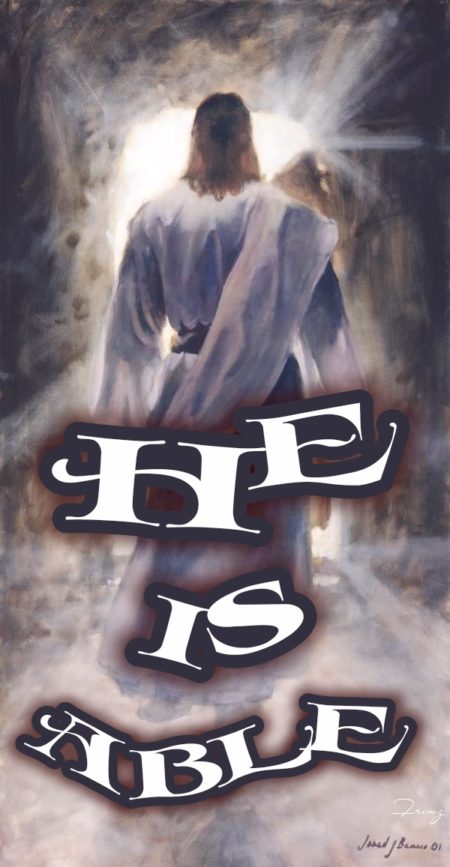
This image is a religious depiction, likely intended for Christian audiences. It combines visual and textual elements to convey a message of faith and hope.
Visual Elements: →
* Figure of Jesus: → The primary visual focus is on a figure, rendered in a style reminiscent of traditional religious art. The figure is seen from the back, indicating a sense of reverence and mystery. Long, flowing hair, and the draped garment suggest a depiction of Jesus.
* Atmospheric Setting: → The background is soft and diffused, with a glowing light emanating from behind the figure. This creates a sense of divine presence, illumination, and perhaps the suggestion of entering into a heavenly realm or a moment of transformation.
* Color Palette: → The color scheme is muted, with a mix of blues, whites, and creams. This palette evokes feelings of peace, serenity, and spiritual purity.
Textual Elements: →
* "He Is Able": → Large, bold text overlays the image. This phrase is the core message of the image. The "He" almost certainly refers to Jesus. The phrase "He is Able" emphasizes the capabilities and power of Jesus. It conveys a message of faith, hope, and assurance that in Jesus, there is the capacity to help, heal, and make things right. The way the word "ABLE" is displayed, with the text on a curve to look like it is being lifted, suggests a promise of success and the light that will take you there.
Overall Interpretation: →
The image serves as a visual representation of Christian faith and belief. The combination of the figure of Jesus, the symbolic background, and the powerful message of "He Is Able" creates a feeling of comfort, hope, and inspiration for the viewer. It is a message that speaks to the challenges of life, offering reassurance and a belief in the capacity of faith to help you get through.
Meanings and Uses: →
* Encouragement: → The image can be used to offer encouragement and support during difficult times.
* Faith and Assurance: → The image can be a visual reminder of the promises of faith and the power of God.
* Symbolism: → The image may represent the ability to achieve what one does not know how to.
* Inspiration: → To inspire people to seek help and seek help that is believed to be powerful and strong.
In conclusion, this image is a devotional piece designed to uplift and remind viewers of the power, love, and help offered through Christian faith.
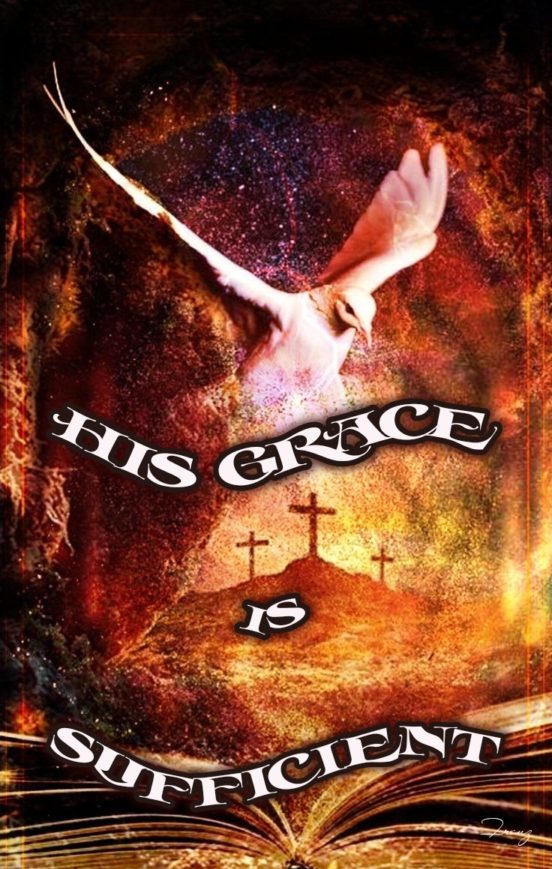
The image is a visually powerful and symbolic Christian message designed to convey faith, hope, and reliance on God's grace. It blends various elements often associated with Christian beliefs into a cohesive composition. The overall tone is reverent and uplifting.
Key Elements and Their Significance: →
* Dove: → The dove is a prominent symbol of the Holy Spirit in Christianity. It represents peace, purity, and the presence of God. The dove's positioning in the image, often depicted in flight, suggests the Holy Spirit's active influence and guidance. The wings and the direction are important to consider.
* Crosses on a Hill: → This scene depicts Golgotha, the hill outside Jerusalem where Jesus Christ was crucified. The crosses (typically three) symbolize the sacrifice of Jesus for the sins of humanity.
* Open Book: → The bottom of the image features an open Bible, the central religious text for Christians. The book's position at the base of the image suggests the Bible is the foundation for faith and the message of grace.
* Text: "His Grace is Sufficient": → This is the core message of the image. It is a direct quote, a powerful statement of faith, drawing from 2 Corinthians 12:9 "And he said unto me, My grace is sufficient for thee: for my strength is made perfect in weakness." This phrase emphasizes the belief that God's grace is all-encompassing and enough to meet any need, overcome any hardship, and provide salvation.
* Color Palette and Background: → The image uses a warm and vibrant color palette, with fiery reds, oranges, and hints of yellow. The use of these colors along with the glitter-like effect in the background can create a sense of light, energy, and divine presence.
Symbolic Interpretation and Meaning: →
1. Connection between the Spiritual and the Earthly: → The image combines elements from the heavens (the dove) and the earthly (the crosses on the hill, and the book). This suggests a connection between the spiritual realm and the human experience, illustrating that God's grace encompasses both.
2. The Sacrifice and the Solution: → The crosses represent sacrifice and suffering. The dove, the Holy Spirit, brings healing and restoration, symbolizing the presence of God's grace, which offers comfort and hope.
3. The Foundation of Faith: → The Bible rests on the very bottom of the image to establish the very foundation of faith, on which everything else depends.
4. Grace as the Answer: → The text "His Grace is Sufficient" is the core message. This emphasizes that God's grace is enough to overcome any challenge or difficulty. It's a message of encouragement and hope, a reminder that believers are not alone.
Overall Message and Purpose: →
The image is a visual representation of the Christian faith, highlighting the key message of grace, sacrifice, and the presence of the Holy Spirit. It's designed to offer comfort, encouragement, and a sense of hope to those who view it. The image may be used to share the Christian faith, celebrate religious events, offer solace in difficult times, or to simply express personal beliefs.
"You Are Not Alone": A Visual Testament of Christian Comfort and Hope →
This image is a powerful visual statement, deeply rooted in Christian faith and offering a message of comfort, reassurance, and divine presence. Let's break down the elements and their significance.
Visual Elements: →
* The Figure of Jesus Christ: → The prominent figure in the image is a representation of Jesus Christ. His appearance, with long hair, beard, and a gentle expression, is a familiar depiction in Christian art. The outstretched hand is a gesture of invitation, comfort, and potentially offering help or guidance.
* Silhouette in the Background: → A shadowed silhouette of a person's face, is a symbolic representation of an individual, a reminder that Jesus is always there as an active presence in the life of a person.
* The Text "YOU ARE NOT ALONE": → This simple but impactful phrase is the core message. The words are overlaid on the figures, reinforcing the idea that this promise of companionship comes from a divine source. The stylized font adds a touch of artistic flair, making the message more visually compelling.
* Background: → The colorful and diffused background. This can represent an atmosphere of light and divinity.
Christian Symbolism and Meaning: →
* Jesus as Savior and Comforter: → The central figure of Jesus is the cornerstone of Christian faith. Christians believe Jesus is the Son of God, who came to earth to atone for the sins of humanity. His presence in the image embodies the Christian belief that Jesus is always present with believers. This imagery serves as a reassurance that Christians are accompanied by Jesus, an offering of comfort in times of hardship, fear, or loneliness.
* The Promise of Companionship: → The primary message, "YOU ARE NOT ALONE," is a fundamental aspect of Christian belief. It speaks to the idea that God (often represented by Jesus) is always present with believers. This presence is intended to offer comfort and support, particularly when facing life's challenges.
* Invitation to Connection: → The outstretched hand of Jesus can be interpreted as an invitation to connect with the divine. It's a call to turn to prayer, faith, and the teachings of Jesus for guidance and support. It also reinforces the belief that a relationship with God is always accessible.
* Hope and Assurance: → The overall message of the image is one of hope. It asserts that faith, love, and companionship are available for everyone, with the assurance that Christians are not alone because of Jesus' presence.
Overall Impact and Purpose: →
This image functions as a visual reminder of key Christian beliefs. It is designed to evoke feelings of comfort, encouragement, and spiritual connection. The combination of the figure of Jesus, the comforting text, and the artistic elements creates a powerful message that can be particularly impactful for:
* Individuals struggling with loneliness or hardship: → The image assures them that they are not alone in their struggles, as Jesus is always available.
* Those seeking faith and connection: → It invites viewers to turn to Jesus for comfort, guidance, and love.
* Christians looking for visual support: → The image can serve as a reminder of the presence of Christ and reinforce their commitment to their faith.
In conclusion, this image is a well-crafted visual statement of Christian faith. It communicates the core tenets of Jesus' presence, the promise of companionship, and the availability of divine comfort and support, making it a message of hope, especially for those who believe in Jesus Christ.
The image is a powerful and direct statement of Christian faith. It presents a portrait of Jesus Christ, superimposed with the words "Christ is enough for me." The use of specific imagery, color, and text all work together to communicate a core tenet of Christian belief: that faith in Christ offers ultimate satisfaction and fulfillment.
Visual Analysis: →
* Central Figure: Jesus Christ → The image prominently features a rendering of Jesus. This portrayal is typical of Western Christian art, showing a man with long, flowing hair, a beard, and a gentle, contemplative expression. His downward gaze suggests introspection, perhaps a focus on prayer, reflection, or the weight of his mission. The lighting is soft and flattering, lending a sense of peace and serenity to the image.
* Color Palette: → The dominant colors are warm tones, particularly in the background, suggesting a sunrise or sunset. This creates a sense of hope, new beginnings, and the promise of eternal life.
* Text Overlay: → The words "Christ is enough for me" are strategically placed, framing the image of Jesus. The font choice is classic and legible, adding to the message's impact. The text's vibrant blue color creates a contrast that grabs the viewer's attention.
* Background Symbolism: The Crosses → The background includes three crosses. These are symbolic of the crucifixion of Jesus, a pivotal event in Christian theology. The crosses are subtly placed, but they add a layer of depth, reminding viewers of Jesus' sacrifice and the foundation of Christian faith.
Interpretation from a Christian Perspective: →
* The Declaration of Faith: → The statement "Christ is enough for me" is a core affirmation of Christian belief. It encapsulates the idea that Christ satisfies all spiritual needs. For Christians, Christ is not merely a teacher or prophet; he is believed to be the Son of God, who atoned for humanity's sins through his death and resurrection.
* Spiritual Fulfillment: → The message implies that nothing else is needed to find meaning, purpose, and lasting happiness. Wealth, power, fame, or any worldly pursuit cannot compare to the completeness found in a relationship with Christ.
* The Cross as a Reminder: → The presence of the crosses underscores the sacrifice Christ made. The image invites reflection on the love of God and the price paid for salvation.
* Personal Relationship: → The phrase "for me" personalizes the belief. It acknowledges that faith is a personal journey and that each individual can have a direct relationship with Christ.
The Broader Significance →
The image is a potent expression of faith meant to inspire and reassure viewers. It's a reminder of the core message of Christianity: that through faith in Jesus Christ, one can find forgiveness, hope, and eternal life. The image is often used to encourage, support, or comfort those in times of hardship, or to be shared as an expression of love and faith to others. It serves as a daily reminder of the true source of fulfillment.

Article: Embracing the "New Creation": A Christian Perspective on Transformation →
The image before us is a powerful visual representation of a core Christian concept: "New Creation in Christ." → It uses a striking combination of imagery and text to communicate a message of spiritual renewal, hope, and profound change. Let's break down the components of the image and unpack its deeper meaning.
Visual Elements: →
* The Person: → The central figure is a person with flowing, reddish-brown hair, arms outstretched or raised, and a sense of motion. Their pose evokes joy, freedom, and a sense of liberation. They are silhouetted against the bright sky, emphasizing their connection to a higher power or spiritual realm. The motion of their hair symbolizes movement and transformation.
* The Sky: → The backdrop is a vibrant sky filled with puffy white clouds. The blue color creates a sense of openness and vastness. The sky often represents the spiritual realm, the divine, and the promise of something beyond the earthly. The clouds suggest the presence of God and hope that they will receive blessings.
* Color and Light: → The image is suffused with sunlight. The play of light and shadow highlights the individual's energy and joy. The contrast between the bright, sunny sky and the figure's silhouette creates a sense of mystery and spirituality.
* Overall Composition: → The composition is dynamic and engaging, the movement of the person's hair, body, and the angle of the text create a sense of excitement.
Textual Elements: →
* "NEW CREATION": → The phrase "New Creation" is placed prominently above the person's head, indicating the ultimate change or transformation of becoming a Christian. This speaks to the idea of rebirth and renewal. It alludes to God's ability to create something entirely new, leaving behind the old and embracing a fresh start.
* "IN CHRIST": → The words "IN CHRIST" are positioned below, grounding the transformation in a specific spiritual context. This phrase is the key to understanding the image's meaning. It highlights that this new creation is possible *through* Jesus Christ.
* Font and Style: → The choice of a bold and flowing font suggests an energetic and bold spiritual journey. The choice of colors, and shadows also conveys the idea that Christians should be bold in their love and worship to God.
Interpreting the Message: →
The image's core message aligns with Christian theology. In Christianity, the concept of "New Creation" refers to the spiritual transformation that occurs when a person accepts Jesus Christ as their Lord and Savior. This transformation is about:
* Rebirth: → Leaving behind one's old self, including sins, weaknesses, and flawed beliefs.
* Renewal: → Being made new in Christ, with a renewed mind, spirit, and relationship with God.
* Redemption: → The forgiveness of sins and the promise of eternal life through faith in Christ.
* Holiness: → Striving to live a life that reflects the character of Christ, guided by the Holy Spirit.
The Significance of "In Christ": →
The phrase "IN CHRIST" is crucial. It signifies that this transformation is not achieved through human effort alone but is a gift received through faith in Jesus Christ. In Christianity, Jesus is seen as the one who:
* Died to atone for the sins of humanity, providing a path to reconciliation with God.
* Rose from the dead, demonstrating victory over sin and death.
* Offers the gift of the Holy Spirit to empower believers to live a new life.
In Summary: →
This image is an inspiring visual depiction of the core Christian belief of "New Creation in Christ." It captures the feelings of freedom, joy, and hope, symbolizing the spiritual transformation and renewal available to those who embrace faith in Jesus Christ. It acts as a visual encouragement to Christians to live out their new identity in Christ and be a beacon of hope to those around them.
Additional Notes: →
* This image would likely resonate with Christians and those interested in exploring Christian themes.
* The message is uplifting and focuses on the positive aspects of faith and spiritual growth.
* The use of the person as the subject is a reminder that change is possible and that with God's help, there is new hope and promise.
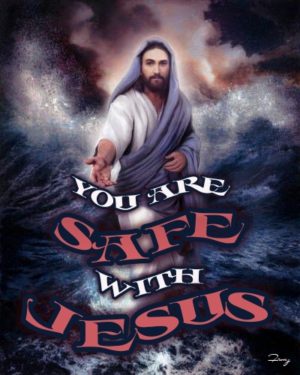
The image is a digitally created depiction with strong Christian symbolism. Let's break down the elements:
* Subject: → The central figure is a representation of Jesus Christ. He's portrayed with a long beard, flowing hair, and traditionally styled robes (a white tunic and a blue/purple cloak). This visual style is common in Christian art and iconography.
* Pose/Action: → Jesus is depicted reaching out his hand towards the viewer. The gesture signifies invitation, help, comfort, and salvation. This is a core tenet of the Christian faith: Jesus offers a path to safety and security.
* Background: → The background is a turbulent sea. The waves are high and the sky suggests a storm. This symbolizes the challenges, trials, and dangers of life. The implication is that even in the midst of chaos and hardship, Jesus provides a haven.
* Text: → The text "YOU ARE SAFE WITH JESUS" is prominently displayed across the image. The bold, stylized font and the way the text is layered over the image's visual elements emphasize its importance as the central message. The red and white coloring of the text further draws attention.
* Overall Tone: → The image evokes a feeling of comfort, hope, and reassurance. It's designed to offer solace to those who might be experiencing difficulties or challenges in their lives. It tells the viewer, with Jesus as a refuge, they can be safe.
Article: →
Finding Refuge in the Storm: The Everlasting Promise of Safety with Jesus →
In a world often marked by turmoil, uncertainty, and overwhelming trials, the promise of safety becomes a deeply cherished hope. Christians find this hope embodied in the figure of Jesus Christ, the central figure of their faith. The image before us visually encapsulates this very idea, offering a message of profound comfort and reassurance: "YOU ARE SAFE WITH JESUS."
The artwork is a potent reminder of the Christian belief that Jesus offers refuge from the storms of life. The visual metaphor of a turbulent sea juxtaposed with the serene presence of Jesus is particularly impactful. The crashing waves and dark sky represent the struggles and hardships we encounter—the challenges, the fears, the doubts, and the pain that can feel like an unending tempest. These are the trials and tribulations that can engulf us.
At the center of this visual drama stands Jesus, reaching out his hand towards the viewer. This simple gesture conveys a multitude of messages: invitation, compassion, and the promise of salvation. The extended hand is an offer of refuge, a plea to cast your burdens upon him, and an embodiment of the Christian faith's core message: Jesus is here to help. He offers solace to all who are in trouble and a way out of the storm.
The inscription "YOU ARE SAFE WITH JESUS" amplifies the visual message. It is a declaration of faith, a statement of truth, and a source of immense comfort. To Christians, "safety" means more than physical protection; it encompasses spiritual security, peace of mind, and the assurance of eternal life. It means finding comfort in the knowledge that you are not alone, that your burdens are understood, and that you are loved unconditionally.
This image serves as a reminder that even in the fiercest storms of life, there is always a sanctuary, a place of peace, and an unyielding source of strength. It invites us to trust in Jesus, to embrace his love, and to find refuge in his grace. It’s a message of enduring hope: no matter how turbulent life may become, you are safe with Jesus. This visual expression reminds us that God’s love never fails and his promise is always with us. It is this promise of hope that guides the heart of every Christian through the storms.
The image is a religious illustration, intended for devotional or inspirational purposes. It uses imagery associated with Christianity to convey a message of faith, reliance on God, and a plea for spiritual guidance. The visual style leans towards a somewhat stylized, digitally-enhanced appearance, common in many religious graphics.
Visual Elements and Symbolic Interpretation: →
1. Central Figures: →
* Jesus: → The central figure is depicted as Jesus Christ. He is holding someone, a believer or follower. Jesus is often portrayed with a beard, long hair, and traditional robes, the image suggests compassion and care for someone in need, mirroring the Christian belief in Jesus's role as a savior and protector.
* The Person Held: → The person being held is an important detail that indicates being saved by Christ.
2. Textual Elements: →
* "I NEED YOUR" →: This is a direct plea to God, expressing a sense of dependence and a desire for divine intervention.
* "HOLY SPIRIT" →: The invocation of the Holy Spirit signifies seeking guidance, comfort, and empowerment. The Holy Spirit is considered the third part of the Holy Trinity (God the Father, Jesus the Son, and the Holy Spirit) and provides wisdom, strength, and spiritual gifts to believers.
* "TO GIVE ME STRENGTH WISDOM AND DIRECTION" →: This list outlines the specific needs of the person:
* Strength →: This refers to the power to withstand challenges, temptations, and suffering. It represents resilience and inner fortitude.
* Wisdom →: The image asks for the ability to make wise decisions, understand God's will, and gain insight into life's complexities.
* Direction →: This signifies seeking guidance and a clear path to follow in life, aligning with God's purpose.
3. Color and Atmosphere: →
* The color scheme leans towards soft, pastel tones, with blues and purples dominating. This creates a feeling of peace, serenity, and spirituality.
* The ethereal background, with its subtle lighting effects, suggests a divine or heavenly presence.
Overall Message and Interpretation: →
The image communicates a clear message of faith and dependency on God. The person held in the arms of Jesus symbolizes the believer's complete reliance on him. The plea for the Holy Spirit's intervention emphasizes the need for divine help in overcoming difficulties, making wise choices, and finding direction in life. The image, therefore, serves as a visual prayer or a statement of faith, reminding viewers of the importance of seeking guidance and support from God in their daily lives.
Uses and Context: →
* Religious Publications and Websites: → The image could be used in devotional materials, social media posts, or websites focused on Christian faith and spirituality.
* Personal Devotion: → The image can be used as a visual aid for prayer and contemplation.
* Cards and Gifts: → The image is appropriate for inspirational cards, gifts, or merchandise related to Christian themes.
* Inspirational Posters or Artwork: → The image could be featured as a piece of artwork designed to provide encouragement, strength, and faith.
The image is a Christian-themed visual representation conveying a message of faith, reliance on Christ, and the ability to overcome challenges through Him. Here's a breakdown:
* Central Figure: → The central focus is on a child being held by a figure, representing Christ. The figure is dressed in a robe.
* Action: → The child is being held, walking or just holding onto the adult figure, with a very slight amount of movement, this suggests trust and guidance.
* Color Palette: → The image uses soft, warm colors, with the light emphasizing Christ.
* Text Overlay: → The most prominent feature is the text overlaid on the image. It reads: "I can do all things through Christ who strengthens me."
Article: →
"Finding Strength in Christ: A Message of Hope and Empowerment" →
The image presents a powerful message of hope and resilience rooted in Christian faith. The central image is a visual representation of the Christian belief in Christ as a source of strength, guidance, and the ability to overcome life's challenges.
The core message is encapsulated in the words: "I can do all things through Christ who strengthens me." This verse is a paraphrase of Philippians 4:13 from the Bible, this scripture often encourages people to find strength in their faith. It suggests that with Christ, one is empowered to face any circumstance, no matter how difficult.
Elements of the Image: →
* Christ's Guidance: → The act of Christ holding the child can be interpreted as a symbol of protection, care, and guidance. It is a reminder that God is always present.
* Trust and Faith: → The image of the child held by Jesus depicts trust and faith, as the child is trusting of Jesus and is not walking alone.
* Overcoming Challenges: → The message speaks to the ability to "do all things". This means the Christian can overcome challenges through Jesus.
How to Apply This Message: →
The message of the image encourages believers to:
* Seek Strength in Christ: → When facing difficulties, turn to prayer, scripture, and faith for strength.
* Trust in God's Guidance: → Believe that God is present and guiding.
* Live with Hope: → Embrace a positive outlook, knowing that with Christ, challenges can be overcome.
In essence, the image is a visual expression of the core Christian tenet of finding solace, strength, and empowerment through a personal relationship with Christ. It's a message of hope, perseverance, and the belief that nothing is impossible with God's help.
Article: A Morning Walk of Faith →
The image presents a powerful message of faith, drawing on visual and textual elements to encourage a daily commitment to prayer and courage. Let's break down its components:
Visuals: →
* The Setting: → The backdrop is a serene scene of dawn or sunset, with a sun either rising or setting over water. The warm colors of orange, yellow, and gold create a sense of peace, hope, and the start of a new beginning. This imagery is frequently associated with a fresh start and a promise of a new day.
* The Figure: → The silhouette of a person walking towards the horizon (or away from the viewer) is a central element. The person's posture suggests a journey, perhaps representing the journey of life or a spiritual path. The anonymity of the figure allows the viewer to imagine themselves in that position, embarking on their own day with God.
* The Bridge/Dock: → The figure is walking on a structure that appears to be a pier or a bridge. This structure suggests a path, a way to cross over, or a connection between the person and something beyond. This could symbolize our connection with God, navigating through life's challenges, and bridging the gap between our earthly existence and the spiritual realm.
Textual Elements : →
* "START YOUR DAY": → This is the opening call to action. It directly urges the viewer to begin their day with intention.
* "WITH A SIMPLE PRAYER": → This reinforces the core message. It highlights the significance of prayer as an essential element of a Christian life. The word "simple" suggests that even a brief, heartfelt conversation with God at the beginning of the day can make a huge difference.
* "Lord, Lead the way": → This central phrase is a declaration of faith and reliance on God. It's a prayer, asking for guidance, direction, and blessing throughout the day. This acknowledges God's authority and wisdom in one's life.
* "THEN BE COURAGEOUS": → This is a call to action after prayer. It signifies that following God's lead requires boldness and fortitude, regardless of any challenges that may come.
* "AND FACE THE DAY": → This final directive, encouraging the viewer to approach each day with a positive attitude and a willingness to embrace whatever it might bring.
Message and Christian Interpretation: →
The image weaves together a message perfectly aligned with Christian values:
* Prayer: → The emphasis on starting the day with prayer underscores the importance of communicating with God. Prayer is a way to seek guidance, express gratitude, and strengthen one's relationship with God.
* Guidance and Trust: → The "Lord, lead the way" directive reflects the Christian belief in God's guiding hand in every aspect of life. It emphasizes the importance of trusting in God's plan and seeking His wisdom.
* Courage: → The encouragement to "be courageous" is consistent with the Christian view that believers should approach life's challenges with bravery and perseverance, relying on God's strength.
* Daily Commitment: → The overall message encourages a daily commitment to faith, reminding the viewer that each day presents an opportunity to live a life of purpose, guided by God.
* Hope and New Beginnings: → The imagery of the sunrise/sunset symbolizes hope, new beginnings, and the possibility for a transformed day.
In conclusion, → the image is a visually and textually rich piece of Christian art. It powerfully expresses the call to begin each day with prayer, trust in God, and find courage to face the challenges ahead.
A Beacon in the Heavens: An Analysis of a Christian Image →
The image presented is a powerful visual statement deeply rooted in Christian faith. It depicts a scene intended to evoke feelings of hope, reassurance, and divine presence. Let's break down the elements and their significance:
Visual Elements and Symbolism: →
* Central Figure: → The focal point is a figure shrouded in a flowing white or light-colored robe. This instantly evokes the image of Jesus Christ, a core figure in Christianity. The posture is one of grace and serenity, suggesting a calm and unwavering presence. The figure's head is subtly bowed, possibly in humility or contemplation.
* Radiance/Light: → Emerging from behind the figure's head is a bright, radiating light. This is a potent symbol of divinity, enlightenment, and the presence of God. It also suggests that Jesus is the light of the world, a guiding star for believers.
* Sky/Background: → The backdrop is a cloudy sky, rendered in shades of blue and purple. The stars twinkling within the sky add to the sense of vastness and the celestial realm. This adds to the feeling of the image, which provides a sense of spiritual comfort.
* Text: → The word "Jesus" is prominently displayed above the figure, in elegant, stylized lettering. This clarifies the identity of the figure and immediately establishes the religious context. The words "Won't Let You Down" are situated at the bottom of the image. This is a key message of the image, implying a promise of support, security, and faithfulness from Jesus.
Overall Message and Interpretation →
The image's primary message is one of hope, faith, and reassurance to Christians. By depicting Jesus radiating light against the backdrop of the heavens, the image conveys the following:
* Divine Presence: → Jesus is present, watching over, and guiding believers.
* Hope in Difficulty: → The image can provide hope and comfort to those facing challenges.
* Unwavering Support: → Jesus' promise to "Won't Let You Down" reinforces the belief that believers are not alone.
Christian Context →
The image’s symbolism is deeply Christian:
* Jesus: → The central figure, the son of God, the savior of humanity.
* Light: → Represents God's presence, truth, and the path to salvation.
* Faith: → Trusting in Jesus and His promises.
* Hope: → The expectation of eternal life and overcoming worldly struggles.
Potential Uses and Appeal: →
This type of image is commonly found in various contexts, including:
* Personal Devotion: → Used as a source of inspiration and comfort in homes or personal spaces.
* Religious Materials: → Included in prayer cards, pamphlets, and church bulletins.
* Social Media: → Shared on social media platforms as a message of faith and encouragement.
Conclusion: →
This image is a well-crafted visual representation of key Christian beliefs. By effectively utilizing symbolism, the image seeks to strengthen faith, provide comfort, and remind believers of the constant support and love that Jesus represents. It serves as a beacon of hope, especially in times of difficulty, reinforcing the message that the believer is never truly alone.
Image Analysis and Interpretation: "Trust in the Lord with all your heart" →
The image is a powerful and evocative depiction of a Christian faith principle. Here's a breakdown of its elements and their significance:
* Visual Composition: → The image centers on the hands and feet of a figure. The focus on the physical gestures draws the viewer in, creating a sense of intimacy and vulnerability. This is a key element in Christian storytelling; the idea of closeness and how God works intimately with humanity.
* The Hands and Feet: → The close-up on hands (of Jesus) is shown helping another's feet, is a powerful visual motif. It conveys the idea of aid and protection. The feet represent our journey through life, and the hands may represent Christ or the divine, providing support and guiding. This action illustrates faith, and commitment to God, and how faith makes a huge difference in our lives and how we live them.
* Color Palette: → The color palette appears warm, with shades of white and gold. These colors often symbolize purity, divinity, and heavenly realms in Christian art, reinforcing the spiritual theme. The background appears golden, representing the glory of God and the goodness that can come from following His teachings.
* Text Overlay: → The text "TRUST IN THE LORD WITH ALL YOUR HEART" is superimposed over the image. This is a direct quote from Proverbs 3:5-6, a well-known verse in the Bible. The placement of the words around the hands and feet emphasizes that this trust is central to our faith journey.
* Overall Tone: → The image carries a deeply spiritual and comforting tone. It is meant to inspire trust, faith, and surrender to a higher power.
The Christian Significance of "Trust in the Lord with all your heart" →
The message "Trust in the Lord with all your heart" is at the core of Christian belief. It speaks to the following core ideas:
* Faith and Belief: → The verse calls for a complete and unreserved faith in God, acknowledging His guidance and wisdom. It goes beyond simply believing in God's existence; it involves trusting in His plans, even when they are not immediately understood.
* Surrender and Humility: → Trusting in God requires a surrender of our own will and understanding. It is an acknowledgment that God's ways are higher than our own (Isaiah 55:8-9).
* Guidance and Providence: → Christians believe that God is actively involved in their lives, guiding them and providing for their needs. Trust in the Lord is the key to experiencing this divine guidance and protection.
* The Importance of Intention: → The phrase "with all your heart" is vital. It stresses that trust must be genuine and wholehearted. It is not enough to merely give lip service; it must come from a sincere and devoted heart.
* Living a Life of Faith: → This message encourages Christians to live a life centered on God. It suggests that even when the future looks uncertain, a steadfast faith and reliance on God will bring peace and stability.
How This Image Relates to the Christian Faith →
The image serves as a visual reminder of these core tenets of Christian faith. Its symbolism evokes:
* The Relationship between God and humanity: → The hands represent Christ's care and support, demonstrating God's active role in our lives.
* Overcoming Obstacles: → It offers hope and encouragement, reminding believers that God is with them during challenges and trials.
* Seeking Faith in Everyday Life: → The image serves as an invitation to reflect on this key concept and its role in shaping our daily decisions and actions.
* Comfort and Solace: → For Christians facing difficult circumstances, this image can provide solace and a renewed sense of faith.
* Evangelism and Inspiration: → The image can be a tool for sharing the Christian message with others. The inspiring words and visuals can touch hearts and encourage a search for faith.
Conclusion →
This image is a profound and spiritually enriching representation of Christian values. It emphasizes the central importance of faith, trust, and surrender to God in the pursuit of a meaningful life. The visual elements, coupled with the powerful message, create a lasting impression, offering a message of hope, guidance, and unwavering faith for all who view it.
Image Analysis: A Plea for Guidance →
The image is a visually powerful and overtly Christian devotional piece. It combines imagery and text to express a prayerful request for guidance, correction, direction, and protection from God. Let's break down the key elements:
* The Central Figure: → The dominant figure is a representation of Jesus Christ. He is depicted in a meditative pose, sitting on a rocky outcrop with his hands clasped in prayer. His appearance (long hair, beard, flowing robes) is consistent with traditional artistic representations of Jesus. The rocky setting and the implied sunrise or sunset suggest a time of solitude and contemplation. This suggests seeking intimacy with God in prayer.
* The Text: → The central message is conveyed through the text, which is strategically placed across the image:
* "Lord": This addresses God directly, acknowledging his sovereignty and power.
* "Correct Me": This indicates a willingness to be disciplined, guided, and taught by God, even when it's uncomfortable. It's a humble recognition of the need for self-improvement.
* "Direct Me": Implies a request to God to lead the believer along the right path, to make decisions that align with His will.
* "And": This coordinating conjunction links the previous requests to the following one.
* "Protect Me": This is a plea for God's safety and defense against harm, both spiritual and physical.
* The Background and Reflection: → The background is a scene that evokes the natural world, which in Christian art, reflects God's creation. This evokes nature's beauty and, potentially, its awe-inspiring power and mystery. The watery surface at the bottom creates a reflection, adding a sense of depth and mirroring the image of Jesus. This suggests that God's presence is reflected in our life.
* Overall Impression and Meaning: → The image is a clear invitation to prayer. It communicates several important Christian themes:
* Humility and Submission: → The willingness to be corrected is a mark of humility and surrender to God's authority.
* Trust and Reliance: → The call to be directed and protected expresses a deep trust in God's care and guidance.
* Spiritual Growth: → The entire message is about seeking spiritual growth, aligning oneself with God's will, and seeking his presence in daily life.
* Personal Devotion: → The image encourages viewers to establish or deepen a personal relationship with God.
Artistic Style and Interpretation: →
* The style of the image is a blend of realism (in the depiction of Jesus) and a more illustrative or devotional style. This is typical of Christian art designed to be readily accessible and emotionally engaging.
* The warm color palette and lighting enhance the sense of peace, hope, and spirituality.
* The composition is simple and direct, making it easy for the viewer to understand and connect with the message.
In Summary: →
This image is a visual prayer, a reminder of the Christian call to rely on God for guidance, correction, direction, and protection. It is designed to inspire a sense of faith, humility, and trust in the believer's relationship with God.
A Visual Proclamation of Faith: Deconstructing the "Jesus Loves You" Image →
The image presented is a digitally-created Christian illustration. It's a visual representation of faith, offering a message of love and devotion centered around the figure of Jesus. The composition, text, and symbolism are all strategically employed to convey a specific message of hope and reassurance.
Visual Elements and Composition: →
* Central Figure: → The primary focus is on a figure of Jesus. He is depicted with traditional characteristics: long hair, a beard, and a robe. He is positioned with his arms raised towards the sky, a gesture that could be interpreted as a sign of praise, blessing, or acceptance.
* Surrounding Atmosphere: → The background is a soft, blurred landscape with warm, pastel colors, suggesting a heavenly or serene environment. This adds to the overall feeling of peace and tranquility.
* The Lambs: → At the base of the image, there are several lambs, meant to symbolize Jesus' role as the "Good Shepherd," who cares for and protects his "flock."
* Font & Text: → The text elements in the image are significant. The words "Jesus," "Loves You," "To The Cross," and "And Back" are placed to surround and emphasize Jesus. The stylized, slightly textured font with a drop shadow gives the message a sense of depth and permanence.
The Message and Meaning: →
The central message of the image is "Jesus Loves You To The Cross And Back."
* "Jesus": → The direct acknowledgment of Jesus' existence and role in Christian faith.
* "Loves You": → This is the most crucial part of the message, emphasizing God's unconditional love for humanity. This love is a fundamental tenet of Christian belief.
* "To The Cross": → This phrase references the crucifixion of Jesus. The cross symbolizes sacrifice, suffering, and ultimately, salvation within the Christian narrative. The phrase implies Jesus' ultimate act of love for humanity.
* "And Back": → This refers to the resurrection of Jesus, the event that Christians believe signifies the triumph over death and the promise of eternal life.
Symbolism and Religious Context: →
The image draws heavily on Christian symbolism:
* Jesus: → Represents the Son of God, the savior of humankind.
* The Cross: → Represents Jesus' sacrifice, forgiveness, and atonement for the sins of humanity.
* The Lambs: → Symbolize purity, innocence, and the believers in Jesus' flock. They are also symbolic of the believers that have been saved by Jesus.
Overall Interpretation: →
The image is a visual evangelistic tool aimed at providing comfort and reinforcing faith. It presents a simple, accessible message of love, hope, and redemption. It is an affirmation of the core beliefs of Christianity, emphasizing the importance of Jesus' sacrifice and the promise of salvation.
Style and Usage: →
The style of the image is characteristic of popular religious artwork, suitable for sharing on social media, printed materials, or personal display. It is intended to uplift, inspire, and share the message of Christian love and faith with the viewer.
Conclusion: →
The image is a deliberate visual representation of Christian faith. It conveys a simple message of love and sacrifice, using familiar symbolism to communicate the key tenets of Christianity. The combination of visual elements and text makes this image a powerful message of hope.
The image depicts a man standing before a wall on which the words "Christianity is the reasonable conclusion" are written. He appears to be in the act of writing the phrase himself, or at least modifying it. This suggests an active participation in affirming this belief. The style of the writing on the wall appears to be hand-drawn, giving it a personal and perhaps informal feel. The simple background and the focus on the man and the message place emphasis on the core idea presented. The overall tone is one of conviction and a claim to intellectual justification.
Article: The Reasonable Conclusion: Exploring the Argument for Christianity →
The image presented – a lone figure adding the finishing touches to the phrase "Christianity is the reasonable conclusion" on a stark, textured wall – immediately evokes a powerful statement. It’s a bold assertion, a claim that resonates deeply with many and provokes contemplation in others. But what does it truly mean to suggest that Christianity → is the “reasonable conclusion”? This article aims to unpack this complex statement, exploring the arguments often presented in its favor and the potential challenges they face.
The assertion rests on the idea that Christianity →, as a belief system, offers the most logical and coherent explanation for the fundamental questions of human existence. These questions often include:
* The Origin of the Universe: → Many Christians embrace the Genesis account of creation. They believe that the intricate complexity and order observed in the universe point to an intelligent Creator God, rather than random chance or purely naturalistic processes.
* The Meaning of Life: → Christianity → offers a purpose for existence, emphasizing the relationship between God and humanity. Life is seen as a sacred gift, a journey with a divinely appointed destiny, and a calling to live according to God's will.
* Moral Values: → For many Christians, morality originates from God and his inherent goodness. The belief in absolute moral standards, such as love, compassion, and justice, is seen as vital. Without a divine foundation, these values could be perceived as subjective or arbitrary.
* The Problem of Evil: → Christianity → provides a framework for understanding the presence of evil and suffering in the world. This is often explained through concepts like the "fall" of humanity, the role of free will, and the ultimate triumph of good over evil through Jesus Christ.
* Hope and the Afterlife: → A core tenet of Christianity → is the promise of eternal life and the hope of a relationship with God. This offers comfort and meaning in the face of death and the uncertainties of existence.
Reasonable Arguments in Favor of Christianity →
Proponents of Christianity → as a reasonable conclusion often cite:
* Historical Evidence: → The life, death, and resurrection of Jesus Christ are central. Proponents argue that the biblical accounts are supported by historical research, archeology, and the widespread influence of Christianity → throughout history.
* Philosophical Arguments: → Many thinkers have found Christianity → to be the most logically consistent and intellectually satisfying framework for understanding reality. They point to the existence of God, the nature of humanity, and the possibility of eternal life.
* Personal Experience: → Faith is often a deeply personal matter. Many individuals report having profound experiences of God's presence in their lives, leading them to conclude that Christianity → is true.
* The Transformative Power of Christianity: → Christianity has shown its ability to inspire acts of love, compassion, justice, and reconciliation throughout history.
The image is a digitally created composition that combines several elements to convey a clear Christian message. The primary elements are:
* A Young Boy: → A fair-skinned young boy is centered, his eyes are closed, and his expression is one of serene happiness. He is holding a large, old-looking Bible. His posture suggests peace and comfort.
* The Word "Spoiler": → Above the boy's head, enclosed in a rounded rectangle, is the word "SPOILER".
* The Phrase "We win.": → Large, bold text on the right side of the image reads "We win."
* Three Crosses: → In the background, silhouetted against the sky, are three crosses. This is a direct reference to the crucifixion of Jesus.
* Color Palette and Background: → The color palette leans towards warm, inviting hues of orange, pink, and purple, creating a soft, hopeful ambiance. The background appears to be a sunset or sunrise, which adds to the sense of optimism.
Symbolism and Interpretation →
The image relies heavily on Christian symbolism to communicate its message:
* The Boy: → The innocent and joyful young boy embodies faith and trust. His closeness to the Bible, and peaceful countenance suggests faith and spiritual nourishment.
* The Bible: → The book the boy is holding represents the word of God. The old, worn appearance of the book implies that the Bible is a timeless and enduring source of truth and guidance.
* The Crosses: → The three crosses are the most potent symbol of Christianity. They symbolize the sacrifice of Jesus Christ, who was crucified. In Christian theology, the crucifixion is seen as the ultimate act of love and atonement for the sins of humanity.
* "We win.": → This statement, placed in proximity to the crosses and the "Spoiler" tag, is the core message. It reinforces the Christian belief in the ultimate victory of good over evil, life over death, and the promise of salvation through faith in Jesus Christ.
* "Spoiler" →: The image cleverly uses the term "spoiler" to play on the common practice of revealing the end of a story. Here, the image suggests that the ending of the "story" of life is predetermined, and it will be a victory for those who have faith.
Overall Message →
The image delivers a message of hope, faith, and the promise of eternal life through Jesus Christ. It uses familiar Christian symbols to reassure believers about the outcome of their faith. The use of a young boy and the warm color scheme gives the image a welcoming, comforting feel.
Possible Audience →
This image is clearly intended for a Christian audience. It is likely to resonate with those seeking comfort, reassurance, and reinforcement of their faith.
In essence, the image is a visual representation of the Christian belief in the ultimate triumph of faith, life, and salvation through the sacrifice of Jesus Christ.
The image is a digitally created artwork with a strong Christian message. It evokes a sense of hope, spirituality, and the promise of the afterlife. It combines elements of the celestial, the divine, and human aspiration.
Visual Elements and Composition: →
* Centerpiece: Jesus Figure. → The image prominently features a rendering of Jesus Christ. He is depicted with the classic features: long brown hair, a beard, and is wearing a flowing white robe. His arms are outstretched in a gesture of embrace or invitation. He stands in a majestic pose on what appears to be clouds. His expression is one of serene kindness.
* Background: Stellar Landscape. → The background is a stunning visual representation of the cosmos. It includes a deep blue night sky filled with countless stars, and prominent nebula colors of pink and purple. A bright, circular glow near the top suggests a celestial body, possibly representing the sun or God's presence.
* Text: → The words "ANOTHER DAY ON THE ROAD TO PARADISE" are superimposed across the image in a flowing, stylized font. The text is positioned to create a sense of movement, almost like a banner or ribbon leading the viewer's eye from top to bottom.
* Clouds: → White, fluffy clouds appear at the bottom of the image, partially obscuring Jesus's feet and adding a sense of his divine location.
* Signature: → The artist's signature, "Frenz," is located in the lower right corner.
Symbolism and Interpretation: →
* Jesus's presence: → The image clearly represents a Christian faith based message of Jesus's power, invitation, and compassion.
* Road to Paradise: → The phrase "Another Day on the Road to Paradise" is the central theme. It suggests the journey of faith and the aspiration towards eternal life and salvation, with each day a step closer to a divine reward.
* Cosmos: → The background of the image is meant to enhance the divine aspect of the message by using the immensity and wonder of the cosmos to depict the spiritual realm of God.
* Outstretched Arms: → Jesus's open arms and welcoming pose represent the love and acceptance offered by the Christian faith. It's an invitation to embrace the faith, to seek forgiveness, and to find comfort in divine grace.
* Clouds: → The clouds emphasize Jesus' divine status, associating him with the celestial realm.
Overall Message: →
The artwork as a whole aims to inspire faith, hope, and encouragement. It is an invitation for viewers to reflect on their spiritual journey, to seek solace in their faith, and to find the strength to live a life aligned with Christian values. The visual composition and the uplifting message are intended to provide comfort and hope.
The image is a visually appealing and impactful piece of Christian-themed art. It uses a combination of text and imagery to convey a message about love and faith, emphasizing the model of Jesus Christ.
Visual Elements: →
* Typography: → The primary focus is the bold, three-dimensional text "LOVE LIKE JESUS." The letters are designed with a sleek, modern aesthetic. They have a glossy, reflective appearance, suggesting a depth and sophistication. The font style is clean and easy to read, ensuring the message is clear.
* Color Palette: → The image utilizes a predominantly warm color scheme.
* The font has an off-white color
* The background has a bright blue color.
* Composition: → The text is centered and takes up a significant portion of the frame, drawing the viewer's attention immediately. The letters are arranged in an upward fashion, which draws a sense of elevation and importance.
Message and Interpretation: →
The central message is clear: "Love Like Jesus." This phrase is a core tenet of Christianity, encouraging believers to emulate the love, compassion, and sacrifice demonstrated by Jesus Christ. The design's use of the embedded images within the letters enhances this message.
Overall Impact: →
This image is a well-crafted and emotionally resonant piece of art. Its simplicity, combined with its carefully chosen visual elements, makes it effective in conveying its message. It is intended to inspire, encourage, and remind viewers of the importance of Christian love and devotion.

The image is a visually striking piece that conveys a strong sense of hope, comfort, and faith, with Christian undertones. The central message is one of reunion, implying a belief in an afterlife where separation is temporary. The use of imagery and text creates a powerful emotional impact.
Text and Composition: →
* Message: → The prominent text "WE WILL MEET AGAIN" is the core of the image. This phrase offers solace to anyone experiencing loss or separation. It speaks to the idea of a future reunion, often associated with religious beliefs about the afterlife, or a general expression of hope.
* Arrangement: → The words are arranged in a visually appealing, stacked format. The "WE WILL" portion is at the top, followed by "MEET" and then "AGAIN." This structure draws the eye down the image.
* Font & Style: → The font is bold and blocky, adding to the visual impact. The words are outlined in a dark color with a slight reflection on the bottom, creating a sense of depth. The blocky style helps emphasize the significance of each word.
Imagery and Symbolism: →
* Figures within the Words: → The letters are filled with painted images. This is a key aspect of the image's symbolism.
* The "WE" has a picture of someone hugging someone else, possibly symbolizing the connection of people.
* The images are bright and full of colors, and maybe symbolize the light of the afterlife.
* Lighting & Effects: → The sunburst or bright light emanating from the top right corner is a common symbol for the divine, heaven, or enlightenment. It adds a sense of hope, peace, and transcendence.
* Background: → The background is a sky with clouds. This helps establish the atmosphere of peace and eternity.
Interpretation and Meaning: →
* Christian Associations: → Given the core message of reunion and the use of heavenly light, this image strongly resonates with Christian beliefs about heaven and the afterlife. It's a message of faith, comfort, and the promise of a future meeting with loved ones who have passed on.
* Universality: → While it leans towards Christian themes, the message of "We Will Meet Again" can be interpreted more broadly. It could offer comfort to anyone experiencing loss, promoting hope for a reunion in a meaningful way.
Overall, the image is a well-designed piece of visual communication that effectively conveys a message of hope, comfort, and faith. It combines striking text with imagery that evokes a sense of peace, the divine, and the promise of reunion. The overall effect is emotionally uplifting and comforting.
The image is a visually engaging piece of Christian art designed to convey a message of love and faith. It combines a stylistic presentation with a powerful religious sentiment. Here's a breakdown of its elements:
1. Composition and Design: →
* Text as the Focal Point: → The phrase "YOU ARE LOVED" is the primary visual element. The words are presented in a bold, three-dimensional style, with a slightly distressed, almost metallic appearance. This emphasizes the message, making it immediately noticeable.
* Jesus as the Fill: → Within the letters of the text, an image of Jesus is integrated. This is the core of the message. Parts of his face, body, and outstretched hand are visible within the cutouts of the letters. It's like a message from him through the words.
* Color Scheme: → A harmonious color scheme is in place. The background is a soft, pale pink, which provides a gentle and inviting backdrop. The words have a color palette of gray, white, and dark blue with light brown outline to provide contrast. This combination of colors works well to create a sense of warmth and serenity.
* 3D Effect: → The words seem to be raised or extruded, providing a sense of depth and dimensionality, giving the image a more contemporary look.
2. Symbolism and Interpretation: →
* "You Are Loved": → This simple phrase is the central message, a core tenet of Christianity. It's a statement of divine love and acceptance.
* Jesus's Presence: → The incorporation of Jesus's image within the text is symbolic. It suggests that the message of love is directly from Jesus. His presence signifies comfort, grace, and salvation, that the image of Jesus brings hope to everyone. It reminds the viewer that they are loved unconditionally and welcomed.
* Reaching Out: → The image depicts Jesus reaching out his hand. This gesture can be interpreted as an invitation.
3. Style and Tone: →
* Modern & Appealing: → The design aesthetic is modern and appealing. It's meant to resonate with a contemporary audience while still maintaining a strong religious message.
* Reassuring and Uplifting: → The overall tone is positive and encouraging. The combination of the message, the image of Jesus, and the warm color palette creates a sense of reassurance and hope.
Article: →
A Message of Hope: "You Are Loved" in Contemporary Christian Art →
In a world often filled with complexities and uncertainties, the simple yet profound message of "You Are Loved" continues to resonate deeply with the human spirit. This particular piece of Christian art encapsulates that message beautifully, merging contemporary design with timeless spiritual themes.
The artwork's power lies in its directness. The phrase "YOU ARE LOVED," rendered in a bold, three-dimensional style, immediately captures the viewer's attention. But the brilliance lies in the execution: within the letters, a visual representation of Jesus is subtly, yet powerfully, present. His image, with a gentle expression and outstretched hand, affirms the message.
The colors used in the image are carefully chosen to create a calming and inviting atmosphere. The soft pink background provides a gentle backdrop, allowing the words and Jesus's presence to stand out.
The overall effect is one of warmth, comfort, and hope. This artwork is not just a pretty picture; it is a statement of faith and a reminder of divine love. It's a visual prayer, a declaration of belonging, and a testament to the enduring power of the message of love in Christianity. This image is a reminder that, amidst the trials of life, we are seen, loved, and valued.
The image is a graphic, primarily textual, with a strong Christian message. Here's a detailed breakdown:
* Text: → The primary message is conveyed through the words "HE HEALS OUR WOUNDS." The font appears to be a 3D, stylized block font, lending a sense of depth and importance to the message. The colors appear to be an off-brown or reddish-brown with a contrasting metallic border, giving it a distinct pop out effect.
* Imagery: → Within the letters, there's an image of a fair-skinned Jesus figure, which seems to show him reaching out to others. This subtly reinforces the message of healing and compassion.
* Color Palette: → The image utilizes a blue backdrop and a blue surface for the letters to sit upon. The colors are cool and calm. The contrast between the warm letter colors and cool background colors helps the text stand out.
* Style and Composition: → The design is clean and modern, with a touch of dimensionality. The letters are positioned at a slight angle and have a metallic outline that creates a sense of depth and realism. The use of perspective and reflection gives the image a more immersive feel.
Article: Healing and Hope: An Image of Christian Faith →
The power of faith often finds expression in compelling visual representations. One such image, "HE HEALS OUR WOUNDS," offers a message of comfort, hope, and divine intervention, resonating deeply within the Christian faith.
The image's core message is conveyed through its bold typography. The words "HE HEALS OUR WOUNDS" are presented in a prominent, three-dimensional font. This deliberate choice emphasizes the significance of the words, as if they were statements of enduring truth.
The background imagery embedded within the letters adds depth to the message. The image subtly depicts a fair-skinned Jesus figure. This carefully chosen imagery acts as a visual metaphor for the core tenets of Christian belief: Jesus' role as a source of healing and redemption for humanity.
The color palette amplifies the image's impact. The use of warm colors for the text and a cool blue backdrop creates a visual contrast. The effect is captivating, capturing the viewer's attention. The overall composition exudes a sense of peace, inviting contemplation and spiritual reflection.
In its entirety, the image "HE HEALS OUR WOUNDS" serves as a visual sermon. It offers a message of solace to those suffering physically, emotionally, or spiritually. The image is more than just an aesthetic piece; it is a reminder of the Christian belief in divine grace, healing, and the promise of restoration. It is a message of hope, reminding us that healing is possible and that we are not alone in our struggles.
Analysis of the Image: "Seek and You Will Find the Truth" →
The image is a visually striking, digitally created work with a strong Christian message. Here's a breakdown:
1. Visual Elements: →
* Text: → The core of the image is the inscription "SEEK AND YOU WILL FIND THE TRUTH". The words are arranged in three lines, using a bold, capital letter font. The font has a 3D-effect with a slight shadow or bevel, giving them depth.
* Background/Fill of Text: → Within the outlines of the letters, there are embedded images. The "SEEK" letters seem to contain a landscape with trees and sky. The "AND YOU WILL FIND THE TRUTH" letters have an image of Jesus, the letters filled with landscapes.
* Jesus: → Within the letters "AND YOU WILL", the image of Jesus is incorporated. Jesus is depicted with long hair and a beard, wearing flowing robes. His pose is gentle and contemplative.
* Color Palette: → The color scheme is warm and inviting, primarily featuring shades of gold, yellow, orange, and brown, along with cool blues in the background. This creates a sense of warmth, hope, and serenity.
* Background: → The background transitions from a deep blue at the bottom to a lighter, more pastel blue at the top. This gradient effect adds depth and enhances the overall visual appeal.
* Reflection: → A reflective surface is simulated at the bottom, creating a mirror effect. This reflection mirrors the image, making it more eye-catching.
* Signature: → The signature "Frenz" is visible at the bottom right.
2. Message and Interpretation: →
The central message, "SEEK AND YOU WILL FIND THE TRUTH", is a direct quote from the Bible, often attributed to Jesus. It is a call to actively search for spiritual understanding, knowledge, and ultimately, a relationship with God.
* "Seek": → This suggests an active pursuit, a conscious effort to find something of value. It requires an open mind, willingness to learn, and the determination to find answers.
* "You Will": → This implies a promise, suggesting that effort put into seeking will be rewarded.
* "Find The Truth": → "The Truth" is often understood in a Christian context as Jesus Christ, or God's teachings. It implies that those who diligently seek will discover God and His teachings.
3. Artistic Style and Technique: →
* Digital Art: → The image appears to be a digital rendering, with a polished, professional quality. This suggests that it was created with specialized software.
* 3D Effects: → The use of a 3D font and reflective surface gives the image a modern, almost cinematic feel.
* Symbolism: → The incorporation of Jesus' image is a strong visual cue to the Christian message. The landscapes within the letters could represent the journey of faith or the beauty of God's creation.
* Overall Impression: → The image conveys a message of hope, faith, and the search for meaning. It's visually appealing and likely designed to inspire and encourage viewers.
4. Intended Audience and Purpose: →
* Target Audience: → This image is intended for a Christian audience or those interested in Christian themes and values. It could be used for various purposes, such as:
* Sharing on social media to spread a message of faith.
* Used as a devotional image or wallpaper.
* As part of religious education materials.
* Used in Christian-themed art or design projects.
* Purpose: → The primary purpose is to share a message of faith and inspire viewers to seek truth. The image aims to draw attention to the spiritual journey and the promise of finding truth.
5. Conclusion: →
The image is a well-crafted piece of Christian art. It's visually attractive, with a powerful message that aligns with core Christian beliefs. Its blend of modern design elements and spiritual themes makes it an effective communication tool for inspiring and encouraging viewers.
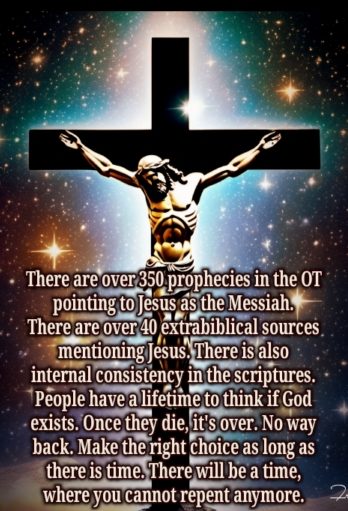
Visual Elements: →
* Central Figure: Jesus on the Cross: → The image's focal point is a depiction of Jesus Christ crucified. This is a universally recognized symbol of Christianity, representing his sacrifice for humanity's sins. The figure is presented in a classical artistic style, with visible wounds and a crown of thorns, emphasizing the suffering.
* The Cross: → The cross itself is a prominent feature, positioned behind Jesus. Its stark black silhouette creates a strong contrast against the background.
* Background: Celestial Scene: → The background is a vivid depiction of a night sky filled with stars, nebulas, and hints of cosmic wonder. This imagery creates a sense of vastness, mystery, and the divine. The use of these celestial elements further suggests the divine or transcendent realm and the connection between the earthly and the spiritual.
* Textual Overlay: → In addition to the primary visual elements, the image has a text overlay that presents specific claims and arguments related to Christianity.
Textual Content & Message: →
The text overlay provides a series of arguments supporting the Christian faith and a call to action:
* Prophecies: → *"There are over 350 prophecies in the OT pointing to Jesus as the Messiah."* This is a common apologetic argument in Christianity, suggesting that the Old Testament (OT) contains numerous predictions that were fulfilled by Jesus' life, death, and resurrection. The image implies that this is a strong evidence of Jesus' messianic identity.
* External Sources: → *"There are over 40 extrabiblical sources mentioning Jesus."* This statement highlights the existence of historical records outside of the Bible that mention Jesus. This is meant to bolster the historicity of Jesus and provide additional validation to his existence.
* Internal Consistency: → *"There is also internal consistency in the scriptures."* This refers to the idea that the different books of the Bible, despite being written by different authors over centuries, present a cohesive narrative and a unified theological message. This consistency is presented as evidence of divine inspiration and the truthfulness of the scriptures.
* Urgent Call to Action (Salvation): → *"People have a lifetime to think if God exists. Once they die, it's over. No way back. Make the right choice as long as there is time. There will be a time where you cannot repent anymore."* This is the core message of the image. It emphasizes the urgency of making a decision about faith. The text posits that a person only has a limited time on Earth to decide whether or not to accept God. After death, there will be no opportunity to change one's mind, and therefore encourages people to make the right choice.
Overall Message and Tone: →
The image as a whole conveys a strong and emotional message. The visual elements serve to grab the viewer's attention, and the text is meant to support the argument for the truth of Christianity. The tone is both persuasive and urgent, encouraging viewers to accept the Christian faith while they still have the opportunity. The image leverages a mixture of historical, theological, and personal appeals to encourage faith.
In conclusion, the image is a Christian message of faith. It uses visual elements like the image of Jesus on the Cross to draw people into the belief. The image uses text and claims to convince others and show that they should choose their faith.

The image is a visually striking piece of Christian artwork that conveys a message of hope and encouragement. It uses a clean, modern design with a focus on text and subtle imagery to communicate its core message. The phrase "GREATER THINGS ARE YET TO COME" is the central theme, hinting at a belief in future blessings and spiritual growth.
Visual Elements: →
* Typography: → The primary element is the text itself. The phrase "GREATER THINGS ARE YET TO COME" is rendered in bold, capitalized letters. The letters have a 3D appearance, giving them a sense of depth and presence. The font is modern and easily readable.
* Imagery: → The letters are filled with a subtle image of a person looking up to sky. the overall effect is soft, and the use of a grayscale or muted color palette reinforces the reverent feel.
* Color and Lighting: → The image features a limited color palette, with a dark background and a lighter gradient on the text. This creates a contrast that makes the text stand out. The lighting appears to be coming from below, creating a reflective surface beneath the text, enhancing the 3D effect and adding a sense of elegance.
* Style: → The overall style is contemporary and motivational. The combination of text, image, and lighting suggests a spiritual or religious message.
Interpretation: →
The message "GREATER THINGS ARE YET TO COME" speaks to a core tenet of Christian faith: hope for the future. The phrase encourages the viewer to believe that the best is yet to come, implying a promise of God's blessings and an opportunity for spiritual development.
* Hope and Optimism: → The core message focuses on future possibilities and encouraging a positive outlook.
* Encouragement: → The message offers reassurance that there is a brighter future ahead.
Religious Context: →
This image is highly relevant to Christian faith, but is also can be applied in other religions.
Overall, the image is a well-designed piece of inspirational artwork that effectively communicates a message of hope and faith. Its clean design and modern style make it appealing, while the underlying message of encouragement resonates with those seeking spiritual comfort and growth. →
The image is a digital graphic that combines text and imagery related to Christianity. It's designed to be motivational and comforting, particularly for individuals facing challenges or feeling a lack of control. The style suggests a modern, perhaps even somewhat edgy, appeal.
Textual Analysis →
The central message is conveyed through the following words:
* "EVEN IF IT'S OUT OF YOUR HANDS"
* "REMEMBER THAT"
* "IT'S STILL IN HIS"
These words are strategically arranged within a stylized frame. The font choice gives the text a bold, impactful feel.
Visual Elements →
* The Crucifixion Image: → The backdrop reveals parts of a depiction of the crucifixion of Jesus Christ. We see a portion of a figure nailed to a cross. This imagery is the core visual element reinforcing the Christian message.
* Color Palette: → The image uses a palette of red, blue, and white. Red serves as the primary background color, symbolizing passion, blood, and sacrifice. The blue is present in the frame that contains the text, adding depth to the design. White is for the outlines of the text and further contrasts against the dark background.
* Reflection: → The image features a glossy reflective effect at the bottom, adding a sense of depth and dimension, perhaps representing a "mirror" or reflection of the message's significance.
Interpretation →
The image's meaning is derived from Christian faith, especially the relationship between Jesus and God.
* The Message: → The overall message is one of faith and trust. It offers reassurance, conveying that even when people experience difficult moments or feel overwhelmed, the power or presence of God is always in control. The phrase "out of your hands" emphasizes the sense of powerlessness humans may feel. However, the message follows up by pointing out the role of a higher power.
* The Crucifixion Context: → The use of the crucifixion image is significant. In Christian belief, Jesus's crucifixion represents the ultimate sacrifice and God's love for humanity. By incorporating this imagery, the graphic invokes the notion that even in suffering or times of adversity, there is a divine plan and ultimately, salvation and hope.
* Target Audience and Purpose: → The image is created to be shared on social media or as digital art. It's targeted toward Christians who are looking for encouragement. Its goal is to provide comfort and inspiration, reminding viewers of their faith and the concept of divine guidance and presence.
Overall →
This image is a modern and emotive depiction of faith, using design elements to create a message of reassurance and hope within the context of Christian belief. It offers a comforting reminder that even when life feels out of control, there is a higher power present.
The image presents a depiction of Jesus Christ, styled in a modern and relatable way.
* Visual Presentation: → Jesus is portrayed with long, flowing brown hair and a beard. He is dressed in a casual outfit: a white t-shirt under a blue denim jacket, giving a contemporary feel. He is holding his thumb up.
* Message: → Superimposed on the image is the message: "I WILL NEVER BE ASHAMED of my faith in JESUS". This text is in bold white letters with a dark-red background. The text is designed to be prominent and draw the viewer's attention.
* Background: → The background is a soft gradient, providing a neutral setting and helping to focus attention on the central figure and message.
Article summarizing the image →
A Modern Take on Faith: Image Depicting Jesus and the Message of Unwavering Belief →
This image offers a modern interpretation of Jesus, coupled with a strong affirmation of faith. The central figure is presented as Jesus, but in a casual and approachable style. This is a deliberate contrast to more traditional, often formal, depictions. He is dressed in a denim jacket, and gives a thumbs up. This contemporary styling aims to make Jesus more relatable to a broader audience, possibly implying a message that faith can be lived and embraced in everyday contexts.
The image's core message is unambiguous: "I WILL NEVER BE ASHAMED of my faith in JESUS". This phrase is prominently displayed, serving as a declaration of unwavering belief. The choice of words emphasizes a commitment to faith, even in the face of potential judgment or discomfort. It speaks to a commitment to stand firm in one's beliefs without hesitation. The boldness of the text further reinforces the intended message of conviction.
The overall composition is straightforward and visually engaging. The neutral background keeps the focus on Jesus and the powerful message. The image is likely designed to be shareable. It reflects a desire to embrace and openly express faith in a contemporary manner.
The image is a Christian-themed visual that uses the traditional imagery of Jesus as the Good Shepherd. It aims to convey a message of spiritual guidance and choosing one's own path of faith, rather than blindly following a crowd. The overall tone is serene and encouraging.
Visual Elements: →
* Central Figure: Jesus: → The central figure is a representation of Jesus Christ, traditionally depicted with long dark hair and a beard. He's dressed in what is commonly understood as the clothing of the time. The light around his head suggests a halo, symbolizing his divine nature. His stance is confident, and he appears to be looking towards the horizon, perhaps indicating guidance and a path to follow. He holds a shepherd's staff, a further symbolic representation of his role as a shepherd.
* Surrounding Sheep: → A multitude of sheep are gathered around and behind Jesus. This reinforces the shepherd-and-flock metaphor central to the image. The sheep, as the flock, represent the followers who are being shepherded.
* Background: → The background is a green field with hills and a sky. This gives an impression of a natural environment, of the biblical nature, and supports the pastoral scene associated with shepherding. The lighting gives the image a sense of depth, contributing to a feeling of a pleasant day, and peacefulness.
* Text: → The text "FOLLOW THE SHEPHERD" and "NOT THE HERD" is overlaid on the image. This text reinforces the core message that the image seeks to communicate.
Symbolism and Interpretation: →
* The Shepherd: → The image of Jesus as the Good Shepherd is taken from the Bible, most notably the Gospel of John. The shepherd's role is to protect, guide, and care for the sheep, which in this context, represent believers or followers of Christ.
* The Sheep: → The sheep represent the people who need guidance and care. They are often seen as vulnerable and in need of a shepherd to lead them. The image evokes the idea of faith, trust, and reliance on a higher power.
* The Herd: → The phrase "NOT THE HERD" contrasts the idea of individual guidance with conformity. It suggests that it is more important to follow a spiritual path (led by Jesus) than simply to follow the crowd or fit in with the masses. It encourages making faith-based decisions.
* Overall Message: → The primary message is to trust in Jesus's teachings and guidance, rather than blindly following others or succumbing to group mentality. It speaks of the importance of spiritual leadership, personal faith, and the individual relationship between a believer and Jesus.
Artistic Style: →
The image is a digital creation. It uses a realistic style to represent Jesus and the sheep. The use of light and color creates a calming and uplifting atmosphere.
Use and Target Audience: →
This image is a common visual used to convey a message of Christianity. It is likely intended to be used by religious groups, individuals, and organizations to:
* Spread a message of faith and guidance
* Encourage spiritual reflection and personal connection with Jesus
* Illustrate the importance of making faith-based decisions.
* Serve as visual aids in religious discussions and teaching materials.
In Conclusion: →
This is a powerful image with clear symbolism. It successfully communicates a message of faith, individual connection with Christ, and the importance of following a spiritual leader, rather than just conforming to the crowd. It is visually pleasing and conveys an overall sense of peace, guidance, and hope.
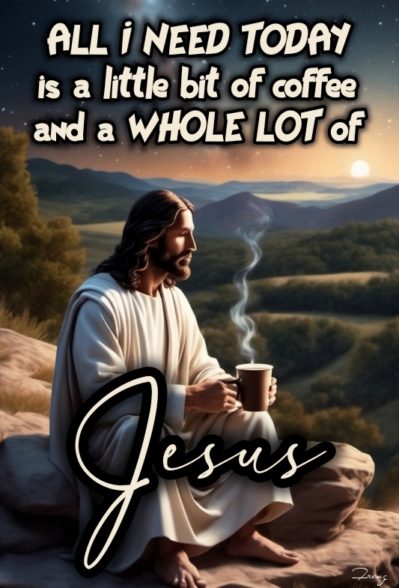
The image is a digitally created meme that blends religious imagery with a modern, casual sentiment. It presents a relatable human need with a touch of spiritual comfort.
Visual Elements →
* Central Figure: → The dominant element is a digitally rendered image of Jesus Christ. He is depicted with long, flowing hair, a beard, and a serene expression, consistent with traditional depictions. He is wearing a white robe, suggesting a sense of purity and spirituality. He is seated on a rock formation, in a natural landscape.
* Setting/Background: → The background is a painted landscape featuring rolling hills, distant mountains, and a sunset or sunrise. The setting adds a sense of peace and tranquility, possibly implying a meditative or contemplative space. The presence of the sun is also indicative of a daily reset, as would be a cup of coffee.
* Object of Interest: → Jesus is holding a brown mug of coffee. Steam rises from the mug, indicating the beverage is hot. This seemingly mundane detail is important in creating a relatable and personal touch.
* Text: → The text is overlaid on the image in a bold, white font with a black outline. The text states: "ALL I NEED TODAY is a little bit of coffee and a WHOLE LOT of Jesus". The word "Jesus" is placed prominently in a stylized script at the bottom of the image.
Interpretation and Message →
* Combining the Mundane and the Spiritual: → The image cleverly juxtaposes the everyday desire for coffee with a yearning for spiritual connection. It implies that both coffee and faith are sources of comfort and well-being.
* Humor and Relatability: → The meme format, combined with the casual phrasing ("a little bit of coffee"), makes the message approachable and humorous. It acknowledges the stresses of daily life and suggests a simple solution: a cup of coffee and a strong faith in Jesus.
* Personal Devotion: → The message suggests that the core need for the day is a connection with Christ, followed by the smaller need of the coffee.
* Positive and Comforting: → The image's overall tone is warm, inviting, and comforting. It can be used to uplift and inspire people.
Target Audience and Possible Usage →
* Christian Community: → The image is clearly designed for a Christian audience. It would resonate well with those who find solace and strength in their faith.
* Social Media and Digital Sharing: → It's designed for sharing on social media platforms (Facebook, Instagram, etc.). It can be used to express personal beliefs, offer encouragement to others, or simply as a lighthearted post.
* Inspirational Content: → It could be used on websites, blogs, or other digital platforms focusing on faith, inspiration, or self-care.
Overall, the image is a visually appealing and thought-provoking meme that combines the familiar with the spiritual, offering a message of faith, comfort, and everyday peace.
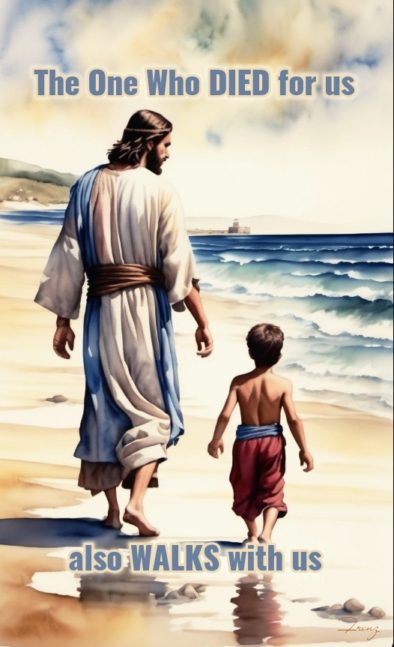
The image is a watercolor-style depiction of a scene on a sunny beach. The central figures are two people walking together. The first is a man with long, dark hair and a beard, resembling the traditional artistic depiction of Jesus Christ. He is dressed in a simple robe, with a blue sash and a brown belt. He is walking towards the viewer, looking out towards the sea. Beside him, walking a bit further ahead and to the right, is a young boy, dressed in red shorts and a blue sash, with his back towards the viewer.
They are walking on a sandy beach, with the gentle waves of the ocean lapping at the shore in the background. The sea is blue, and the sky is a soft combination of blues and whites, suggesting a bright, clear day. In the distance, a building or structure can be seen on the horizon.
Text is overlaid at the top of the image saying "The One Who DIED for us" and at the bottom, "also WALKS with us".
Meaning and Interpretation →
The image carries a clear Christian message of faith, comfort, and the ongoing presence of Christ in the lives of believers. Here’s a breakdown of the symbolism:
* Jesus Christ: → The man's appearance strongly suggests Jesus. The image emphasizes Jesus's sacrifice on the cross for the sins of humanity.
* The Boy: → The boy represents a follower or a believer. The fact that he is walking along side Jesus show companionship, guidance, and a promise of eternity and comfort
* Walking Together: → The act of walking together symbolizes companionship, guidance, and a journey of faith. Jesus is not just a figure of the past but is also a presence in the present, actively involved in the lives of those who follow Him.
* The Beach and Sea: → The beach setting represents a place of peace, serenity, and natural beauty. It can also be seen as a place of new beginnings and transition. The sea symbolizes the vastness and power of God.
* The Text: → The phrases "The One Who DIED for us" and "also WALKS with us" explicitly connect the historical sacrifice of Jesus with his ongoing presence and support in the lives of believers. This emphasizes the theme of eternal life and divine accompaniment.
Article: Walking with Him →
The image is one that can be used to promote the gospel of Christ and the relationship that is to be had through faith in Jesus.
Article: →
Have you ever felt lost, alone, or uncertain about the path ahead? Life’s journey can be challenging, full of twists and turns that can sometimes leave us feeling overwhelmed. It's easy to look back and realize all that you have done and feel as if the weight of the world is on your shoulders. In these moments, it is crucial to remember that we are not alone.
The image we see before us captures a powerful truth. It portrays a moment of connection, a symbol of faith and an everlasting promise. It shows a figure walking with a young boy, symbolizing the journey of faith and the reassurance that we are not meant to walk it alone.
The man, representing Jesus Christ, is depicted walking alongside a young boy on a beach. The boy, an image of faith and followership, looks ahead as they walk together, the ocean waves breaking gently in the distance. The sky is light and the day is clear.
The text above the image reads, "The One Who DIED for us", and reminds us of Jesus' ultimate sacrifice. The words are a reminder of the gospel, that God loved us so much that He sent His only Son to pay the ultimate price for our sins.
And below the image, the words say, "also WALKS with us". It's a promise. That the sacrifice that Jesus made did not end at the cross. It is a testament to the continuing presence and guidance we have as we walk in faith. That sacrifice opened up the doors to eternity with him.
This image invites us to reflect on the power of faith. It's about knowing that Jesus walks with us in every moment. Whether we are facing a time of challenge, or of joy, He is always there. He is the one who loves us unconditionally, guides us with unwavering kindness, and promises eternal life.
Let this image be a reminder. In our lives, we are not alone. Jesus walks with us and gives us a love that surpasses all understanding.
The image is a digitally created meme that humorously addresses the topic of religious belief and atheism. It uses a classic, widely recognized representation of Jesus Christ along with text to express a lighthearted sentiment about the perceived quality of arguments against religion. The tone is gentle, suggesting empathy for those who might encounter these arguments.
Visual Elements →
* Depiction of Jesus: → The central figure is a familiar depiction of Jesus Christ. He is presented as a man with long, wavy brown hair and a beard, dressed in casual modern clothing (a button-down shirt over a white tee-shirt and jeans) He's sitting outside, suggesting a place of peace or contemplation. His downcast eyes and folded hands suggest a sense of restfulness or a gentle contemplation of the viewer.
* Setting: → The scene is on a hillside or mountaintop. The blurred background hints at a scenic view, adding to the sense of tranquility.
* Text: → The text overlays the image in two parts:
* "Rest here, weary traveler." This immediately sets a tone of comfort and rest, suggesting a need for respite.
* "You've seen too many bad atheist arguments." This is the crux of the message, implying that the viewer has been exposed to poor or unconvincing arguments against religious belief.
Interpretation and Meaning →
* Target Audience: → The meme is targeted towards those who are already religious or who are sympathetic to religious beliefs. It speaks directly to their experience, suggesting that encountering flawed arguments from atheists can be tiring.
* Humor and Irony: → The humor comes from the juxtaposition of the serious religious figure (Jesus) with a lighthearted and relatable sentiment. The use of the word "bad" to describe the arguments is an understatement, and the image invites the viewer to agree with the sentiment.
* Message: → The primary message is to offer a comforting thought. It expresses empathy for those who are exposed to arguments against religion, as if Jesus understands their fatigue or frustration.
* Underlying Message: → The meme also implies that some of the arguments used by atheists are not intellectually sound or are easily refuted, and that the believer should not take them too seriously.
Overall, the image functions as a meme that offers a comforting view for those who have had to deal with bad atheist arguments, portraying a lighthearted tone of empathy and support.
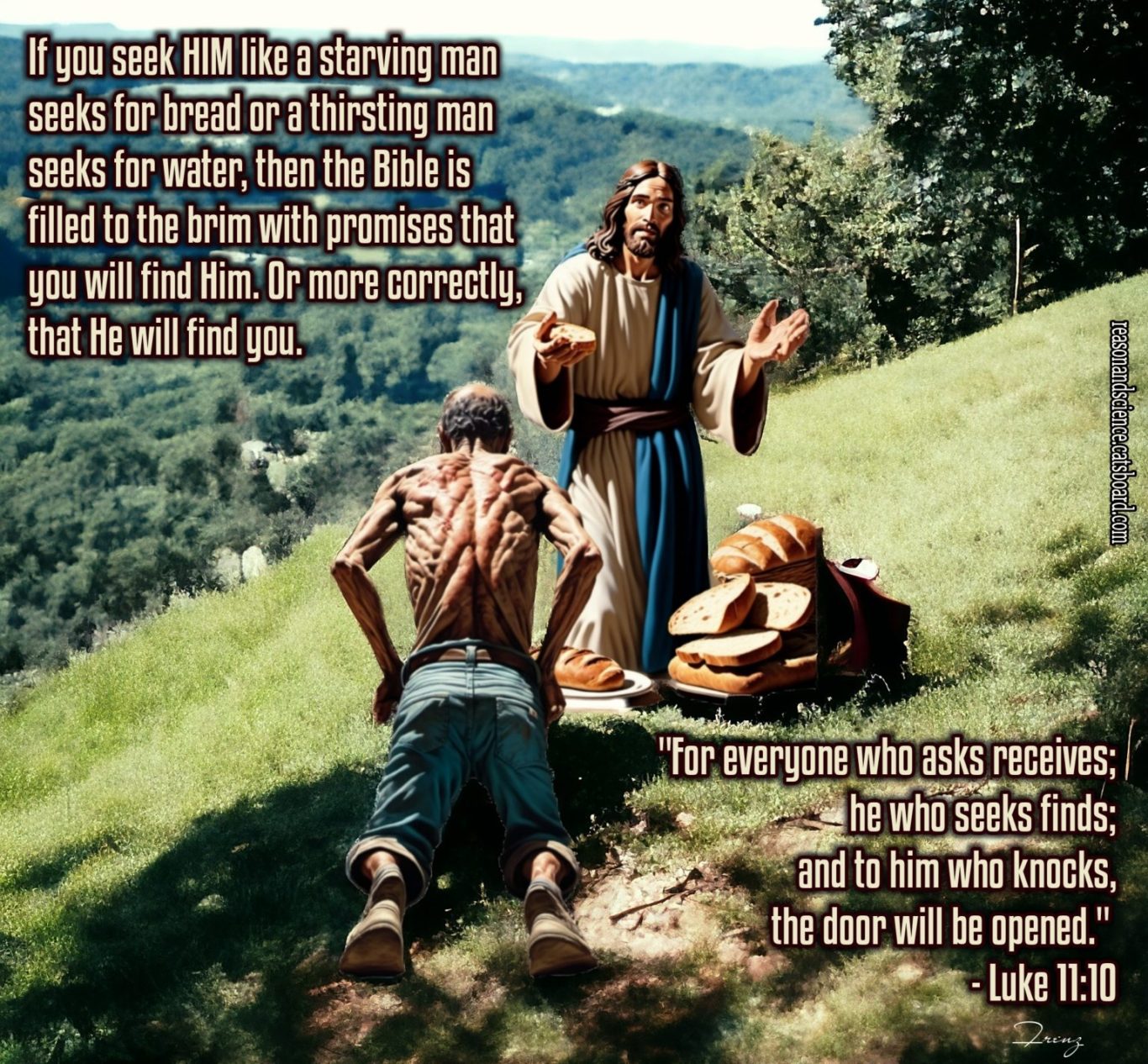
The image is a digitally-enhanced Christian artwork, intended for devotional purposes. It combines visual imagery with a scriptural message to convey a specific theological concept. The art style appears somewhat stylized, aiming for a visually striking and memorable effect.
Visual Elements and Interpretation: →
* Central Figures: → The dominant figures are Jesus and a severely emaciated man, positioned on a grassy hillside. Jesus is depicted with traditional iconography: long hair, a beard, and a robe. The emaciated man represents the "seeker" described in the text. His physical condition dramatically conveys a sense of dire need, aligning with the metaphors of starvation and thirst in the accompanying text.
* Symbolic Elements: →
* Bread: → A basket and loaves of bread are prominently displayed near Jesus. Bread symbolizes spiritual nourishment, sustenance, and the "bread of life" that Jesus offers. The bread is offered to the man who seems to be physically starving.
* Setting: → The outdoor setting, with the grassy hill and distant trees, provides a natural backdrop, lending a sense of tranquility and openness, and suggests the opportunity to commune with the divine.
* Color and Light: → The image is well-lit, with natural light casting shadows, which adds depth to the visual and emphasizes the scene's focus.
Textual Analysis and Theological Message: →
* Quote: → The central text is from Luke 11:10, which states, "For everyone who asks receives; he who seeks finds; and to him who knocks, the door will be opened."
This verse promises that the pursuit of God yields results.
* Asking → implies prayer and seeking divine guidance.
* Seeking → suggests a focused effort to find God.
* Knocking → conveys persistence and a desire for entry.
* Supplementary Text: → The accompanying text frames the verse by encouraging the viewer to seek Jesus with the same intensity a starving man desires bread or a thirsty man desires water. This emphasizes the urgency and importance of seeking God. The image further strengthens this point by the starving man that is willing to crawl for help. The text clarifies that God will come to find you.
* Overall Message: → The primary message is one of encouragement and reassurance. It urges believers to pursue a relationship with God and assures them that their efforts will be rewarded. The artist may be intending to highlight the following:
* The Importance of Seeking God: → Emphasizes that seeking God should be a top priority in one's life, and that God will come to you if you are seeking.
* God's Availability: → Asserts that God is not distant or unreachable, but open and responsive to those who seek Him.
* God's Grace: → Alludes to God's grace and willingness to meet the needs of those who seek Him.
Christian Theological Context: →
The image resonates with core Christian tenets:
* God's Initiative: → God's desire to be found is reflected in the text emphasizing that "He will find you."
* Salvation: → The message of seeking and finding aligns with the Christian doctrine of salvation, where humanity, recognizing its spiritual need, seeks God through faith in Jesus Christ.
* Prayer and Relationship: → The emphasis on asking, seeking, and knocking underscores the importance of prayer, personal reflection, and building a relationship with God.
* God's Word as Promise: → The Bible is filled with promises for those who are seeking Jesus.
Artistic Style and Effectiveness: →
* Strengths: →
* Visual Impact: → The image is visually arresting, especially the stark contrast between the emaciated figure and the imagery of bread, capturing the viewer's attention and conveying the urgency of the message.
* Clarity: → The composition is clear, with the central figures and text easily distinguishable.
* Thematic Relevance: → The elements consistently support the intended message.
* Possible Considerations: →
* Stylization: → The stylized appearance might be seen as both a strength and a limitation, depending on the viewer's preference. It can enhance memorability but might also be perceived as less realistic.
* Potential for Misinterpretation: → The image can be misinterpreted if the viewer doesn't understand the central message about God's love and sacrifice.
In Conclusion: →
The image is a well-conceived piece of Christian artwork that uses both visual and textual elements to convey a message of hope, encouragement, and the importance of seeking God. It effectively utilizes symbolism, biblical scripture, and compelling imagery to inspire reflection and potentially prompt a deeper connection with one's faith.
The image is a Christian-themed graphic, conveying a message of faith, trust, and reliance on God. The primary message is a call to action, encouraging the viewer to "Put Your Hand In The Hand Of The Man Who Calmed The Sea." The phrase is a direct reference to Jesus Christ and his ability to perform miracles, particularly the calming of storms and turbulent waters.
* Font and Style: → The font has a slightly three-dimensional or embossed look, which is emphasized by the mirrored finish. This gives the words a sense of weight and importance.
* Color Palette: → The color scheme is centered around blues, whites, and some warmer tones. The blue often conveys the calmness of the sea.
* Background: → The background is solid black which ensures that the text and image are highlighted.
Interpretation and Meaning: →
* Core Message: → The central message is to place trust in God, symbolized by the "Man Who Calmed The Sea." This is a call to seek God's guidance and protection in times of difficulty or uncertainty.
* Biblical Context: → The phrase "Put Your Hand In The Hand Of The Man Who Calmed The Sea" is drawn from religious sentiment. Stories in the Bible describe Jesus calming storms. For Christians, this narrative represents Jesus's ability to offer peace and security, even amidst life's storms.
* Encouragement and Hope: → The overall tone of the image is encouraging and hopeful. It offers a sense of reassurance and comfort, suggesting that faith can bring solace and overcome adversity.
Overall Impression: →
The image is designed to evoke a sense of reverence and spiritual connection. It serves as a visual reminder to maintain faith, seek comfort in divine guidance, and trust in the power of God to overcome challenges. It's a direct and accessible message of faith, making it a potentially effective visual for those seeking religious comfort or inspiration.
The image is a humorous meme that combines religious imagery with a modern-day profession.
* Visual Elements: →
* It features an artistic depiction of Jesus Christ. He's portrayed in a pilot's outfit, including aviator goggles, a headset, and a leather bomber jacket.
* The background suggests the cockpit of an airplane, reinforcing the pilot theme.
* The overall style is painterly, likely generated or heavily edited with AI.
* Text: →
* "IF JESUS IS YOUR CO-PILOT" is displayed at the top.
* "SWAP SEATS" is written at the bottom.
Article: Taking the Helm: A Humorous Perspective on Faith and Control →
The image of Jesus as a co-pilot of a plane, with a clear instruction to "swap seats," is a clever and thought-provoking meme. It’s a visual joke that plays with ideas of faith, control, and the complexities of human existence, offering both comedic value and a deeper layer of interpretation.
Humor and Irony →
The primary source of humor in this image lies in its subversion of expectations. We are accustomed to associating Jesus with spiritual guidance and a sense of protection, but in this context, that protection is applied to the safety of an aircraft. The implication is that having Jesus as a co-pilot might not be the safest option in terms of flight skills. The joke highlights the perceived need to have control and expertise, implying a lack of earthly competence.
Faith, Trust, and Control →
The image’s message can be interpreted on a more profound level. The instruction to "swap seats" suggests that if Jesus is your co-pilot, you should relinquish the role of pilot to yourself. This can be seen as a reference to the human tendency to rely on faith and, at times, cede personal control to a higher power. The humorous approach encourages us to reflect on the balance between faith and taking responsibility for one's own actions and decisions. The image playfully challenges the idea of total reliance on a divine hand in everyday matters.
Potential Interpretations →
* Self-Reliance: → The meme could be seen as promoting self-reliance. If Jesus is your co-pilot, the meme suggests that you can steer your own life.
* Practicality: → It is a humorous way of acknowledging the practical realities of life. Flying a plane requires specific skills. In the image, it seems to suggest that a deep faith in itself is not enough.
* The Human Condition: → The image reflects our own desires to take the initiative and not let others do things for us.
Conclusion →
The image is a simple yet effective piece of humor that offers a surprisingly insightful look at faith and personal responsibility. It encourages us to reflect on the roles of faith, control, and our own actions in our everyday lives. The meme's popularity lies in its ability to deliver a memorable message in a visually striking and relatable manner.
The image delivers a clear and direct message: parents need to prepare their children spiritually for the challenges of the world. It frames this as an urgent necessity due to the perceived influence of Satan in the world. The overall tone is one of seriousness and perhaps a hint of fear, urging the viewer to action.
Visual Elements and Their Symbolism: →
* The Child: → The central figure is a young boy. His age and appearance suggest innocence and vulnerability. He wears a blue shirt and has a backpack. This visual creates an image of a regular kid, which increases the feeling that anyone's child could be affected by the "satanic" world.
* The Bible: → The boy is holding a Bible. This is the primary symbol of faith and Christian doctrine. It represents the spiritual "armor" that the image advocates for children to possess. The size of the book and its prominence in his hands reinforce this point, portraying the Bible as a protective shield.
* The Backdrop: → The background is blurred, with subtle cloud-like formations that suggest a heavenly or idealized setting. This is in contrast to the "world ruled by satan" that the text describes.
* The Text Overlay: → The text is the core of the message:
* "IN A WORLD RULED BY SATAN": This phrase immediately sets the tone. It establishes a narrative of conflict, with Satan as the antagonist. The use of such a strong term suggests a belief in a pervasive evil influence.
* "YOU BETTER ARM YOUR KIDS": This is a direct call to action. The word "arm" suggests a militaristic or defensive approach, implying a need to protect children from spiritual harm.
Possible Interpretations and Context: →
* Christian Worldview: → The image strongly reflects a specific Christian worldview. It presupposes a belief in the literal existence of Satan, spiritual warfare, and the Bible as a source of truth and protection.
* Spiritual Warfare: → The message is heavily influenced by the concept of "spiritual warfare" - the belief that Christians are engaged in a constant battle against evil forces.
* Parental Responsibility: → The image appeals to parents' sense of responsibility to protect their children. It suggests that parents have a duty to provide their children with religious instruction and guidance to navigate the challenges of the world.
Overall, the image is a powerful visual statement aimed at Christian parents. It uses symbolism and text to create a strong impression that promotes spiritual preparedness for children. The imagery could be used to teach about the Bible.
The Courage to Question: Finding Truth in the Face of Doubt →
The image presents a thought-provoking message centered around the pursuit of truth, visually articulated through the depiction of Jesus alongside a young child. The central message, inscribed in elegant typography, acts as a guiding principle: "TRUTH is available only to those who have the courage to question whatever they have been taught." This statement underscores the importance of critical thinking and independent exploration in the journey towards understanding.
Visual Elements and Their Significance: →
* Jesus as a Modern Mentor: → The image's representation of Jesus is notable. He is depicted in a modern style, wearing a denim jacket, white t-shirt, and jeans. This departure from traditional depictions of Jesus creates a relatable and accessible figure. This modern representation suggests that the principles Jesus espoused are timeless and can be applied in contemporary contexts. His posture, seated and contemplative, implies wisdom and serenity.
* The Child as a Representation of Innocence and Curiosity: → The young child standing beside Jesus symbolizes purity and a natural curiosity. The child's presence suggests that the pursuit of truth is not limited by age or background. It is available to all who possess the courage to ask questions. The child's expression, looking to the side, suggests that the child may be questioning his own thoughts and beliefs.
* The Cosmic Background: → The background is a swirling mix of celestial colors and stardust. This imagery amplifies the feeling of vastness and mystery that lies within the pursuit of truth. It evokes the idea that truth is a vast, complex expanse to be explored.
* The Text: A Call to Action: → The words themselves are simple yet powerful. "Truth" is emphasized in a bold, prominent font, catching the viewer's eye immediately. The subsequent lines are an invitation to move past passive acceptance and embrace active inquiry. The text acts as a call to intellectual courage.
Interpreting the Message: →
The core message emphasizes the necessity of questioning the information we receive, particularly from established institutions, beliefs, or teachings. It promotes a mindset of critical examination, urging viewers to develop the courage to challenge the status quo in the search for truth.
* Challenge Preconceived Notions: → The image and text challenge viewers to step outside of the comfort zone of unquestioning adherence. It speaks to the importance of a willingness to confront our ingrained beliefs and assumptions.
* Embrace Skepticism, Not Blind Faith: → The image promotes a balance between faith and skepticism, encouraging an individual to seek truth through investigation.
* Personal Responsibility for Truth: → The message implicitly emphasizes that finding the truth is a personal journey, one that requires courage, effort, and a willingness to explore the unknown.
In Conclusion: →
The image serves as a powerful visual metaphor, reminding us that the pursuit of truth is an ongoing journey, one that requires intellectual curiosity, open-mindedness, and the courage to question. It promotes a spirit of critical thinking, making a compelling case for engaging with the world and our own beliefs with thoughtfulness and discernment. It is a visual statement that encourages a mindful approach to learning and understanding.
The image presents a philosophical and theological argument for the existence of God. It combines a visual backdrop of a vibrant and awe-inspiring depiction of space and a written text designed to convey a specific line of reasoning. Let's break down both aspects:
* Visuals: → The background is a stunning, digitally-created image of a nebula and galaxy. It's filled with swirling colors, stars, planets, and cosmic phenomena. This visually communicates the vastness, beauty, and mystery of the universe, setting the stage for the claims made in the text.
* Textual Argument: → The text provides a concise, three-step argument, rooted in a particular philosophical stance:
1. "Being cannot come from non-being." → This is a fundamental philosophical principle, often stated as "Ex nihilo nihil fit" (from nothing, nothing comes). This establishes the core premise that something must have existed before anything else.
2. "Since we exist, then being has always been in one form or another." → This builds upon the first point. The very fact of our existence (and the existence of the universe) indicates that there was a pre-existing "being."
3. "Since the universe had a beginning, a non-physical being must have existed beyond the universe, causing the universe into existence." → This combines the first two points with the idea of a universe with a beginning (often associated with the Big Bang theory). If the universe had a beginning, and being cannot come from non-being, something external to the universe itself must have initiated its existence. This "something" is posited as a non-physical being.
4. "That being is God." → The conclusion of the argument directly identifies the "non-physical being" as God.
Detailed Article: The Cosmic Argument for God's Existence →
The image presented offers a compelling argument for the existence of God, weaving together philosophical reasoning and astronomical observation into a concise statement. The core of the argument hinges on the principle of causality and the beginning of the universe.
1. The Principle of Being: →
At the heart of the argument lies the concept that "being cannot come from non-being." This is a fundamental metaphysical principle that underpins much of Western philosophy. It suggests that something cannot arise from nothing; there must always be a pre-existing state or cause. Everything that exists has a cause.
2. Existence and Causation: →
The argument then shifts from the abstract to the concrete, observing our own existence. We exist. As does the universe. Since being cannot come from non-being, there has always been "being" of some kind. The argument doesn't specify the exact nature of this pre-existing being, but simply asserts its necessary existence.
3. The Origin of the Universe: →
Building upon these premises, the argument then makes the crucial move of applying it to the universe. The idea of a finite universe with a beginning, especially supported by the Big Bang theory, is introduced. If the universe had a beginning, something must have caused it. Again, that initial cause must have been something that existed prior to the universe itself. This is where the concept of a "non-physical being" becomes essential.
4. The Leap to God: →
The image makes a direct connection: "That being is God." This is the crux of the argument. Because the causative being existed before the universe, outside of the universe, and non-physical, the argument posits that this being is, in essence, God. This aligns with common theistic concepts of God as a transcendent, eternal, and ultimate creator.
Conclusion: →
The image and the accompanying argument offer a compelling and thought-provoking attempt to link scientific observations with philosophical reasoning to infer the existence of God. While the argument may be open to critique, it effectively highlights the mystery of existence, the principle of causality, and the potential for a transcendent, divine being. The visual contrast of cosmic grandeur with the simple textual argument elevates the discourse to a higher level that prompts questions of existence and creator.
The image is a motivational and philosophical piece designed to reflect on the nature of knowing God. The visual elements contribute to the message:
* Background: → The serene landscape of a lake or river surrounded by trees and mountains evokes a sense of peace, contemplation, and natural beauty. This setting provides a backdrop for reflection.
* Central Figure: → The figure of a man sitting on a dock, fishing, embodies a person seeking something. The act of fishing can symbolize patience, a deliberate approach, and the possibility of a reward. His solitude adds to the introspective feel.
* Text Overlay: → The quote "Knowledge of God is unique in that it is conditioned by moral and spiritual factors. A spiritually indifferent person can have a profound knowledge of physics, or literature, or history, or sociology, or even of theology. But a spiritually indifferent person cannot know God. According to the Bible, the knowledge of God is promised to those who honestly seek Him." is the core message and explicitly links knowledge of God to moral and spiritual engagement.
* Overall Tone: → The image has a calming, thoughtful, and encouraging tone, inviting the viewer to consider their own relationship with God and the importance of seeking Him with sincerity.
Detailed Article →
The Pursuit of Knowledge: A Different Kind of Science →
In a world saturated with information, we often focus on the pursuit of knowledge. We strive to understand the physical world, the intricacies of history, the nuances of literature, and the complexities of human society. Yet, there's a unique realm of knowledge—the knowledge of God—that operates under a different set of principles. This is the core message conveyed by the image: knowledge of God is not acquired through the same methods as secular subjects, but through an investment in moral and spiritual factors.
The Limitations of Intellectualism →
The image's text points out a crucial distinction: a person can be exceptionally well-versed in various fields, from physics to theology, without truly knowing God. This is because the knowledge of God doesn't come through intellectual prowess alone. It requires more than the accumulation of facts and data. This highlights the limitations of purely intellectual understanding. While knowledge of the world is valuable, it is not the key to spiritual understanding.
The Role of Moral and Spiritual Factors →
What, then, are the conditions for knowing God? The image clarifies that moral and spiritual factors are crucial. This means aligning one's life with a moral compass and engaging in spiritual practices that cultivate a relationship with God. It suggests a need for ethical behavior, compassion, humility, and a willingness to grow spiritually. These are the foundations upon which one may come to truly know God.
The Promise of Honest Seeking →
The image's message offers an invitation and a promise. According to the Bible, the knowledge of God is "promised to those who honestly seek Him." This suggests that the key is sincerity. An honest seeker is one who approaches God with an open heart, a genuine desire to understand, and a willingness to change. This active and humble pursuit is rewarded with knowledge.
The Fisherman's Lesson →
The image of the fisherman sitting peacefully on the dock is a powerful metaphor. It symbolizes the process of seeking God. Fishing requires patience, a willingness to wait, and a focus on the task at hand. It mirrors the spiritual journey: a persistent, focused effort to connect with the divine. The fisherman, like the honest seeker, must cast his "line" (prayer, contemplation, and action) and patiently wait for the response.
Conclusion →
The image is a thoughtful reminder. It calls on the viewer to assess their approach to knowledge. It invites us to consider whether we're merely accumulating information or truly seeking a deeper understanding of the divine. The knowledge of God, as the image suggests, is not just an academic pursuit, but a journey of the heart, a test of character, and a relationship built on honesty and faith.
The image is a persuasive statement promoting the rationality of belief in God, specifically from a Christian perspective. It directly addresses the relationship between faith and science, arguing that scientific discoveries do not contradict, but rather support, the idea of a Creator.
Textual Analysis: →
* Headline: "Belief in God is rational." → This is the central claim. It positions faith not as a blind leap, but as a logical and reasonable choice.
* "There is not a single scientific discovery that challenges the Christian conviction that a Creator brought the universe, life, and humanity into existence." → This is the core argument. It asserts that science and Christianity are compatible, and implies that scientific findings actually support a Christian worldview. It challenges the common perception that science and religion are in direct conflict.
* "In fact, the opposite is true. The design of the universe and life provide compelling reasons to think that a Mind is behind everything we see." → This reinforces the argument by suggesting that the complexity and order of the universe and life point towards an intelligent designer. The phrase "the opposite is true" strengthens the claim by implying that science actually *supports* the belief in a Creator.
* Key Concepts: →
* Creator: → The image explicitly refers to a "Creator" to indicate the existence of a divine being who brought everything into existence.
* Design: → The text uses "design" to highlight the perceived order and complexity of the universe and life. This implies that this intricate order couldn't have happened by chance, and is evidence of intelligent design.
* Mind: → The text suggests the existence of a "Mind" behind everything. This emphasizes the rational aspect of the universe, attributing the creation and order of the world to intelligent thought.
Visual Analysis: →
* Background Image: → The background image shows a peaceful lake scene at dusk or dawn. The image features a lone person in a boat, silhouetted against the serene water and a beautiful sunset. The tranquil environment and the feeling of solitude provide a sense of calm and introspection, which is consistent with the theme of contemplation about faith and the universe.
* Color Scheme: → The colors are warm and inviting, with hues of orange, pink, and purple in the sky and water. This palette evokes feelings of peace, hope, and perhaps awe at the beauty of the world.
* Text Style: → The text is a slightly bold, sans-serif font, making it easy to read. The font color is white, which contrasts effectively with the darker background image.
Overall Interpretation: →
The image uses both text and visuals to create a persuasive and emotionally appealing message. It aims to reassure viewers that religious belief, specifically Christian belief, is not incompatible with scientific understanding. The image is intended to encourage contemplation about the nature of existence and to suggest that evidence from the universe and life supports the belief in a divine Creator. The calming visual elements may be used to create an atmosphere of serenity and understanding, which contrasts the common idea that religious belief is a struggle. This juxtaposition may be used to further support the image's central message.
The image presents a contemplative and hopeful scene set within a church. The dominant element is the back view of an elderly woman sitting on a wooden pew, gazing towards brightly lit stained-glass windows. The visual is paired with a message of perseverance and faith: "Preach the Truth even if only one person accepts it." This combination creates a sense of solemnity, dedication, and the importance of sharing one's beliefs regardless of the audience size.
Visual Elements: →
* Subject: → The focus is on an elderly woman. Her back is turned to the viewer, which invites the audience to empathize with her. Her gray hair and the simple cut of her clothing convey a sense of age, experience, and perhaps a lifetime of faith. The anonymity of her face emphasizes the universality of the message.
* Setting: → The scene is clearly within a church. The presence of wooden pews, high ceilings, and ornate stained-glass windows establishes the environment. The architecture suggests a traditional Christian church. The diffused light coming through the windows creates a sense of spiritual atmosphere and serenity. The windows are the central point of light and could represent hope and the divine.
* Lighting: → The lighting is a key element. The strong light shining through the stained-glass windows draws the eye and symbolizes enlightenment, knowledge, and divine presence. The overall tone is soft, with the central light source emphasizing the importance of the message.
* Composition: → The composition is centered, with the woman placed in the middle of the frame, ensuring the viewer's focus is on her and the windows. The alignment of the pews and the shape of the windows create a sense of order and symmetry, reinforcing the atmosphere of reverence and reflection.
* Text: → The text overlaid on the image is direct and encouraging. It promotes sharing one's faith and beliefs even when faced with adversity or lack of acceptance. This message complements the visuals, reinforcing the idea of steadfastness and commitment to one's truth.
Interpretation and Message: →
* Faith and Perseverance: → The image is a visual encouragement to share the truth, regardless of the potential for acceptance. It suggests that even reaching a single person with one's message is significant. This conveys the belief that truth has inherent value and impact.
* Devotion and Contemplation: → The woman's posture and the setting within a church suggest an act of prayer, contemplation, and personal connection to faith. The image might represent the importance of the woman's personal faith, but also her commitment to it.
* Hope and Enlightenment: → The bright light from the stained-glass windows represents divine light, the truth, and hope. It contrasts with the shadows and the woman's back turned, which creates a sense of longing and pursuit of something greater.
* Inclusivity: → While the image has a Christian context, the message of preaching the truth can be seen as universally applicable. The message could encourage others to find their own truth.
Overall Tone: →
The image has a respectful, encouraging, and inspirational tone. It combines a serene setting with a strong message of belief and dedication. The image aims to inspire viewers to value their truth and be persistent, even when facing challenges or doubt.
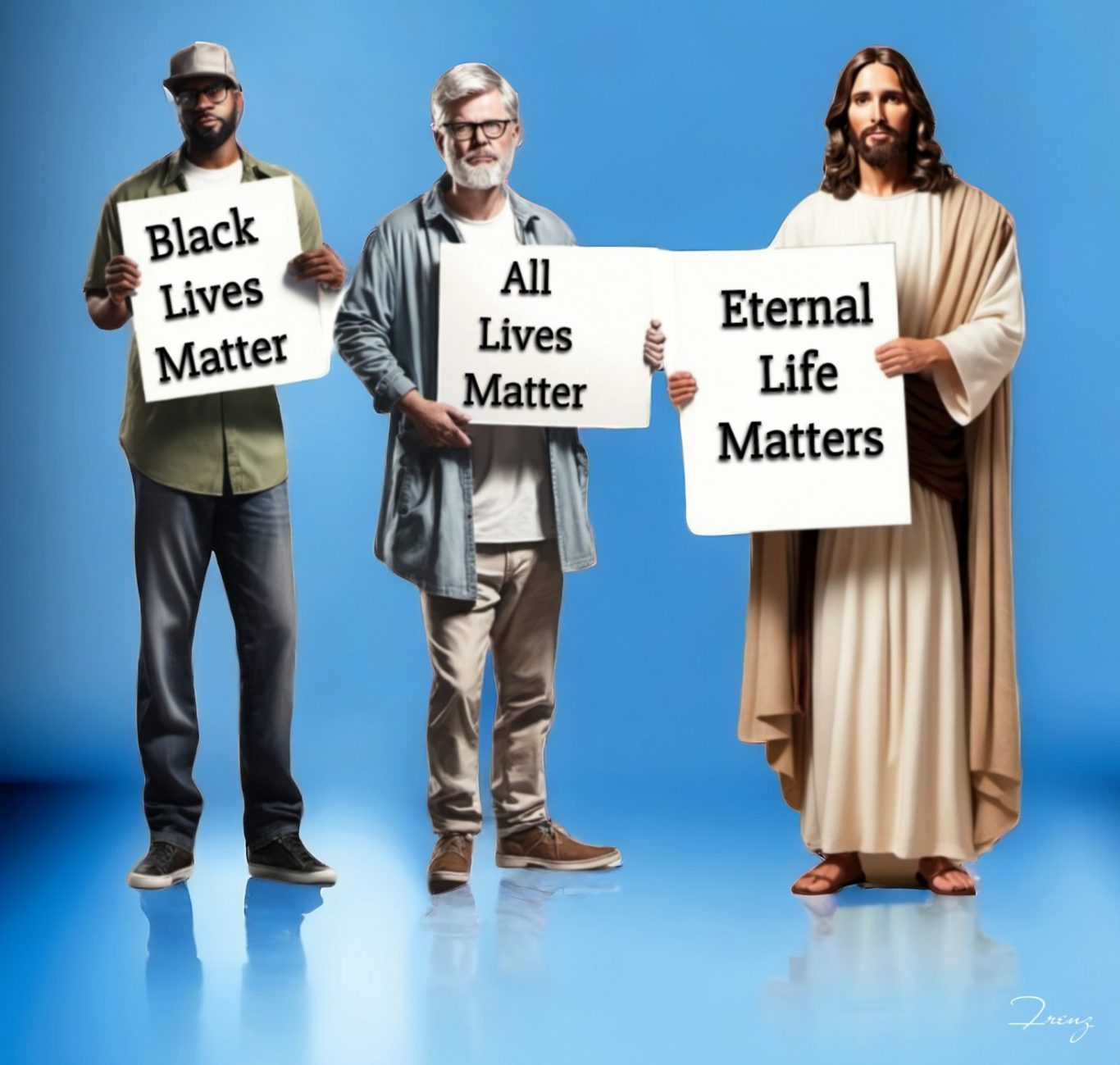
The image presents a digitally created composite with a clear symbolic intention. It depicts three figures standing side-by-side, each holding a sign.
* The Figures: →
* A Black Man: → He is dressed in contemporary casual attire (cap, glasses, button-up shirt over a tee, jeans, sneakers). He holds a sign reading "Black Lives Matter."
* An Older White Man: → He also wears modern, casual clothes (glasses, button-up shirt over a tee, khakis, sneakers). He holds a sign that says "All Lives Matter."
* Jesus: → Represented in traditional artistic depictions (long hair, beard, robe and tunic). He holds a sign proclaiming "Eternal Life Matters."
* The Signs: → The text on the signs forms the core of the image's message.
* The Background: → A smooth, gradient blue backdrop creates a clean, uncluttered space.
Article: Decoding the Message: An Interpretation of the "Lives Matter" Image →
This image is a striking visual statement that attempts to synthesize different viewpoints within a single composition. It uses symbolism to engage with complex social and religious issues. Let's break down the potential meanings:
* The "Lives Matter" Dilemma: → The juxtaposition of "Black Lives Matter" and "All Lives Matter" is immediately striking. It acknowledges the ongoing societal debate regarding racial justice.
* "Black Lives Matter" →: This represents the movement that began as a response to the disproportionate violence against Black people and systemic racism. It demands recognition and protection of Black lives.
* "All Lives Matter" →: The phrase is often used to counter the "Black Lives Matter" movement, arguing that all lives deserve equal consideration. It may be seen as a statement of inclusivity but is often perceived as downplaying the specific issues that Black communities face.
* The Image's Implicit Message →: The image attempts to address the tension between the two phrases. It seems to suggest that, while recognizing the importance of Black Lives Matter, the ultimate goal is to focus on "Eternal Life" for all.
* The Role of Jesus: → The inclusion of Jesus as the final figure adds a layer of religious interpretation:
* Jesus as a Unifier: → By being centered, Jesus implies he encompasses and transcends the division between "Black Lives Matter" and "All Lives Matter." The choice to include Jesus would also suggest, his life is the only life that matters.
* "Eternal Life Matters": → This message positions the focus on a spiritual realm. It asserts that, from a Christian perspective, the ultimate concern should be the salvation and eternal well-being of all. It attempts to suggest a bigger picture that transcends the immediate concerns of this world.
* Artistic Considerations: →
* The digital creation is contemporary art.
* The imagery is direct and designed to provoke thought.
* Conclusion: →
The image is an effort to comment on an important social and political conversation. It attempts to bridge the gap between different perspectives by invoking a spiritual answer.
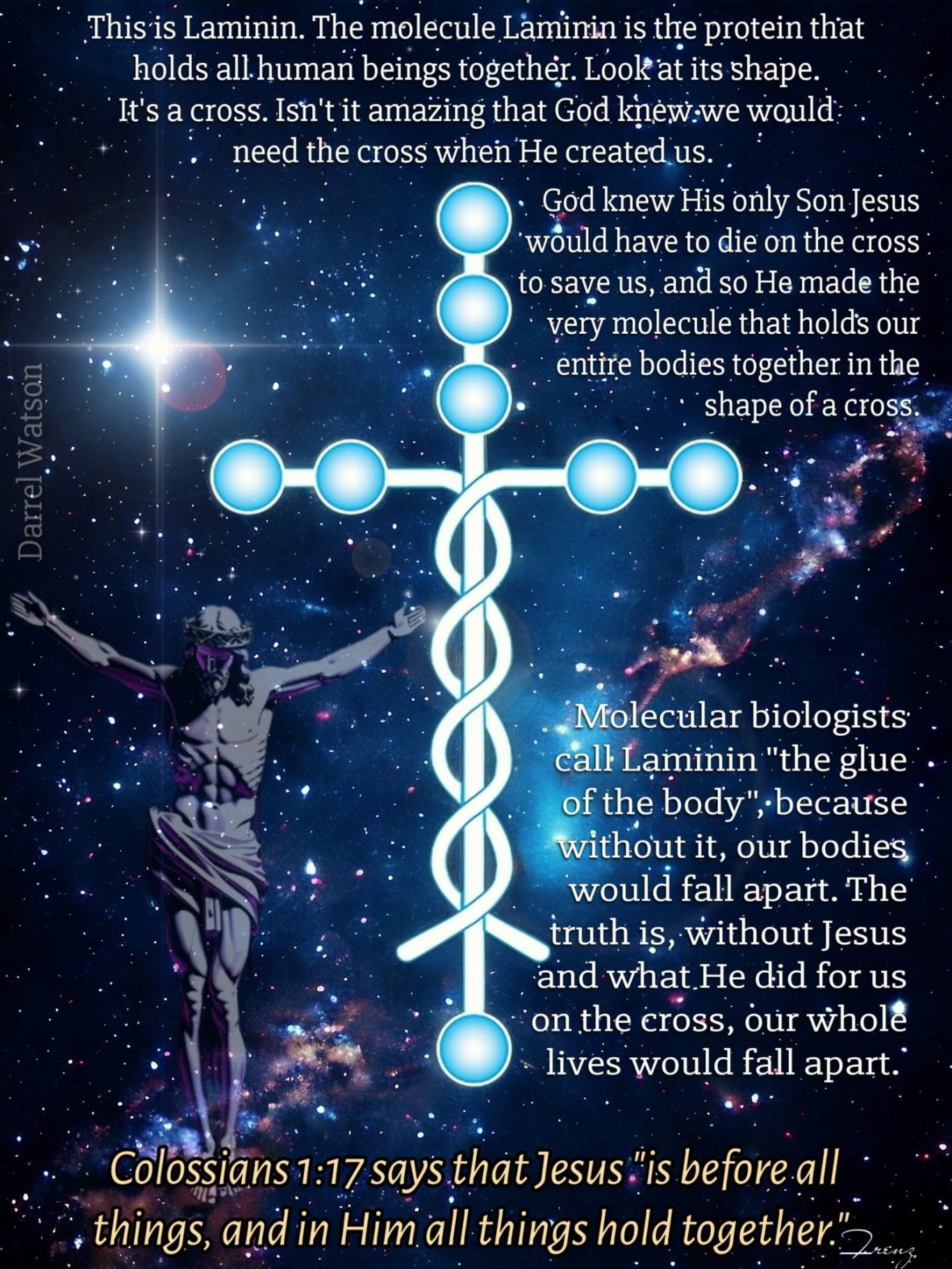
* Cosmic Background: → The image's backdrop is a deep-space scene, filled with stars, nebulas, and celestial light. This sets a vast, awe-inspiring context.
* Laminin Molecule Depiction: → The central, dominant image is a stylized representation of the Laminin molecule. It's rendered in a glowing, bright-blue color, featuring a cross-like structure. The cross-like shape is reinforced by spheres at the ends of the arms and the base of the cross. The vertical portion has a double helix-like twist.
* Jesus on the Cross: → A depiction of Jesus Christ crucified is on the bottom left of the image. His arms are outstretched, symbolizing both suffering and the embrace of love. The color of the image is not very detailed.
* Textual Elements: → Several blocks of text are interspersed throughout the image, providing the message and context.
* Colossians 1:17: → The image concludes with a verse from the Bible (Colossians 1:17): "He is before all things, and in him all things hold together."
Message and Interpretation: →
The image delivers a specifically Christian message, attempting to connect scientific concepts with religious faith and symbolism.
1. Laminin as a Divine Sign: → The core of the message hinges on the Laminin molecule, a crucial protein found in the human body. The image emphasizes the cross-like shape of the molecule. The text explicitly draws a parallel between Laminin's function (holding the human body together) and the cross of Jesus Christ.
2. God's Foreknowledge: → The text claims that God, knowing Jesus would die on the cross to save humanity, created the Laminin molecule in the shape of a cross. This suggests divine planning and an intimate connection between creation and the crucifixion.
3. The Cross as Salvation: → The message underscores the importance of Jesus' death on the cross for the salvation of humanity. Without Jesus, the text states, life would fall apart. The cross serves as both a symbol of suffering and of the ultimate sacrifice, symbolizing forgiveness of sins and the gift of eternal life.
4. The Binding Power of Christ: → The Colossians 1:17 verse is used to emphasize the central role of Jesus in holding everything together. This reinforces the idea that Christ is the unifying force in the universe, both physically (as Laminin holds the body together) and spiritually (as Jesus holds the Christian believer together).
5. Scientific and Religious Integration: → The image attempts to blend scientific concepts (Laminin) with religious beliefs. This approach aims to lend credibility to the religious message by using scientific facts as illustrations. The message argues that what the molecule does on a physical level (holding together the physical body), Jesus does on a spiritual level, holding together the lives and faith of believers.
Overall, the image is a visual sermon aimed at: →
* Reinforcing Christian faith through visual and scientific associations.
* Emphasizing the importance of Jesus' sacrifice and the message of the cross.
* Presenting faith in a way that appeals to scientific and rational thinking.
* Providing an easy-to-digest metaphor that illustrates how Jesus saves and holds everything together.
The image is a visual argument for the existence of God, employing the concept of intelligent design. It presents a chain of reasoning that attempts to connect the complexity of the human body to the need for a divine creator.
* Background: → The background features a visually appealing celestial backdrop, evoking a sense of wonder and perhaps hinting at the vastness of the universe. The stars are a common symbol often used to represent the divine.
* Text: → The text is central to the image's message. It's structured to make a logical argument.
* Figure: → A male figure is standing with his back to the viewer, gazing towards a bright light in the center, which is the Designer, God.
* Overall Message: → The image argues that the complex information within the human body necessitates an intelligent designer, identifying that designer as God.
Detailed Article: The Code of Life and the Question of Design →
The human body is an awe-inspiring marvel, a testament to the power of life. But when we delve into the intricate details of how we function, we begin to encounter questions that probe at the very foundations of our understanding. This image presents a powerful argument for the existence of a divine designer.
It begins with a fundamental premise: Life doesn't simply arise from matter. For living cells to coalesce into a functional human being, they need instructions. These instructions, the image suggests, are analogous to the code that runs a computer.
Consider the human body's complexity. Each of us is composed of trillions of cells, and within each cell lies the blueprint for how to build and operate the body. This blueprint isn't just about assembling basic components; it's a complex, intricate system. The image specifically points to the instructions that would allow for things like an arm, a leg, a blue eye, and a heart to be constructed. Without these instructions, the image implies, there would be no life.
The image then draws a parallel between the human body and computer software. A computer, no matter how advanced, is useless without the digital code—the software—that tells the hardware how to operate. In this analogy, the cells are like the hardware, and the instructions within them are like the software.
Following this logic, the image asks a crucial question: Who engineered the "software" that tells the cells in a human body how to operate?
The answer provided is: The Designer, God. →
This argument is rooted in the principle of intelligent design. Proponents of intelligent design argue that the complexity of biological systems is evidence of an intelligent cause. They point to the sheer number of interacting parts, the specificity of the information, and the apparent "purpose" within biological systems as evidence that such systems could not have arisen by chance or purely through natural processes.
The image is designed to prompt reflection and questions about the origin of life and the nature of existence. It's a call to consider the possibility that the incredible intricacy of the human body points to a divine creator. It invites the viewer to contemplate the idea that the order, complexity, and seeming purpose within our bodies is not merely a product of random events but the result of deliberate design.
The image is a visually appealing blend of a quaint, idealized neighborhood scene and a message of Christian faith. The imagery evokes a sense of peace, beauty, and the blessings of everyday life, all framed within a context of God's love and provision.
Visual Elements: →
* Setting: → A serene, sun-drenched residential street. The houses are neatly lined up, each with its own character, typical of an American suburban landscape. Lush, green trees and neatly trimmed lawns add to the idyllic atmosphere. The presence of classic cars parked on the street further enhances the sense of a nostalgic, wholesome environment. The sky is a brilliant blue with puffy white clouds.
* Style: → The artwork has a slightly stylized, painted quality, giving it a warm and inviting feel. It could be considered as a piece of digital art made to resemble a vintage illustration.
* Composition: → The perspective draws the viewer's eye down the street, implying a sense of depth and journey. The balanced arrangement of elements, such as the houses, trees, and cars, contributes to the overall sense of order and tranquility.
Textual Elements: →
* Message: → The text is a message of Christian faith and reassurance. It focuses on the idea that God, in creating the universe, had humanity's well-being in mind. The text highlights God's foresight and intention to provide for our needs and enjoyment.
* Key Points: →
* God knew about the good things in our lives (homes, cars, food, etc.) from the beginning.
* These things were made possible through the creation of the universe from pure energy.
* God created the universe specifically with us in mind, understanding how much these things would mean to us.
* God's love is the driving force behind this provision.
* Tone: → The tone is warm, comforting, and uplifting. It emphasizes God's loving care and the blessings of everyday life.
* Author: → The signature "Frenz" is at the bottom of the image.
Interpretation and Meaning: →
The image and text work together to communicate a core Christian belief: that God is loving, all-knowing, and actively involved in our lives. The beautiful neighborhood scene symbolizes the abundance and beauty of God's creation, including the "good things" we enjoy. The text reminds us that these blessings are not accidental but part of God's loving plan. It reassures the reader that God understands and values our lives and well-being. The overall message is one of hope, gratitude, and a sense of divine care in the midst of everyday life.
In essence, the image is designed to: →
* Inspire feelings of gratitude and appreciation for the good things in life.
* Provide comfort and reassurance from a Christian perspective.
* Reinforce the belief in God's love and care for humanity.
* Create a sense of peace and hope.
The image is a visually stunning and spiritually resonant piece, likely intended for Christian audiences. It combines a dramatic celestial backdrop with a contemplative human figure, creating a sense of awe, wonder, and the importance of faith.
Visual Elements: →
* The Cosmos: → The vast majority of the image is filled with a stunning depiction of space. Nebulae, planets, and stars are rendered in vibrant colors, suggesting the immense scale and mystery of the universe. This serves as a backdrop that represents the "infinite God" mentioned in the text.
* The Landscape: → Below the cosmos, there is a landscape of rocky, mountainous terrain. The mountains are softened with a hazy atmosphere, giving a sense of distance and mystique.
* The Figure: → A small child, or young person, is sitting on a large rock formation with their back to the viewer, gazing upward. The figure is dressed in a simple blue hooded jacket. This person is central to the image as it is meant to represent humanity.
* Color Palette: → The image uses a palette of blues, purples, oranges, and muted browns, creating a sense of peace, and vastness. The colors of the celestial background add to the sense of awe and wonder.
* Text Overlay: → A text overlay is placed on the image, directly addressing the intended message of the image.
Textual Elements and Meaning: →
* Quote: → The text reads:
* "While we can never fully understand everything about our infinite God, He has graciously revealed to us all we need to know to love and trust Him. Indeed, to trust His perfect power and character in the face of great mystery is the logical thing to do."
* Interpretation: → The quote's main message is one of faith. It acknowledges that human comprehension of God's nature is limited. Despite this, it asserts that God has provided everything necessary for humans to build a relationship with Him, through love and trust. The text encourages believers to trust God's power and character despite the unknowns and mysteries of faith.
Combined Interpretation (Visual and Textual) →
The image's components are intended to convey the following:
* Humanity and the Divine: → The small figure looking up at the expansive cosmos represents humanity's place in the universe and its relationship with God. The figure is small in comparison to the setting, emphasizing human insignificance next to God.
* Awe and Wonder: → The visual grandeur of space generates a sense of awe, designed to show the limitless power of God.
* Faith over Understanding: → The quote reflects the core message of Christian faith that emphasizes the importance of belief and trust in God, even when faced with complexities and unknowns. The image suggests that through faith, it is possible to connect with something far grander than oneself.
* Trust Amidst Mystery: → The message also speaks to the idea that in the face of mystery, trust is more important than understanding. The quote essentially states that it is sensible to trust in the face of the unknown.
Overall Message →
This image serves as a reminder to trust in the divine and have faith in the face of the unknown. The image and quote combine to encourage reflection on the nature of faith, God, and the human experience. It's meant to reassure and uplift, offering hope and strength to those seeking comfort in their faith journey. The image attempts to show that trust in God is the only logical course of action when faced with mysteries.
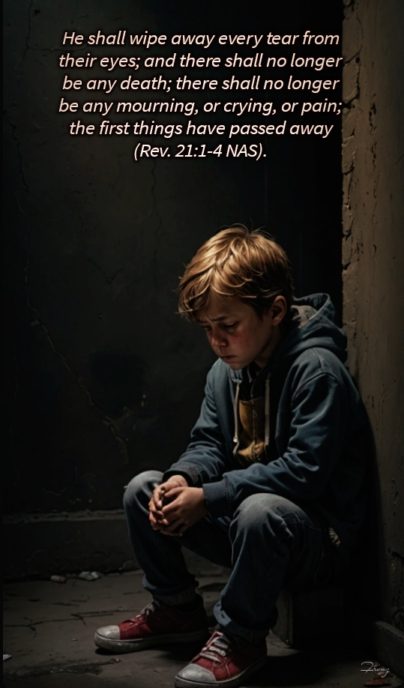
The image presents a young boy, seemingly in a state of sadness or contemplation. He is seated, with his head bowed and his hands clasped, conveying a sense of introspection and possibly sorrow. The setting appears somewhat dark and austere, possibly a corner of a room or alleyway, further emphasizing the feeling of isolation.
Textual Overlay: →
The image is overlaid with a quote from Revelation 21:1-4 (NAS), which describes the promise of a new heaven and a new earth. The text reads: "He shall wipe away every tear from their eyes; and there shall no longer be any death; there shall no longer be any mourning, or crying, or pain; the first things have passed away." This biblical verse is presented in white text over the dark background, highlighting the verse and its importance to the image's message.
Interpretation and Article →
A Promise of Comfort and Hope in the Midst of Suffering →
The image is a powerful visual representation of grief, loss, and the hope offered through Christian faith. The visual elements and text combine to create a compelling message about faith, hope, and ultimate redemption.
The Boy's Burden: →
The young boy, sitting in the shadowy corner, embodies the vulnerability and often-unseen struggles that children and adults often experience. His posture and downcast gaze suggest a personal hardship – a loss, a pain, or an unseen burden that weighs heavily upon his young shoulders. This image serves as a reminder of the suffering that exists in the world.
The Promise of the Bible: →
The accompanying quote from Revelation 21:1-4 brings a powerful counterpoint to the image's somber mood. It offers a promise of comfort and healing in the face of suffering. The verse speaks of a future where all suffering is removed – where tears are wiped away, death is no more, and pain and mourning are things of the past. This promise is a cornerstone of Christian belief, offering hope in times of despair and a vision of eternal life.
Bringing the Two Together: →
The image effectively marries the boy's image with the text. The visual conveys the immediate reality of suffering, the struggles that people face, both big and small. The quote, in contrast, promises an end to all of it. The two ideas combine to say: "While there may be suffering now, the future promises a place without suffering and a promise for eternal life. God is there to heal all hurts."
Applications for Modern Life: →
This image can serve as a source of reflection and comfort for people.
* For those in grief: → The image offers a message of hope, providing consolation in the face of loss, and reminding viewers that suffering is not the end.
* For those struggling with pain: → It reminds viewers that even in the darkest moments, there is a promise of ultimate healing and the removal of all pain.
* For the faithful: → It reinforces the core tenets of Christian faith – that God loves them and offers redemption and eternal life to those who believe.
Conclusion: →
The image is a powerful juxtaposition of suffering and hope. It captures the experience of hardship and loss, while simultaneously reminding viewers of the hope offered by the Christian faith. This imagery serves to connect the world's sorrow and God's promise of comfort, helping viewers to find meaning and reassurance within their own lives.
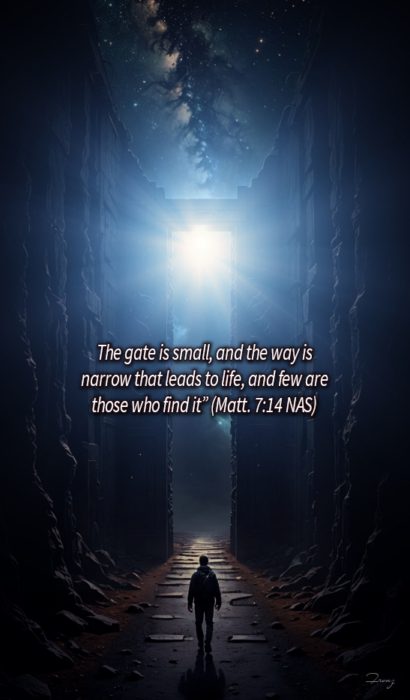
The image is a visually striking composition designed to convey a specific religious message.
* Central Figure: → The primary element is a person. He is shown from the back, walking in a desert landscape. The footprints leading away from him suggest his journey and the path he has taken.
* Setting: → The background is a vast, arid desert landscape. The golden hues of the sand and the setting sun (or rising sun) create a warm and evocative atmosphere. The open space gives a sense of vastness and emphasizes the solitary figure.
* Textual Elements: → Overlaid on the image are several lines of text which reinforce the image's religious message.
* "The 'Son' is Jesus Christ."
* "The Son is 'God.'" - This asserts the deity of Jesus, central to Christian theology.
* "Psalms 45:6 was a prophecy written for Jesus Christ." - This directs the viewer's attention to a specific biblical passage, which is often interpreted as a prophetic reference to Christ.
* "Jesus Christ is the Messiah promised by the Old Testament." - This summarizes a key Christian belief: that Jesus fulfilled the prophecies made in the Old Testament regarding the Messiah (the Anointed One).
Overall, the image is designed to be a visual statement of Christian belief, affirming the divinity of Jesus, his role as the Messiah, and the fulfillment of Old Testament prophecies in his person. → The setting evokes a sense of journey, perseverance, and spiritual significance.
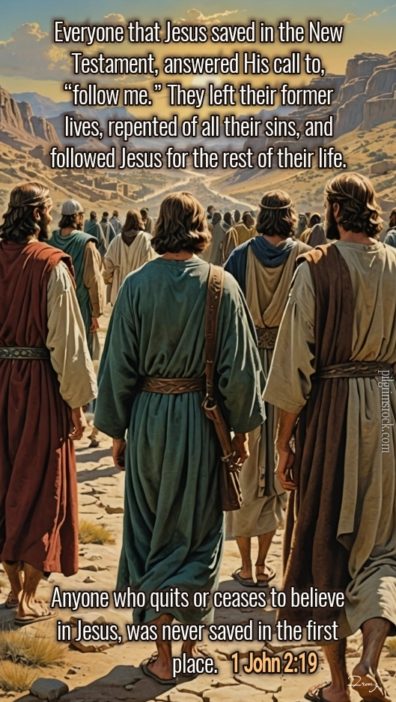
The image is a Christian meme or inspirational graphic. It combines a visual element (a depiction of people following Jesus) with two key theological points expressed in text. The overall message is about commitment to following Jesus and the implications of abandoning that commitment.
Visual Analysis: →
* Scene: → The image depicts a group of men, followers of Jesus, walking forward. The perspective is from behind, focusing on their backs and the movement of their journey. They appear to be walking on a path, towards a sunlit, mountainous backdrop. This implies a journey, a destination, and perhaps a sense of hope.
* Style: → The image has a digital art or illustrative style. The lighting is warm, creating a sense of peace and spirituality.
* People: → The followers are dressed in clothing that is typical of biblical times. They are diverse, some appearing more affluent and others more simple, which could be a deliberate inclusion in a depiction of everyone answering Jesus’s call, no matter their background.
* Composition: → The composition is centered around the group of people, drawing the viewer's eye along the path, and into the background. The text boxes are overlaid on the image.
Textual Analysis: →
The text provides the core message of the image, split into two key ideas.
* First Point: → "Everyone that Jesus saved in the New Testament, answered His call to, 'follow me.' They left their former lives, repented of all their sins, and followed Jesus for the rest of their life."
* This section is a generalized summary of the response of those who followed Jesus in the New Testament. It describes how they responded with belief and action.
* "Answered His call to 'follow me'": → It refers to the direct invitation Jesus often made to people, calling them to discipleship.
* "They left their former lives": → This stresses the decision to forsake previous activities and lifestyle for a new path.
* "Repented of all their sins": → This highlights a turning away from wrongdoings as a core part of the followers' lives.
* "Followed Jesus for the rest of their life": → Indicates a life-long commitment.
* Second Point: → "Anyone who quits or ceases to believe in Jesus, was never saved in the first place. 1 John 2:19"
* This statement is a more cautionary message, based on a verse in the New Testament (1 John 2:19).
* It implies that continuing to believe and follow Jesus is a sign of genuine salvation, while abandoning faith suggests that salvation had not occurred in the first place.
Theological and Symbolic Interpretation: →
* Salvation: → The image's core theme is about salvation (being saved from sin). The text discusses the act of responding to the call of Jesus and the implications of the choices a person makes.
* Discipleship: → The image promotes the act of discipleship, which is the act of being a student or follower of Jesus.
* Commitment: → The image stresses the importance of a continued and life-long commitment to follow Jesus.
* Faith and Works: → The image touches on the interplay between faith (believing in Jesus) and works (the actions that follow from faith).
Intended Audience and Purpose: →
The image is clearly targeted towards Christians. Its purpose is to:
* Encourage and inspire: → The image inspires people to commit and persevere in their faith.
* Teach or remind: → The image aims to remind Christians of the commitment that is associated with their faith.
* Warn and Discourage: → The image provides a cautionary warning against abandoning faith.
Overall, the image is a powerful Christian message meant to motivate and encourage believers to follow Jesus consistently throughout their lives.
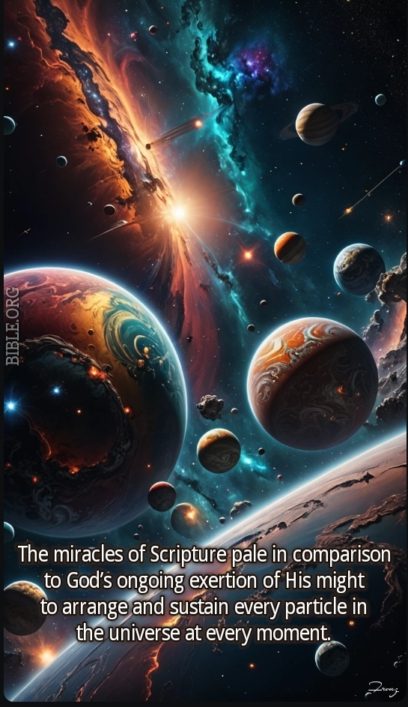
The image is a symbolic representation of the Bible and its significance in the Christian faith. It uses visual cues that resonate with concepts of nourishment, spiritual sustenance, and the enduring nature of the biblical text. The overall aesthetic is warm and inviting, likely aiming to convey a sense of peace, reflection, and reverence.
Visual Elements and Their Meaning: →
* The Open Bible: → The prominent placement of an open Bible is the central focus. The open pages suggest that the text is meant to be read, studied, and contemplated. The sunlight shining on the pages emphasizes the importance of the word in the image.
* Bread: → The presence of bread, both a whole loaf and slices, is a powerful symbol. It speaks to physical nourishment and the concept of the "bread of life" that is commonly associated with Jesus Christ in Christian teachings. Bread, as a basic human necessity, implies the essential nature of spiritual food found in the Bible.
* Glass of liquid: → The liquid in the glass enhances the overall themes of spiritual and physical sustenance.
* Text Overlay: → The text reinforces the visual message. It highlights the remarkable fact that the Bible, despite being written by diverse individuals over a long period, presents a cohesive narrative. It emphasizes the consistency of the Bible’s message from the beginning to the end, reinforcing its divine inspiration.
* Lighting and Composition: → The lighting is soft and diffused, creating a sense of calm and serenity. The composition of the image is balanced, with the central elements (Bible, bread, and glass) arranged in a way that directs the viewer's eye and reinforces the message.
Symbolism and Interpretation: →
* Bible as a Source of Truth: → The open Bible symbolizes the accessibility and enduring nature of the Christian faith, meant to be engaged with and studied.
* Bread and Spiritual Nourishment: → The bread represents the spiritual food offered by the Bible. Just as physical bread sustains the body, the teachings of the Bible are meant to nourish the soul.
* Consistency and Divine Inspiration: → The text overlay underscores the image's message. It highlights the remarkable unity and coherence of the Bible, despite its diverse authorship. This emphasizes the belief in its divine origin.
Overall Message: →
The image is a Christian message. It invites the viewer to engage with the Bible as a source of spiritual nourishment, truth, and guidance. It conveys the belief that despite its diverse origins, the Bible offers a consistent and unchanging message from beginning to end. The warm lighting and the symbolic food elements contribute to the invitation to a place of peace.
Audience: →
The image is targeted at a Christian audience, or anyone interested in exploring the Christian faith. It's a gentle and inviting portrayal, aiming to encourage reflection and engagement with the Bible.
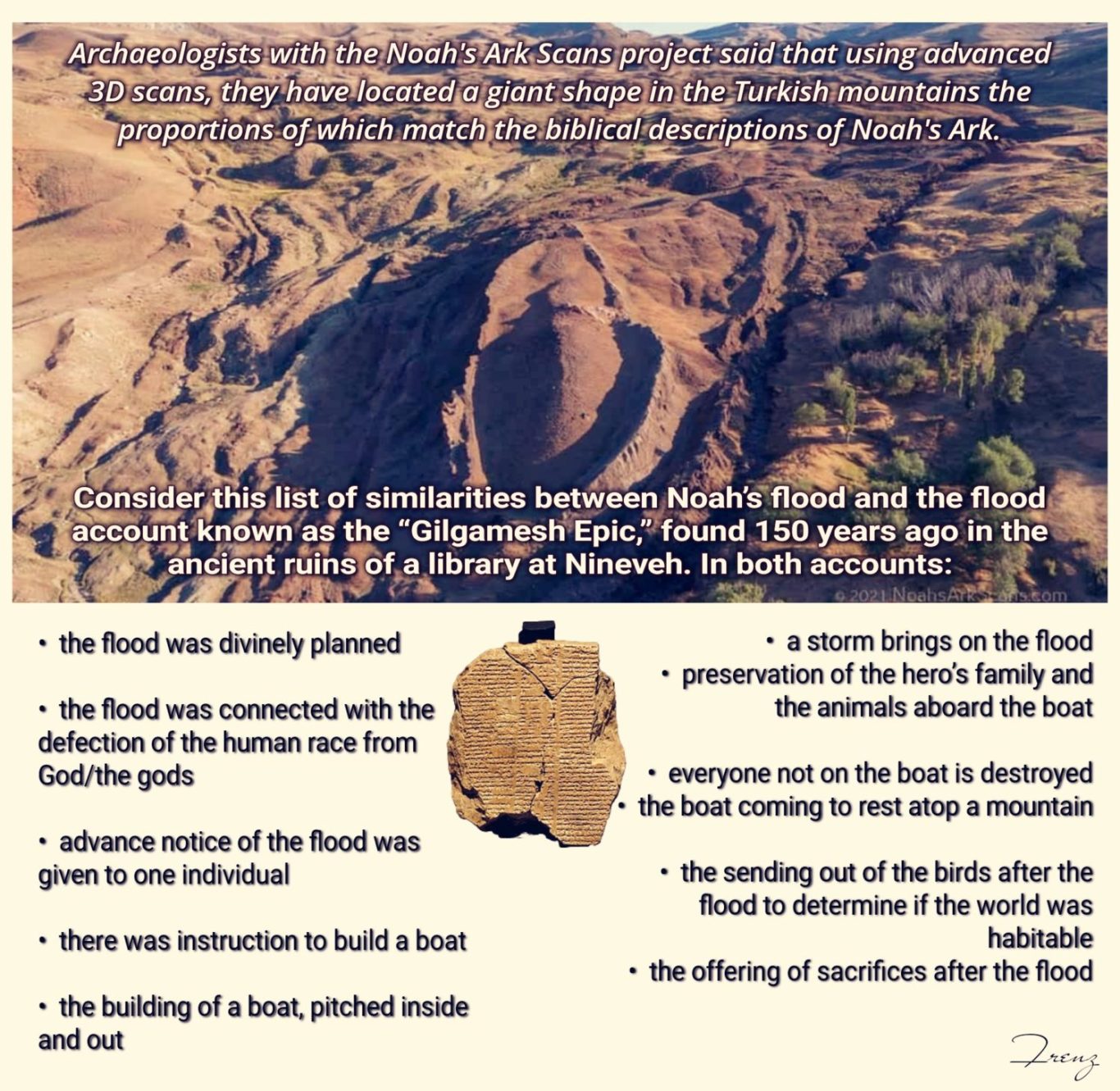
The image presents a case for the potential discovery of Noah's Ark, connecting it to the biblical narrative and the Mesopotamian flood myth, the "Gilgamesh Epic."
Visual Elements: →
* Background Image: → The primary visual element is an aerial view of a mountain range. The image includes a dark shape. This shape is the object of the search: a large, elongated structure in the mountains of Turkey. This is presented as the potential location of Noah's Ark.
* Text Overlay: → The text is layered over the image. It consists of a headline-like introduction followed by a list of similarities.
* Clay Tablet Image: → A picture of a damaged clay tablet is included. This likely symbolizes the "Gilgamesh Epic," and the archaeological context where the flood story was found.
Textual Content & Interpretation: →
1. Opening Statement: →
* "Archaeologists with the Noah's Ark Scans project said that using advanced 3D scans, they have located a giant shape in the Turkish mountains the proportions of which match the biblical descriptions of Noah's Ark."
* Interpretation: → This is the core claim. The image asserts that a team has used 3D scanning technology to find a structure in Turkey that aligns with the biblical descriptions of Noah's Ark.
2. Comparison to Gilgamesh Epic: →
* "Consider this list of similarities between Noah's flood and the flood account known as the "Gilgamesh Epic," found 150 years ago in the ancient ruins of a library at Nineveh. In both accounts:"
* Interpretation: → This emphasizes the broader context of the flood story. The image links the biblical account to a Mesopotamian flood myth. This suggests a common origin. The "Gilgamesh Epic" being found in the ruins of a library is highlighted as an important finding in this field of research.
3. List of Similarities: →
* The list provides a comparative analysis of the two narratives, highlighting common elements:
* "the flood was divinely planned"
* "the flood was connected with the defection of the human race from God/the gods"
* "advance notice of the flood was given to one individual"
* "there was instruction to build a boat"
* "the building of a boat, pitched inside and out"
* "a storm brings on the flood"
* "preservation of the hero's family and the animals aboard the boat"
* "everyone not on the boat is destroyed"
* "the boat coming to rest atop a mountain"
* "the sending out of the birds after the flood to determine if the world was habitable"
* "the offering of sacrifices after the flood"
* Interpretation: → This list is the central argument. By outlining the overlapping elements, the image reinforces the plausibility of the flood stories.
Overall Message and Target Audience: →
* Message: → The image aims to support the idea that Noah's Ark may have been discovered and to reinforce the religious and historical plausibility of the biblical flood account. It attempts to use evidence from archaeology, technology and ancient texts to strengthen its claim.
* Target Audience: → The image targets individuals interested in religious beliefs, archaeology, and the Bible.
Christian Perspective (Implied): →
The image implicitly connects to a Christian perspective. The focus on the Bible, Noah's Ark, and the idea of divine intervention all resonate with core Christian beliefs. The "Gilgamesh Epic" is presented as a related story, suggesting the biblical narrative holds a degree of historical validity.
The image is a visual presentation of a core theological concept about faith, understanding, and the nature of creation. It combines a picturesque image with a direct biblical quote and a clarifying statement about the meaning of "understanding" in the context of faith.
Visual Elements: →
* Setting: → The image features a window with curtains. The warm light shining through suggests a bright, hopeful morning. The light pouring through the window evokes a sense of revelation, guidance, and divine presence. The choice of a window implies looking beyond the physical world into a realm of understanding and deeper truths.
* Color Palette: → The color palette is warm and inviting, with browns, yellows and hints of green. This adds to the message of hope and encouragement which faith provides.
* Text Overlay: → The image contains two sections of text. The text is clear and legible, carefully placed so as not to distract from the central window image.
Textual Analysis: →
1. The Core Scripture (Hebrews 11:3): →
* "Through faith we understand that the worlds were framed by the word of God..." → This is the foundational statement. It immediately introduces the centrality of faith. This faith is not blind belief; it leads to understanding. The understanding is not the knowledge of the human mind but it comes from God. It is linked to the creation of the world.
* "...so that things which are seen were not made of things which do appear." → This emphasizes the difference between the visible and the unseen, as well as the power of God. It suggests that the visible world originated from something that is not visible. This points to a divine, unseen power that brought everything into existence. Faith recognizes this unseen origin.
2. Clarifying Explanation: →
* "Understand' is intellectual perception, not sense perception." → This part clarifies what "understand" in the biblical context means. It is about the ability to grasp something intellectually, rather than perceiving it with our physical senses. In this context, understanding comes from faith, the "eyes of our mind" which allows us to comprehend things that are not apparent to the senses.
* "Intellectual perception is clearly a part of faith." → This stresses the connection between faith and reason. Faith is not something that rejects understanding; it is the foundation of the understanding of God.
* "We can "understand" God's creation by faith" (Ro 1:20). → This sentence further explains the connection of faith, understanding, and the creation of the world.
Theological and Interpretive Significance: →
* Faith and Understanding: → The image presents the core Christian concept that faith, not mere observation, leads to true understanding of the world and God's actions within it.
* The Nature of Creation: → The image emphasizes that creation is more than just what we can see and touch. It is a manifestation of God's word and power, originating in the unseen realm.
* The Role of Faith: → It underscores the role of faith as the key to unlocking a deeper comprehension of God's will. Faith allows us to recognize the unseen realities that shape the visible world. It is a call to view the world through the lens of faith, opening the mind and heart to truth.
Overall Message: →
The image is a call to go beyond the world as our senses experience it and to embrace a perspective shaped by faith. It invites reflection upon how God created the world and how it can be understood through spiritual insight, thus promoting the power of faith and the recognition of God in our lives.
The image presents a powerful statement of faith centered on the belief in God's infinite power and the plausibility of miracles. It visually blends this message with a depiction of Jesus walking on water, reinforcing the core theme.
Visual Elements →
* Jesus Walking on Water: → The central visual is a digitally rendered image of Jesus, viewed from behind, walking on water. This immediately brings to mind the biblical account in the Gospels (Matthew 14:22-33, Mark 6:45-52, John 6:16-21), representing a significant miracle. The setting appears serene, likely during sunrise or sunset, with the water reflecting the light, enhancing the sense of awe and wonder.
* Color Palette: → The image employs warm, soft colors. The tones of the sky and water create a sense of peace and light.
* Text Overlay: → The text is placed strategically over the image to highlight the message. The fonts are easy to read.
Textual Analysis →
The message presented is the core of the image, which is structured into two main parts:
* Opening Statement: → "Every miracle of Scripture is reasonable in light of God's infinite power." This sets the tone by affirming the possibility of miracles within the framework of Christian belief. It suggests that believers should not struggle to reconcile scripture's miracles with the idea of a powerful God who created everything, even if they appear to defy the laws of nature.
* Supporting Argument: → "As God created and sustains the laws by which atheists deny the possibility of miracles - laws that are nothing more than how God chooses to order the universe for a particular period of time - He cannot be limited by them." This section offers a theological argument to justify the believability of miracles.
* Focus on Atheism: → It directly engages with the viewpoint of atheists, who typically reject the supernatural by denying the existence of God and the possibility of miracles.
* God's Sovereignty: → The key point of this section is the argument that if God created the laws of the universe and upholds them, then God is not bound by them. The implication is that God can choose to act outside these laws when it serves divine will. It paints an image of God as a sovereign creator, not subject to limitations.
* Universe's Order: → The laws of nature, the author argues, are essentially a method by which God runs the universe for a certain period of time. The universe's order could be considered a "rule book" by which it runs, but God wrote that rule book and is therefore not bound by it.
Overall Message →
The image's central message is a declaration of faith in the reasonableness of miracles. It defends the notion that miracles are plausible.
The image is meant to comfort and encourage Christians who face doubts about the possibility of the supernatural and encourage reflection on God's power.
Visual Analysis: →
* Setting: → The image depicts a scene that appears to be set in an ancient city, likely Jerusalem or a similar location in the Middle East. The architecture is characterized by stone buildings, arched doorways, and narrow streets.
* Characters: → The primary focus is on four men walking in procession, viewed from the back. They are dressed in robes and tunics that are reminiscent of the clothing worn in the time of Jesus. This imagery immediately links the image to the historical context of the Gospels.
* Atmosphere: → The overall atmosphere suggests a sense of community and purpose. The presence of other figures in the background hints at a larger movement.
* Text Overlay: → The text is superimposed on the image and is the primary message.
Textual Analysis: →
The core argument presented is centered on the claims of the Gospel writers:
* "None of the Gospel authors gained anything from their testimony... →" This statement asserts that the authors of the Gospels (Matthew, Mark, Luke, and John) did not receive personal benefit, such as wealth, power, or fame, from their writing.
* "...and instead suffered persecution and death for their claims. →" This claim reinforces the belief that the Gospel authors were willing to endure significant hardships, including death, for the truth of their writings.
* "The authors lacked motive and bias. →" The inference is that, since the Gospel authors were persecuted and died rather than gaining anything, they did not have a motivation to create the stories for their own personal gain and were telling the truth.
Interpretation and Purpose: →
The image is designed to support the historical reliability of the Gospels. The arguments it makes are based on the following principles:
* Sacrifice as Evidence: → The persecution and martyrdom of the Gospel authors are used as an argument that they truly believed what they wrote. The implication is that people do not typically die for lies or things they know to be false.
* Absence of Motive/Bias: → The image intends to show that the authors did not write to gain anything for themselves. Therefore, any claims made in the Gospels can be taken at their word.
Overall Message: →
The combined image and text intend to portray the Gospel authors as honest and trustworthy witnesses. Their apparent willingness to suffer and die for their beliefs is presented as evidence that the stories they wrote should be believed.
Criticisms and Considerations: →
* Authorship Debate: → While the image uses the term "Gospel authors," the actual authors of the Gospels are still debated.
* Historical Context: → While the image intends to give a historical feel, the accuracy of the portrayal of the time is debatable.
* Lack of Independent Verification: → The primary argument relies on the writings themselves. It doesn't account for other sources of information that may have been lost to history.
In summary: →
The image is a visual representation of a classic apologetic argument for the reliability of the Gospels. It seeks to persuade the viewer that the authors were credible witnesses because they suffered for their claims, with the underlying suggestion being that they were telling the truth.
* Visuals: → The image presents a digitally-painted scene of two men in a wooden boat on a body of water, likely the Sea of Galilee. Both men appear to be Middle Eastern, with long hair, beards, and dressed in simple, traditional-looking clothing. One man holds a fishing rod and looks out into the distance, while the other is reading from a small book, presumably a manuscript. The background depicts a sunset or sunrise with warm colors in the sky.
* Text Overlay: → Superimposed over the image is text that reads:
* "The early dates for both Luke and Mark make it highly unlikely they could have been written without vetting from those who were there and saw the truth about Jesus."
* The website "coldcasechristianity.com" is also visible.
* A signature "Frenz" is present.
Analysis of the Message: →
The image and accompanying text convey a key argument used in Christian apologetics (the defense of the Christian faith):
1. Early Dating of Gospels: → The message focuses on the timing of the Gospels of Luke and Mark. Proponents of this argument suggest that these Gospels were written relatively soon after the events of Jesus' life, death, and resurrection.
2. Vetting and Eyewitness Testimony: → The text argues that the early dating of these Gospels means they were likely vetted and checked by people who had been eyewitnesses to Jesus' life and ministry. This implies that the authors (Luke and Mark) would have had to ensure their accounts aligned with the established narrative and testimony of those who had directly witnessed the events.
3. Truth and Accuracy: → The message suggests that this "vetting" process adds credibility to the Gospels, as it would have been difficult to propagate false information without challenge from those who knew the truth.
Supporting Arguments and Considerations: →
* Historical Context: → Those who support this viewpoint often cite historical evidence and textual analysis to propose early dates for Mark (likely written in the late 50s to early 60s AD) and Luke (possibly in the early 60s or early 70s AD).
* Manuscript Evidence: → Some scholars look at the content and the absence of some later developments (like the destruction of Jerusalem) within the Gospels to support an early date.
* Counterarguments: → Critics of this argument often point to internal textual evidence, such as literary style, the use of sources, and discrepancies in accounts of events, to cast doubt on early dating and to question the extent of eyewitness input.
* Authorship: → The image doesn't explicitly say who is in the boat but the focus on Luke and Mark connects to the authorship of those Gospels, in Christian tradition, Luke was a physician and a disciple of Paul and Mark was a follower of Peter.
Overall, the image and message are intended to reinforce the historical reliability and trustworthiness of the Gospels of Luke and Mark from a Christian perspective. → The visual elements contribute to the message by creating a serene scene that evokes biblical imagery.
The image presents a serene scene. We see a group of figures, meant to represent Jesus and his disciples, walking away from the viewer along a path through a lush, well-kept garden or park. They are dressed in robes and appear to be engaged in a thoughtful walk. The background includes trees, foliage, and glimpses of other elements like a cross or decorative plantings, emphasizing the peaceful and contemplative atmosphere. The color palette is soft and natural, with greens and browns dominating.
Text Analysis and Interpretation →
The accompanying text forms the core message of the image:
* "The Gospels are appropriately varied and nuanced, just like all multiple eyewitness accounts." → This is the central argument. It points out that the four Gospels (Matthew, Mark, Luke, and John) present the story of Jesus' life and teachings from different perspectives. The image suggests that these variations are to be expected in any collection of accounts from individuals who witnessed the same events.
* "The variations between the sign descriptions is further evidence of this expected variation." → The text implies that variations in the Gospel descriptions of signs (miracles, events) are not inconsistencies, but rather evidence of multiple accounts from individuals witnessing similar events.
* "coldcasechristianity.com" → - This indicates that the message and likely the image are associated with "Cold Case Christianity", a ministry dedicated to Christian apologetics.
Overall Message →
The image and text work together to support the apologetic viewpoint that the variations within the Gospels are not a weakness, but instead a strength, confirming the authenticity and reliability of the accounts.
The author wants the viewer to take the following from the image:
1. Acceptance of Variation: → The author wants the viewer to know that differences in accounts from witnesses should be expected.
2. Reassurance and Trust: → The image works to reassure the audience that those differences do not necessarily indicate dishonesty or fabrication; rather, they can be seen as evidence of individual perspectives and emphasis.
3. Strengthening Belief: → The message aims to encourage the audience to think about the similarities and differences between the Gospels' stories, and how that information can be used as evidence.
The image is a visually appealing composition with a clear message, aimed at a Christian audience. It blends a serene beach scene with a philosophical statement about the origin of life, ultimately asserting the necessity of God as the creator.
Visual Elements: →
* Background: → A beautiful beach scene forms the backdrop. The image features clear blue water, gentle waves, a sandy beach, and a tropical shoreline. The bright sun and clear sky contribute to the overall sense of peace and beauty, often associated with God's creation in Christian thought.
* Text Overlay: → The text is superimposed on the beach image, ensuring it is readable. The placement ensures the text is easily seen.
Text Analysis: →
* Central Argument: → The text presents a cyclical view of life. It highlights the fact that all living beings come from pre-existing life: babies from parents, chickens from eggs, plants from seeds, etc. This is a simplified version of a scientific understanding.
* Theological Conclusion: → The argument is presented as a sort of paradox of life. The message asserts that this cyclical nature, "This closed loop of life", could only be possible because "God first created life." The implication is that God is the original source of life, without which the cycle couldn't have begun. The language and argument are commonly used by Christians to provide a justification for their faith.
* "Ad Infinitum (apart from God):" → This phrase emphasizes the potential "endless loop" of cause and effect in the natural world. It then separates this idea. It also uses the word "ad infinitum", which means "to infinity" or "forever." This highlights the seemingly endless nature of the cyclical argument, thus, creating a need for a creator.
* Bible.org Logo: → This logo, in the upper right corner, provides the religious context, making it clear this is a Christian message.
Message and Interpretation: →
The image's primary message is a religious one. It's a faith-based argument, attempting to explain the origins of life and demonstrate the role of God in the process of creation.
Overall, the image uses a visually appealing scene of a beach to draw the viewer's attention. Then the image blends scientific reasoning with a Christian perspective to present a faith-based explanation for the origin of life, thereby solidifying the argument of God's existence and importance to life.
The image is a visual argument, using both text and imagery to convey a specific worldview. It argues for the complexity of life and, by implication, the necessity of a creator. The serene image of a sailboat at sunset is likely meant to evoke feelings of peace and wonder, setting a tone that contrasts with the complex scientific arguments being made.
Textual Analysis →
The text is divided into two main sections, forming the core of the argument:
1. First Paragraph: The Challenge of Creation: →
* Assertion: → Scientists, despite immense resources and knowledge, have failed to create life from scratch.
* Emphasis: → The "simple" cell is incredibly complex, surpassing anything humanity has produced.
* Implication: → If humans with our combined intelligence can't replicate life, then life must be the result of something far more sophisticated than chance or natural processes.
2. Second Paragraph: The Mystery of Complexity: →
* Elaboration: → Highlights the incredible organization within a single cell (trillions of atoms, cells cooperating, communicating, and reproducing to build consciousness and every other trait of life).
* Conclusion: → Random encounters of material and energy cannot explain the origin of life ("neither a scientific nor reasonable explanation").
* Supporting Argument: → The implication is that these complex interactions could not have happened by chance.
Visual Elements →
* Sunset/Sunrise over the Ocean: →
* Evokes feelings of peace, beauty, and awe, setting an emotional tone.
* Provides visual contrast to the intellectual claims in the text.
* May also implicitly suggest a sense of beginning or origin.
* Sailboat: →
* Represents human endeavor and exploration.
* Might symbolize a journey or a quest for understanding.
* Can add a sense of journey to this image.
Underlying Message and Interpretation →
* Christian Worldview: → This image strongly hints at a Christian perspective. The core argument aligns with the common creationist belief that the complexity of life is evidence of intelligent design and, by extension, God's existence. The reliance on "scientific" sounding reasoning to attack the scientific explanations of life indicates the source and intent of the image.
* Critique of Scientific Materialism: → The text implicitly critiques scientific materialism (the belief that only matter and its interactions exist). The image argues that materialism alone cannot explain the origin or complexity of life.
* Argument From Design: → This is a classic argument from design. It begins with the observation of apparent order and complexity in the natural world, and concludes that there must have been an intelligent designer, i.e., God, to create this order.
* Appeal to Wonder: → The image attempts to elicit a sense of wonder at the complexity of life, implying that science alone, as it is commonly taught, cannot provide answers that satisfy all of the questions a thinking person has.
Important Considerations →
* The Argument's Weakness: → The image does not offer any positive proof of a creator. It relies on the limitations of current scientific understanding to make its case.
* The Nature of Scientific Knowledge: → Scientific understanding is always evolving. The image's argument could become weak as scientific understanding increases over time.
* The Role of Faith: → The argument made in the image ultimately asks for a leap of faith. It asks viewers to consider the limits of human capabilities.
In conclusion: → the image presents a persuasive appeal, meant to convince people to think about God's role in the creation of life. The sunset picture, the beautiful ocean, and the intelligent wording work in harmony to support the message.